Curtains
Acoustic curtains for homes and offices
- Acoustic curtains are dense, heavy curtains, often lined, that absorb part of the sound reflected inside a room and soften the echo.
- They do not insulate sound the way a wall does. They help most in open-plan rooms, meeting areas and home cinemas, and less against street noise.
- An absorption rating applies only to one fabric, as measured in its maker's test report, so the report comes with the quote.
Price from €35/m, as of October 2026
Glass walls, concrete and hard floors reflect sound, so in an open-plan living room or a meeting room speech echoes and tires the ear. A curtain along a whole wall is one of the simplest ways to reduce that echo, and it also screens off an area and controls the light.
Dense fabrics from €35/m · Lining €11/m · making €13/m
What are acoustic curtains?
An acoustic curtain is usually one whose weight, density and texture absorb more sound than an ordinary sheer or lined curtain. It is made from heavy, bulky fabric, often with a lining, and hung across a whole wall or a run of windows in full folds.
No special material is involved. The sound is absorbed by the fibre and by the air in the folds and between the curtain and the wall, so the result depends on how the curtain is made and hung as well as on the fabric.
Do curtains reduce noise?
Curtains reduce echo, not the noise that comes in from outside. Inside a room, sound bounces off glass, walls and ceiling. A heavy curtain absorbs part of those reflections, so speech becomes clearer and the room quieter. It is most noticeable in large rooms with little furniture and big windows.
Street noise is stopped first by the windows and walls. A curtain can soften it a little but will not replace a better glazing unit. If a bedroom faces a busy street, combine the two: suitable windows and a dense lined curtain down to the floor.
Where do acoustic curtains work best?
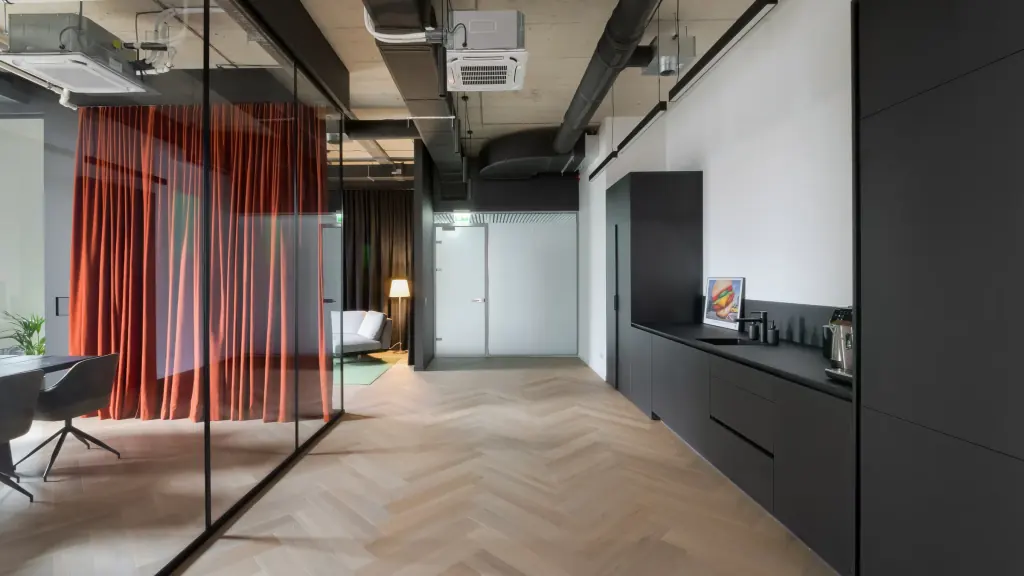
In an open-plan living room with a kitchen and large windows, where conversation and the television echo. In a home cinema, where a curtain across the whole wall darkens the room and absorbs reflections. In an office or meeting room with glass partitions, where a curtain on a ceiling track screens off the area when privacy is needed and draws back when the space should be open. In a bedroom or a child's room with many hard surfaces.
In large rooms the curtain often hangs not only at the window but across a whole wall, or as a partition. The ceiling track is then fitted so that the curtain follows the corners, and when drawn back it takes up as little room as possible.
Which fabrics and making absorb more sound?
Heavy, bulky fabrics absorb most: bouclé, terry, a velvet surface, a dense heavy blackout. In our catalogue Bukle, Terry and Gravity Blackout are marked as suitable for rooms with an echo. A lining adds another layer and more weight.
The making matters as much. The more fabric in the folds, the more sound it absorbs, so acoustic curtains are usually made with wave pleats, which need 2.0× the track length in fabric. The curtain should reach the floor, and a gap of at least a few centimetres between the curtain and the wall or glass also helps. A ceiling track along the full wall lets the curtain cover the whole reflecting surface, not just the window.
| Fabric | Price | Texture | Light held back |
|---|---|---|---|
| Gravity Blackout | €35/m | Heavy, 350+ g/m² | 100% |
| Terry | €37/m | Bulky terry | 85–90% |
| Volume | €42/m | Chunky 3D structure | 100% |
| Bukle | €43/m | Bouclé (looped, bulky) | 90–95% |
| Blackout lining | €11/m | Sewn to the main fabric | about 100% |
Making: €13 per metre when the curtain is up to 300 cm high. The track and the fitting are priced separately.
How do you read acoustic ratings?
A fabric's sound absorption is measured in a laboratory to EN ISO 354. The result is summed up in one number, the weighted sound absorption coefficient αw, and a class from A to E under EN ISO 11654. Class A absorbs most.
That number applies only to one fabric and one way of testing: which pleating, and how far from the wall the curtain was hung. For that reason we do not publish general decibel figures or percentages. If your project needs a rating, we send the fabric maker's test report with the quote. If there is no report, we say so.
Acoustic curtains for an office or meeting room
In an office a curtain usually does two jobs at once: it screens off a meeting area behind a glass wall and softens the echo in an open space. The ceiling track runs along the whole area, and the curtain is drawn back to the wall when no partition is needed.
For companies, orders are planned in stages so that measuring and fitting do not interrupt the working day, and payment is by invoice. More on orders for companies is on the Hotels and offices page.
How much do acoustic curtains cost?
The price depends on the fabric, the lining and the width and drop of the curtain. An example for a meeting area with a 5 m ceiling track and a drop of 2.8 m: Bukle 10.3 m × €43 = €442.90, lining 10.3 m × €11 = €113.30, making 10.3 m × €13 = €133.90, ceiling track 5 m × €9 = €45, fitting 5 m × €9 = €45. In total about €780.
The exact price is given after measuring. From order confirmation to installation takes 3–4 weeks.
Questions
Do acoustic curtains block street noise?
Only in part. Curtains mainly reduce the echo inside a room, while street noise is stopped first by the windows and walls. A dense curtain down to the floor can soften it a little, but it will not replace a better glazing unit.
Are blackout curtains acoustic?
Heavy blackout fabrics, especially with a lining, absorb more sound than light ones, but blackout describes how much light is held back, not sound. For an acoustic curtain what counts is weight, a bulky texture, full folds and the area it covers.
Can you give the sound absorption figures?
A rating (αw and the class under EN ISO 11654) applies only to one fabric and one test method. If your project needs it, we send the fabric maker's test report with the quote. If there is no report, we say so.
Are acoustic curtains suitable for an office?
Yes. In an office a curtain on a ceiling track often screens off a meeting area behind a glass wall and softens the echo in an open space. The fitting is done in stages, and payment is by invoice.