Blinds
Wooden blinds made to measure in Vilnius
A full guide for 2026. Wooden blinds are a popular choice for flats in the Old Town, family houses in Žirmūnai and offices in Naujamiestis.
Wooden blinds from €56 per m² · About €101–153 for a 120 × 150 cm window, fitting €15
Contents
1. Types and materials of wooden blind. 2. Advantages in the Vilnius climate. 3. Operation and mechanisms. 4. Fitting in 4 steps. 5. Care and life. 6. Recommendations by district of Vilnius. 7. Prices for 2026.
Which types and materials of wooden blind are there?
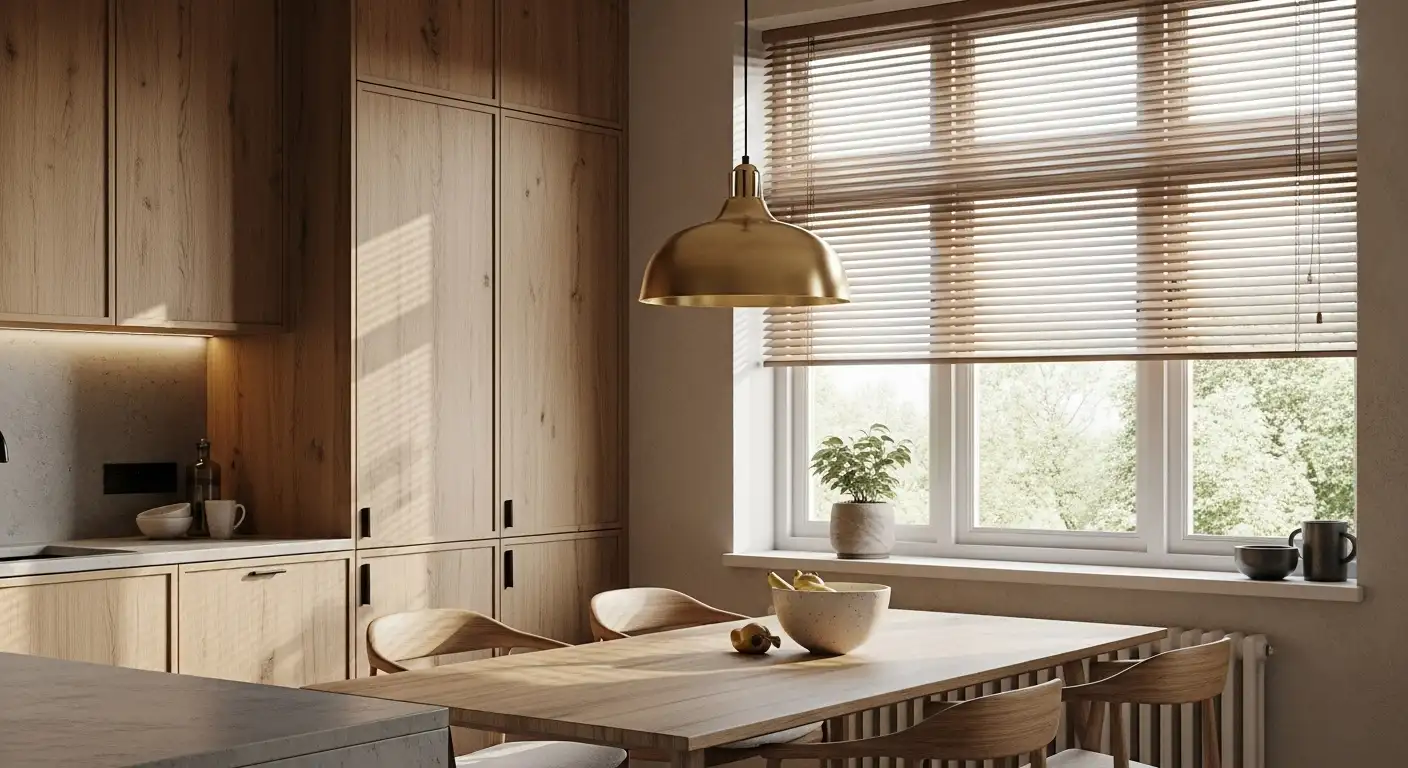
Wooden blinds are made of natural wood (basswood, abachi, bamboo) or damp-resistant imitations. The slats come 25, 35, 50 or 65 mm wide. The main advantage is control of the light, with insulation: in summer they hold back the heat, and in winter they reduce heat loss. Prices start at €56 per m². The full buying guide, with prices, is linked below.
Choose by room: natural wood and bamboo for dry rooms, and faux wood for damp rooms or any room.
Natural wood (basswood, abachi, brushed basswood): slats 25–65 mm wide; suitable rooms: living room, bedroom, study. Advantages: natural grain, warmth, a pattern that is never repeated. Drawbacks: not resistant to damp, and heavier.
Wood-effect (faux wood): slats 35 and 50 mm wide, in PVC with a wood-grain finish; suitable rooms: kitchen, office, damp rooms. Advantages: fully resistant to damp, long-lasting, cheaper. Drawbacks: a less authentic grain.
Bamboo: slats 35 and 50 mm wide; suitable rooms: living room, bedroom, eco-friendly homes. Advantages: natural, light, a distinctive grain. Drawbacks: sensitive to damp (choose faux wood for a bathroom), a limited range of colours.
Why choose wooden blinds in Vilnius?
Control of the light, insulation and a natural look are the main advantages in the Vilnius climate.
Natural grain: the texture and warmth of real wood bring a sense of comfort to the room. Insulation: wood helps hold the temperature, warmer in winter and cooler in summer, which matters in the Vilnius climate. A pattern of its own: every wooden blind differs, because the grain of the wood never repeats.
Compared with vertical blinds, which are usually aluminium or PVC, wooden blinds have a few extra advantages. They insulate against sound on noisy streets, give privacy without full darkening, go with Scandinavian and classic interiors, and are warmer and more natural than aluminium.
How are wooden blinds operated?
Two mechanisms in one product: raising, and tilting the slats to adjust the light.
Manual operation: cords or a chain, the classic and reliable way, suited to small windows. Raising: the fork, until it clicks. Tilting: the cord or chain mechanism.
Electric operation: by remote control, convenient for large balcony windows and doors. Suited to new-build homes and to French windows in Žvėrynas.
A tip: for large openings (over 200 cm), divide the blinds into 2–3 parts, each with its own controls.
How are wooden blinds fitted? Four simple steps
Fitting takes 15–30 minutes and suits PVC, wooden and aluminium windows.
1. Measure the opening exactly: measure the width and height at three points, and use the smallest measurement. 2. Mark the bracket positions: at least 10 cm from the edges of the window, and we recommend 3 brackets for windows wider than 120 cm. 3. Fix the brackets: use 4 mm screws, which suit PVC, wooden and aluminium windows. 4. Fit and check: put in the blind, lock it, and check the tilting of the slats and the raising.
Professional measuring in Vilnius: the designer measures exactly, works out the stack height and advises which blind to choose. Measuring is free in Vilnius. In Kaunas and Klaipėda it is free on orders of €200 or more. Elsewhere in Lithuania the visit is paid, and the price is agreed beforehand.
How do I look after wooden blinds, and how long do they last?
Wooden blinds treated with a protective finish last a long time in a dry room with proper care.
Clean with a duster or a dry cloth. In the Vilnius air, vacuum once a month. Avoid damp for blinds without a protective finish. Check the gaps between the slats (at least 0.5 cm). Lubricate the mechanisms regularly. Our warranty on mechanisms is 24 months.
Which wooden blinds suit which districts of Vilnius?
Different districts have different needs and architecture.
Senamiestis, the Old Town: narrow 25 mm slats for classic arches, keeping the historic look. Žirmūnai: wider 50 mm slats for modern balconies and large windows. Žvėrynas: two-part blinds for French windows, each part with its own controls. Naujamiestis: electric blinds for noisy houses, for privacy and sound insulation.
What do wooden blinds cost in 2026?
The price depends on the material and the slat width.
Natural wood (25 mm slats): from €56 per m². Natural wood (50 mm slats): from €72 per m². Bamboo (35 and 50 mm slats): €70 per m². Faux wood, a wood imitation (35 and 50 mm slats): from €48 per m². Fitting: €15 per blind.
Wooden or faux wood (wood-effect) blinds?
The choice between real wood and faux wood blinds is often decided less by looks than by the conditions in the room. In a living room or bedroom, where the humidity stays steady, real wood blinds look their best. For a bathroom, a kitchen or a cellar, faux wood without question.
Resistance to damp: wooden, low, and they warp; faux wood, high, suitable for bathrooms and kitchens. Weight: wooden blinds are lighter and good for large windows; faux wood is heavier and can be hard to operate by hand. Look: wooden has an authentic grain; faux wood only imitates it. Price: wooden costs more (from €56 per m²); faux wood is the cheaper alternative (from €48 per m²).
Insulation: wooden is better for heat insulation; faux wood is weaker. Care: wooden must avoid damp and is more demanding; faux wood is easier, and can be wiped with a damp cloth. Life: in a dry room wooden blinds last a long time, while in a damp one faux wood keeps its shape better.
How does damp warp wooden blinds, and what should I avoid?
Real wood is a living material and reacts to the damp around it. In a bathroom, the humidity after a shower can briefly reach 80–90%. In those conditions wooden blinds begin to warp within a few months: the slats bend and the mechanism starts to stick.
A common mistake is to fit wooden blinds in a bathroom or a kitchen. The result: within 6–12 months the slats bend and the blind loses its look. For a bathroom and a kitchen, choose faux wood blinds, roman blinds in a damp-resistant fabric, or other damp-resistant materials instead.
Divide a window wider than 150–160 cm into two separate sections, or fit motorised operation. For openings over 200 cm, vertical blinds may also suit. A wide wooden blind can weigh 4–6 kg, and if it is raised by hand every day, the mechanism wears quickly.
Choose the slat width
Wooden blinds are made in 4 slat widths, from the compact 25 mm to the wide 65 mm.
from €56/m²
Compact 25 mm wooden blinds in basswood, for smaller windows and classic interiors. Cord and wand operation.
- — 1 material
- — Width up to 1800 mm
from €62/m²
Versatile 35 mm wooden blinds with a choice of five materials (basswood, bamboo, abachi, brushed wood, PVC). Non-invasive brackets for plastic windows. The widest range of uses.
- — 5 materials
- — Width up to 3000 mm
from €72/m²
50 mm wooden blinds, with an electric motor available: a choice of five materials and widths up to 3630 mm. Somfy and Brel motors for large windows.
- — 5 materials
- — Width up to 3630 mm
- — Electric operation
from €85/m²
The widest, 65 mm wooden blinds, for large windows and formal interiors. Width up to 3063 mm, height up to 4000 mm. Electric operation available.
- — 1 material
- — Width up to 3063 mm
- — Electric operation
Questions
Which slat width suits my window?
25 mm slats suit smaller windows (up to 80 cm wide), 35 mm suit medium-sized windows (80–140 cm), and 50 mm slats suit large windows (over 140 cm). The larger the window, the more in proportion a wider slat looks, and the more modern the effect.
Do decorative tapes improve how well the blind blocks the light?
No. Decorative tapes are purely a look: they cover the cords, but do not close the gaps between the slats. They usually add €10–20 to the price. For real light blocking, combine wooden blinds with blackout curtains.
How do I choose between manual and motorised operation?
Manual operation suits smaller windows (up to 150 cm wide) and is much cheaper. Motorised operation suits large windows, places that are hard to reach and older people. Motorising is available for 50 and 65 mm blinds and adds about €40 to the price (the calculator's figure).
Which wood is used for good-quality blinds?
Good wooden blinds are usually made of Canadian basswood, a light, strong wood that is widely used in the trade. Natural wood costs more than faux wood, but gives a more authentic look and better heat insulation.
How much does it cost to fit wooden blinds?
Wooden blinds start at €56 per m², and fitting is priced separately at €15 per blind. The quote shows fitting as a line of its own, so you see at once what the blind costs and what its fitting costs.
Are wooden blinds suitable for a bathroom or a kitchen?
No. Real wood warps in damp rooms within 6–12 months. For a bathroom and a kitchen, faux wood (wood-effect) blinds are recommended: their composite structure does not react to damp and stays stable.
How much do wooden blinds cost for a standard window?
For a standard window (100 × 150 cm), wooden blinds cost from €84 (25 mm basswood) to €128 (65 mm basswood), plus €15 for fitting. The price depends on the slat width, the kind of wood and the type of operation. The exact price is given after measuring.
How do I clean wooden blinds?
Every 1–2 weeks, vacuum with a soft attachment or wipe with a microfibre cloth. For local marks use a damp cloth with mild soap; no special products are needed. Avoid strong chemical cleaners or excess water, which can damage the varnish and make the wood swell.
How do natural and faux wood blinds differ?
Natural wooden blinds (basswood, bamboo) give authentic warmth and a distinctive grain, but do not suit damp rooms and cost more. Faux wood (a PVC composite) looks similar, but resists damp, is lighter and is cheaper. Natural wood insulates heat better, and faux wood suits a bathroom better.
How long do wooden blinds last?
Well cared for, wooden blinds last many years in a dry room. The life depends on the quality of the wood, the protection of the varnish and regular care. Canadian basswood blinds usually last longer than bamboo, because their structure is more stable. Our warranty on mechanisms is 24 months.
Do wooden blinds improve heat insulation?
Yes. A closed wooden blind creates an extra layer of air between the blind and the glass, which acts as insulation. In winter it reduces heat loss through the window, and in summer it blocks direct sun. The effect is stronger with 50 mm slats than with 25 mm.
Ideas for your home
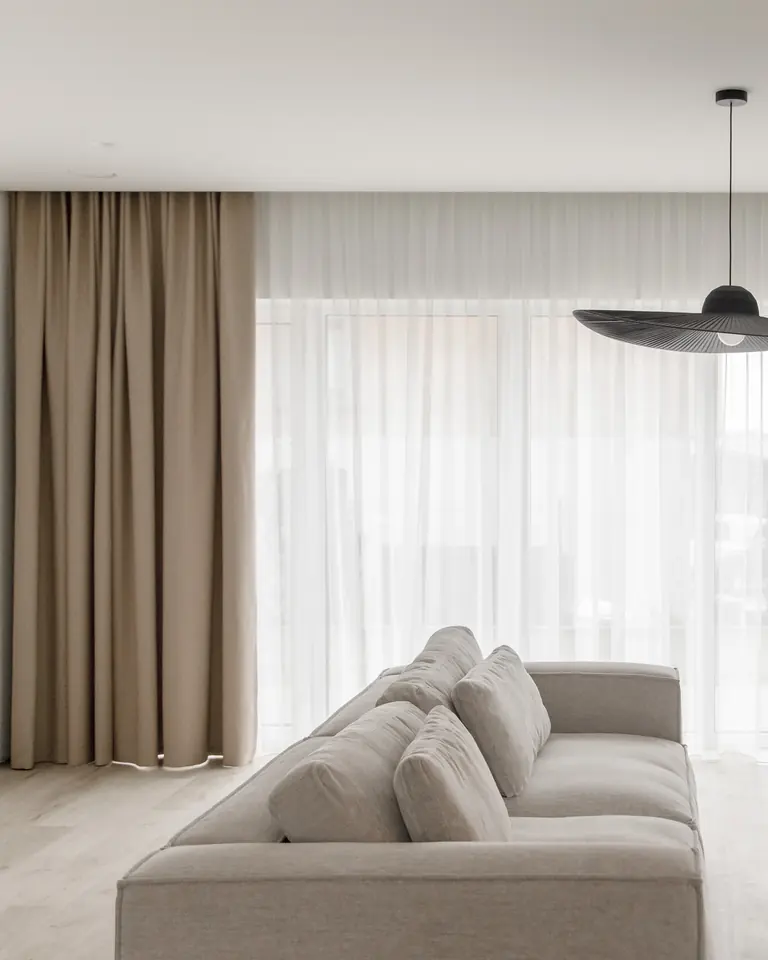
Flat, living room. A white sheer across the whole window wall and sand-coloured curtains from ceiling to floor. 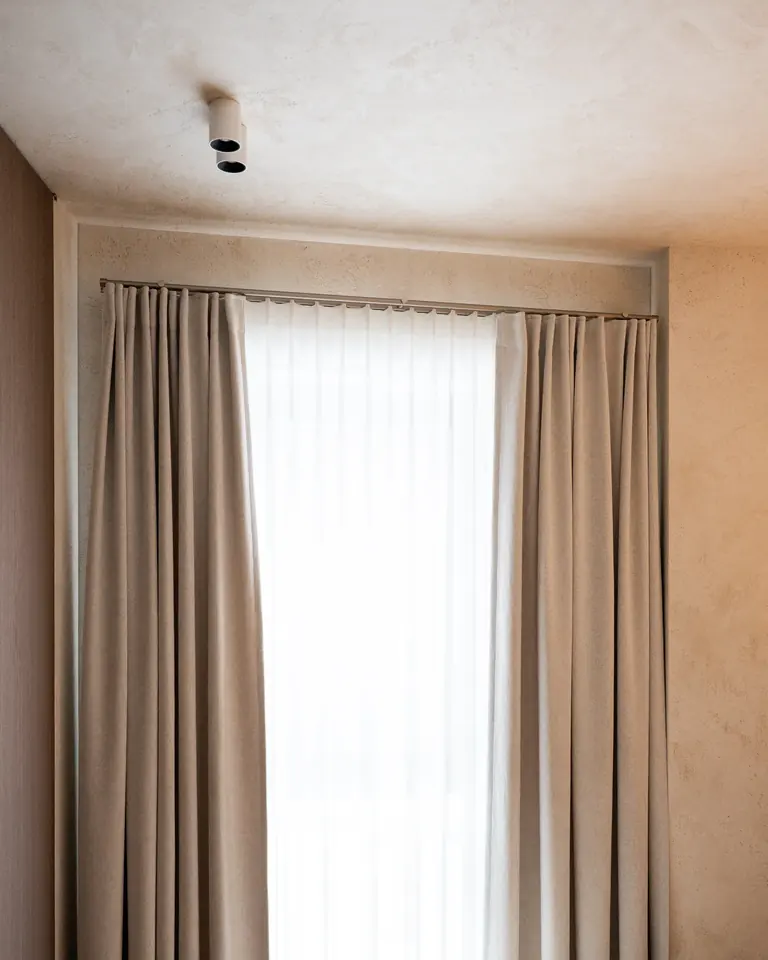
House, window recess. Sand-coloured curtains and a white sheer on a ceiling track. 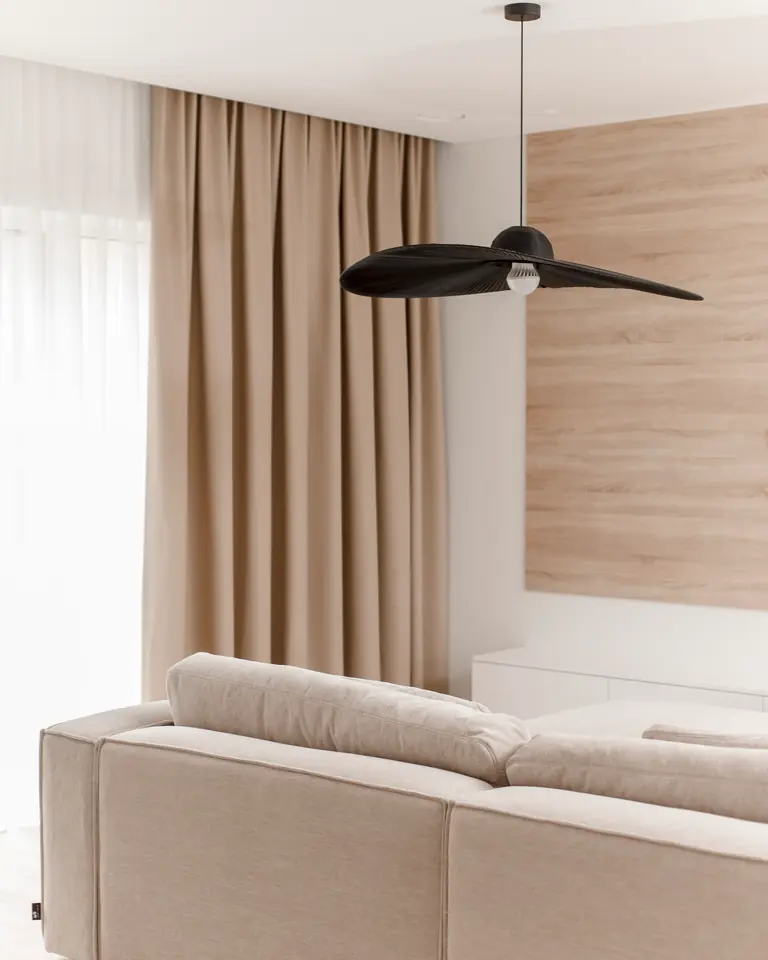
Flat, living room. Sand-coloured curtains and a white sheer from ceiling to floor. 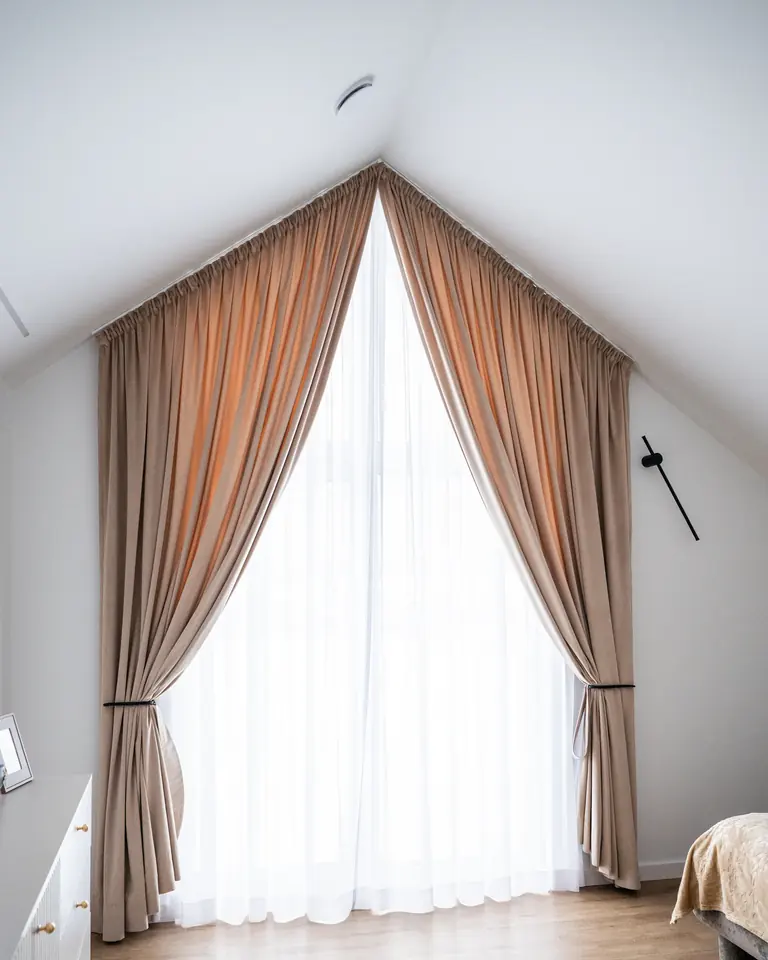
House, bedroom under a pitched roof. Peach curtains with tie-backs and a white sheer. 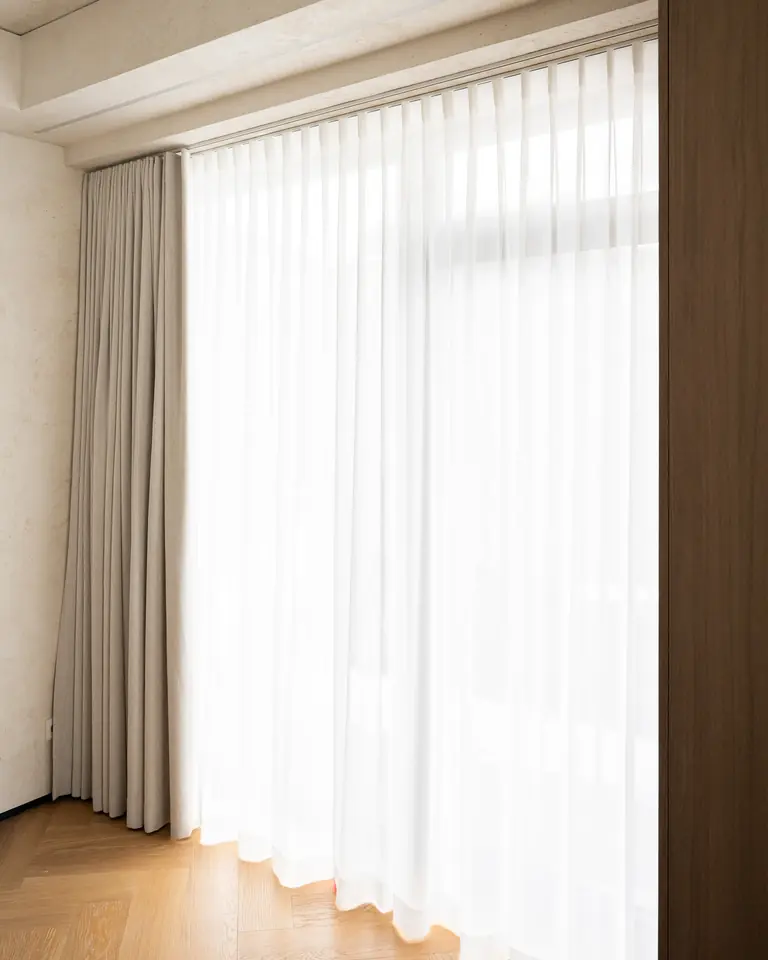
House, room with oak floors. A sheer in wave pleats and a pale curtain in a ceiling recess. 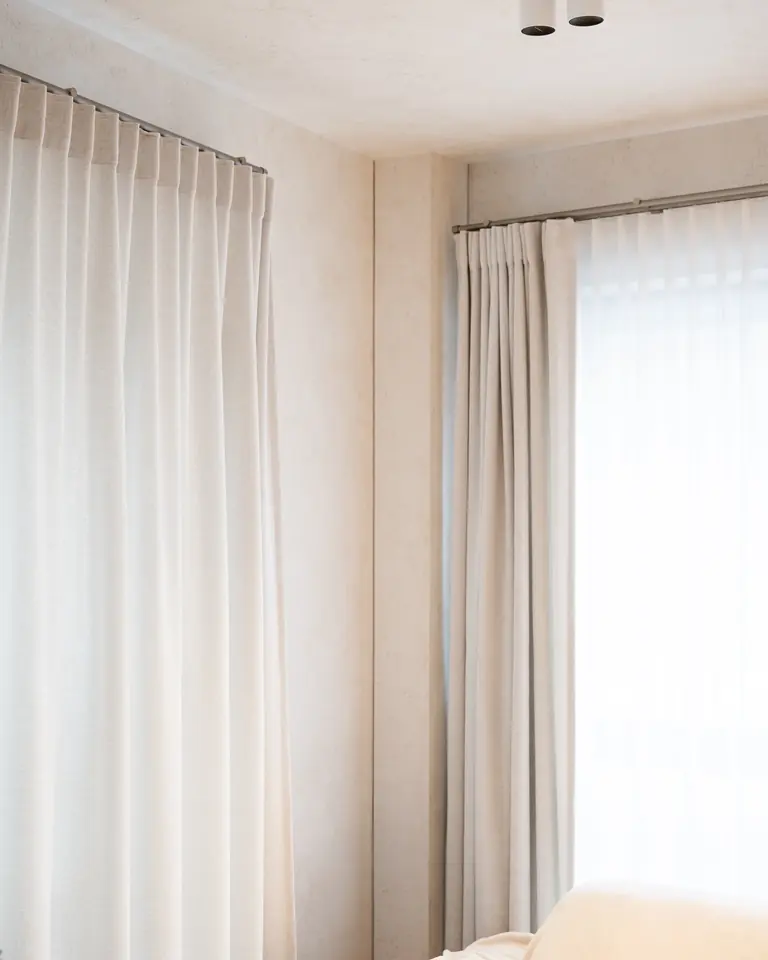
House, corner room. White sheers in wave pleats on ceiling tracks.