Curtains
Blackout curtains
- Blackout curtains hold back 95–100% of the light, but only when no light gets round the edges.
- The track is fixed to the ceiling and extends 20–30 cm past the window on each side, the curtain ends are turned back to the wall, and the hem stops 1–2 cm above the floor.
- A set with fabric, making, track and fitting costs from €250.
Price from €250, as of October 2026
Blackout curtains for a bedroom, fitted so that the gaps are closed and light does not get round the edges.
Blackout curtains with fitting from €250 · With heavier fabrics (Bukle, Gravity) up to €600
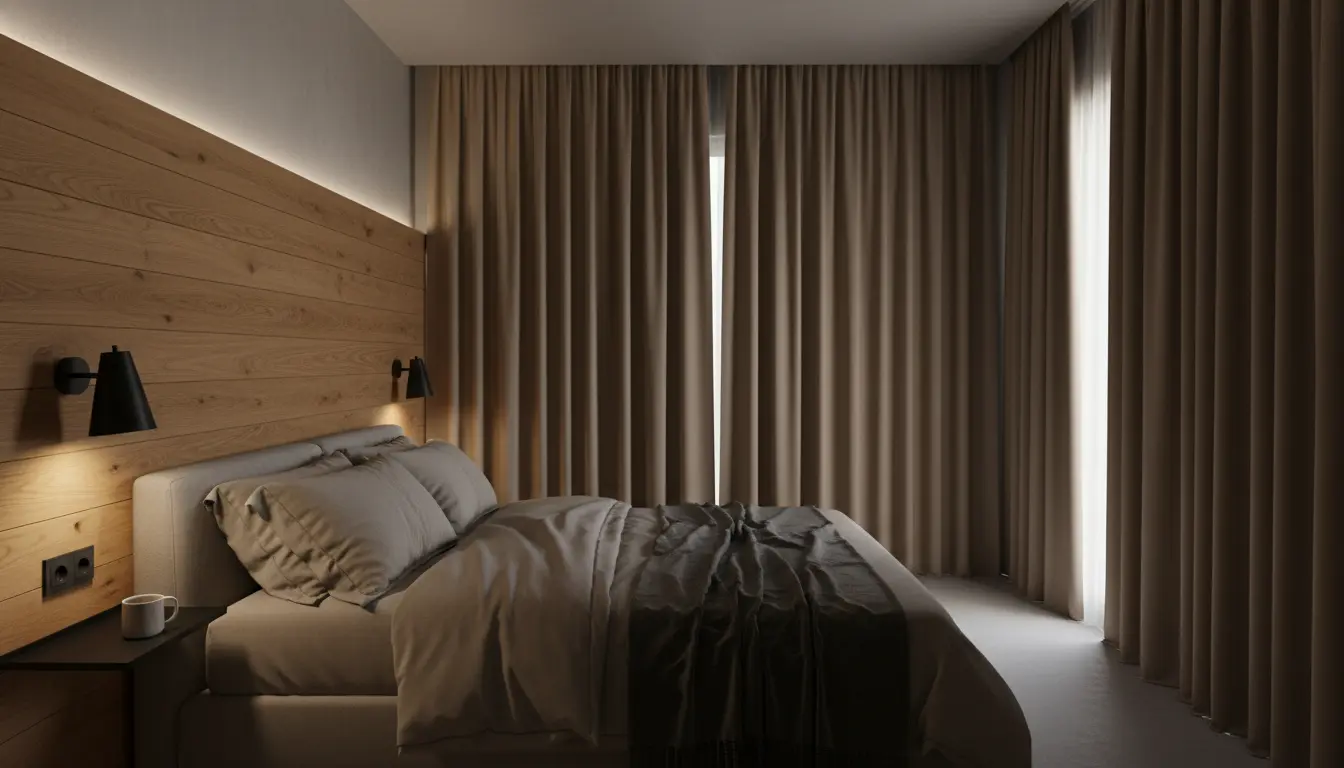
What are blackout curtains?
Blackout curtains block the light completely, so a room can be slept in by day. A well-made blackout curtain has several layers: a decorative face, a light-blocking layer and a finished back. A true blackout fabric lets no light through, so you can sleep or watch a film at any time of day. The dense fabric also cuts heat loss in winter and keeps heat out in summer.
Four facts matter. A true blackout fabric blocks 95–100% of the light and a dim-out usually about 75–85%, a difference felt most in a bedroom and a child's room. Even a 100% fabric fails without a tight fit: the top, the sides and the bottom must be covered, or light gets through the gaps. The track extends 20–30 cm to each side, and the fabric stops 1–2 cm above the floor. A complete blackout set with fitting costs from €250, and up to €600 for a standard window with heavier fabrics (Bukle, Gravity).
Why does a tight fit matter most?
Because light that gets in round the edges undoes even a true blackout fabric, the fitting matters as much as the fabric. Three points decide the fit: the edges (curtains wider than the window, so light does not pass at the sides), the top (a track with a cover, or a ceiling track, hides the light above the curtains) and the floor (curtains that reach the floor or have extra cover at the bottom).
A standard blackout fabric darkens a room fully only when all four points are closed. At the top, light gets in between the track and the ceiling; a ceiling track with no gap, or a cover, closes it. At the sides, the track extends 20–30 cm past the window on each side and the curtain ends are turned back to the wall. At the bottom, the curtain reaches to 1–2 cm above the floor, not to the sill. The curtains need enough fullness: 1.5× the track length for a tape heading, 2× for a wave heading. With poor fitting the total leak reaches 25–30% of the light; a true blackout needs all four zones covered.
A worked example for a 200 × 260 cm bedroom window. Grace Blackout (€32/m × 5.30 m, wave heading at 2.0×): €169.60. Making, €13/m × 5.30 m: €68.90. Tape and hanging: €31.80. Ceiling track, 2.5 m × €9/m: €22.50. Fitting, 2.5 m × €9/m: €22.50. In total about €315; with all four zones closed, the room is dark even at midday in summer.
Wall-mounted pole
Ceiling track with returns
What does fitting blackout curtains include?
Measuring with an allowance at the sides, choosing a track with a cover, covering the side edges, setting the hem length, advice on the type of fabric, and the warranty: 12 months on sewing and tracks, 24 months on mechanisms and motors. The fitting decides whether the blackout fabric holds the light back.
Blackout or dim-out: what is the difference?
Blackout curtains block 95–100% of the light, make the room dark and suit a bedroom or a home cinema. Dim-out curtains usually hold back about 75–85% of the light, dim a room without making it dark, and suit a living room or an office better.
For something more compact than curtains, cassette blackout roller blinds take less room and hold back 95–100% of the light.
Who are blackout curtains for?
Bedrooms, for sleep at any time of day, especially where the windows face a lit street. Children's and babies' rooms, for daytime naps and for falling asleep on summer evenings, when the sun sets late. Home cinemas, so that the screen is clear at any time of day and the room works like a real cinema.
Where are blackout curtains measured and fitted?
In Vilnius, Kaunas, Klaipėda and across Lithuania. Measuring is free in Vilnius. In Kaunas and Klaipėda it is free on orders of €200 or more. Elsewhere in Lithuania the visit is paid, and the price is agreed beforehand. The track and the curtains are fitted so that no light gets round the edges.
What makes a fabric blackout?
A coating built into the fabric. Blackout is often taken to mean a thick or dark fabric, but that is a myth: neither the colour nor the weight decides it.
A classic blackout fabric has three layers: the decorative base fabric, a light-reflecting middle layer and an airtight coating on the back. The coating, usually acrylic or PVC, is what blocks the light: 95–100% of it, whether the fabric is white or black.
A 2-pass coating is applied in two layers. A 3-pass coating has three, and the middle one is usually white, to reflect more light. Triple-coated fabrics last longer and keep their properties better after washing.
One weak point is enough to spoil it: light that gets in round the edges undoes even a true blackout fabric. A ceiling track with returns to the wall closes the gap between the track and the wall.
Blackout curtains in your town
Blackout curtains for bedrooms and children's rooms: measuring, making and fitting across Lithuania.
- Curtains in Vilnius
Blackout curtains across the districts of Vilnius, where measuring is free.
- Curtains in Kaunas
Blackout curtains for bedrooms in Kaunas: the Old Town, Eiguliai and Šilainiai.
- Curtains in Klaipėda
Blackout curtains with thermal insulation for the coastal climate.
Questions
How do I wash blackout curtains?
Wash them at 30 °C on a delicate cycle, turned inside out so the coating does not rub against the drum. Avoid high temperatures, bleach and tumble dryers: hot air damages the light-blocking layer and makes it delaminate. In cheaper 2-pass fabrics, pinholes of light appear sooner after heavy washing. Hang the curtains straight to dry.
Do blackout curtains save energy?
They can reduce heat loss in winter and hold back part of the sun's heat in summer. A dense multi-layer fabric (over 250 g/m²) adds insulation at the window: less cold air comes in during winter, and the room overheats less in summer. The effect is clearest on older windows, which lose more heat through the glass.
What is the difference between blackout and dim-out curtains?
The level of light held back. Blackout blocks 95–100% of the light, dim-out usually about 75–85%. Blackout fabric has a 2-pass or 3-pass coating; dim-out is a denser fabric with no coating or one thin layer. Blackout suits a bedroom and a child's room, dim-out a living room or an office, where you want less light but not none.
Can blackout curtains be a light colour?
Yes, in any colour, white included. The colour does not affect how much light is blocked: that is done by the multi-layer coating (2-pass or 3-pass) on the back of the fabric. Choose a 3-pass coating for a light fabric, because any gap in the coating shows more through a pale colour.
How much does making blackout curtains cost?
€13 per metre for lined and blackout curtains with a drop of up to 300 cm; for taller curtains the price is given after measuring. Hanging is €4 per metre. Coated fabrics sometimes need extra work at the edges, and then the making price is confirmed after measuring. The heading also affects it: pinch pleat, eyelet or wave.
How much do blackout and dim-out curtains cost?
Blackout fabrics in our catalogue cost from €28.50 per metre (Double-sided blackout) to €42 per metre (Noir Blackout, Volume), and the dim-out Massive Dimout €28.50 per metre. Making is €13 per metre for either, for a drop of up to 300 cm. Over the years a good 3-pass blackout fabric works out cheaper, because it keeps its properties better after washing.
Which track should I choose for blackout curtains?
A ceiling track with returns to the wall, which close the gap between the track and the wall so that no light gets in at the sides. An ordinary wall pole can leave gaps of light at the top and sides, and the room is then less dark. Make the track a little wider than the window so that light does not get round the edges.
What fabric weight (g/m²) suits blackout curtains?
Over 200 g/m², and preferably over 250 g/m²: the heavier fabric insulates better and absorbs more sound as well as blocking the light. Lighter fabrics (150–200 g/m²) block enough light but add less. Coated blackout fabrics usually weigh 250–350 g/m², triple-weave ones 180–260 g/m².
How long do blackout curtains last?
That depends on the coating and the washing. A good 3-pass blackout fabric, looked after properly, keeps its properties longer than a cheaper 2-pass one. High temperatures and a tumble dryer do the coating the most harm. Flaws in the coating show sooner in light fabrics, so a 3-pass coating matters most there.
Do blackout curtains reduce noise?
In part. They reduce the echo in a room but do not soundproof it. A heavier, denser fabric (over 250 g/m²) absorbs some sound, which is most noticeable in large rooms with hard floors and walls. Blackout curtains will not stop street noise or noise from neighbours; they only soften the sound of the room a little.
Ideas for your home
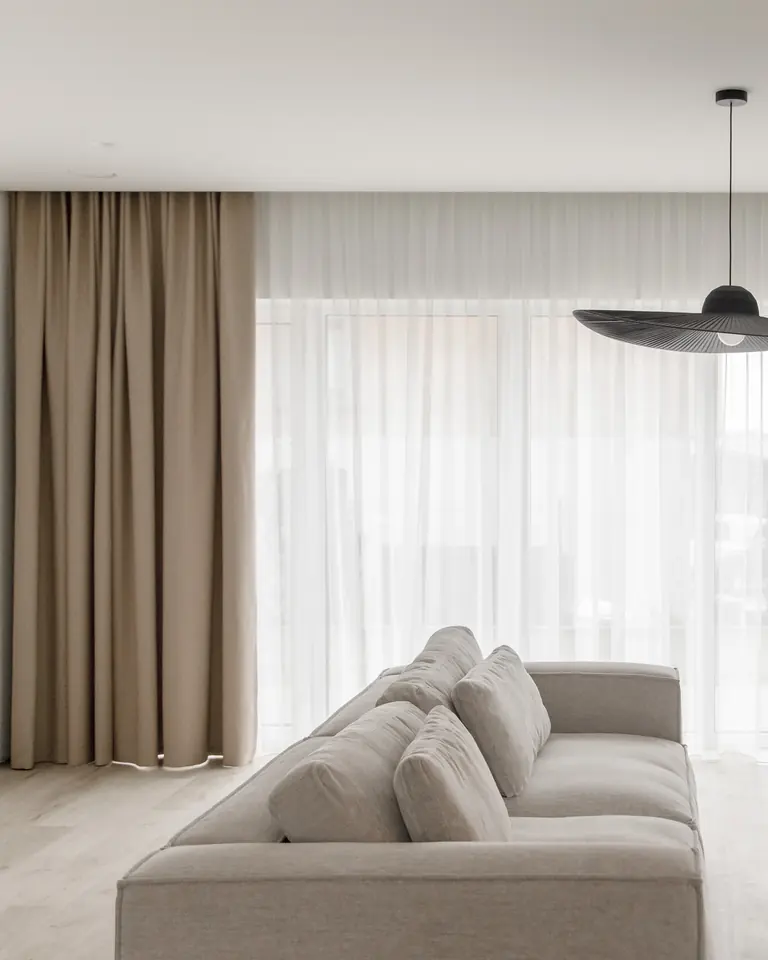
Flat, living room. A white sheer across the whole window wall and sand-coloured curtains from ceiling to floor. 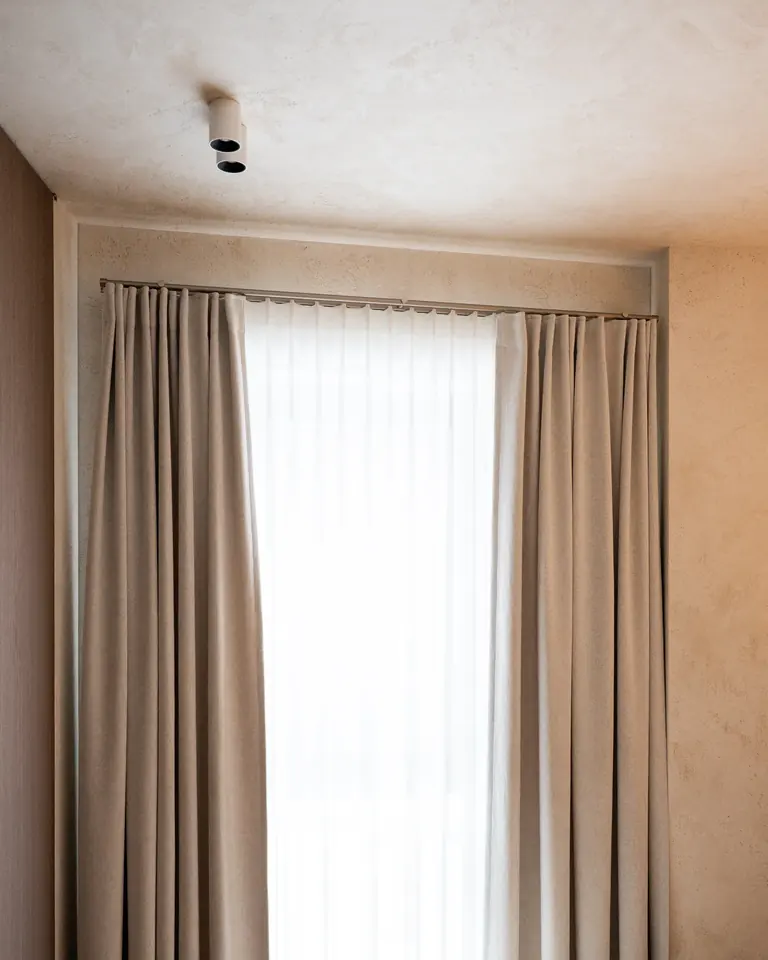
House, window recess. Sand-coloured curtains and a white sheer on a ceiling track. 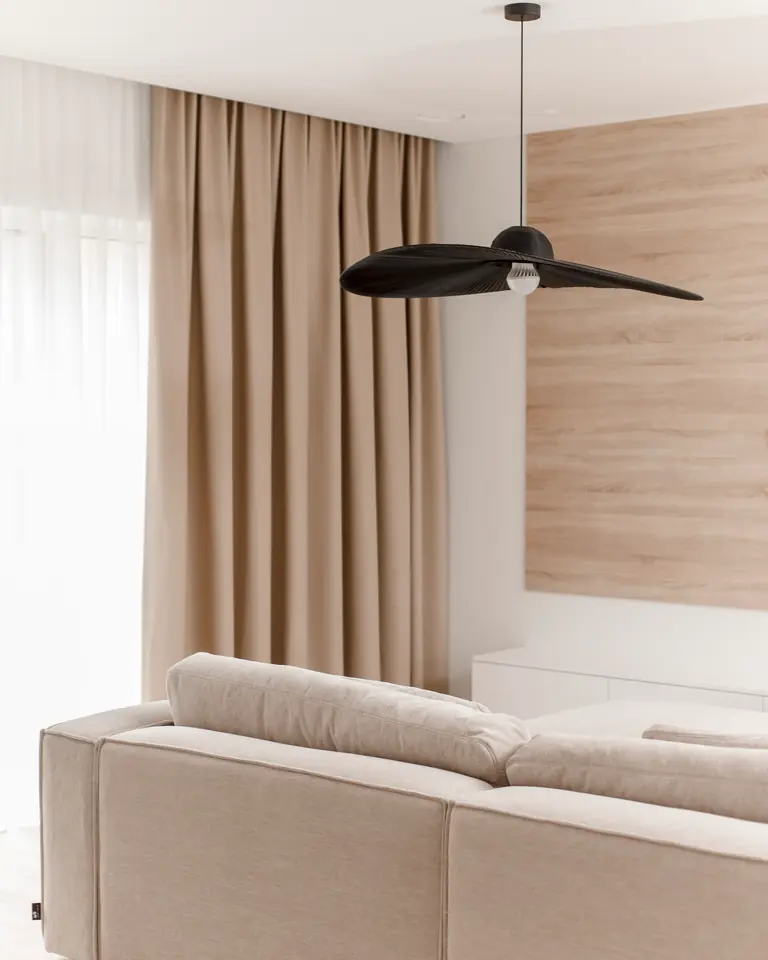
Flat, living room. Sand-coloured curtains and a white sheer from ceiling to floor. 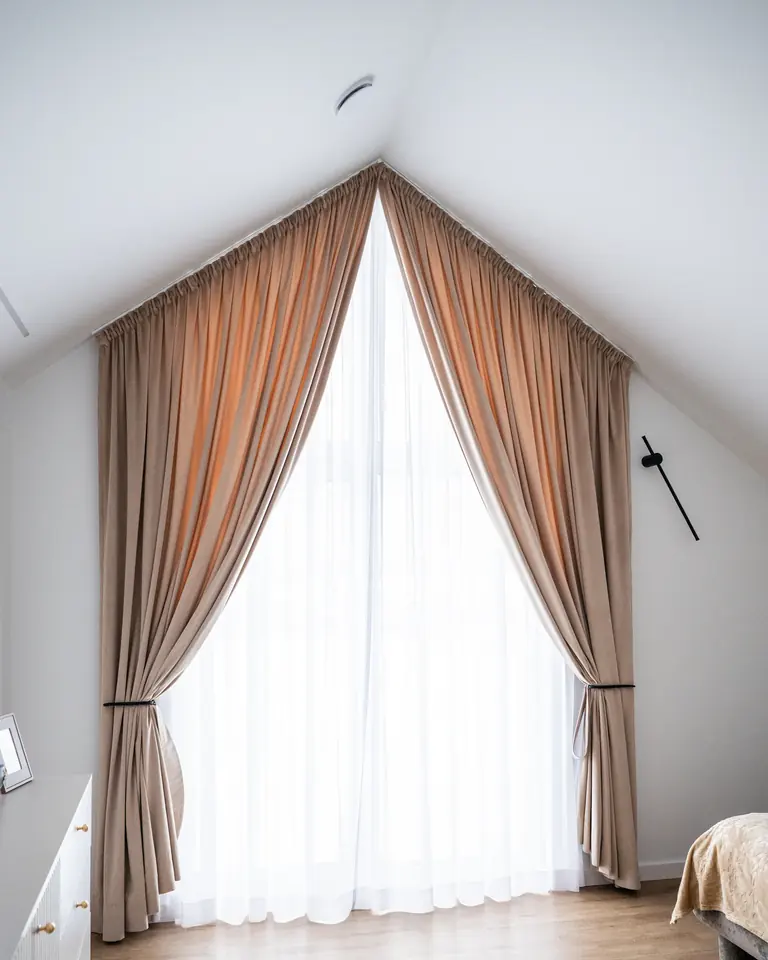
House, bedroom under a pitched roof. Peach curtains with tie-backs and a white sheer. 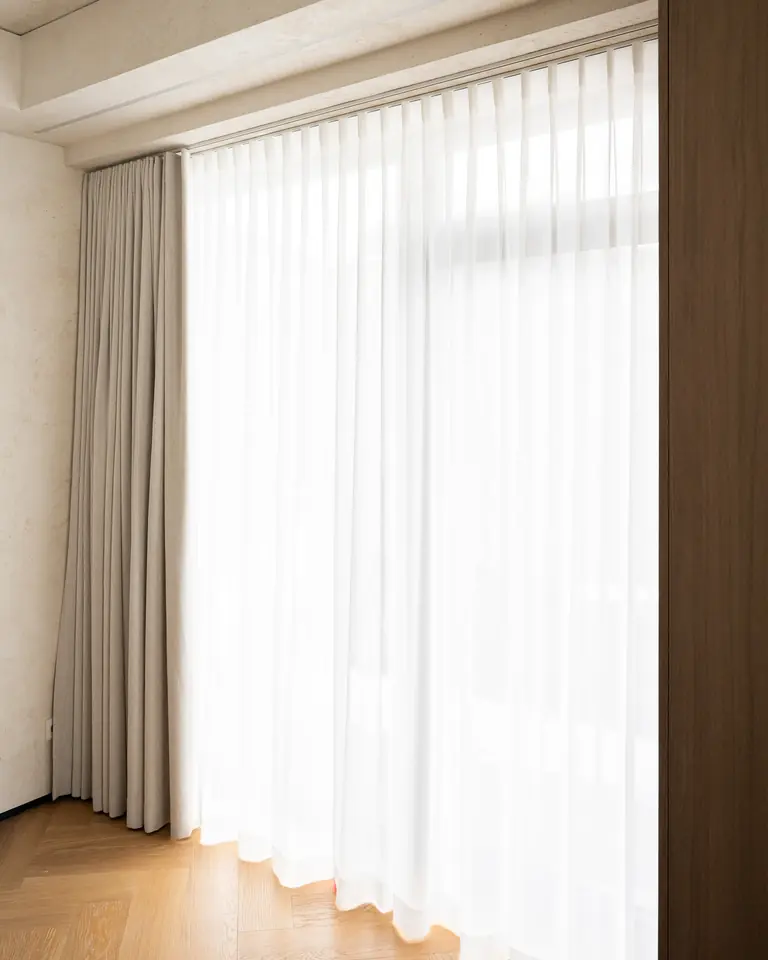
House, room with oak floors. A sheer in wave pleats and a pale curtain in a ceiling recess. 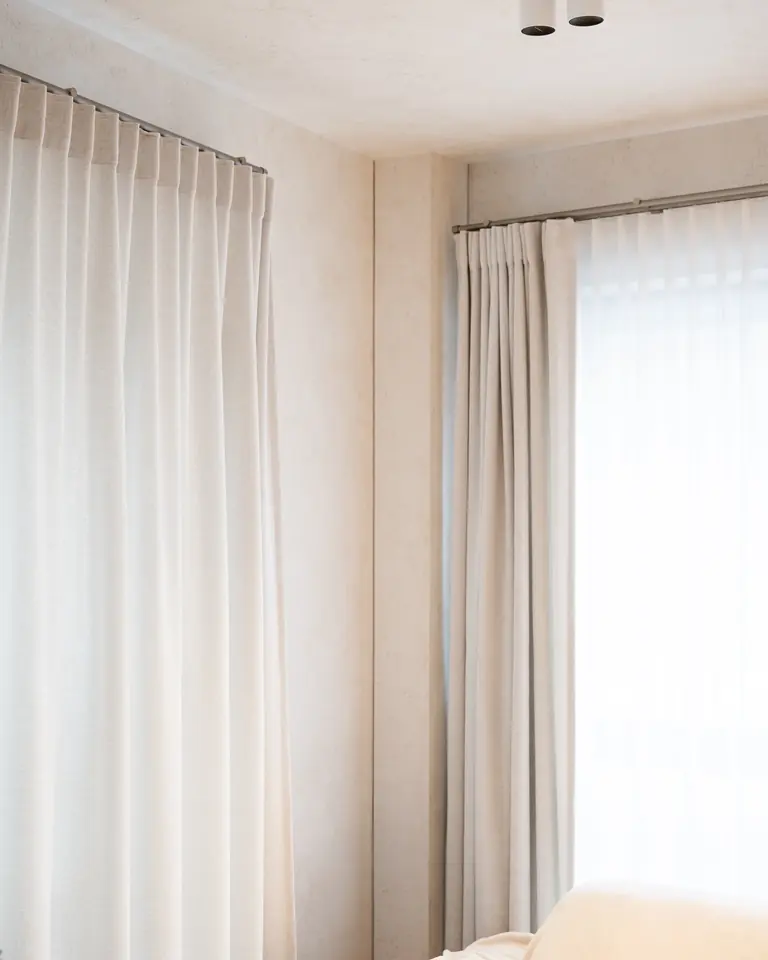
House, corner room. White sheers in wave pleats on ceiling tracks.