Author: Jegor Janockin
Reviewed by: Curtain.lt editorial team
Last updated:
Curtain care: how to wash, steam and stop them shrinking
- Most curtains can be washed at 30 °C on a gentle cycle, without a hard spin, and dried hanging.
- Velvet, silk, heavy fabrics and some blackout fabrics are dry-cleaned only.
- Check the label before washing: the table below gives the care for each of our fabrics.
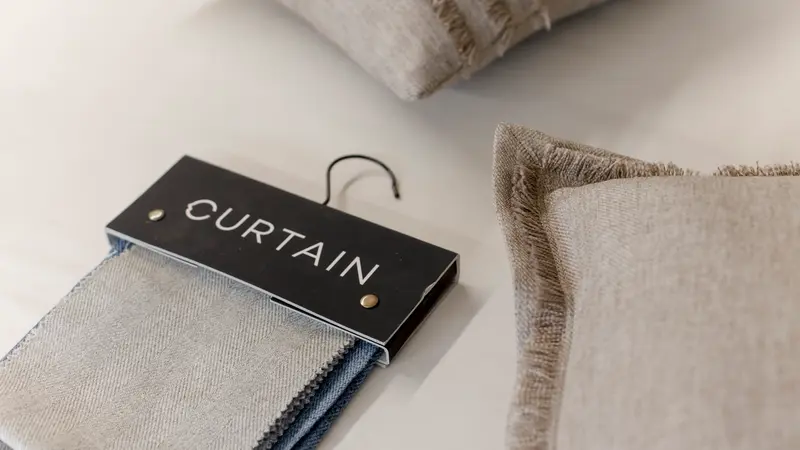
Curtain care starts with the fabric. Linen, viscose, cotton, polyester, blackout and velvet react differently to damp and heat, so the same wash will refresh one fabric and may shrink or distort another. For curtains that last, three things matter most: read the label, keep the temperature low and dry them gently.
How to wash curtains: the temperature for each fabric
The safest rule is to wash no hotter than 30 °C, on a gentle cycle, and dry the curtains hanging. But some fabrics do not like water at all: their coating, weight or surface changes after washing. The table gives the care for all our fabrics, following the makers' instructions.
| Fabrics | How to clean | Note |
|---|---|---|
| Voile, Lietutis, Net sheer, Soft voile, Sevim, Lavina | Wash at 30 °C | Gentle cycle; Net sheer dries quickly |
| Ramune, Non-iron net sheer | Wash at 30 °C | Hang damp or steam; no ironing needed |
| Crepe, Šilkas | Wash at 30 °C on a gentle cycle | Iron only on a low setting |
| Nobel | Dry clean, or wash at 30 °C on a delicate cycle | — |
| Grace Blackout, Pera Blackout, Minimalism, Nord, Nova, Skandy, Raw, Heritage, Timber, Massive Dimount | Wash at 30 °C | No hard spin and no tumble dryer |
| Abby, Double-sided blackout, Aura, Nordic Soft | Wash at 30 °C or dry clean | Gentle cycle |
| Heat | Damp cloth or dry clean | Thermal coating |
| Chrome, Gravity Blackout, Motion, Noir Blackout, Softy Blackout, Terry, Wiz | Dry clean | Gravity, because of its weight |
| Bukle, Volume | Dry clean only | — |
| Lining | As the main fabric | A lining sewn on is cleaned together with the fabric |
If a curtain is not made from our fabric, follow its own label. When in doubt, choose a lower temperature or dry cleaning.
What to do before washing curtains
Before taking the curtains down, first check whether the fabric is natural, blended or synthetic, and whether it has a lining. The lining causes the most trouble: the main fabric and the lining dry at different rates, so after a wrong wash the curtain can ripple, shrink or even twist.
- Check the care symbols on the label, and do not ignore them.
- See whether the curtain has a lining or a blackout layer.
- If the curtain is long or heavy, plan where you will dry it hanging.
- Before washing, remove the hooks, the weights and any detachable fittings.
Types of fabric and the golden rules of washing
| Fabric | Can it be washed at home? | Temperature | The key point |
|---|---|---|---|
| Polyester | Usually yes | Up to 30 °C | The most stable fabric, but avoid hot drying |
| Linen | With care | Up to 30 °C | Prone to shrinking and creasing; dry gently |
| Cotton | Usually yes | 30 °C | Can shrink if the cycle is too hot |
| Viscose | Only on a gentle cycle | Up to 30 °C | When wet it is sensitive to stretching and distortion |
| Velvet | Usually no | Dry cleaning | The pile can stick together and lose its direction |
| Blackout with a lining | Only with great care | Up to 30 °C | The layers shrink at different rates, so the risk is higher |
Natural fibres move more in the wash, so do not expect a natural fabric to look identical afterwards: the aim is to clean the curtain and keep its fall and proportions. A lower temperature is almost always safer.
How do you stop curtains shrinking in the wash?
The fear is well founded: a few centimetres of shrinkage in a long curtain shows at once at the floor. Shrinkage is usually caused not by the water itself but by heat and drying that is too aggressive. The biggest mistake is to wash from habit, as you wash bedding or clothes.
- 1Choose a gentle cycle and a temperature no higher than 30 °C, unless the label allows more.
- 2Do not use a hard spin, because it distorts long fabric and the pleats.
- 3Do not tumble dry unless you are quite sure the fabric is suited to it.
- 4After washing, hang the curtain as soon as possible, so that its own weight brings the fall back.
The main risk with a lining
If the main fabric and the lining shrink unevenly, the curtain can start to curl or pull to one side. Such curtains are safest at a dry cleaner.
Steamer, iron or dry cleaner?
A garment steamer is in most cases the safest home care tool. It lets you refresh the fall and remove creases almost without touching the fabric. It suits linen, blended fabrics and sheers, where an iron can leave shiny marks.
Contact ironing does not suit every fabric. Velvet, silk, more delicate viscose or a bonded blackout layer can lose their structure under too hot a soleplate. If unsure, iron through a cloth, from the wrong side, or put the iron away and use steam.
When to go straight to a dry cleaner
If the curtains are dear, long, heavy, velvet or have a blackout lining, dry cleaning often costs less than one spoiled curtain.
How do you remove stains at home?
The rule for stains is simple: the sooner you react, the less aggressive a product you need. Blot a fresh stain gently first, do not rub it. Rubbing presses dirt deeper into the fibre, especially if the fabric is soft or fluffy.
- For most fresh stains, lukewarm water and a mild soap solution are enough to begin with.
- For a grease stain, talc or dry shampoo can be used briefly to soak up the grease.
- For coloured fabrics, do not use chlorine bleach.
- Try any product first on a hidden spot.
A regular care routine that spares the fabric a big clean
The biggest mistake is to remember the curtains only when they already look tired. Dust builds up gradually, so regular, light care is almost always more effective than rare, aggressive washing.
- 1Every 1–2 months, run a vacuum cleaner with an upholstery attachment over the fabric.
- 2Once a week, air the room and give the curtains a light shake.
- 3Once a year, or as needed, do a deeper clean, according to the type of fabric.
- 4In a dusty home, or one with pets or an open-plan kitchen, check the fabric more often.
When does dry cleaning pay for itself?
Dry cleaning usually pays for itself when the curtain is dearer, made to measure or has sensitive layers. It is easier than it looks to ruin such a fabric with one wrong cycle, and remaking or repairing a long curtain almost always costs more than one safe clean.
This applies above all to linen, velvet, lined blended fabrics and blackout curtains. When in doubt, ask before washing rather than try to rescue the fall and the length afterwards: ask the dry cleaner, and also whoever made or fitted the curtains, who knows how that fabric behaves.
A dry cleaner is also useful when the curtains have hung for a long time and have collected dust, smells, grease or city dirt. Such cases often call for more than washing: a safe, deeper clean that cannot be repeated at home.
Before the cleaned curtains go back up, check the hooks, the tapes and how the track glides. Sometimes the problem is not the fabric but worn hooks or gliders, which spoil the fall of the whole curtain.
How to store seasonal or little-used curtains
If you change curtains with the seasons, store them only when they are clean. Dust, grease or damp soak in deeper in storage and are harder to remove later. Fold the fabric loosely, do not tie it tightly with bands, and do not keep it in sealed bags, where damp collects. A breathable textile cover or a cotton bag is almost always better than plastic.
Take particular care with long lined or blackout curtains. If you press them too hard, they will need longer steaming later, and some layers can be left with permanent fold marks. Natural fabrics such as linen or viscose blends also dislike heavy things on top of them, because the line of the fall can change over time.
What to avoid even if the fabric looks sturdy
- Do not use a strong all-purpose cleaner just because it suits other household textiles.
- Do not pour hot water over a stain if you do not know where it came from.
- Do not wring the fabric by hand as if it were a towel.
- Do not keep damp curtains screwed up in a ball: deep creases and smells form.
Frequently asked questions
Can lined curtains be washed in a washing machine?
Often they can, but only if the label allows it and the fabric has no sensitive blackout layer or bonded lining. The main thing is to choose a low temperature and a gentle cycle, and to avoid aggressive drying.
How often should curtains be washed?
For most homes a deeper clean once a year is enough. With a kitchen close by, a dusty home, pets or windows often open to a busy street, clean them more often.
How should curtains be dried after washing?
Hanging, and not fully dried in the machine. The fabric distorts less that way, and the fall comes back more readily than if it is dried folded or over-dried.
What if the curtains have got shorter after washing?
Do not try to stretch them by force. Hanging them while still a little damp and steaming them gently sometimes helps, but if the fabric has shrunk for good, the curtain may need altering or a different hem.
Is a steamer safe for all fabrics?
Not for all, but in most cases a steamer is safer than direct ironing. Hold it back from delicate fabrics, and if in doubt, start with less steam.
When is it better to take curtains to the dry cleaner?
When the fabric is dear, long, heavy, velvet, silk or has a blackout layer, a dry cleaner is almost always safer than trying to do everything at home. The care for each of our fabrics is in the table at the start of this guide.
See the curtain options
If you are considering a new fabric or want textiles that are easier to look after, start with all the curtain categories.
See curtainsLooking for a more natural fabric?
If you are drawn to linen or linen blends, see what suits them and what to know about caring for them.
Linen curtainsThe next step
If this guide has answered your questions, move on to a specific product or check your budget.