Roller blinds
Blackout roller blinds
Multi-layer roller blinds that block the light, bring a room close to complete darkness for sleep, and cut heat loss through the window.
Blackout roller blinds from €45 each · Cassette blinds with side channels from €90
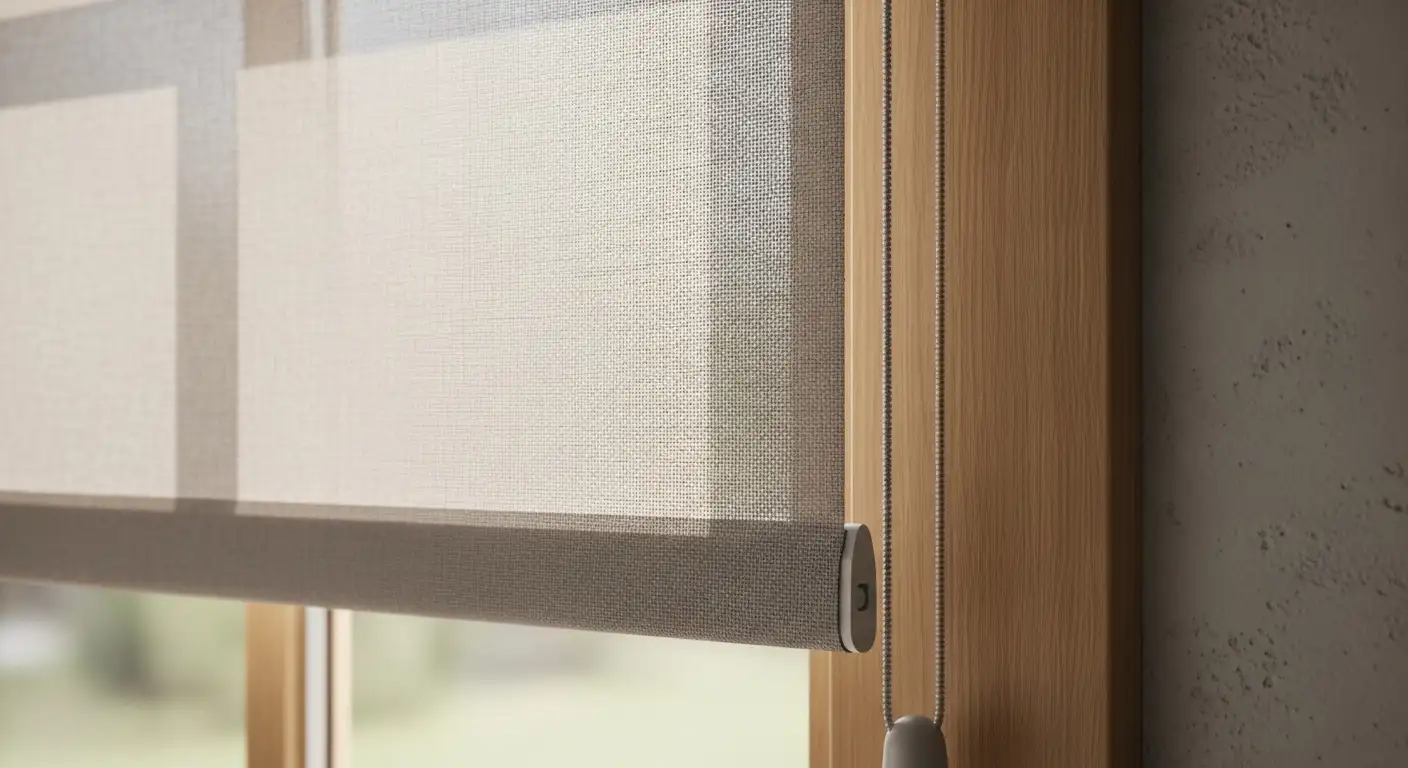
Why do blackout roller blinds matter for sleep?
Blackout roller blinds are made of a special multi-layer fabric that stops the light entering a room. The fabric has an inner light-blocking layer, so light passes neither through the fabric nor through its pores. The darkness comes from the construction, not the colour: even pale shades darken as well. In Vilnius and other Lithuanian towns, blackout blinds matter most in winter, because of bright street lamps, and in summer, because of early sun and long light evenings.
Sleeping in the dark supports the body's natural production of melatonin, the hormone that regulates the sleep cycle and falling asleep. Even a little light at night can disturb sleep.
Blackout roller blinds reduce light from the street, from car headlamps and from advertising screens, so sleep is deeper and waking is easier. This matters most for people who work shifts, for small children and for light sleepers.
What are the main advantages of blackout roller blinds?
Better sleep: darkness lowers the suppression of melatonin and helps you fall asleep and stay in deep sleep. Light control at any hour: a dark room can be made at any time of day, which helps shift workers and babies' daytime sleep. Insulation: a good blackout fabric reduces heat loss through the window in winter and holds back heat in summer. Privacy: a dense fabric lowers how much can be seen from outside and slightly dampens street noise.
Blackout blinds also protect the interior: blackout fabrics reduce the UV light that reaches the room, so furniture and floors keep their colour for longer.
How do blackout roller blinds compare with other blackout options?
How blackout roller blinds compare with day and night, pleated and roman blinds, and when to choose them.
Blackout roller blinds with a cassette and side channels darken a room the most, suit small windows very well and large ones well, insulate very well, are easy to look after and suit roof windows with a special system. Day and night blackout blinds let light through between the bands, suit small and large windows well, insulate well, are easy to look after and suit roof windows to a limited extent. Blackout pleated blinds, tensioned in the window frame, darken well, suit small windows very well and large ones moderately, insulate well, take light to moderate care and suit roof windows very well. A blackout roman blind's fabric lets no light through, but more light passes at its sides than with a roller blind in side channels, and these blinds suit small windows well and large ones moderately, insulate well, take moderate care and rarely suit roof windows.
Which types of blackout roller blind are there?
Cassette blackout roller blinds: the fabric rolls into a cassette at the top, and guide strips at the sides leave the light almost no way in. This gives the most complete darkening, and suits a bedroom.
Open blackout roller blinds: the fabric is visible and there are no side guides, so thin strips of light can remain, but the fabric is still blackout. It is the more economical option, and suits a living room or a study.
Roof-window blackout roller blinds: special systems with side channels hold the fabric close to the glass. They are made for roof windows and attics, and help to control the temperature.
Day and night blackout roller blinds: with dense blackout bands, up to 70–80% of the light can be blocked. This is convenient if you want a day mode and an evening mode in the same window, especially in a kitchen or a living room.
Which rooms suit blackout roller blinds best?
Bedroom: street light, morning sun and car headlamps are shut out, which helps keep the sleep cycle unbroken. Child's room: the dark makes a daytime nap and an early summer bedtime easier, and safe versions are made without hanging cords. Home cinema: blackout blinds remove reflections on the screen, so the picture stays clear at any hour.
Study: it cuts reflections on the screen, especially when the window faces south or west. Guest room: it lets guests rest at any hour, with privacy. Attic: special roof-window systems with guides darken attics fully.
How do I choose blackout roller blinds?
Four steps to choosing one.
1. Consider what the room is for. For a bedroom and a child's room choose the highest light blocking (cassette blinds with guides). For a living room and a study, open blackout blinds may be enough. An attic or roof window needs a special system with guides.
2. Choose the level of darkening. For a bedroom, aim for 95–100% light blocking, with a cassette and guides for the most darkness. A blind without a cassette will do if absolute darkness is not critical.
3. Decide how it will be fitted. On the window frame, with a cassette and guides, covers the edges best. On the wall above the recess, add 5–10 cm at the sides. Inside the recess, the measurements must be exact, so that no gaps remain.
4. Fabric and colour. Pale shades darken as well as dark ones. Polyester fabrics resist fading and are easy to clean. Choose the colour to suit the style of the room.
Child safety: if the blinds are for a child's room, we recommend systems without loose hanging cords, or with fixed chain holders. These lower the risk of a child becoming tangled in the chain or tearing off the mechanism while playing.
How do I measure the windows correctly?
The designer measures the windows at the visit, but if you want to prepare, or to estimate a price, it helps to know how the measuring is done.
Fitting on the frame: measure the width and height of the glass at three points, and check that the window handles will not catch on the blind's cassette. This way of fitting covers the edges best and suits bedrooms.
Fitting on the wall: add 5–10 cm on each side to the width of the opening, measure the height from the fixing point to the sill, and check that there is room above the window for the cassette.
How do I look after blackout roller blinds, and how long do they last?
Blackout roller blinds need little care. Usually it is enough to wipe off dust regularly with a soft cloth or a vacuum cleaner with a soft attachment. Most modern blackout fabrics are antistatic and resist fading.
Clean with a dry or damp cloth and avoid aggressive chemical cleaners. Well cared for, blackout roller blinds last many years.
Are blackout roller blinds made to measure?
Yes. They are made to the measurements of each window, from the standard windows of a Vilnius flat to non-standard attic windows and panoramic glazing. For each project the fabric is chosen for strong light blocking, good insulation and looks.
Each blind is made to the measurements of your window, fitted anywhere in Lithuania, and the designer advises on site, according to your space.
What is the halo effect, and how does a cassette system prevent it?
The halo effect is a ring of light seen round a closed blind. It is most visible at night, when street lighting or car headlamps are on outside. It has a simple physical cause: a freely hanging blind never closes completely. A gap of 2–5 mm always remains between the edges of the fabric and the window frame.
A cassette blind with side channels prevents it: the channels close the gaps between the fabric and the window frame. Fitting outside the recess, above the window frame, further reduces the light that enters over the top.
By fabric type: a cassette with side channels blocks 95–100% of the light and suits a bedroom and a child's room. A free-hanging blind blocks 80–90% and suits a living room and an office. Cellular blackout blocks 90–97% and suits a bedroom and saving energy. Room darkening blocks 70–90% and suits a living room and a dining room.
A measuring error of even 2–3 mm can make the fabric catch or leave gaps, so accurate measuring is an essential step.
How do blackout blinds cope with summer heat, and which backing should I choose?
Against sun and heat, blackout roller blinds also work as a thermal barrier. A silver (aluminium) backing reflects the sun's rays back out through the glass, while a backing matched to the colour of the fabric absorbs part of the heat. The closer the blind is fitted to the glass, the more effective the barrier.
A silver (aluminium) backing reflects heat best and suits south- and west-facing windows. A colour-matched backing reflects heat moderately, and suits a bedroom and a child's room. A plain blackout fabric reflects heat weakly and suits north-facing windows better.
What do blackout roller blinds cost in 2026?
Prices depend on the type of system, the fabric and the size of the window. The exact price is given after measuring. Measuring is free in Vilnius. In Kaunas and Klaipėda it is free on orders of €200 or more. Elsewhere in Lithuania the visit is paid, and the price is agreed beforehand.
An open blackout roller blind blocks 80–90% of the light, starts at €45 each, and suits a living room and an office. A cassette blind with side channels blocks 95–100%, starts at €90 each, and suits a bedroom and a child's room. A roof-window blackout blind blocks 95–100%, starts at €120 each, and suits roof windows and attics. An electric blackout blind (Somfy) blocks 95–100%, starts at €200 each, and suits windows that are hard to reach.
Blackout fabric costs €11–43 per metre, depending on the maker. A fuller breakdown of prices is in the roller blind fitting guide.
Questions
How do I measure a window for blackout roller blinds?
Measure the window at three points, at the top, in the middle and at the bottom, and note the smallest width and height. For a fit inside the recess, check that the recess is deep enough. For a fit outside the recess, make the blind at least 5–10 cm wider on each side, so that every gap is covered.
What is the halo effect, and how do I avoid it?
The halo effect is a ring of light round a closed blind, caused by gaps of 2–5 mm between the edges of the fabric and the window frame. Avoid it with a cassette blind running in side channels, fitted outside the recess above the window frame. This matters most in bedrooms.
How do I look after blackout roller blinds?
Clean them regularly with a vacuum cleaner or a soft brush to remove dust. Do not use aggressive chemicals or solvents, which can damage the blackout fabric and reduce how well it blocks the light. For dirt, use a damp, soft cloth with mild soap.
How do rubberised blackout roller blinds differ from ordinary ones?
A rubberised blackout blind has an extra protective layer, which blocks the light more effectively than an ordinary polyester fabric and insulates better against heat. The denser fabric also absorbs sound better. Such blinds are usually heavier and dearer: blackout fabric costs €11–43 per metre.
How do blackout roller blinds differ from ordinary light-filtering roller blinds?
Blackout blinds block 95–100% of the light, while ordinary light-filtering (room darkening) blinds let 10–30% through. The difference comes from a dense fabric with an opaque layer. That is why blackout blinds are the better choice for bedrooms and children's rooms.
How do cassette blinds differ from free-hanging blackout roller blinds?
A cassette blind running in side channels blocks 95–100% of the light, because the fabric always stays close to the glass. A free-hanging blind is simpler and cheaper, but blocks only 80–90%, because of the gaps along the edges. For a bedroom, the cassette blind with side channels is clearly the better choice.
Which way of fitting blocks the most light?
Fitting outside the recess, above the window frame, because it covers the whole window opening with no gaps. Fitting inside the recess looks tidier, but often leaves visible gaps. In both cases, a cassette with side channels improves the result considerably.
How much does it cost to fit blackout roller blinds in Lithuania?
Fitting blackout roller blinds in Lithuania costs from €3–5 per m², and the blinds themselves from €7. Blackout fabric costs €11–43 per metre, headrails and mechanisms €5–95, and making and fitting €4–64. Compare quotes from several suppliers.
Are blackout roller blinds suitable for a bathroom or a kitchen?
Only if the fabric resists damp, which usually means rubberised or vinyl-based models. Standard textile blackout fabrics can warp in damp rooms. For a bathroom, choose PVC or aluminium blinds with a blackout function.
Ideas for your home
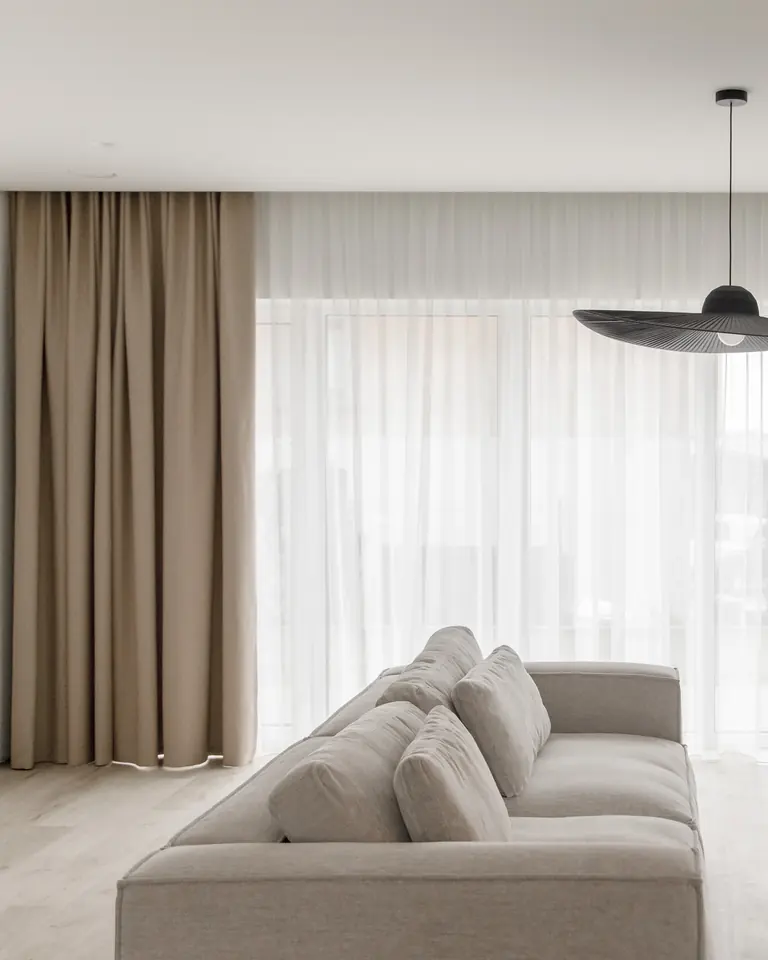
Flat, living room. A white sheer across the whole window wall and sand-coloured curtains from ceiling to floor. 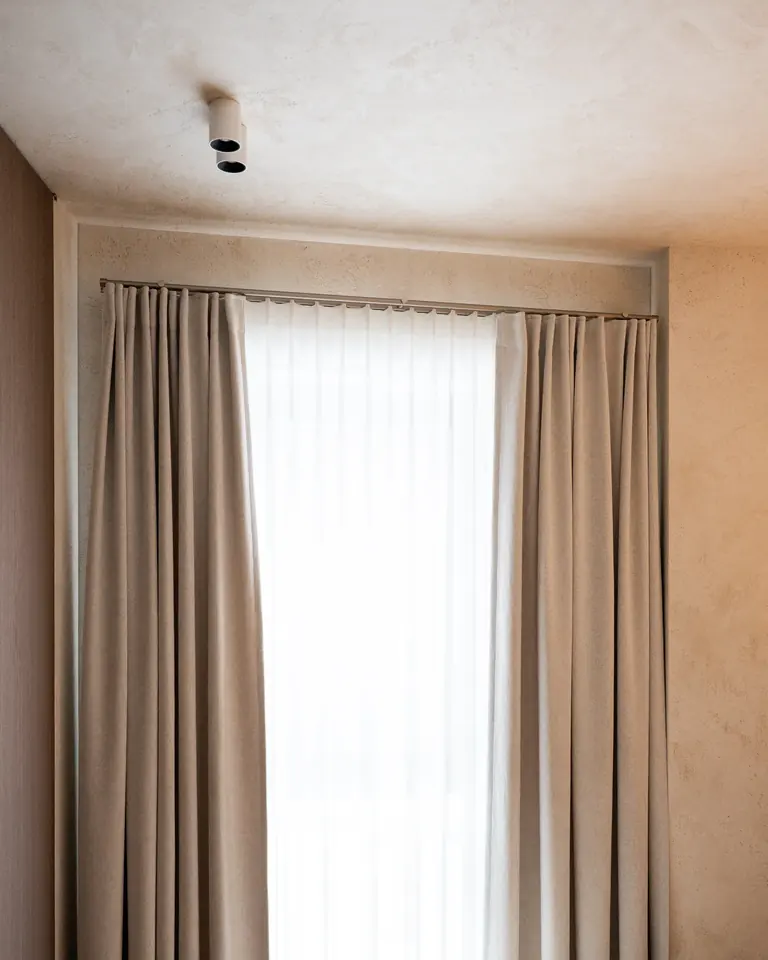
House, window recess. Sand-coloured curtains and a white sheer on a ceiling track. 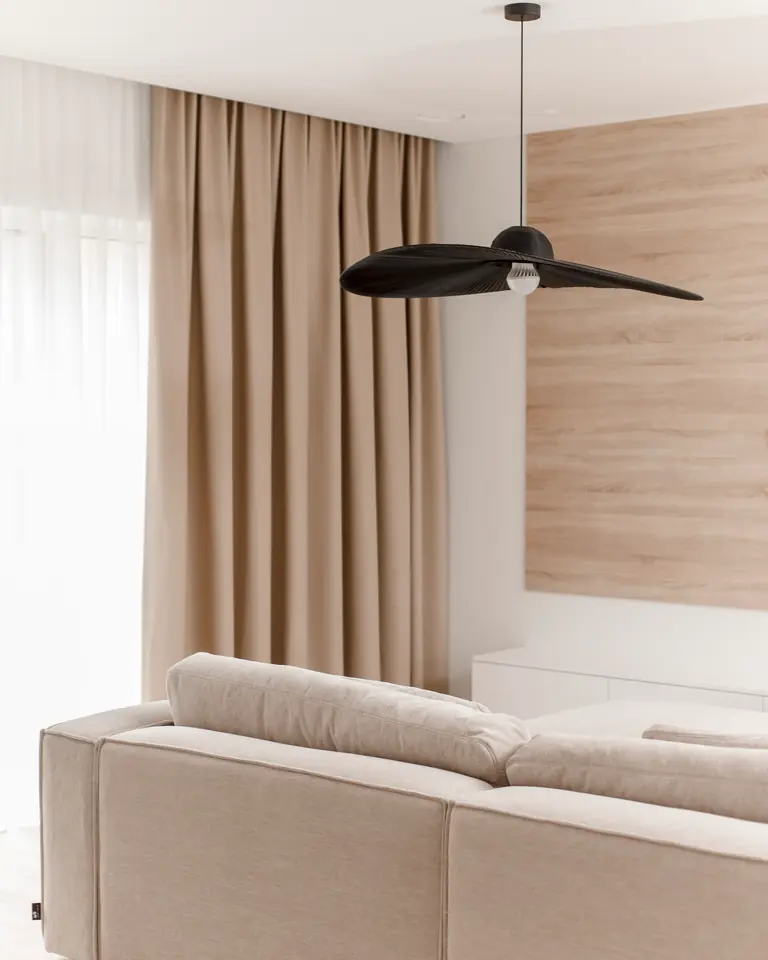
Flat, living room. Sand-coloured curtains and a white sheer from ceiling to floor. 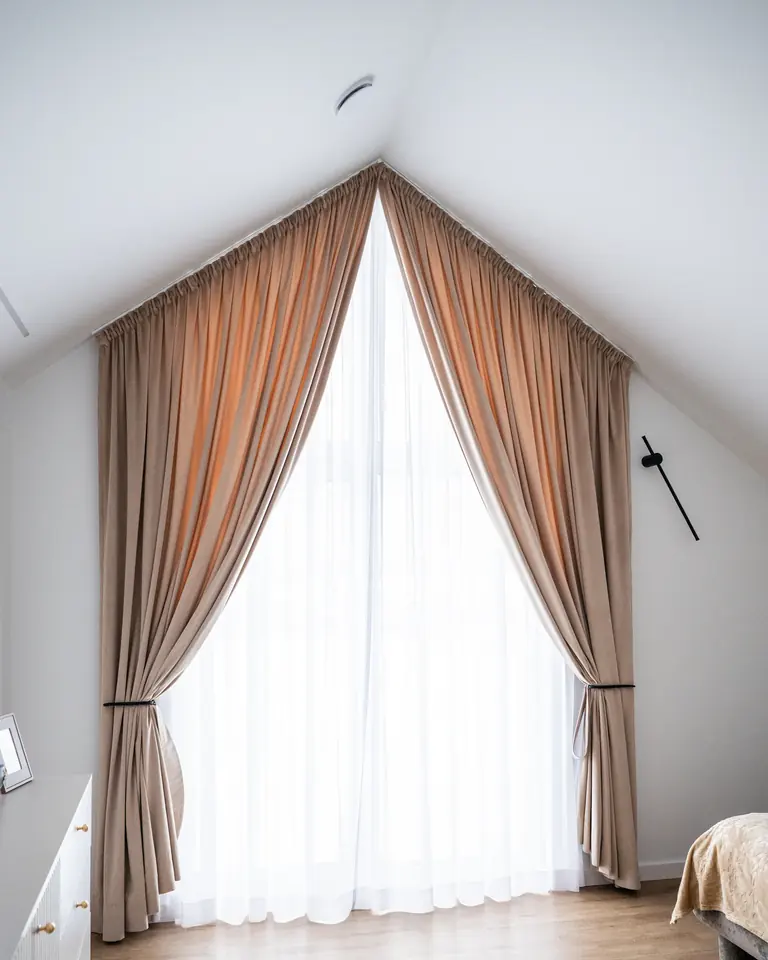
House, bedroom under a pitched roof. Peach curtains with tie-backs and a white sheer. 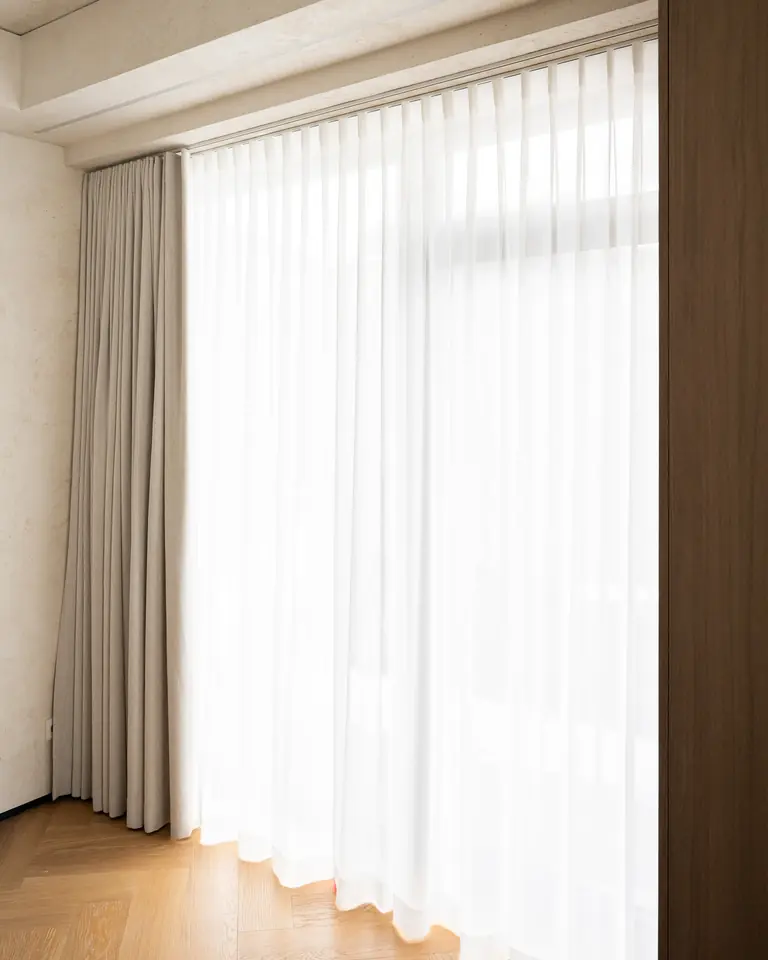
House, room with oak floors. A sheer in wave pleats and a pale curtain in a ceiling recess. 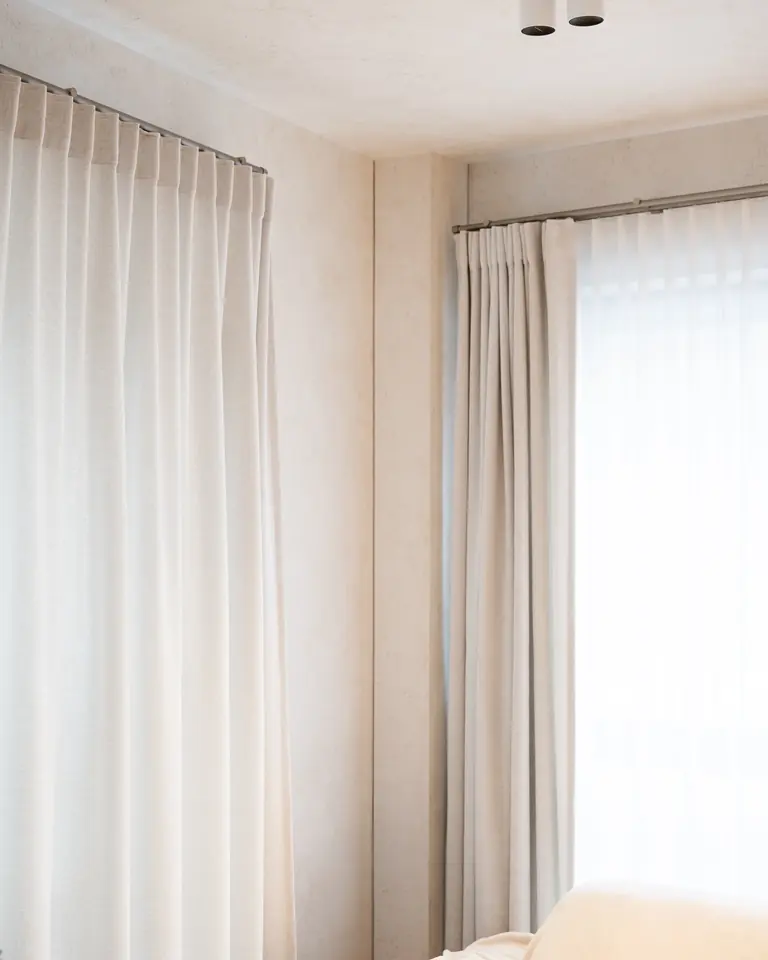
House, corner room. White sheers in wave pleats on ceiling tracks.