Lined curtains
Lined curtains: dim-out and blackout
- Lined curtains are made from dense fabrics that hold back 75–100% of the light: dim-out leaves a dusk glow, and blackout darkens the room.
- So that light does not get round the edges, the track is fixed to the ceiling and extends 20–30 cm past the window on each side, and the curtain ends 1–2 cm above the floor.
- Fabrics cost from €24 per metre, and making €13 per metre.
Price from €24/m, as of October 2026
Ten blackout and dim-out fabrics that hold back 75–100% of the light, for deep sleep even on the light nights of summer.
Fabric from €24/m · Width 290–335 cm · holds back 75–100% of the light
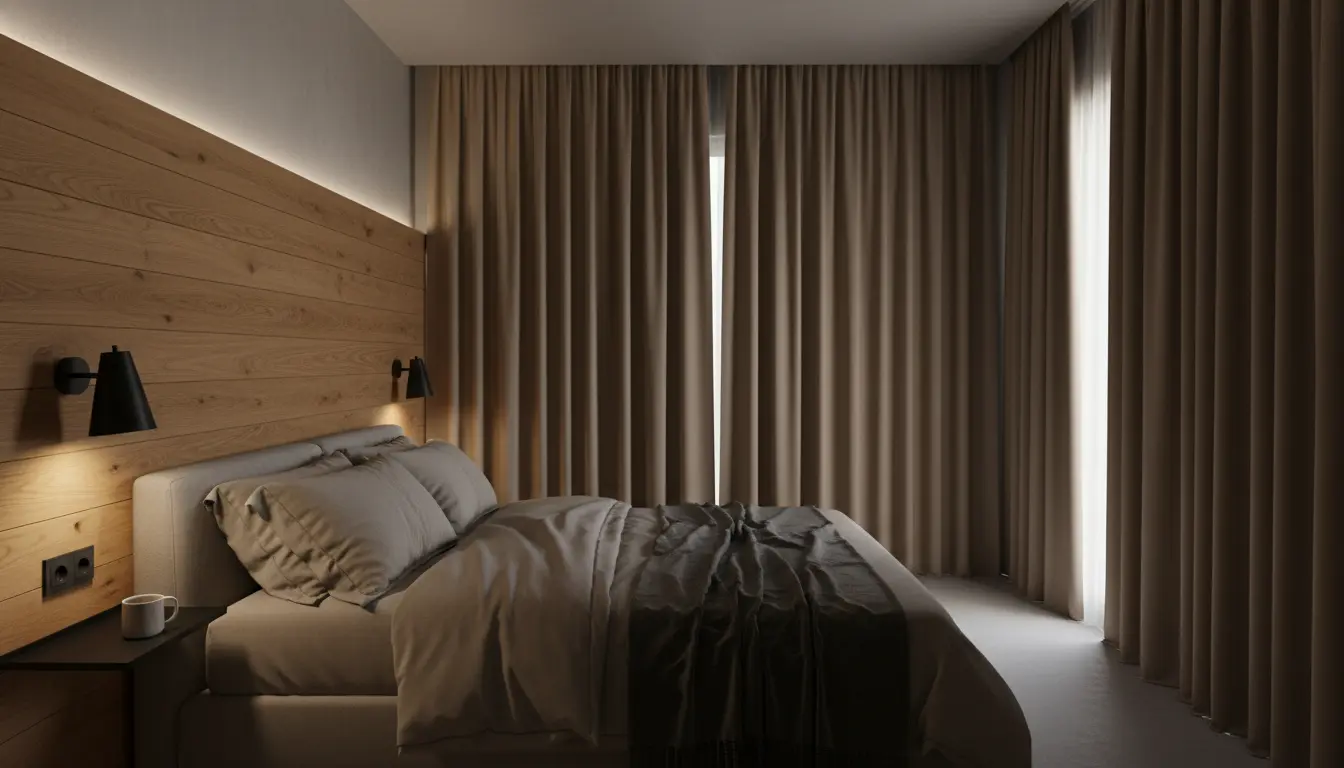
How do the blackout fabrics compare?
Lined blackout curtains do three jobs. They darken: a blackout fabric holds back up to 100% of the light, even at midday in midsummer. They keep warmth in: a dense fabric, especially one with a thermal coating (Heat), reduces heat loss through the window. And they quieten a room: a heavy fabric softens the echo.
The table lists the ten blackout and dim-out fabrics, priced per running metre. The fabric needed is the track length times the fullness: 1.5× for a tape heading, 2× for a wave heading.
| Fabric | Price | Light held back | Width | Character |
|---|---|---|---|---|
| Minimalism 1 and 2 | €24/m | 90–95% | 300 cm | Basic fabric with an anti-static coating |
| Massive Dimout | €28.50/m | about 75–85% (dim-out) | 300 cm | Fluid fall; suits a living room |
| Double-sided blackout | €28.50/m | 100% | 320 cm | Different colours on the inside and the outside |
| Abby | €29.50/m | 95–100% | 295 cm | The classic microfibre fabric |
| Grace Blackout | €32/m | 100% | 320 cm | Soft micro-relief texture |
| Heat | €32/m | 100% | 290 cm | Thermal insulation coating |
| Aura | €34.50/m | about 95% | 300 cm | Silk effect |
| Gravity Blackout | €35/m | 100% | 290 cm | 350+ g/m², heavy, even fall |
| Heritage | €39.50/m | 90–95% | 300 cm | Linen look |
| Bukle | €43/m | 90–95% | 295 cm | Pronounced 3D bouclé texture |
The full specifications of all ten fabrics are in the fabric catalogue.
A worked example: a 200 × 260 cm bedroom window
Track length: 200 + 25 + 25 = 250 cm, with the track extending 25 cm past the window on each side. Fabric width: 250 cm × 2.0 (wave heading) + 30 cm for the edges = 530 cm, that is 5.30 running metres of fabric. Drop: from the track to 1 cm above the floor, about 270 cm.
Price: fabric (Grace Blackout, €32/m × 5.30 m): €169.60; making, €13/m × 5.30 m: €68.90; tape and hanging: €31.80; ceiling track, 2.5 m × €9/m: €22.50; fitting, 2.5 m × €9/m: €22.50. In total about €315.
For the exact price for your window, use the calculator or book a measuring visit.
Dim-out or blackout?
Lined blackout curtains hold back 95–100% of the light, so the room is dark at any time of day. In Lithuania that matters most in summer, with its light nights: in June the sun rises at 4:42. Dense blackout fabrics such as Heat (€32 per metre) and Gravity Blackout (€35 per metre, 350+ g/m²) also reduce heat loss through the window. For both light control and privacy in a bedroom, hang two layers: a dark linen-look blackout for the night and a sheer for soft light by day.
Choose by how dark the room needs to be; the two levels follow. Cassette blackout roller blinds are a more compact alternative to curtains and hold back 95–100% of the light.
Dim-out (about 75–85%): Massive Dimout, €28.50 per metre. A soft dusk glow remains and silhouettes show. It suits rooms that should not go fully dark: a living room, a study, the room of a child who is afraid of the dark.
Full blackout (95–100%): Grace, Heat, Abby and Double-sided blackout, €28.50–32 per metre. The light is held back completely, so the room is dark at any hour. It suits a bedroom, a child's room for daytime naps, and a home cinema.
Which blackout curtains suit which room?
Bedroom: Grace, Abby and Aura, for deep sleep even on the light nights of summer. Children's room: Minimalism 1 and 2 (anti-static coating), for daytime naps and early mornings. Home cinema: Gravity Blackout (350+ g/m²), for full darkness and a heavy, even fall.
What are the five most common blackout mistakes?
Even a 100% blackout fabric fails if one of these five things is wrong. They are the commonest mistakes in choosing and fitting, each with what it causes.
1. A track straight above the window, with no overhang. Open curtains cover 15–20 cm of glass on each side: the room looks darker, and at night the blackout is lost at the sides. Fix: extend the track 20–30 cm past the window opening on each side.
2. A plastic track for blackout fabric. Blackout curtains for a 200 × 260 cm window weigh several kilograms, and plastic tracks bend in time. Fix: metal tracks only (aluminium or steel) with four or more fixing points.
3. Curtains that end at the sill. Light slips under the hem: even a 100% blackout fabric fails if the gap at the bottom is more than 2 cm. Fix: curtains that stop 1–2 cm above the floor, not at the sill.
4. Too little fullness. Blackout fabric without folds (less than 1.5×) is stretched flat, and its edges pull away from the corners of the window. Fix: 1.5× the track length for a tape heading, 2× for a wave heading.
5. Washing in hot water (above 30 °C). High temperatures damage the blackout coating: after a 60 °C wash it can crack and let light through. Fix: wash at 30 °C on a gentle cycle; Bukle, Heat and Chrome are dry-clean only.
Wall-mounted pole
Ceiling track with returns
Measuring and fitting
Windows are measured in Vilnius, Kaunas, Klaipėda and across Lithuania. Measuring is free in Vilnius. In Kaunas and Klaipėda it is free on orders of €200 or more. Elsewhere in Lithuania the visit is paid, and the price is agreed beforehand. Whether light gets round the edges depends on accurate measuring. From order confirmation to installation, curtains, roman blinds and other blinds take 3–4 weeks, and tracks 1–2 weeks.
Book a measuring visit, or use the measuring guide if you would rather measure the windows yourself.
Lined curtains in your town
Lined and blackout curtains are measured and fitted across Lithuania. See the service in your town.
- Curtains in Vilnius
The designer's visit, measuring and making in every district of Vilnius.
- Curtains in Kaunas
Blackout curtains for bedrooms in Kaunas, measured at home.
- Curtains in Klaipėda
Curtains chosen for the coastal climate, with thermal protection.
Questions
What is the difference between dim-out and blackout curtains?
By how much light they hold back. Dim-out fabrics (for example Massive Dimout, €28.50 per metre) usually hold back about 75–85%: the room stays at dusk level and silhouettes show. Blackout fabrics (Grace, Heat, Double-sided blackout, from €28.50 per metre) hold back 95–100%, dark enough to sleep at midday in summer. Dim-out suits a living room; blackout suits a bedroom and a child's room.
Are blackout curtains suitable for a child's room?
Yes, for daytime naps and early summer mornings: in Lithuania the sun rises at 4:42 in June and 5:30 in May. Abby (€29.50 per metre, a microfibre texture) or Minimalism 1 and 2 (€24 per metre, with an anti-static surface that gathers less dust) suit a child's room. Fabrics that wash at 30 °C, such as Abby, Grace or Minimalism, are the most practical there.
Which curtains are best for a completely dark bedroom?
Blackout curtains that hold back 100% of the light (Grace Blackout, Double-sided blackout, Heat), fitted with no gap at the wall: the track extends 20–30 cm past the window opening on each side, and the fabric stops 1–2 cm above the floor. Only then does the room go fully dark, which deep sleep needs in a Lithuanian summer, with its light nights.
Do lined curtains help keep a room warm?
Yes. Heavy blackout fabrics add a layer of insulation at the window. Heat (€32 per metre) has a thermal insulation coating, and the heavy Gravity Blackout (over 350 g/m², €35 per metre) reduces heat loss through the window. In summer the same fabric keeps south-facing rooms from overheating.
How heavy are blackout curtains?
A standard blackout fabric weighs 200–280 g/m²; heavier ones (Gravity Blackout, Bukle) weigh 350+ g/m². A 200 × 260 cm window at 2× fullness needs about 5.2 m² of fabric, which weighs 1.1–1.8 kg (the heaviest fabrics up to 2.2 kg). That calls for a metal track with at least four fixing points. Plastic tracks are not suitable for blackout curtains.
Do blackout curtains reduce noise?
A little. Dense, heavy fabrics (Bukle, Gravity Blackout) soften the echo in a room and slightly dampen sound at the window. How many decibels depends on the fabric, the window and the room, so we do not promise a figure. A double layer, a sheer plus a blackout curtain, adds to the effect. Curtains cannot block noise completely; that needs dedicated acoustic insulation.
Can blackout curtains be washed?
Most can, at 30 °C on a gentle cycle (Abby, Grace, Minimalism, Heritage). Fabrics with coatings or metallised surfaces (Chrome, Heat, Bukle, Gravity) are dry-clean only. Hang the curtains up damp after washing; most fabrics need no ironing. Care instructions are on each fabric's page.
Ideas for your home
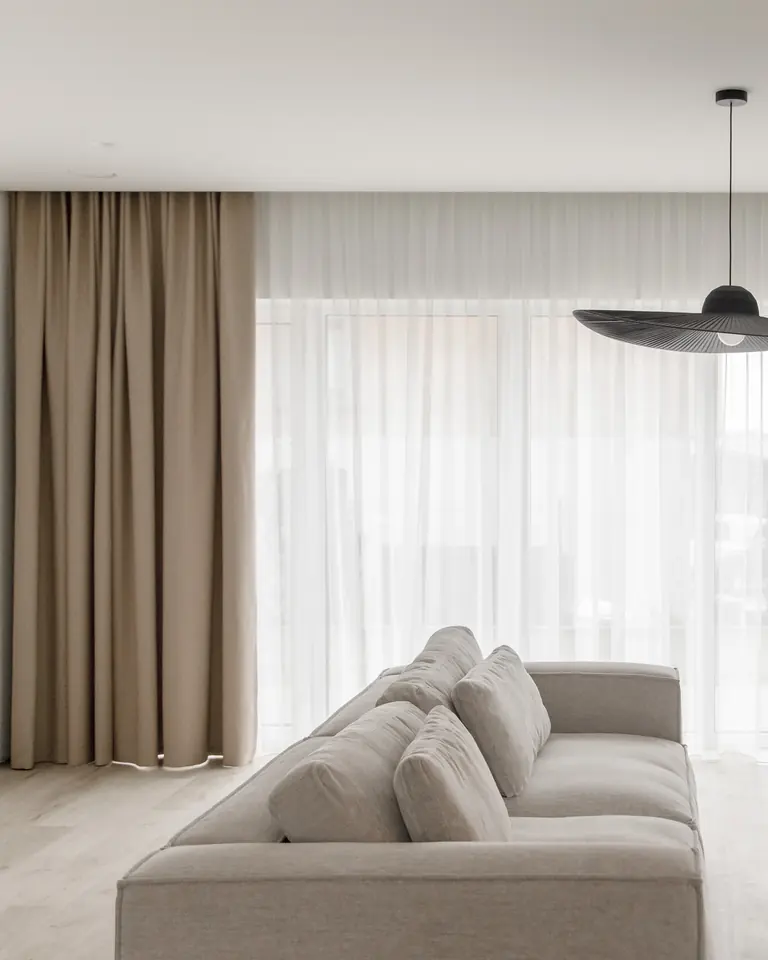
Flat, living room. A white sheer across the whole window wall and sand-coloured curtains from ceiling to floor. 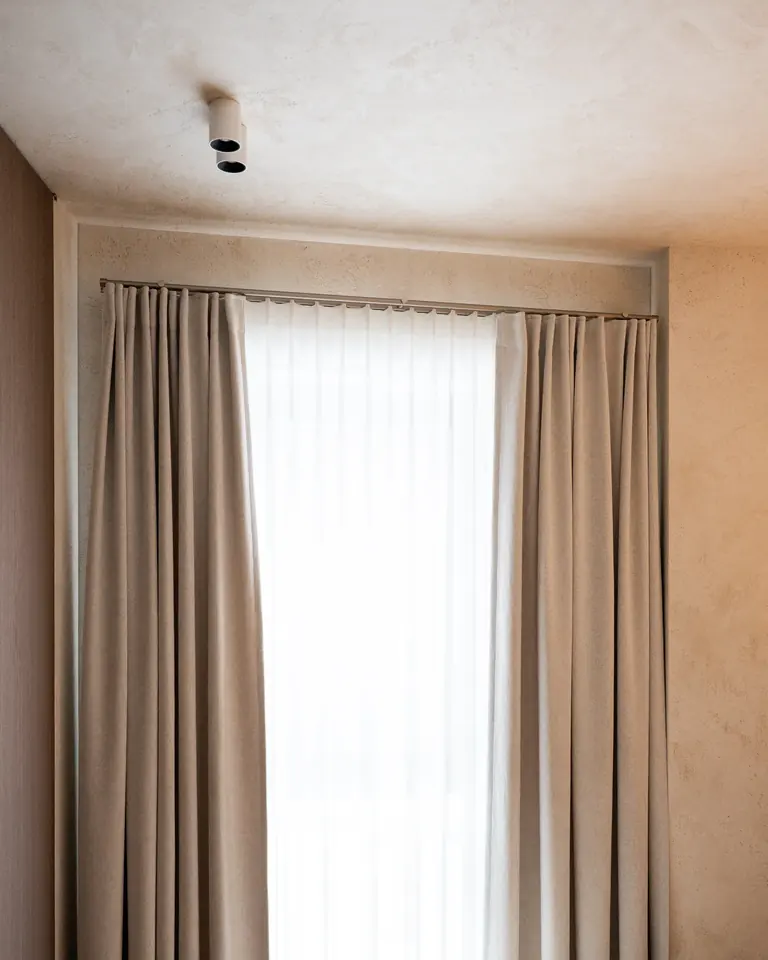
House, window recess. Sand-coloured curtains and a white sheer on a ceiling track. 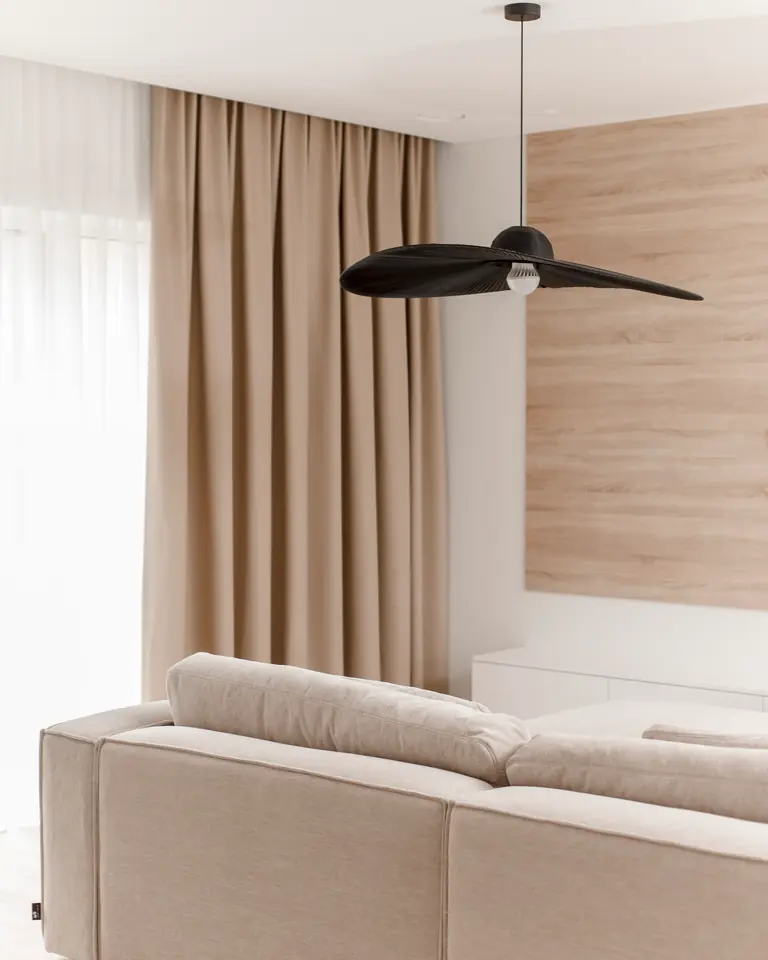
Flat, living room. Sand-coloured curtains and a white sheer from ceiling to floor. 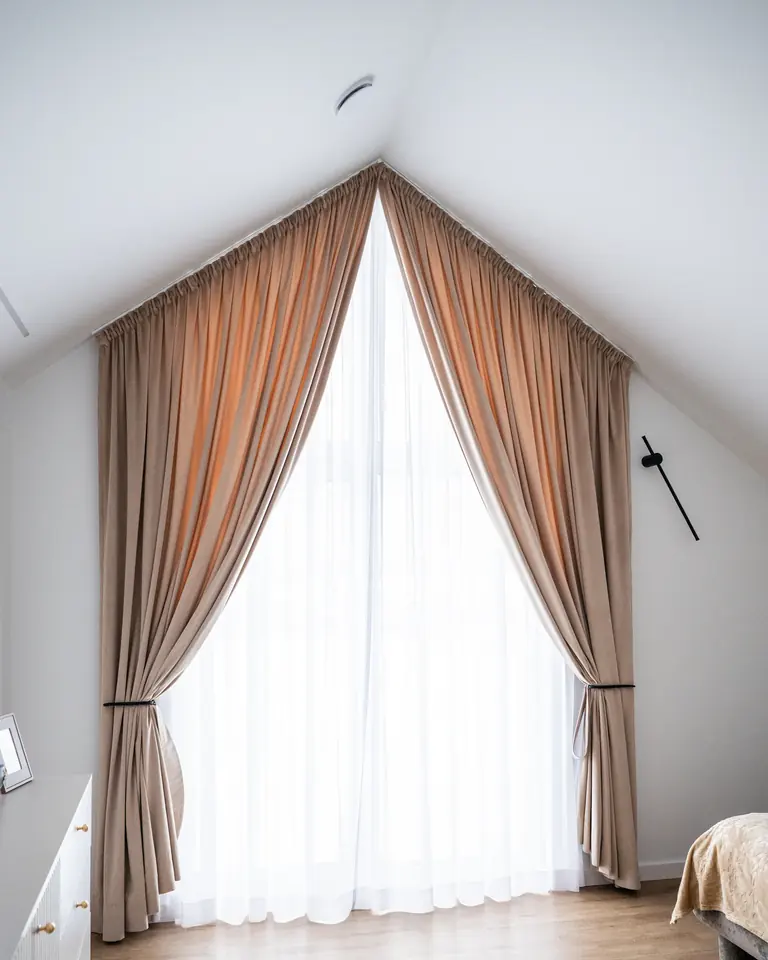
House, bedroom under a pitched roof. Peach curtains with tie-backs and a white sheer. 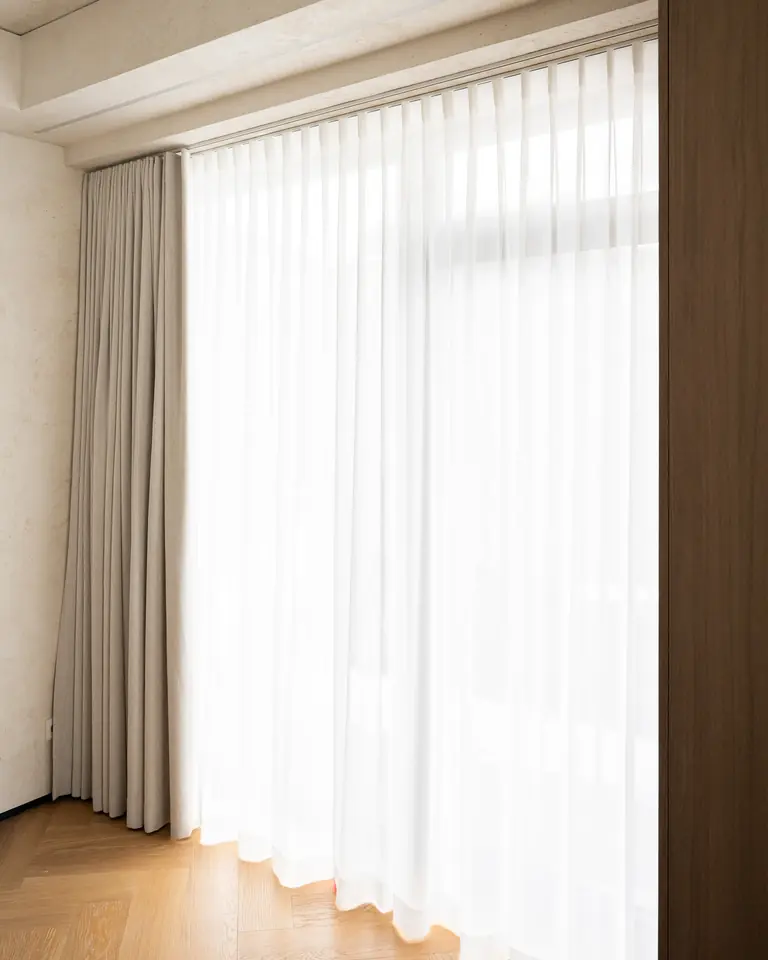
House, room with oak floors. A sheer in wave pleats and a pale curtain in a ceiling recess. 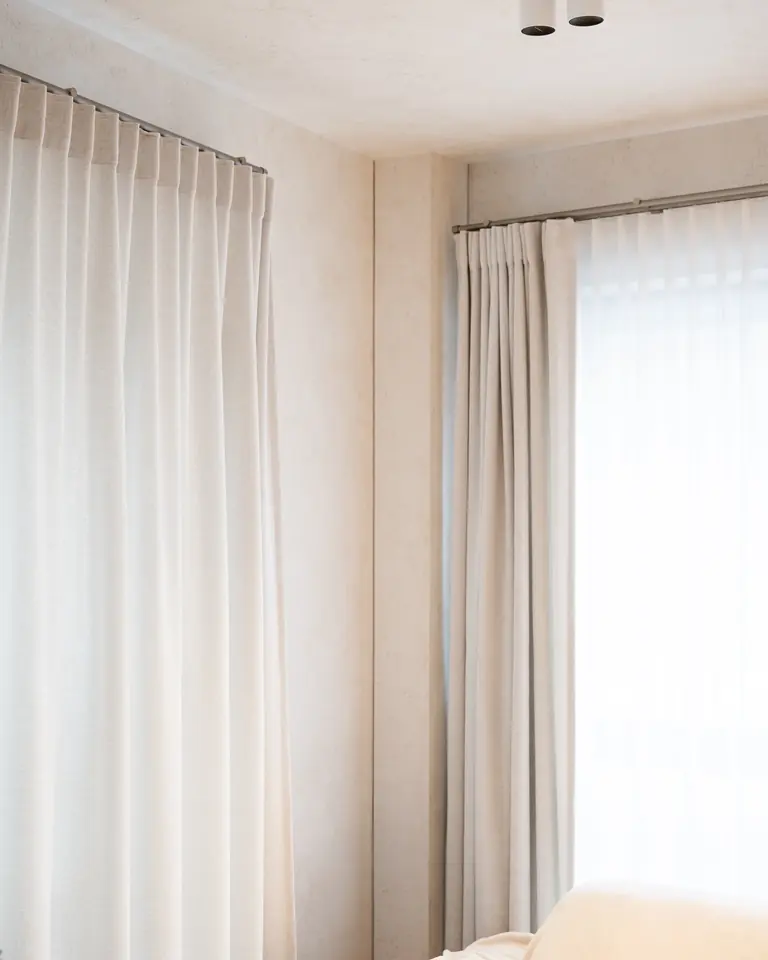
House, corner room. White sheers in wave pleats on ceiling tracks.