Tracks
Curtain tracks for living rooms
Ceiling, wall or electric: which suits your living room? The living room often has the largest windows in the house and the heaviest curtains. The right track must carry the weight, fit the architecture and suit the style. This guide draws on 500+ projects.
Tracks for living rooms from €9 per metre · Measuring is free in Vilnius. In Kaunas and Klaipėda it is free on orders of €200 or more. Elsewhere in Lithuania the visit is paid, and the price is agreed beforehand.
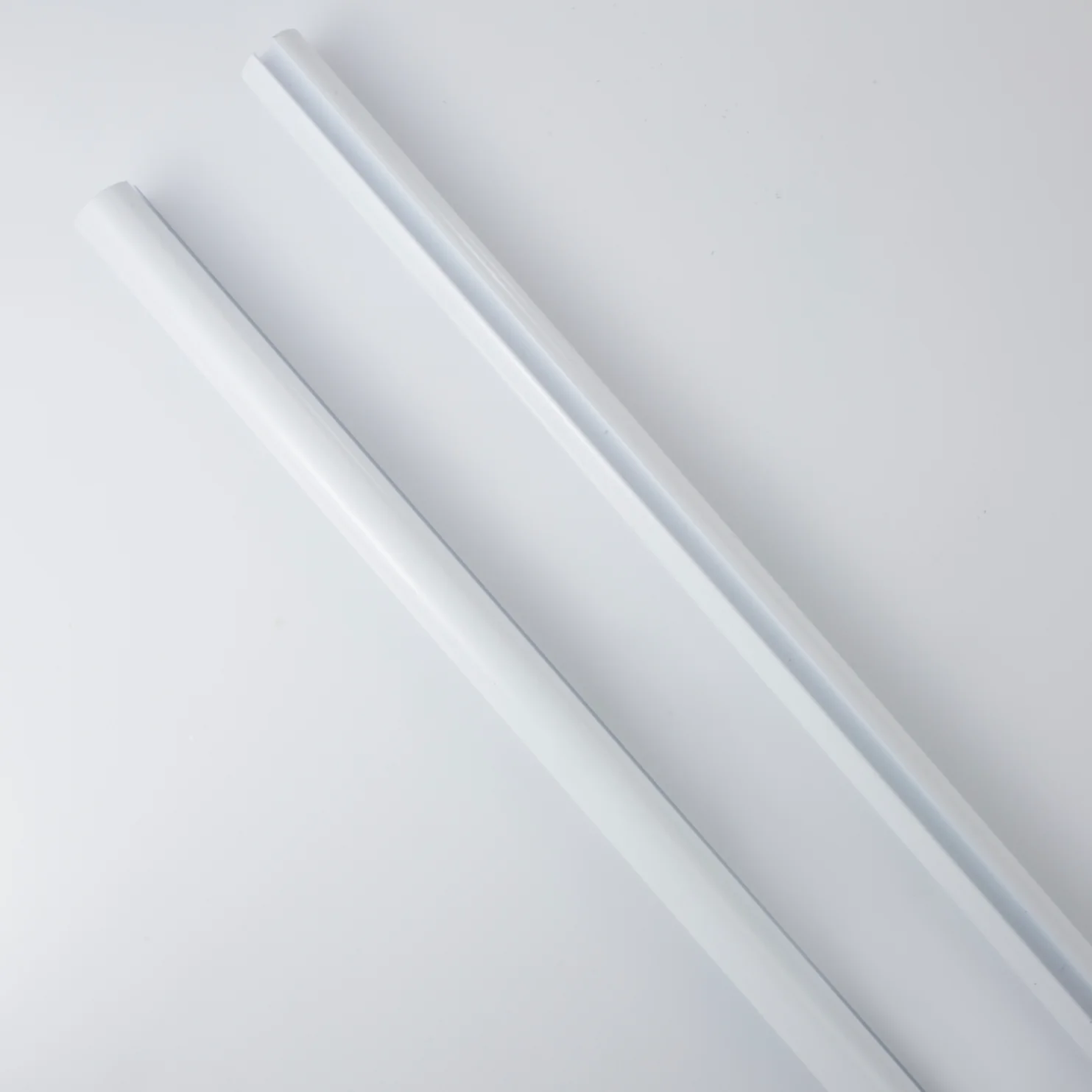
Which tracks suit a living room?
Six conditions decide the choice of track in your living room.
An open-plan living room with a dining area. Where the living room runs into the dining room or the kitchen, a ceiling track keeps the ceiling line unbroken and does not cut the wall into sections. One continuous aluminium ceiling track of 5–8 m gives a clean architectural line.
Panoramic or French windows. For windows 250 cm wide or more, use a ceiling track with three brackets or a sturdy 28 mm pole. For floor-length curtains the track must run at least 15 cm past each side, otherwise part of the glass stays covered by day.
Heavy curtains. Velvet, dim-out and jacquard fabrics are much heavier than sheers, and on a window 3 m wide their weight shows. A ceiling track with enough brackets, or a 25 mm wall pole with a centre bracket, carries it without sagging.
Classic or contemporary style. A classic living room suits wall poles with decorative finials (balls, cones, crystal). Contemporary minimalism suits a hidden ceiling track, which disappears and lets the curtains seem to fall from the ceiling.
A high ceiling (2.8 m or more). A ceiling track works especially well in a tall room: it extends the window up to the ceiling and lets in more light when the curtains are open.
Budget and priorities. For a standard living room: a ceiling track from €9 per metre, a wall pole from €14 per metre, a double track (curtains plus a sheer) from €18 per metre. An electric track with a Brel motor costs €420–610 for a set of up to 3 m, without fitting. Count the measuring and the fitting as well as the track itself.
Want to see all the profiles in one place? The curtain poles and tracks page lists them, and the comparison guide sets the types side by side.
A ceiling track or a wall pole for a living room?
A ceiling track tends to win in open-plan rooms, and a wall pole in classic ones.
Compared on the main points. Height: a ceiling track makes the room look taller, while a wall pole stops at the window. Difficulty of fitting: a ceiling track is moderate and needs a sound ceiling structure; a wall pole is easy and is fixed to the wall above the window. Price: a ceiling track from €9 per metre, a wall pole from €14 per metre (round) or €15 per metre (square). Heavy curtains (5 kg or more): a ceiling track spreads the load along the profile, and a wall pole longer than 2 m needs a centre bracket. Decorative finials: not needed on a ceiling track, since the profile is hidden; a wall pole takes balls, crystal or cones. Style: a ceiling track suits contemporary, minimalist and Scandinavian rooms, and a wall pole classic, art deco and French ones.
Our recommendation for a living room: an open-plan living room with a high ceiling and heavy curtains, an aluminium ceiling track (one profile along the whole wall, for a continuous look). A classic separate living room with a decorative accent and a standard ceiling, a 25 mm wall pole with ball finials. If the window is wider than 3 m and you draw the curtains every day, add electric operation with a Brel or Somfy motor.
Track length and layout by window width
The track is long enough when the open curtains clear the glass.
Recommended lengths by window width: for a window of 120 cm, a track of 160–180 cm (20–30 cm each side; a 19 mm pole is enough); for 180 cm, 220–240 cm (a 19–25 mm pole, or a ceiling track with two brackets); for 240 cm, 280–300 cm (a centre bracket is needed, and a 25–28 mm pole carries 4–5 kg); for 300 cm, 340–360 cm (a ceiling track is recommended, and a double track for heavy curtains); for a panoramic window of 400 cm, 440–460 cm (a ceiling track with three brackets; consider electric operation); for 500 cm or more, 540 cm and longer with joined profiles (a joining piece and a central support are required).
A tip: if the curtains will also cover the track, the open curtains stack right at the edge of the wall, so a reserve of 15–25 cm on each side is a practical need and not a matter of style.
Electric tracks in a living room: when are they worth it?
Electric motors for living rooms: prices, scenes and smart-home integration.
An electric track in a living room pays off when the window is wider than 3 m, the curtains weigh 4 kg or more, or you want to join a smart-home system. Brel Home motors are in the price calculator; Somfy motors are fitted to a project and priced separately. Check beforehand that the motor works with your smart-home system (Google Home, Alexa or another), so that you do not have to change the whole set later.
Where an electric track helps most: windows over 3 m, where drawing by hand strains the fabric; heavy curtains of 4 kg or more, where a motor spreads the load evenly; tall windows over 2.6 m that cannot be reached without a chair; smart-home scenes, such as closing at sunset or a holiday mode; and a double track that moves the curtains and the sheer together.
Price (2026): an electric track with the motor, fitting and programming costs from €170 per metre. The exact price is given after measuring, because it depends on the length and the ceiling construction.
If you want control but the budget is tight, motorise the main window only and leave the smaller ones by hand.
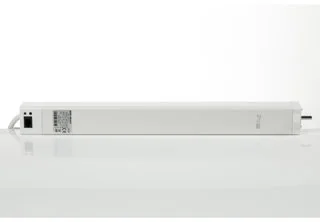
Five common mistakes when choosing a living room track
1. A track that is too short, so the curtains cover the glass. A 200 cm track is bought for a 180 cm window, and once the curtains are open they still cover part of the glass and the room gets less light. The rule: the track should be 30–50 cm wider than the window, 15–25 cm on each side. This mistake matters most in living rooms, where the evenings are short of light.
2. A pole that is too thin for heavy curtains. A 16 mm pole on a 3 m window with velvet curtains bends in the middle. Over 2 m, always use 25–28 mm with a centre bracket, or a ceiling track that spreads the load along its length.
3. A wall pole in an open-plan living room. When the living room runs into the dining room, a wall pole with finials breaks the ceiling line and makes the room look divided. Use a hidden ceiling track from wall to wall instead.
4. Finials chosen by fashion and not by style. Classic ball finials on a contemporary pole look out of place. A contemporary living room suits cone, cylinder or square finials in a matt finish (anodised, matt black). A classic one suits ball, crystal or twisted designs in gold or bronze.
5. A pole fixed into plasterboard without anchors. A wall pole must be fixed into concrete, masonry or at least a timber frame behind the plasterboard. A screw in plasterboard without proper anchors is pulled out by the weight of the curtains in time, taking a piece of the board with it. The wall structure is checked at measuring.
Living rooms in Vilnius, Kaunas and Klaipėda
How the type of building and the place change the choice of a living room track.
Vilnius. In older houses with a classic interior, wall poles with classic finials suit. In open-plan flats with high ceilings a ceiling track is more practical. Aluminium ceiling tracks suit new flats.
Kaunas. Classic wall poles of 25 mm with ball finials suit the historic architecture. In newer flats with higher ceilings, ceiling tracks are more convenient. For large or hard-to-reach windows, consider electric operation.
Klaipėda. By the sea the finish has to withstand salty air, so stainless steel or anodised aluminium is chosen, and plain steel poles are avoided. New flats by the sea often have panoramic windows, which suit ceiling tracks, and electric operation pays off more often there than inland.
Child safety and further reading
If young children use the living room, fix the control cord or chain to the wall higher than a child can reach, or choose electric operation with no cords. A guide to choosing a track, step by step for each type of window, is in the guides.
Questions
Which track suits a living room?
Either an aluminium ceiling track, from €9 per metre, or a wall pole of 19–28 mm with decorative finials, from €14 per metre. A ceiling track wins in open-plan living rooms and under ceilings higher than 2.8 m, because it runs in one line from edge to edge. A wall pole looks better in a classic separate living room, where round or crystal finials become part of the style. In a new flat the ceiling track is often easier to fit, because the ceilings are level and solid.
Should the track go into the ceiling or onto the wall?
It depends on three things: the ceiling height, the weight of the curtains and the style of the interior. With a ceiling of 2.8 m or more, a ceiling track makes the room look taller and lets the curtains fall from the ceiling. With a lower ceiling, or where you want a decorative accent, choose a wall pole with finials (ball, cone or crystal), from €14 per metre (round) or €15 per metre (square). For an open-plan living room with no break in the line, choose a ceiling track; for a classic separate living room, a wall pole. At the measuring visit the designer checks the ceiling construction and advises on the spot.
How much does a track for a large living room cost?
For a window 3–4 m wide, the price calculator gives: a 4 m aluminium ceiling track with five brackets and fitting, €161; a 4 m round wall pole with brackets, end caps and fitting, €185. Fitting is charged per metre (€15 per metre for a 4 m ceiling track, €13 per metre for a wall pole). An electric track costs from €170 per metre, fitted and programmed.
Which finials suit a contemporary living room?
Minimal ones: cone, cylinder, flat disc or square, in a restrained finish such as matt black or silver. Shiny gold or bronze with carved detail belongs to classic interiors. Our wall poles come in five finishes: silver, black, bronze, brown and gold. A Scandinavian living room suits silver or brown, and an industrial one matt black. A round wall pole costs from €14 per metre, a square one from €15 per metre, and an end cap €6.
Is an electric track worth it in a living room?
Yes in three cases: the window is wider than 3 m (drawing the curtain by hand pulls the fabric out of line), the curtains are heavy (4 kg or more, in velvet, dim-out or jacquard), or you have smart-home scenes. An electric track costs from €170 per metre. For a standard window of 1.8 m a hand-drawn track is usually enough: a ceiling track with fitting costs €71, an electric one €490.
How many metres of track does a 4 m window need?
440–460 cm, which is 20–30 cm past each side, so that the open curtains clear the glass and do not cover the frame. For a window this size an aluminium ceiling track is the most reliable (the price calculator allows six brackets for a 4.6 m track), or a joined track across the whole wall. A long wall pole without centre brackets gradually bends under heavy curtains. If the curtains are opened every day, consider an electric track (from €170 per metre).
Ideas for your home
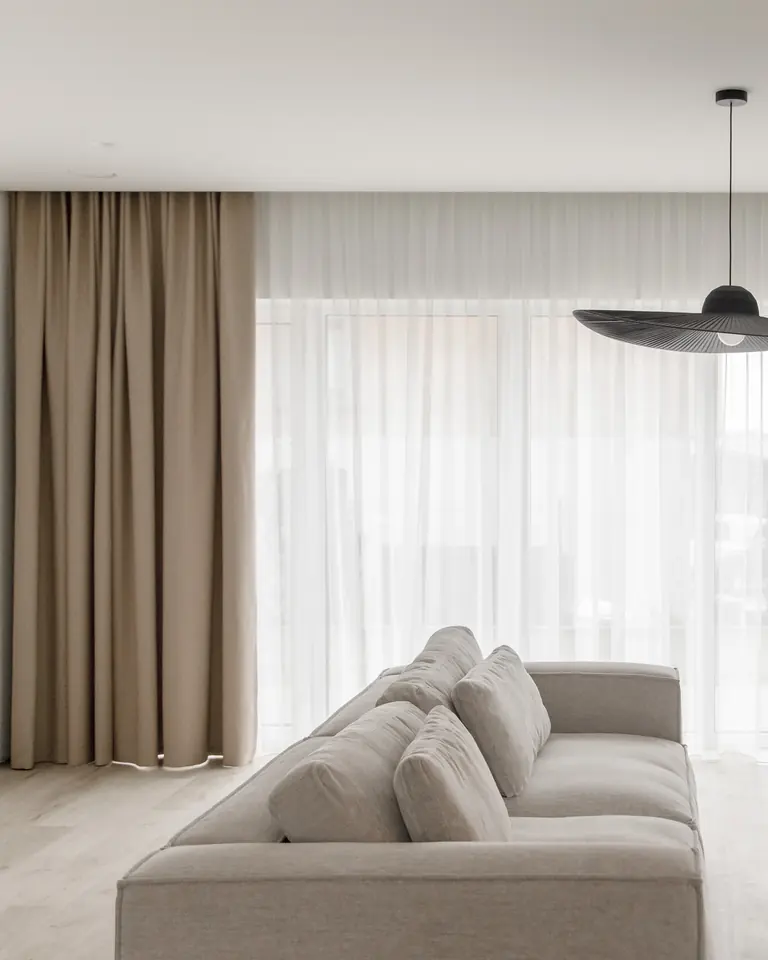
Flat, living room. A white sheer across the whole window wall and sand-coloured curtains from ceiling to floor. 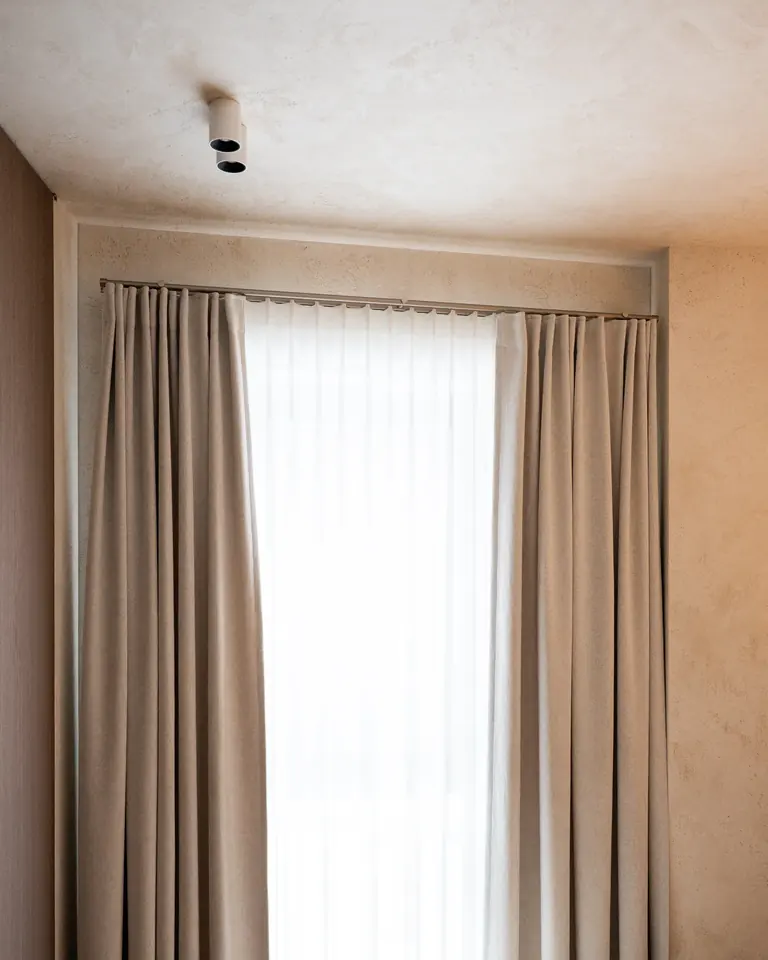
House, window recess. Sand-coloured curtains and a white sheer on a ceiling track. 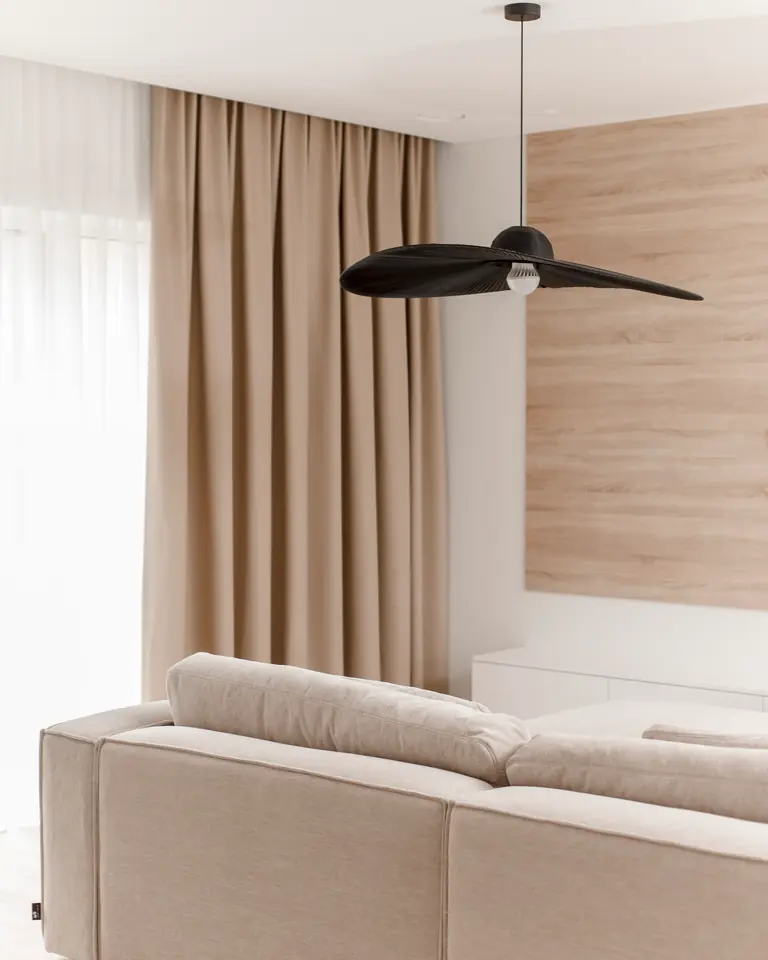
Flat, living room. Sand-coloured curtains and a white sheer from ceiling to floor. 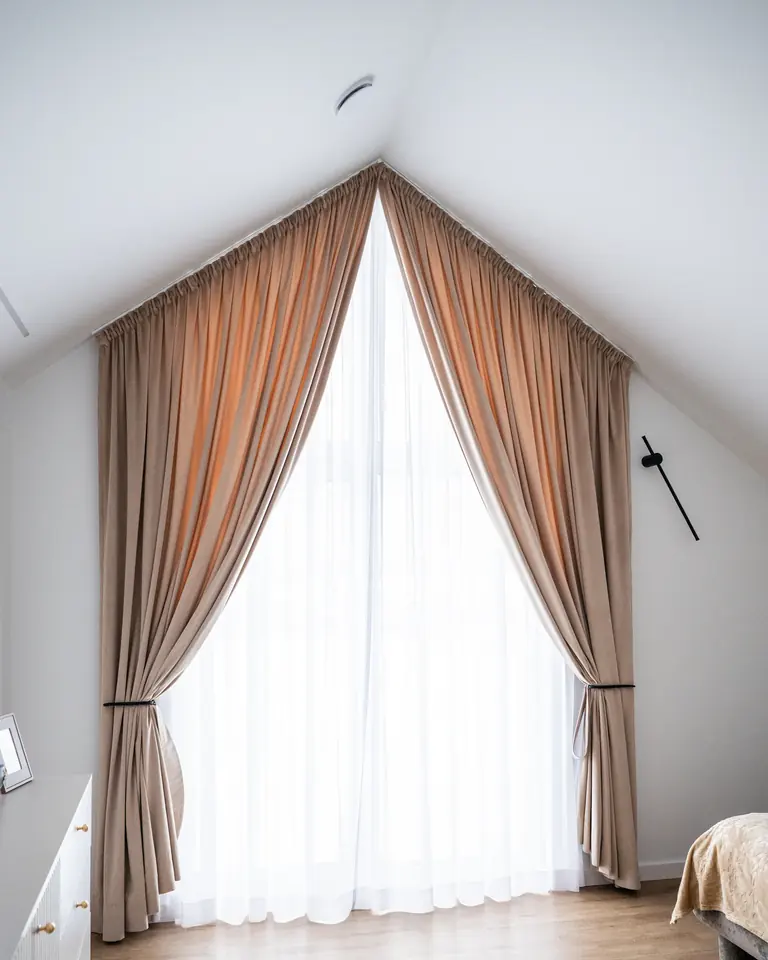
House, bedroom under a pitched roof. Peach curtains with tie-backs and a white sheer. 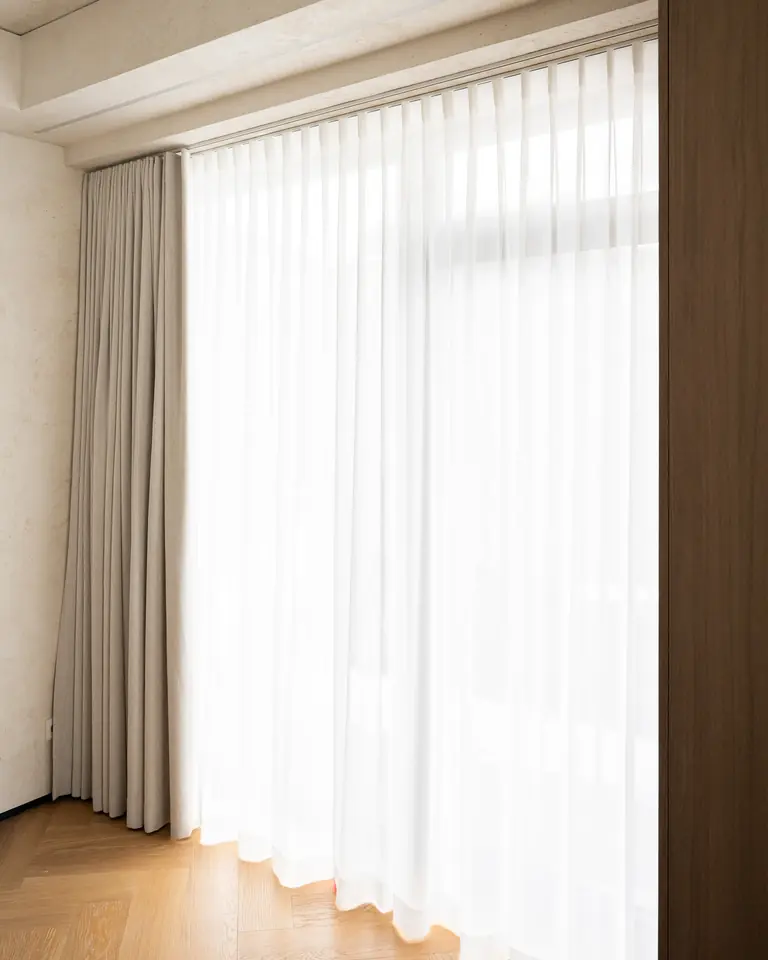
House, room with oak floors. A sheer in wave pleats and a pale curtain in a ceiling recess. 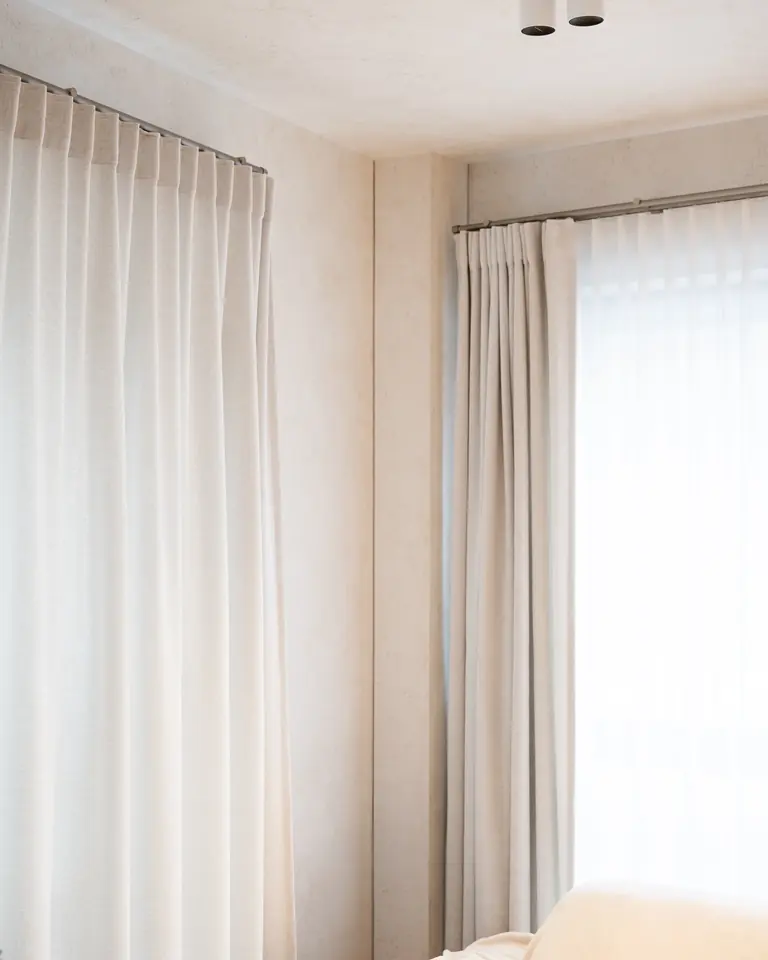
House, corner room. White sheers in wave pleats on ceiling tracks.