Author: Jegor Janockin
Reviewed by: Curtain.lt editorial team
Last updated:
Curtain track types compared: ceiling, recessed, wall-fixed and electric
- Ceiling track (from €9 per metre): fixed to the ceiling, for a modern interior and a wave heading.
- Recessed track in a ceiling recess: when the track must not be seen. The recess is built during the renovation.
- Wall-fixed pole (from €14 per metre): for a classic interior and eyelet curtains.
- Electric track (from €170 per metre, fitted): for large, tall or hard-to-reach windows.

Ceiling tracks (€9–10 per metre) and wall-fixed poles (€14 per metre) differ in more than where they are fixed: they look different, take different curtain headings and cost different amounts. The type decides whether a wave heading runs smoothly and whether a blackout curtain closes without light leaking round it. This guide compares the main types by room, style and budget.
A pole or track is part of the room's design as well as a fixing, and it stays in place for years. The wrong type can spoil the dearest curtains or make the ceiling look lower.
- Ceiling tracks → single, double and hidden in a recess
- Electric curtain tracks → motors and prices by length
- Recessed curtain tracks → what to decide during the renovation
Types of pole and track: ceiling, wall-fixed, recessed and motorised
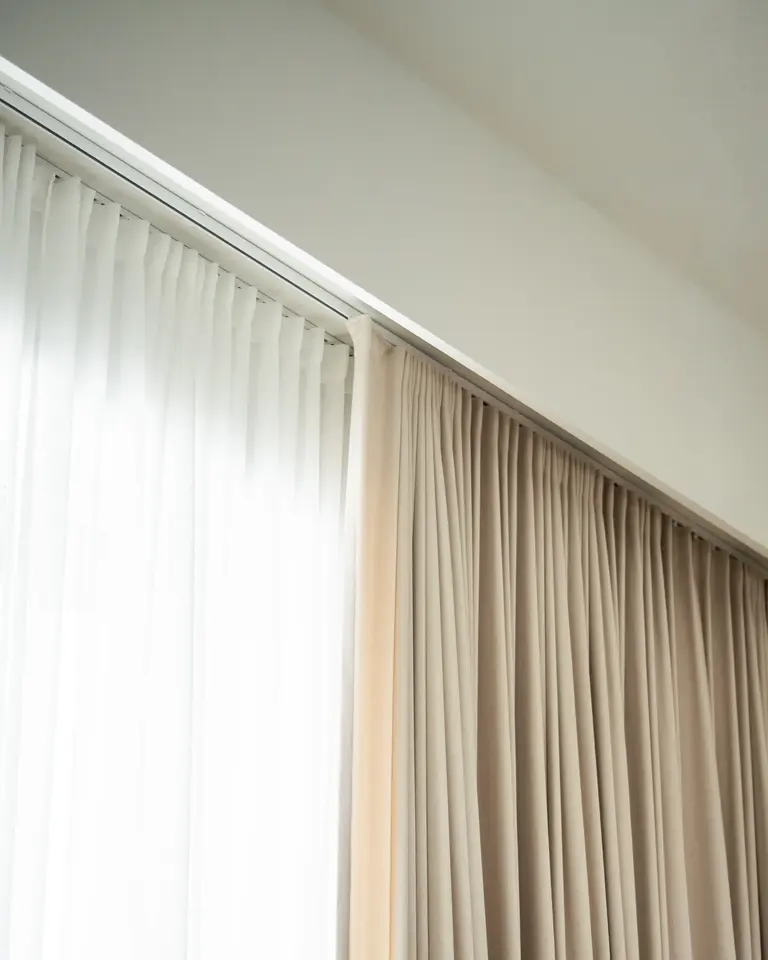
A ceiling track is fixed straight to the ceiling, or as close to it as possible, which makes a continuous horizontal line and makes the room look taller. It is essential when the ceiling is higher than 280 cm or the window reaches right up to the ceiling. It is the only type that works with a wave heading, which needs special gliders that can move only in the channel of a track, not on a standard tube.
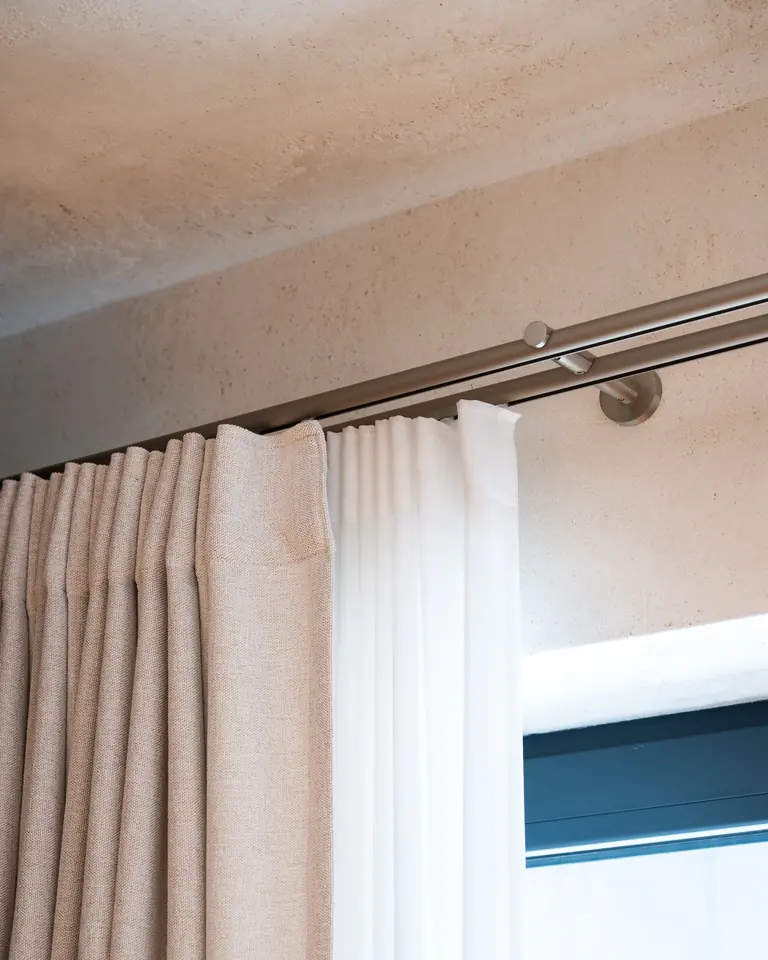
A wall-fixed pole is fixed to the wall above the window, with decorative finials on show, and suits traditional and classic interiors. A wall-fixed tube costs about €14 per metre. A wooden pole is chosen for a traditional look, warmth and durability.
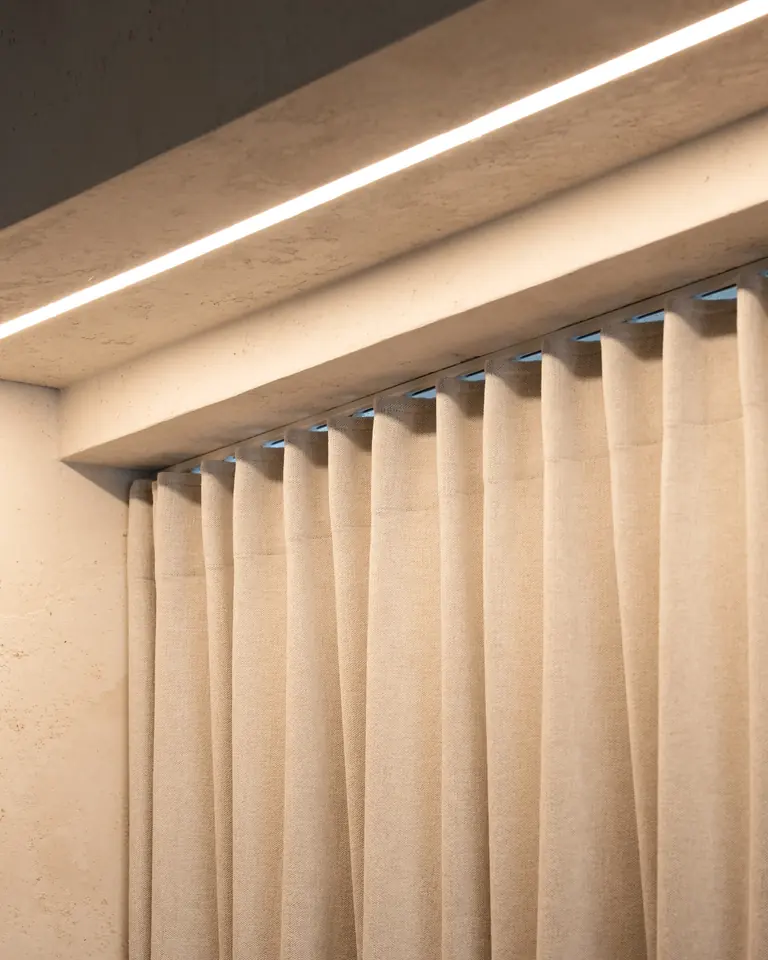
A recessed track is a track in a ceiling recess that is built during construction or renovation. When the curtains are closed the track cannot be seen at all. It is popular in minimalist Scandinavian and Japanese interiors.
A motorised (electric) track is worked by remote, app or voice command and can be part of a smart-home system. It earns its place on large windows, where heavy curtains are awkward to draw by hand. It costs from €170 per metre, fitted and programmed, and needs a 230 V cable or a battery motor.
Choosing by situation: modern or classic, heavy or light, blackout or sheer
| Situation | Recommended type | Why |
|---|---|---|
| Modern or minimalist interior | A ceiling track or a hidden recess | Clean lines, an invisible mechanism |
| Classic or traditional interior | A wall-fixed pole with decorative finials | Decorative value, a wooden pole |
| Heavy blackout curtains | A ceiling track with side returns | It closes the gap and stops light leaking |
| Light sheer or voile curtains | A light wall-fixed tube or a ceiling track | The brackets are strong enough |
| Wave heading | Only a ceiling track with gliders | A technical requirement: it cannot go on a tube |
| Eyelet heading | Only an open tube (up to 35 mm in diameter) | The rings must slide freely |
| Pleated heading | A ceiling track or a wall-fixed tube | Versatile: suits both types |
| Double pole (sheer + lined) | A double ceiling track or a double tube | Two-layer draping |
A dark fabric alone is not enough for blackout
A wall-fixed pole leaves a gap between the pole and the wall, and light gets through it even with the densest fabric. The only answer is a ceiling track with side returns, which close the gap. Heavy blackout curtains need reinforced brackets at least every 60–80 cm, so that the track does not sag in the middle.
How each type looks
A hidden recess gives the cleanest look: the track cannot be seen at all, and the curtain seems to rise straight out of the ceiling. A ceiling track makes a clean, modern line and suits most modern interiors. A wall-fixed pole with decorative finials depends on the quality of the details: good wooden or metal finials make a strong accent, while cheap plastic ones look cheap at once.
- A wave heading (needs a ceiling track with gliders): even, rhythmic waves. At 2.0× fullness a 300 cm track needs 600 cm of fabric.
- A pleated heading (suits both types): a classic, structured look. At 2.5× fullness a 300 cm track needs 750 cm of fabric.
- An eyelet heading (only on an open tube): geometric folds, modern, but not always right for a classic interior.
- A pocket (slot-top) heading: the simplest and cheapest-looking, it hides the pole, but it limits how the curtain moves.
In practice: fitting, durability and care
Fit the pole or track 10–15 cm above the window frame or 5–15 cm below the ceiling. When the ceiling is higher than 280 cm, the pole is usually fixed to the ceiling. The pole should extend 20–30 cm beyond the window on each side, so that curtains drawn back clear the window completely.
A recessed track is the hardest to fit: the recess has to be built in advance during the renovation, but it is the most durable. A ceiling track is of medium difficulty. Aluminium profiles are light, durable and easy to clean, and the gliders can be changed separately. A wall-fixed pole is the easiest to fit yourself. A motorised track is a job for a professional and needs an electrical supply.
Plasterboard: special plugs are essential
Fixing into plasterboard needs special spiral or expanding cavity fixings. Ordinary plastic plugs do not hold the load in plasterboard and can pull out. If you can, fix straight into the metal frame behind the board.
- 1A pole fitted right above the window frame → the room looks low. The answer: fit it 10–15 cm above the window frame or 5–15 cm below the ceiling.
- 2A pole too narrow (the same as the width of the window) → curtains drawn back cover the edges of the window. The answer: the pole should be 20–30 cm wider on each side.
- 3A wave heading hung on a wall-fixed tube → the mechanism sticks. The answer: use only a ceiling track with gliders.
- 4No special plugs for plasterboard → the pole pulls out. The answer: spiral or expanding cavity fixings.
- 5Curtains too short → they give an impression of cheapness. The answer: curtains should reach the floor or only just touch it.

Price ranges by type
The table gives the prices per metre from our price list. They are the same ones the track price calculator uses. Fitting is calculated separately by the type and length of the track.
| Type of pole or track | Price | How hard to fit | Extras |
|---|---|---|---|
| Ceiling track, white | €9/m | Medium | Gliders, brackets |
| Ceiling track, black | €10/m | Medium | Gliders, brackets |
| Double ceiling track | two tracks at €9/m each | Medium | Double gliders |
| Recessed track in a recess | track from €9/m | High (needs a recess) | A plasterboard recess built during the renovation |
| Wall-fixed pole, round tube | €14/m | Low | Brackets, end caps |
| Wall-fixed pole, square tube | €15/m | Low | Brackets, end caps |
| Electric track | from €170/m, fitted | A professional's job | A 230 V cable or a battery |
A wall-pole bracket is €13 and an end cap €6. Prices are final.
Making is €8 per metre for sheers and €13 per metre for lined curtains, and hanging €4 per metre. Sheer fabrics cost, per metre: voile €9.50, net sheer €12, Lietutis €13, Ramune €16, Nobel €16.50. Lined and blackout fabrics cost €11–43 per metre.
Recommendations by room
- Living room: for a modern interior, a ceiling track with a wave heading or a hidden recess. For a classic one, a wooden pole with decorative finials. A double pole lets you combine sheers and lined curtains.
- Bedroom: a ceiling track with side returns closes the gap between the track and the wall. A wall-fixed pole in a bedroom can leave gaps of light.
- Child's room: a ceiling track without cords, or an electric track, both safer than corded mechanisms. With an electric track, keep the remote out of the child's reach and hide the power cable.
- Kitchen and bathroom: a short wall-fixed pole in stainless steel or aluminium. Wooden poles are best avoided in damp rooms.
- Study or office: a ceiling track with light sheer curtains. A motorised track is handy here.
- 1Decide the type of pole or track by the height of the ceiling, the style of the room and the heading of the curtains.
- 2Measure the window: the pole should be 20–30 cm wider than the window on each side.
- 3Choose the heading (wave, pleated or eyelet): it decides the type of pole or track.
- 4Check the wall and ceiling material: plasterboard needs special plugs.
- 5Buy the pole or track with all its parts: brackets, gliders, end caps.
- 6Fit it: mark the positions, drill the holes, insert the plugs, fix the brackets.
- 7Hang the curtains: check that they move freely and that the draping is even.
In short
A hidden recess gives the cleanest look, a ceiling track suits the most interiors, a wall-fixed pole is the easiest to fit and a motorised track is the easiest to use. Two rules have no exceptions: a wave heading needs a ceiling track with gliders, and blackout needs a ceiling track with side returns.
Frequently asked questions
How do you choose a curtain track or pole mechanism?
The type of heading decides it first: wave curtains need a ceiling track with gliders, eyelet curtains an open tube, and a pleated heading suits both. The style of the interior matters too: ceiling tracks suit a modern one better, and wall-fixed poles a classic one. Then the height of the ceiling: if it is higher than 280 cm or the window reaches right up to the ceiling, choose a ceiling track.
How do you measure the length of a pole or track correctly?
The pole should be 20–30 cm wider than the window on each side, so that curtains drawn back clear the window completely. That means adding 40–60 cm in all to the width of the window, so that open curtains do not block the daylight.
How do you fix a curtain pole into plasterboard?
With spiral or expanding cavity fixings. Ordinary plugs do not hold the load in plasterboard and can pull out. Where you can, fix straight into the metal frame behind the plasterboard.
How much do poles, tracks and mechanisms cost?
A ceiling track costs €9–10 per metre, a wall-fixed tube about €14 per metre, and an electric track from €170 per metre, fitted and programmed. The final price depends on the length, the material and extras. Wooden poles can cost more than metal ones.
Can wave curtains be hung on a wall-fixed pole?
No. Wave curtains cannot be hung on a wall-fixed pole. This heading needs a ceiling track with special gliders that give an even wave effect. With an unsuitable pole the curtains will not fall in regular waves, and the mechanism can be damaged.
What is the difference between a ceiling track and a wall-fixed pole?
A ceiling track is fixed to the ceiling and makes the room look taller, and a wall-fixed pole is fixed to the wall and is easier to fit. Ceiling tracks suit a modern interior and high ceilings better, and wall-fixed poles a classic style. A wall-fixed tube costs about €14 per metre, and a ceiling track €9–10 per metre.
Which pole or track suits blackout curtains?
For a blackout effect you need a ceiling track with side returns, which closes the gap between the track and the wall: a dark fabric alone is not enough. A standard wall-fixed pole leaves gaps of light at the sides and the top.
Which type of pole or track suits high ceilings?
A ceiling track, for ceilings over 280 cm or where the top of the window reaches the ceiling. It makes the room look taller still and gives one continuous line, where a wall-fixed pole would make the space look cut off.
Which poles suit a classic interior?
Wall-fixed poles suit a classic interior best, wooden ones especially. Wooden poles give warmth and a traditional look, and go well with pleated curtains. Wall-fixed poles are also easier to fit and come in many designs.
Which track suits motorised curtains?
An electric track made for a motor, which opens and closes the curtains by remote or phone. It needs a 230 V cable or a battery motor and is harder to fit than an ordinary track, so have a professional fit it.
When do you need a recess for curtains?
A recess is needed when you want to hide the track mechanism completely and get a clean, minimalist look. A recess also gives a better blackout effect, because it closes the gap at the top. In a modern interior a ceiling track set in a recess is a common way to hang curtains.
Which types of pole and track suit a modern interior?
Ceiling tracks and hidden recesses suit a modern interior best: they make a clean, minimalist line. Metal tracks in black or white go well with contemporary interiors.
How much do sheer and lined curtains cost?
Sheer fabrics cost, per metre: voile €9.50, net sheer €12, Lietutis €13, Ramune €16, Nobel €16.50. Lined and blackout fabrics cost €11–43 per metre. A dark fabric alone does not black out a room: it also needs a track with side returns.
How much do making and fitting cost?
Making is €8 per metre for sheers and €13 per metre for lined curtains, and hanging €4 per metre. The fitting price depends on the type of pole or track: ceiling tracks usually take more work than wall-fixed poles.
What are the advantages and drawbacks of a motorised track?
Advantages: easy control by remote or app, suits large windows, and can be built into a smart-home system. Drawbacks: a higher price (from €170 per metre, fitted), the need for an electrical supply and a professional's work, and mechanical parts that may need servicing. It pays off most on large windows and panoramic glass walls.
What are the weight limits for poles and tracks?
Heavy blackout curtains need reinforced brackets at least every 60–80 cm, so that the track does not sag in the middle. Light sheer and voile curtains need only a standard ceiling track or a wall-fixed tube. Fixing into plasterboard needs special plugs or a fixing into the metal frame.
See the pole and track collection
Ceiling tracks, wall-fixed poles and electric mechanisms: the whole collection, with prices.
See poles and tracksHow do you fit a pole or track correctly?
Detailed instructions with 8 steps, a table of fixings and a list of the commonest mistakes.
Read the fitting guideCompare the fitting price before you order
Once it is clear which type of pole or track suits the interior, the next step is to check the budget for fitting and the parts.
See the fitting costThe next step
If this guide has answered your questions, move on to a specific product or check your budget.