Author: Jegor Janockin
Reviewed by: Curtain.lt editorial team
Last updated:
Recessed curtain tracks: how to plan one during a renovation
- A recessed curtain track is a ceiling track set in a recess in a plasterboard ceiling: the curtain falls straight from the ceiling and the track is not seen.
- The recess is planned before the ceiling is closed: 10 cm deep for one track, 15–20 cm for two, 20–25 cm for a wave heading, and 12–15 cm high.
- The track is fixed 5 cm from the wall into a reinforced spot, with fixing points every 60–80 cm.
- For an electric track, bring the cable into the recess 10–15 cm from its end, and in a closed ceiling leave a 30 cm × 30 cm hatch for the motor.
Price from €9/m, as of October 2026
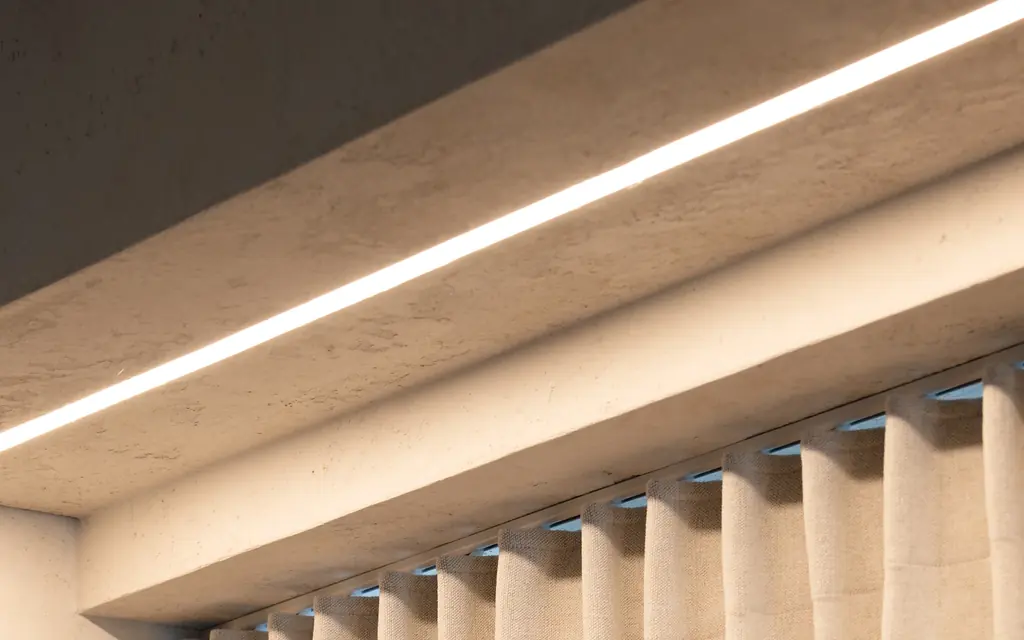
A recessed track is settled during the renovation, not when the curtains are chosen. Once the ceiling is closed, the depth of the recess, the reinforcement or the cable for an electric track cannot be changed without opening it up. This guide covers how big the recess should be, how to lay out the tracks in it, where the LED strip goes and what to pass to the plasterboard fitters in writing.
What is a recessed curtain track?
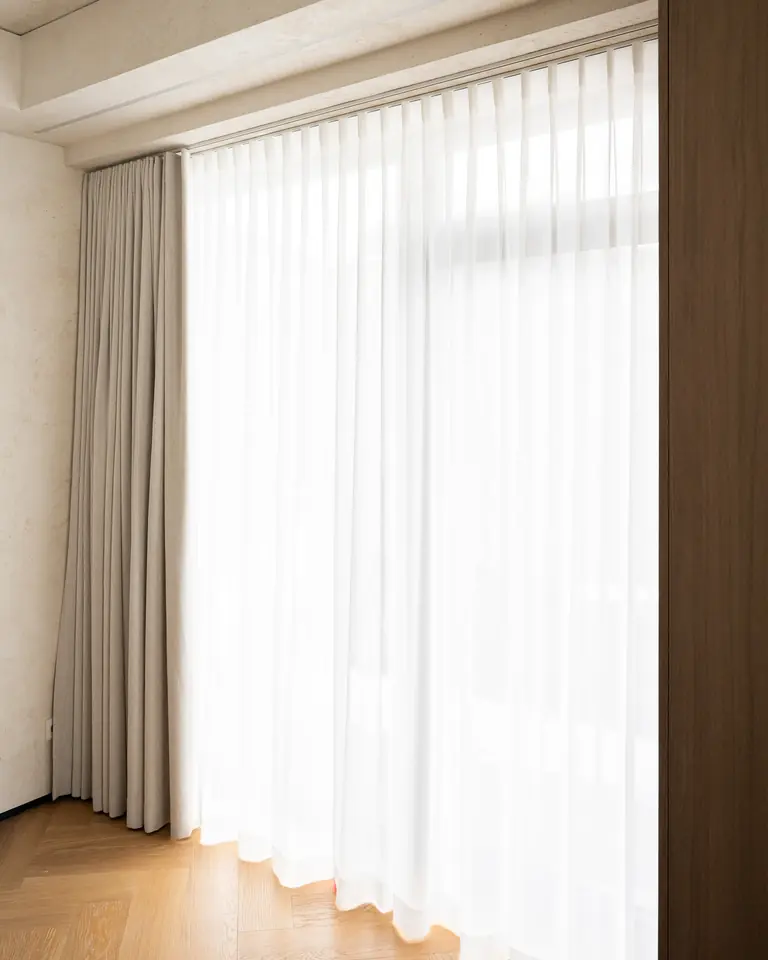
It is an ordinary aluminium ceiling track, fitted not on the surface of the ceiling but in a recess: a strip left in the plasterboard ceiling by the window wall. The track is fixed at the top of the recess, the curtain hangs inside it, and from the room you see only the fabric rising out of the ceiling.
The difference from a ceiling track fitted on the ceiling is in the finish, not in the mechanism: the track, the gliders and the heading of the curtain are the same, only hidden. So the same choices apply to a recessed track: one or two tracks, a wave heading, an electric motor.
When does a recessed track make sense?
- When plasterboard or stretch ceilings are being fitted and the recess can still be planned.
- When the curtains should fall straight from the ceiling and the track should not be seen even from close by.
- When two layers are hung, a sheer and a lined curtain, and each needs its own track 5 cm apart.
- When you want indirect lighting: an LED strip in the recess lights the curtain from above.
- When an electric track is planned: the motor and the cable hide in the recess.
If the renovation is finished and the ceilings are concrete, a recess can no longer be made, and the option left is a ceiling track on the surface of the ceiling. That is also nearly invisible, only without the shadow line.
How deep and how high should the recess be?
The depth of the recess depends on how many tracks go in it and on the heading of the curtain. One track needs 10 cm, two tracks 15–20 cm, and a wave heading 20–25 cm, because the waves project on both sides of the track. The height of the recess, from the surface of the ceiling to its top, is 12–15 cm: that is what it takes for the track and the gliders not to be seen from the room.
On the ceiling
In a ceiling recess
| Set-up | Recess depth | Recess height |
|---|---|---|
| One track | 10 cm | 12–15 cm |
| Two tracks: sheer and lined curtain | 15–20 cm | 12–15 cm |
| Wave heading | 20–25 cm | 12–15 cm |
Choose the depth with room to spare
If you do not yet know whether you will hang one layer or two, make the recess for two tracks or for a wave heading. A recess that is too deep still covers the track, while in one that is too shallow a wave heading goes flat and rubs on the edge.
How do you lay out the tracks in the recess?
The tracks are laid out by the 5 cm rule: 5 cm from the wall to the first track, 5 cm between the tracks and 5 cm from the last track to the edge of the recess. The sheer hangs nearest the wall and the window, and the lined or blackout curtain nearer the room: by day the lined curtain is drawn back while the sheer stays closed, and in the evening the lined curtain closes in front of it. That way the curtains do not rub on each other or on the edge of the plasterboard.
The recess is at least as long as the track: the track extends 20–30 cm beyond the window opening on each side, so that a curtain drawn back does not cover the glass. The recess is often made the whole length of the wall, from corner to corner, and then the curtains can be drawn right back to the wall.
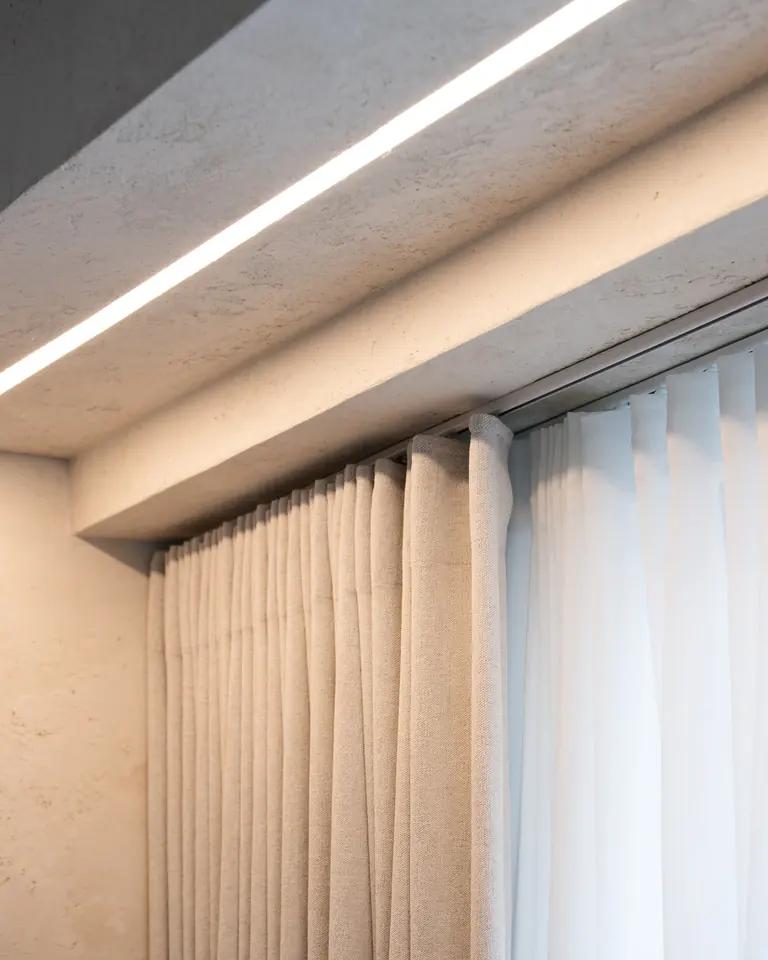
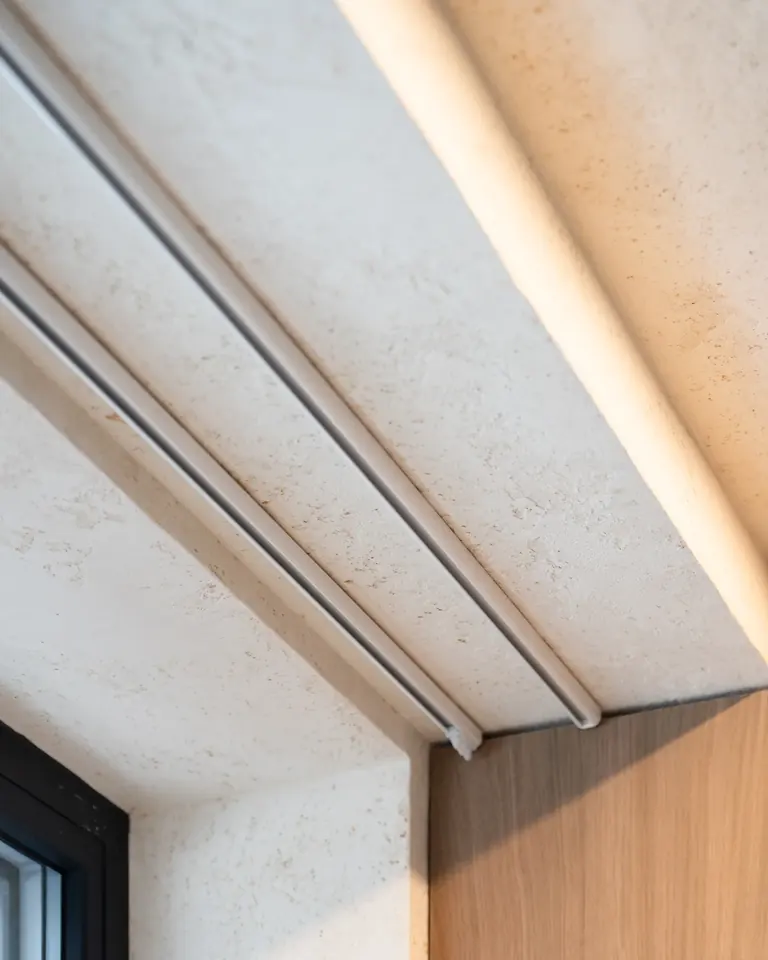
An LED strip in the recess: what to watch for
An LED strip in the recess lights the curtain from above, and in the evening the fabric becomes a source of light. The place for the strip is planned together with the recess: most often it is set into the plane of the ceiling by the edge of the recess, or inside the recess on the room side, so that the light falls on the fabric and not in the eyes.
- The LED strip must not get in the way of the track and the gliders: leave it a separate place in the width of the recess.
- Plan access to the power supply unit: it must be reachable without opening the ceiling.
- Choose the colour of the light to suit the fabric: warm light goes with linen and sand shades.
- If there is to be an electric track, plan the LED and the motor cables together.
How do you prepare the recess for an electric track?
The motor of an electric track sits at the end of the track, so a 230 V cable has to be brought into the recess 10–15 cm from its end, on the side where the motor will go. In a closed suspended ceiling, leave a 30 cm × 30 cm access hatch beneath the motor, so that it can be reached without opening the ceiling.
If a cable can no longer be run, a battery motor charged with the maker's charger is left, and then there has to be room in the recess to reach it. An electric track, fitted and programmed, costs from €170 per metre, and the motors carry a 24-month warranty.
- Electric curtain tracks → motors, control and prices by length
- Motorised curtains in a smart home → the hub, scenes and cables
What should you tell the plasterboard fitters?
The reason for most remakes is simple: the fitters did not know which tracks you would hang. Before the ceiling is closed, give them these figures in writing, and ask them to show you the reinforcement before the plastering.
- 1Recess depth and height: by the set-up, 10 cm, 15–20 cm or 20–25 cm deep and 12–15 cm high.
- 2Recess length: the window opening plus 20–30 cm on each side, or the whole wall from corner to corner.
- 3Reinforcement: a timber or metal-profile strip at the top of the recess, with fixing points every 60–80 cm.
- 4The edge of the recess: straight and horizontal along its whole length, checked with a laser level.
- 5Electrics: a 230 V outlet in the recess 10–15 cm from the end if there will be an electric track, and the place for the LED power supply.
- 6The access hatch: 30 cm × 30 cm under the motor in a closed ceiling.
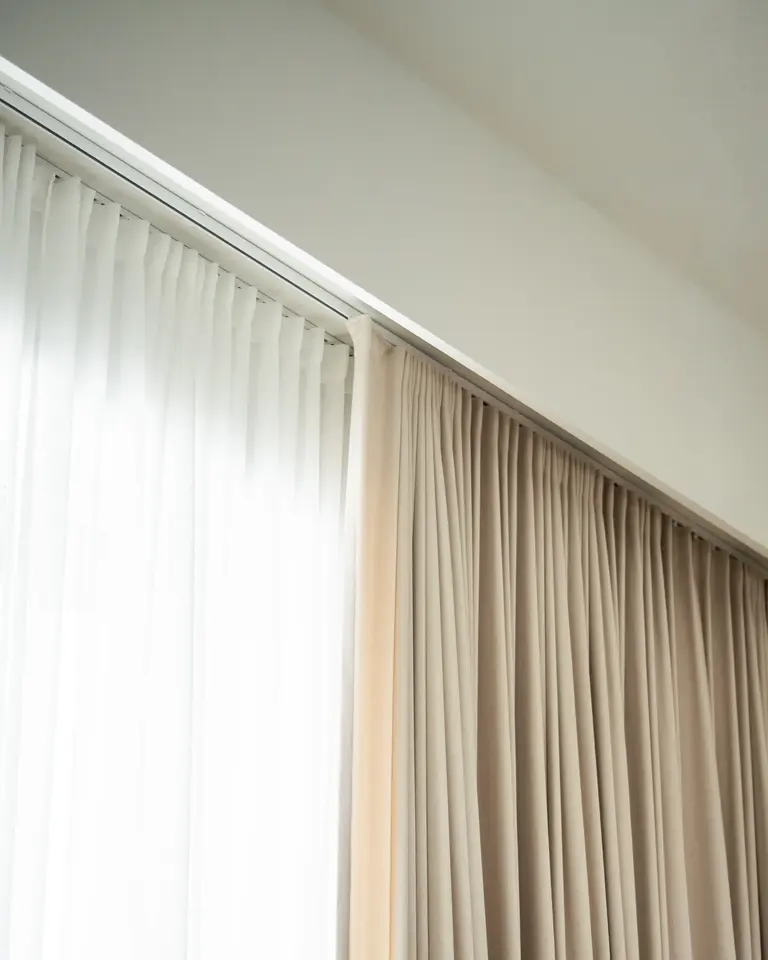
The most common mistakes with a recessed track
- A recess too shallow for a wave heading: the waves go flat and rub on the edge of the plasterboard.
- A fixing that is not reinforced: a heavy curtain in time pulls the track and the board down.
- A crooked edge to the recess: the straight line of the curtain only shows it up.
- A forgotten cable: an electric track becomes possible only with a battery.
- An LED strip in the same place as the track: the gliders catch, and the light does not fall on the fabric.
How much does a recessed track cost?
A track in a recess costs the same as one on the ceiling: from €9 per metre. Fitting in a recess costs from €85 per window, because it takes more accuracy and time. An electric track, fitted and programmed, is from €170 per metre. The recess itself is built by the plasterboard fitters, so its cost is in their quote. From order confirmation to fitting the track takes 1–2 weeks.
- Ceiling tracks → prices with fitting, and the types
- Curtain track fitting cost → all the fitting rates
- Measuring a curtain recess → a full measuring guide for the fitters
Frequently asked questions
Can a recessed track be fitted once the ceiling is finished?
In a plasterboard ceiling a recess can sometimes be made later, but that means redoing the ceiling. In a concrete ceiling with no suspended ceiling there is nowhere to make a recess, so a ceiling track is fitted on the surface of the ceiling.
How deep should the recess be for two curtains?
Two tracks, one for the sheer and one for the lined curtain, need a recess 15–20 cm deep. If at least one of the curtains will have a wave heading, choose 20–25 cm.
Can an electric track be built into a recess?
Yes. The motor fits at the end of the track in the recess if the cable is brought 10–15 cm from the end of the recess. In a closed ceiling, leave a 30 cm × 30 cm access hatch under the motor.
Who builds the recess: the plasterboard fitters or the track fitters?
The recess is built by the plasterboard fitters during the renovation, and the track is fitted into the finished recess. It is best to agree the measurements with us before the fitters start: the recess will then be made for the particular track.
Planning a recess during a renovation?
The designer visits, measures the window and the ceiling, agrees the recess measurements with your builders and suggests a track.
Book a measuring visitThe next step
If this guide has answered your questions, move on to a specific product or check your budget.