Author: Jegor Janockin
Reviewed by: Curtain.lt editorial team
Last updated:
Curtain recess in a ceiling: depth, width and measurements
- Recess depth: 10 cm for one track, 15–20 cm for two, 20–25 cm for a wave heading.
- Recess height: 12–15 cm. Space the tracks by the 5 cm rule: 5 cm from the wall, between the tracks and to the edge of the recess.
- The track runs 20–30 cm past the window opening on each side.
- Reinforce the fixing points every 60–80 cm, and for an electric track plan a power outlet inside the recess.
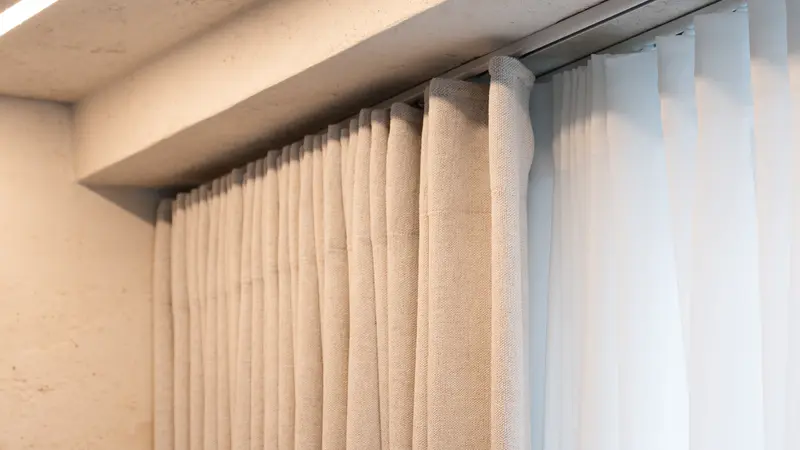
The size of a curtain recess depends on the number of tracks, the heading and how the window is built. One track needs a recess 10 cm deep, two tracks need 15–20 cm and a wave heading at least 20–25 cm. The track is 40–60 cm longer than the window opening is wide, and is fitted 10–15 cm above the top of the window. Exact measurements given to the plasterboard fitters before the ceiling is closed save an expensive rebuild.
A curtain recess does more than hide the track. Its depth, its width and its distance from the wall decide whether sheers and blackout curtains hang evenly and whether a wave heading forms full waves, so all three are settled at the design stage.
- A ceiling track in a recess → tracks, prices and fitting
- Recessed curtain tracks → what to decide during the renovation: LED, motor, access hatch
The basic rule: the more layers, the deeper the recess
The commonest mistake is to build the recess by eye, without exact figures. The track goes in, the ceiling is closed, and only then does it turn out that the fabric cannot move freely or that the wave heading hangs flat. Putting that right costs money and time.
A single track needs 10 cm of depth, the minimum for the fabric to hang and move freely. A double track, with sheers and lined curtains hung together, needs 15–20 cm: the rear track (nearer the window) carries the sheers and the front one (nearer the room) the lined curtains, which close in front of the sheers in the evening.
A wave heading needs the most room: at least 20–25 cm of depth, because its gliders and waves take more space than standard hooks or rings. In a recess that is too narrow the fabric cannot move freely and the waves flatten.
An eyelet heading threads onto a bare pole no more than 35 mm in diameter, so it cannot hang from a ceiling track and needs a wall-fixed pole. A pinch pleat heading works on both ceiling tracks and wall-fixed poles, but takes 2.5 times the width of the pole in fabric.
| Heading | Minimum recess depth | Fullness | Type of track or pole |
|---|---|---|---|
| Wave heading | 20–25 cm | 2.0× | Ceiling track with gliders |
| Pinch pleat heading | 10–15 cm | 2.5× | Ceiling track or wall-fixed pole |
| Eyelet heading | — (wall-fixed) | 1.5× | Wall-fixed pole, up to 35 mm |
| Standard hooks | 10 cm | By tape (flex 1.5×) | Ceiling track or wall-fixed pole |
A ceiling fixing becomes essential where the ceiling is higher than 280 cm or the top of the window reaches right up to the ceiling. The curtains then fall from the ceiling itself, which makes the room look taller.
The depth of the recess (from the wall to its edge) follows the 5 cm rule: 5 cm from the wall to the track, 5 cm between the tracks if there are two, and 5 cm from the last track to the edge of the recess. That spacing lets the fabric move freely without rubbing on the plasterboard edges.
Types of pole and track
Ceiling tracks with gliders, wall-fixed poles and wave heading tracks: see which one suits your recess.
See poles and tracksHow far from the wall and the window: radiators and sills
A radiator under the window is one of the commonest reasons curtains kink or hang unevenly. With the track too close to the wall, the fabric rests on the radiator and bends out of line. Set the front of the track at least 5–10 cm further from the wall than the front of the radiator.
Where a deep sill projects more than 15 cm from the wall, use longer bracket arms or a ceiling track set further out from the wall. Curtains that stop at the sill end 1 cm above it, so they do not rub on it.
Fit the track 10–15 cm above the top of the window. At that height the curtains clear the glass completely when drawn back, and a strip of wall shows between the window frame and the track. Fitted lower, the open curtains partly cover the glass.
The length of the track matters as much: it is 40–60 cm longer than the window opening is wide, so it runs 20–30 cm past the opening on each side. A window opening 150 cm wide, for example, takes a track 190–210 cm long.
A dark fabric alone does not black out a room: the track matters too. Only a ceiling track with side returns closes the gap between the track and the wall, so no light gets in at the sides. Blackout curtains on an exposed wall-fixed pole always leave light showing at the sides.
Floor length
Sill length
What to tell the plasterboard fitters: a checklist
Most recesses are rebuilt not because the fitters made a mistake but because nobody told them in time exactly what was needed. Before work on the ceiling starts, have an exact technical drawing with the figures on it. Without one, the plan often has to change after the ceiling is closed.
- 1Recess width: measure the window opening from one edge to the other and add 40 cm on each side. A window 150 cm wide + 40 cm + 40 cm = a recess 230 cm wide.
- 2Recess depth: give the exact depth for the tracks you have chosen: 10 cm (1 track), 15–20 cm (2 tracks) or 20–25 cm (wave heading).
- 3Reinforced fixings: at the track's fixing points the plasterboard must be backed with a timber or metal-profile frame. Tell the fitters where the fixing points are, usually every 60–80 cm along the track.
- 4The recess edge: the front edge of the recess must be straight and level. A crooked edge shows, and it is hard to put right once the ceiling is closed.
- 5A power outlet for motorised blinds: if you plan motorised roman blinds or an electric track, the outlet has to be planned inside the recess. The standard position is 10–15 cm from the edge, at the back of the recess.
- 6Recess height: at least 12–15 cm from the surface of the ceiling to the bottom edge of the recess.
On the ceiling
In a ceiling recess
Arrange a consultation
The designer measures at your home and prepares a technical drawing for the builders before the ceiling is closed.
Arrange a consultationWhat a correctly built recess looks like
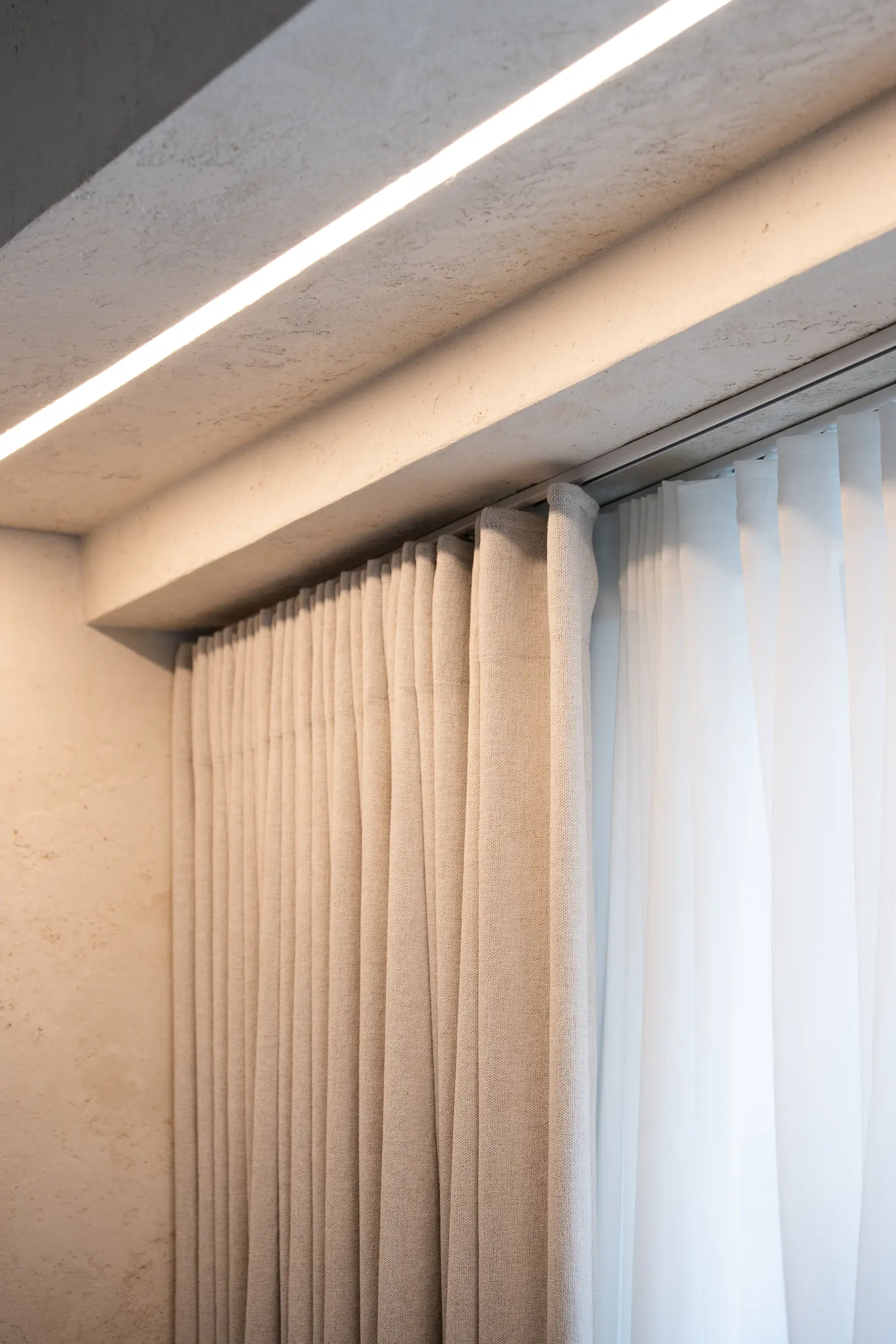
In cross-section, a well-built plasterboard recess shows the ceiling surface; the recess cavity, 10–25 cm deep, with a ceiling track and gliders at the back of it; the fabric falling from the track; and the lower edge of the recess, which hides the track from below. The curtains seem to come out of the ceiling with no visible joint, which gives a clean, modern look.
The lower edge of the recess must be exactly level along its whole length: against an evenly falling curtain, even a 2–3 mm slope shows. Ask the fitters to check it with a laser level, not only by eye.
Seen from the front, a wave heading should form even waves of the same depth across the whole width of the curtain, each about 8–10 cm deep. If the recess is too narrow, or the track too close to its edge, the waves are squeezed flat.
The commonest building mistakes, and how to avoid them
Check each of these before the ceiling is closed:
- A recess too shallow (8 cm instead of 20 cm for a wave heading): the fabric rubs on the edge and the waves flatten. Check the depth with a tape measure before the ceiling is closed.
- A fixing point that is not reinforced: within a few months the track pulls the plasterboard down. Insist that the fitter shows you the reinforcing profile.
- An edge that is not level: the fabric falls unevenly. Check the edge with a laser level.
- No power outlet, or one in the wrong place: an electric track cannot be fitted without opening the ceiling.
- A blackout track without side returns: light gets in at the sides and the room does not go dark.
- A recess too narrow: open curtains have no room at the sides and cover the edges of the window.
A curtain recess is planned step by step from the design stage, not measured once. Three figures decide the result: the depth of the recess, the length of the track and the fitting height. Every measurement goes to the plasterboard fitters in writing, with an exact technical drawing, before the ceiling is closed.
Wrong: 8 cm
Right: 20–25 cm
Work out the price
Get a guide price for tracks and poles from the measurements of your recess.
Open the price calculatorFrequently asked questions
How wide should curtains be compared with the window?
The fabric is 1.5–2.5 times the length of the track, depending on the heading: 2× fullness for a wave heading, 2.5× for pinch pleats and 1.5× for eyelets. The track itself is 40–60 cm longer than the window opening is wide (20–30 cm on each side), and a recess is planned with 40 cm added on each side.
What is the difference between ceiling and wall fixing of a track?
A ceiling fixing holds the track straight to the ceiling; a wall fixing holds it to the wall above the window opening. Ceiling fixing becomes essential where the ceiling is higher than 280 cm or the top of the window reaches the ceiling. A ceiling track with side returns is also the only kind that closes the gap between the track and the wall completely, which matters most for blackout.
How much do sheer curtains cost?
Sheer fabrics cost €9.50–16.50 per metre and making €8 per metre, so the final price depends on the width of the window, the fabric and the heading: a wave heading takes more fabric than a simple pleat. The fabric is 1.5–2.5 times as wide as the track (2.0 times for a wave heading), so a curtain takes a good deal more material than it first appears to.
How much do poles, tracks and mechanisms cost?
It depends on the type. A ceiling track costs from €9 per metre and a wall-fixed pole from €14 per metre. Electric tracks cost from €170 per metre, fitted and programmed. Eyelet curtains need a bare pole no more than 35 mm in diameter, and the mechanism you choose has a direct effect on the final price.
How much do lined curtains cost?
It depends on the density of the fabric, how much light it blocks, the size and how complicated the making is: the fabrics cost €11–43 per metre and making €13 per metre, and the track length and the heading decide how much fabric you need. A dark fabric does not block all the light on its own: the track has to be chosen so that no light shows round the edges.
What should you tell the plasterboard fitters when forming a recess for curtains?
Give them an exact technical drawing with every measurement beforehand, because changes after the ceiling is closed are expensive. The depth of the recess follows the 5 cm rule: 5 cm from the wall, 5 cm between the tracks and 5 cm to the edge of the recess. If you plan motorised roman blinds or other motorised mechanisms, agree where the power supply goes in advance too.
How much do making and fitting cost?
Making is priced per metre of fabric, €8 per metre for sheers and €13 per metre for lined curtains, and fitting a ceiling track costs from €9 per metre. Exact measuring and a detailed technical drawing avoid expensive remakes. Order the making and the fitting from the same supplier, so that the measurements agree.
How wide should a ceiling recess for curtains be?
Work out the distance from the wall to the edge of the recess (its depth, in this guide) by the 5 cm rule: 5 cm from the wall to the first track, 5 cm between tracks if there are several, and 5 cm from the last track to the edge. In a recess that is too narrow the fabric cannot move freely and a wave heading goes flat. Match the depth to the chosen tracks before the plasterboard work starts, and along the wall make the recess at least 40 cm longer than the window on each side.
How far should a pole be from a sill or a radiator?
Curtains that stop at the sill end about 1 cm above it, so the fabric does not rub and wear. Over a radiator, the front of the track sits at least 5–10 cm further from the wall than the front of the radiator, so that the fabric falls freely. The exact distance depends on the room.
What does a wave heading need from the recess?
A special ceiling track with gliders and a recess at least 20–25 cm deep: a standard pole will not do. Each wave should be 8–10 cm deep, and a recess that is too narrow squeezes the waves and spoils the look. A double track carries sheer and lined curtains on one fixing, but the depth of the recess is then worked out by the 5 cm rule for each track separately.
How high above the window should the track be?
10–15 cm from the top of the window. A higher track makes the window look larger and the room more spacious. If the top of the window is almost at the ceiling, the track goes on the ceiling so the look stays tidy.
Why leave no gap between the track and the wall for blackout curtains?
Because light comes through any gap left open between the track and the wall, however dark the fabric. Only a ceiling track with side returns that fit against the wall closes that gap completely. With blackout lined curtains, the type of track matters as much as the density of the fabric.
Can eyelet curtains be fitted on a ceiling track?
No. Eyelet curtains thread onto a bare pole no more than 35 mm in diameter, so they cannot hang from a ceiling track. They need a wall-fixed pole, which means no ceiling recess has to be built for them. Decide how the curtains will be fitted before you choose the heading.
How do you work out the amount of fabric for curtains?
Multiply the length of the track by the fullness: 2× for a wave heading, 2.5× for pinch pleats and 1.5× for eyelets. A 200 cm track with a pinch pleat heading, for example, needs 500 cm (5 m) of fabric width. Add about 10–15 cm on each side for the side hems.
Get in touch
The designer measures the recess at your home and helps you choose the tracks for it.
Get in touchThe next step
If this guide has answered your questions, move on to a specific product or check your budget.