Author: Jegor Janockin
Reviewed by: Curtain.lt editorial team
Last updated:
How to fit roller blinds: on the frame, in the recess or on the wall
- Choose the position: on the window frame (no drilling into the wall), inside the recess or on the wall above the window.
- Measure the width and drop in three places and use the smallest figure. In a recess the blind is 1–2 cm narrower than the recess; on the wall it extends 5–10 cm beyond the opening on each side.
- Mark the bracket positions, check them with a spirit level, and screw in one bracket, then the other.
- Fit the blind, fix the chain safety device and check that the fabric winds evenly.
On uPVC (plastic) windows, roller blinds go either in the recess or on the wall or ceiling, and either way the window is measured at three points. In a recess the fabric is 1–2 cm narrower than the recess. On the wall, the blind should overlap the opening by 5–10 cm on each side, blackout blinds especially. Firmly fixed brackets, a spirit level and a chain safety device make the blind last and keep it safe.
The first decision: in the recess or on the wall or ceiling
Decide where the blind will go before buying it: the position sets the width of the fabric and the type of mechanism.
A recess fit looks cleanest: the blind sits exactly in the window opening. It has to be 1–2 cm narrower than the recess, and the mechanism needs a further 1–4 mm gap at each side; without it the fabric rubs on the sides of the recess, jams and wears faster. A recess fit does not suit a blackout blind that has to shut out all the light, because light still gets in at the sides.
Fixed on the wall above the opening (a face fix), the blind overlaps the opening by 5–10 cm on each side. For a blackout blind this is the only way to darken the room fully. It also makes the window look larger and the room more spacious. A ceiling fix is used when the recess is too shallow.
The third position is the window frame. The blind is fixed to the opening sash and measured to the glass, glazing beads included, so the window opens without the blind coming down. Cassette blinds on uPVC windows are usually fitted this way, and their brackets can go on without drilling (see below).
Front view
Side section
| Feature | In the recess | On the wall |
|---|---|---|
| Fabric width | 1–2 cm narrower than the recess | The recess plus 5–10 cm on each side |
| Light blocking | Partial (gaps remain at the sides) | Full (especially with blackout) |
| Look | Cleaner, built into the opening | Makes the window look larger |
| For blackout | Limited | Recommended |
| Gap for the mechanism | 1–4 mm on each side | Not needed |
Cassette blinds for uPVC windows
Cassette blinds are the type most often chosen for uPVC windows. The mechanism is hidden in the cassette and the fabric runs in side channels, so it does not swing when the window opens.
Width and drop: the three-point method
Everything else depends on the measurements, and one of the commonest mistakes is to measure in one place only.
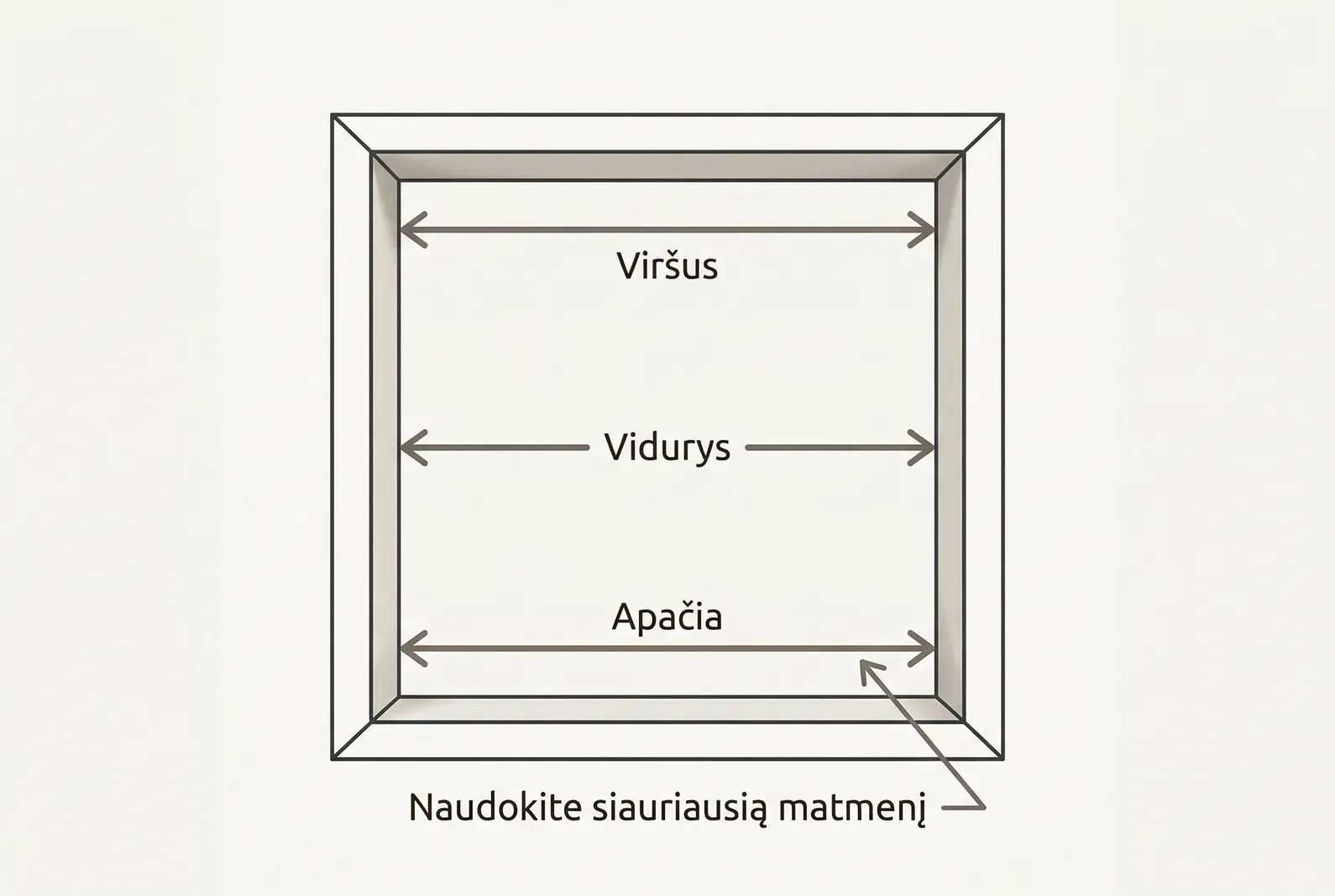
Measure at three points. Take the width at the top, in the middle and at the bottom, and use the smallest figure; take the drop on the left, in the centre and on the right, and again use the smallest. Even windows in newer buildings can be 5–10 mm out.
Sizing a blind for the recess
Take 1–2 cm off the smallest width: for a recess 90 cm wide, order a blind 88–89 cm wide. The drop runs from the top of the recess to the sill.
Sizing a blind for the wall
Add 5–10 cm on each side to the window width: a window 90 cm wide takes a blind 100–110 cm wide. The drop runs from the fixing point to where the fabric should end, usually 10–15 cm below the sill.
Tell the width of the glass apart from the width of the whole frame. When the brackets are screwed into the glazing beads of a uPVC window, measure the glass including the beads: the narrow strip around the glass that takes the brackets. Use screws 10–12 mm long in the beads, so they do not damage the inside of the window. Measure with a steel tape: it does not stretch, so the figures are more accurate.
Fitting the brackets, step by step
- 1Mark the bracket positions. Work out from the length of the blind where each bracket goes: normally 3–5 cm in from each end, with a centre bracket added on blinds longer than 120 cm.
- 2Check the level. Mark the first point and draw a level line to the second with a spirit level. Even a 2–3 mm slope shows along the whole length of the fabric.
- 3Drill and plug. Concrete and brick take universal plastic plugs (6–8 mm), plasterboard takes cavity fixings, and plastic glazing beads take short 10–12 mm screws.
- 4Fix the brackets. Fix one end first, check the level, then fix the second. Never tighten both brackets fully at the same time.
- 5Fit the blind. Put the chain side in first, then the other; the cassette should lock in with a clear click.
- 6Check that it works. Pull the blind down and let it roll back up: it should wind evenly, without rubbing or drifting to one side.
Levelling and chain safety
A bracket out of level makes the fabric wind crooked and drift to one side; the tension becomes uneven and the mechanism wears faster. Use the spirit level twice: before drilling, and again before the screws are tightened for good.
Chain safety in children's rooms
Always fix the chain to the wall with a safety cleat, or choose a mechanism with an automatic tensioner, so that it does not hang loose. Fix the cleat so that the chain is taut and out of a child's reach. This matters most in children's rooms, where a loose chain is a strangulation risk.
Common mistakes and how to put them right
- 1Measuring in one place only: the fabric ends up too wide or too narrow. Always measure at three points and use the smallest width.
- 2The wrong plugs: the brackets work loose within 2–4 weeks. Use expanding plugs in plaster and cavity fixings in plasterboard.
- 3Drilling into the main window frame: this damages the window and can affect its warranty. Drill only into the glazing beads, or use a fixing that needs no drilling.
- 4Leaving the chain safety device off: a loose chain is a danger to children. Always fix the chain to the wall or use an automatic tensioner.
- 5Skipping the level check before the final fixing: the fabric winds crooked. Use the spirit level before each hole is drilled and before the final tightening.
- 6A cassette that will not lock into the brackets: the blind's length does not match the distance between them. Check that distance; the tolerance is 2–3 mm at most.
How do you fit a roller blind on a uPVC window frame without drilling?
With hook-on or adhesive brackets, a roller blind can be fixed to the opening sash of a uPVC window without drilling into the frame or the wall. Hook-on brackets go over the top of the sash; adhesive ones are stuck on with double-sided tape. Both suit light cassette and mini blinds measured to the glass, glazing beads included.
- 1Hook-on brackets sit over the top edge of the sash. Before ordering, check that there is a gap between sash and frame for the bracket; if the window will not close tightly over it, choose adhesive brackets.
- 2Adhesive brackets stick to the glazing bead or the frame. Clean the surface, degrease it with surgical spirit and let it dry, then press the bracket on and hold it for a few seconds.
- 3Wait before hanging the blind: the tape needs time to bond, so follow the tape maker's instructions.
- 4Check that the window opens and closes freely and that the blind does not rub on the handle or the seal.
Fixing without drilling suits a window still under warranty, a rented home or a light blind. A wider or heavier blind, or a blackout blind on the wall, holds more reliably on screwed brackets.
Fixing without drilling
On a window under warranty or in a rented home, choose a fixing without drilling. Wipe and degrease the frame with spirit before the double-sided tape goes on: grease sharply reduces its grip. It suits only blinds weighing 3–4 kg or less.
Price guide and tools
| Type of blind | Price for a standard window |
|---|---|
| Simple chain-operated roller blinds | €15–30 |
| Cassette roller blinds | €25–50 |
| Blackout roller blinds | €30–70 |
| Day and night roller blinds | €40–90 |
| Motorised roller blinds with remote control | €80–200 |
Fitting costs from €7 per blind; making the blind to size adds €10–25 per blind.
- A drill with a 6–8 mm bit (for concrete or brick)
- A spirit level (or a phone app)
- A steel tape measure
- A pencil for marking
- A set of screwdrivers
- Plugs for the type of wall (universal 6–8 mm plugs for concrete, cavity fixings for plasterboard)
- Surgical spirit to degrease the surface (for fixing without drilling)
In short
Four things decide the result: measuring at three points, the fixing position (in the recess or on the wall), plugs that match the wall, and a spirit level. A blackout blind always goes on the wall, with 5–10 cm of overlap on each side. The chain safety device is always fitted: a loose chain is a danger to children.
Frequently asked questions
Should roller blinds go in the recess or on the wall?
Either works; it depends on the window and the result you want. A recess fit looks tidy but needs exact measuring. Where full darkness matters, fix the blind on the wall with 5–10 cm of overlap on each side.
How do I measure a window for roller blinds?
Measure at three points, top, middle and bottom, and use the smallest figure. This matters most in older buildings, where recesses are rarely square. Measured this way, the blind fits and does not rub on the sides of the recess.
How do I fix the cassette of a roller blind?
The cassette sits on brackets that are first screwed to the window frame, the wall or the ceiling. Check the brackets with a spirit level before fixing them for good. In plastic glazing beads, use 10–12 mm screws so as not to damage the window.
What is the right way to fit roller blinds?
Measure exactly and settle the fixing position first. Then fix the brackets, check them with a spirit level, fit the cassette and check that the fabric runs smoothly. Plywood packers keep the brackets at an equal distance from the window frame.
What tools do I need to fit roller blinds?
A drill with a 6–8 mm bit (for concrete), a spirit level, a steel tape, a pencil and a set of screwdrivers. For fixing without drilling, add surgical spirit and double-sided adhesive tape; for plasterboard, cavity fixings.
What is the difference between a recess fit and a fix on the wall?
In the recess, the blind sits inside the window opening, with the fabric 1–2 cm narrower than the recess. On the wall, it overlaps the opening by 5–10 cm on each side, which matters most for blackout blinds; a wall fix is also the more flexible option when the recess is too narrow or uneven.
What does fitting a roller blind cost?
From €7 per blind in Lithuania. Sets of cassette roller blinds with fitting start at €25–50 for a standard window. Fitting them yourself saves the fitting charge, but needs the right tools and plugs.
How do I check that a roller blind is level?
Hold a spirit level on the cassette before the brackets are fixed for good, while the screws are not yet fully tightened. If the brackets are at different heights, the fabric runs crooked and can jam.
How much do roller blind mechanisms and headrails cost?
From €15 for a simple chain-operated mechanism with a headrail to €80–200 for a motorised one with remote control. The price depends on the material, the type and the maker.
How much overlap should a blackout roller blind have?
5–10 cm on each side beyond the window opening. That stops light getting in at the sides and darkens the room fully; the wider the overlap, the darker the room.
What are the safety requirements for a roller blind chain?
The chain must be fixed to the wall with a safety cleat or worked by a mechanism with an automatic tensioner, so that it does not hang loose and a child cannot reach it. For small children, cordless or motorised blinds are the safest. This matters most in children's rooms.
Can roller blinds be fitted without drilling?
Yes, with hook-on brackets or double-sided adhesive tape. It suits a rented home, or a window whose warranty you want to keep, and only blinds weighing 3–4 kg or less.
How much do blackout roller blinds cost?
€30–70 for a standard window in Lithuania. Larger sizes and special fabrics reach €120 or more. For an exact price, ask for a quote.
How do I prepare the surface for adhesive tape?
Clean it and degrease it with surgical spirit, so the tape bonds firmly, then let it dry completely before sticking anything on: damp or grease greatly reduces the grip.
When should I choose cassette roller blinds?
On uPVC windows, and wherever the look matters: the whole mechanism is hidden in the cassette, and the fabric runs in side channels, which keeps it tidy.
What does making a roller blind cost?
€10–25 per blind in Lithuania, depending on the fabric and the size. Making and fitting together usually cost €20–45 for a standard window.
Need help with fitting?
Roller blinds can be measured and fitted for you, with the level checked and the chain safety device fixed.
Arrange a design consultationCompare the types of roller blind
Blackout, day and night and cassette roller blinds, and the windows each one suits.
See roller blindsBlackout roller blinds for a dark bedroom
Where the aim is a dark bedroom, the blackout blinds and the details of fitting them are compared on a page of their own.
See blackout roller blindsThe next step
If this guide has answered your questions, move on to a specific product or check your budget.