Author: Jegor Janockin
Reviewed by: Curtain.lt editorial team
Last updated:
Roller blinds or curtains: a compact fitting or the warmth of fabric
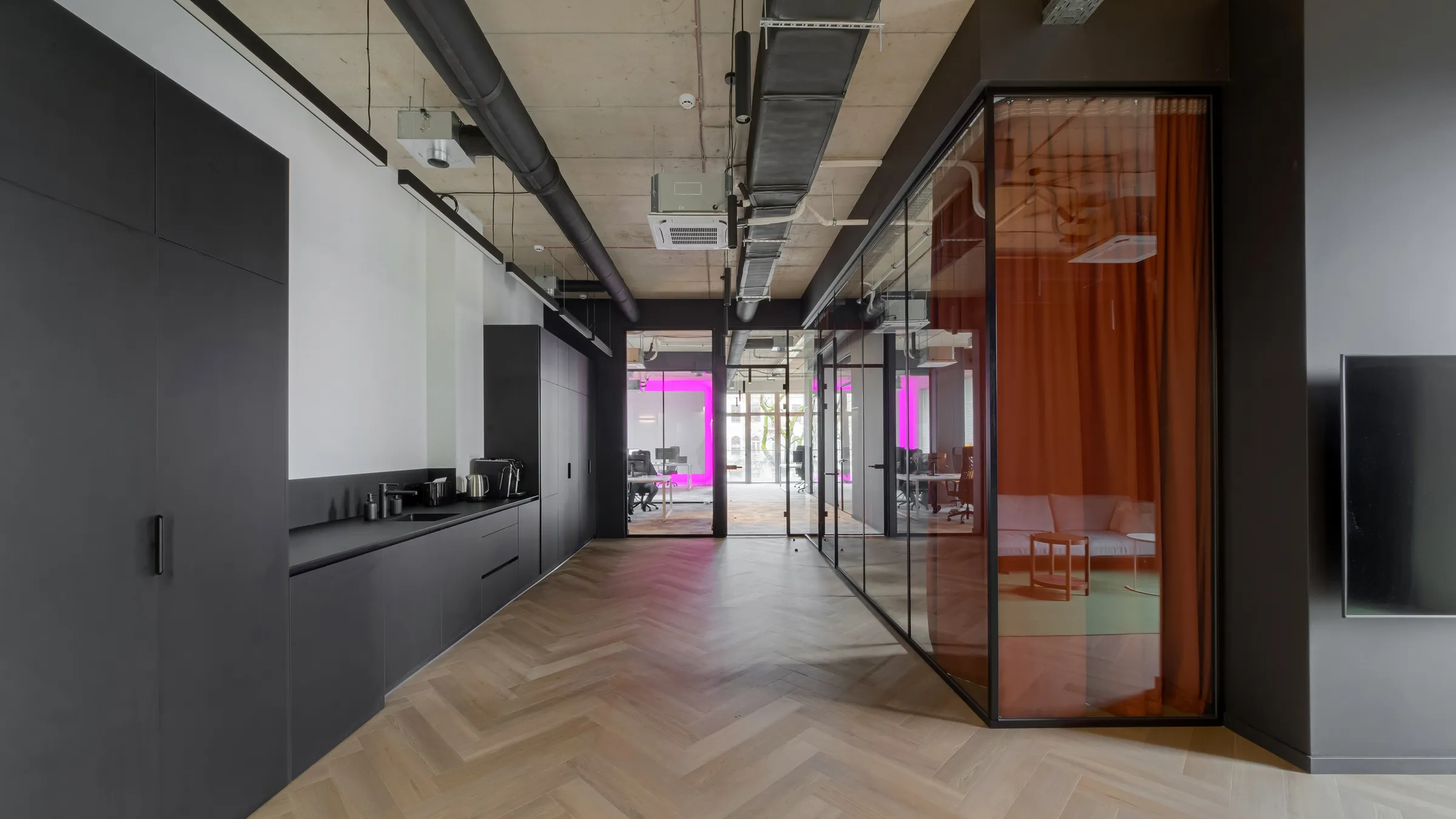
Choose roller blinds for a compact fitting, exact darkening and a lower starting price. Choose curtains for fabric, sound absorption, insulation and large windows. A cassette blackout roller blind with side channels darkens a room almost completely, takes only 6–8 cm above the window and costs from €55 for a small one. Lined curtains darken to a similar degree and add fabric to the room. This guide gives a ten-point comparison, verdicts for six rooms, layered options, prices and the five mistakes we see most often.
Roller blinds or curtains in four points
1. Compactness and exact darkening: roller blinds (cassette blackout, €75–160). 2. Look, sound absorption and insulation: curtains (linen €240–480, lined blackout €180–340). 3. A layered bedroom (roller blind plus curtains) costs 30–40% more than either on its own and does both jobs (€450–700 for three windows). 4. Over ten years a classic roller blind costs €110, blackout curtains €320 and linen curtains €440. The gap is small enough that the character of the room can decide.
Roller blinds and curtains: what each one is
A roller blind is a single sheet of fabric wound onto a tube at the top, worked by a chain or a motor. There are three main types: classic (the tube is open), cassette (the tube sits in a cover) and day and night (two layers of fabric that slide over each other). The fabric is polyester, linen, PVC or blackout fabric with an acrylic coating.
Curtains hang from a track or pole and fall in loose folds. The fabric is 1.5 to 2.5 times the length of the track, to allow for the folds. They are made in linen, cotton, polyester or velvet, and can have a blackout lining, an acoustic layer or a fabric that holds heat. They are drawn sideways.
Roller blinds or curtains: a comparison on ten points
| Point | Roller blinds | Curtains |
|---|---|---|
| 1. Compactness | ★★★★★ (only 6–8 cm above the window) | ★★ (take 10–20 cm from the wall) |
| 2. Blackout | ★★★★★ (special fabric plus side channels) | ★★★★ (blackout lining; light comes round the edges) |
| 3. Sound | ★★ (thin fabric) | ★★★★★ (dense fabric and folds) |
| 4. Insulation | ★★★ (a single layer of fabric) | ★★★★ (the lining and the folds hold back heat) |
| 5. Control of light | ★★★ (open, half or closed) | ★★ (open or closed, with no gradations) |
| 6. Cleaning | ★★★★ (damp cloth or dry cleaning) | ★★ (wash every 6–12 months) |
| 7. Lifespan | ★★★ (8–10 years; the fabric can be replaced) | ★★★★★ (15–25 years for good linen) |
| 8. Starting price | ★★★★★ (from €35) | ★★ (from €70/m plus a track) |
| 9. Fitting | ★★★★★ (15–30 minutes) | ★★★ (track and hanging, 45–90 minutes) |
| 10. Look | ★★★ (modern, minimal) | ★★★★★ (suits most rooms; classic) |
When to choose roller blinds: five situations
- 1You want a room as dark as possible and need to save space. A cassette blackout blind with side channels darkens almost completely, while curtains always let light past the edges.
- 2You have a tight budget. A roller blind for an average window (1.2 × 1.5 m) costs €55–120; curtains with a track and making cost €170–300. For a first-time renter, roller blinds are a sensible start.
- 3The room is small and curtains would crowd it: a bathroom, a passage, a small kitchen. A blind close to the glass takes no floor space.
- 4It is a work room where you want to cover the whole window in one movement, for video calls or screen glare. A blind comes down in about three seconds; curtains have to be drawn and their folds set.
- 5The interior is minimal or Scandinavian. Roller blinds match the clean lines; curtains add a texture the style may not want.
When to choose curtains: five situations
- 1A living room or dining room where you want warmth and fabric. Curtains make a room feel finished; a roller blind on its own often looks functional without making the room feel lived in.
- 2Tall windows, down to the floor. Curtains hung from the ceiling to the floor make the room look taller, where a blind leaves the space unused.
- 3Sound matters: a home cinema corner, a room used for video calls, a bedroom on a noisy street. A heavy lined fabric absorbs more sound than a roller blind, which does almost nothing.
- 4A child's room. Curtains without tiebacks or cords are the safe default; the chain of a traditional roller blind has to be fixed to the wall, or the blind replaced with a cordless one.
- 5A historic interior, such as Vilnius Old Town or a renovated house in Kaunas, where the classic look is part of the investment. Roller blinds can look like a temporary fix there.
Room by room: the usual choice
| Room | Recommendation | Reason | Layered alternative |
|---|---|---|---|
| Living room | Curtains | Look, sound absorption, size | A day roller blind plus curtains |
| Bedroom | A cassette blackout roller blind plus curtains | Full darkening plus sound absorption | Either one, if the budget is limited |
| Kitchen | Roller blinds (often roman blinds) | Compactness, resistance to smells | Short light curtains on a small window |
| Child's room | Curtains without tiebacks | Safe: no hanging cords | A cordless roller blind plus short curtains |
| Study | Roller blinds (often day and night) | Control of light at a screen | Curtains, if there is no screen glare |
| Bathroom | PVC blinds or pleated blinds | Damp | A water-resistant roller blind |
Layering: combining roller blinds and curtains
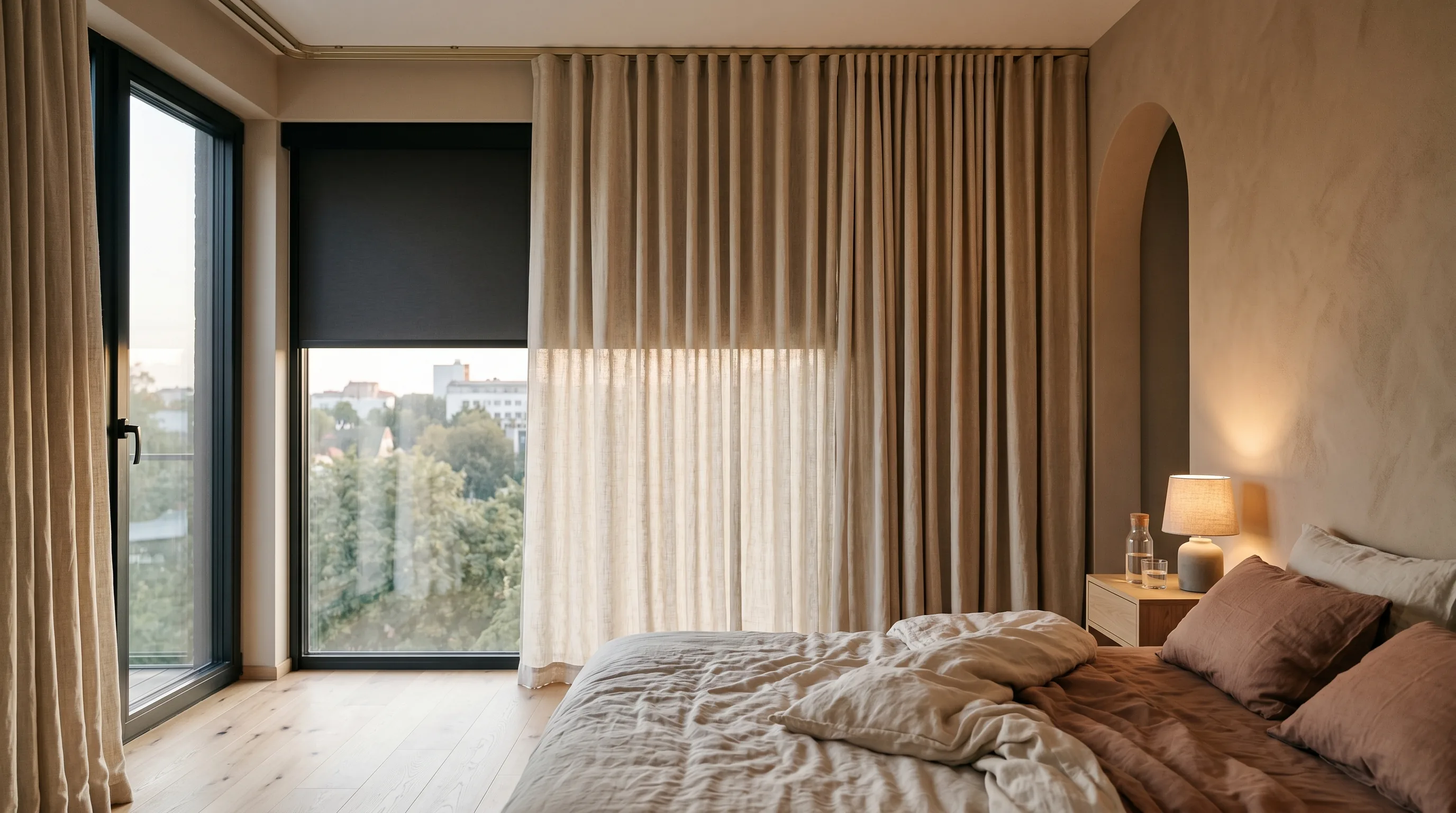
A layered window lets each layer do its own job. The inner layer, next to the glass, is the roller blind, which controls light exactly. The outer layer, next to the wall, is the curtain, which adds fabric, sound absorption and insulation.
- 1A cassette blackout roller blind with linen or polyester curtains is the standard for a bedroom. By day the curtains dress the window; at night the blind darkens it almost completely.
- 2A day and night blind with heavy curtains suits a living room where you want to control light at every stage of the day and have full privacy in the evening.
- 3A sheer roller blind with blackout curtains is a lower-budget bedroom. By day the blind lets light through; at night the curtains darken the room.
- 4A motorised roller blind with hand-drawn curtains on a track: the blind runs on a motor, the curtains are drawn by hand.
The cost is not double
A roller blind with curtains usually costs 30–40% more than a single layer. For an average bedroom with three windows in Vilnius in 2026, the two layers cost €450–700 and a single one €300–500.
What do roller blinds and curtains cost, to buy and over ten years?
| Type | Price range | Notes |
|---|---|---|
| Classic roller blind (open tube) | €35–80 | Low-cost; offices and small windows |
| Cassette day roller blind | €55–110 | Mid-range; kitchens and living rooms |
| Cassette blackout roller blind | €75–160 | Bedrooms; near-total darkening |
| Day and night roller blind | €90–180 | Living rooms; light adjusted continuously |
| Polyester curtains (made to measure) | €130–240 | All-round; includes a track and making |
| Lined blackout curtains | €180–340 | Bedrooms; adds sound absorption |
| Linen curtains | €240–480 | Natural fabric; living rooms |
| Type | Starting price | Replacement or upkeep over 10 years | Total over 10 years |
|---|---|---|---|
| Classic roller blind | €55 | €55 (replaced in year 9) | €110 |
| Cassette blackout roller blind | €120 | €70 (fabric replaced in year 5) | €190 |
| Polyester curtains | €170 | €40 (dry cleaning, twice) | €210 |
| Blackout curtains | €260 | €60 (lining replaced in year 7) | €320 |
| Linen curtains | €360 | €80 (dry cleaning, three times) | €440 |
Over ten years the cheapest classic roller blinds (€110) and mid-range polyester curtains (€210) are only €100 apart. The decision is about the result you want: a compact blind that does its job (roller blinds) or warm fabric that softens the room (curtains).
Five mistakes to avoid when choosing between roller blinds and curtains
1. An open-tube roller blind in a bedroom
An open-tube blind is the cheapest option, but its fabric is exposed to dust, children and cats. In a bedroom, where you want full darkening and quiet sleep, it lets light in at the sides and collects dust. Use a cassette blackout blind with side channels instead. It costs only €30–40 more and the result is clearly better.
2. Heavy curtains on a plastic pole
Blackout curtains are heavy: the densest fabrics, such as Gravity Blackout, weigh over 350 g/m². A standard 16 mm plastic pole starts to sag in time. Use a metal pole of 20 mm or more (20 or 25 mm) or a sturdy aluminium ceiling track, with brackets no more than 60–80 cm apart. It costs €20–30 more, and the pole will not bend.
3. Too little fabric in the curtains
The curtain width should be 1.5 to 2.5 times the length of the track, depending on the heading: 1.5× for a flex tape or eyelets, 2× for a wave heading and 2.5× for pinch pleats. When a customer saves money by buying fabric only as wide as the track, the curtains look stretched, like a sheet hung on a wall. This figure is always checked at a measuring visit, because the common assumption is that the fabric needs to be only as long as the track.
4. Measuring for the first time yourself
A customer measured with a tailor's tape instead of a steel tape and ordered from those figures. At fitting, the width differed from the measurement by 1.5 cm, the blind caught on the window handle, or the curtain was 3 cm too short. Book a measuring visit instead; the terms are in the questions below. In about 20 minutes the designer takes six measurements with a steel tape.
5. Choosing on price alone
A customer sees a €35 roller blind for the living room and plans a budget around it. The final price nearly always includes extras: a cassette cover (€30–80), a smart-home module (€60–120), non-standard fixing (€20–40) and a better fabric. After a few months the customer finds that the cheapest option does not suit the room. Discuss the real price, with every extra, at the measuring visit, and compare it with an alternative on the full budget.
Child safety: cords and chains
In a small child's room the greatest danger is a loose hanging control cord or chain, which can wrap around a neck. For families with small children we therefore offer motorised or cordless options. Where a chain stays, fix it to the wall with a cleat, out of a child's reach, and keep the remote of a motorised blind away from the child.
The chain of a traditional roller blind is the greatest risk: a hanging, attractive object for a child. Curtains without tiebacks are the safe default; with tiebacks they need a safety cleat on the wall. Keep the cot and any furniture a child can climb away from the window.
Which suits which kind of home in Vilnius, Kaunas and Klaipėda?
Central Vilnius (Old Town, Žirmūnai, Antakalnis) has many older flats, where curtains suit better as the main covering. In newer districts such as Pašilaičiai, Pilaitė and Naujininkai, with standard windows, cassette blackout roller blinds, alone or with curtains, are more practical.
In Kaunas, curtains suit the older flats of Žaliakalnis and the centre, and roller blinds suit the blocks of Šilainiai and Eiguliai. On the coast, in Klaipėda, we recommend roller blinds, because PVC or coated polyester roller blinds cope better with the damp sea climate.
Frequently asked questions
Are roller blinds cheaper than curtains?
At the start, yes. A classic roller blind for a 1.5 × 2 m window costs from €55, and polyester curtains with a track from €170. Over ten years the gap narrows to €100 (€110 against €210), because curtains last longer and are replaced less often.
Which suits a bedroom better, a cassette blind or curtains?
Ideally both, the blind behind the curtains. If you choose one, a cassette blackout blind darkens more completely and is more compact, while curtains add sound absorption and a softer look. On a noisy street the curtains matter in a bedroom. A good pairing is a cassette blackout blind with medium-weight polyester or linen curtains.
Should curtains be the same length as roller blinds?
Not usually. Curtains normally reach the floor or end 1–2 cm above it, while a roller blind ends at the sill or 5–10 cm below it. The exception is café curtains, which cover only the lower half of the window and suit kitchens and small windows.
Which saves more heat?
Lined curtains reduce heat loss through a window more than roller blinds do. They create a double air gap (between the glass, the fabric and the room) and have more mass. In north-facing bedrooms in Vilnius and Kaunas, curtains with a thermal lining also reduce the difference in temperature between the floor and the window zone.
Can a roller blind replace curtains in a living room?
Functionally, yes: it controls light and gives privacy. For looks, often not. A living room is where the warmth of fabric matters, and a roller blind alone can look industrial, especially in a large room with high ceilings. A sheer roller blind with sheer curtains works well, at €250–400 per window.
How long do roller blinds and curtains last?
Roller blinds last 8–10 years, and then it is usually the fabric that is replaced, not the mechanism. A cassette blind lets you replace only the fabric after a few years (about €70 in the ten-year table). Polyester curtains last 10–15 years and linen 15–25 years with proper care. A blackout lining is replaced after 7–10 years, when it starts to delaminate.
Can a roller blind be washed at home?
No. The fabric has a special coating that washing damages. Wipe it with a damp cloth every two weeks and clean it by hand, following the maker's instructions, every 3–6 months. For heavy stains use professional dry cleaning (€15–30 per blind). Washable curtains go in at no more than 30 °C with a mild detergent; some fabrics are dry-clean only.
Does a blackout roller blind work without side channels?
Not completely. Blackout fabric blocks 99% of light, but light still gets through the gaps of about 2–5 mm at the sides, between the blind and the window frame. Side channels close those gaps and give full darkening. They cost an extra €40–80 depending on the size of the window, and in a bedroom the difference is clear.
Is a motorised roller blind worth it?
It is, when the window is higher than 2.5 m and hard to reach, when one room has many windows (one remote or smart-home control), or when small children live in the home (cordless or motorised is safer). A motor adds €120–250, and a smart-home module €60–120. Somfy and Brel motors are fitted, and mechanisms and motors carry our 24-month warranty.
Do curtains suit a modern interior?
Yes, with a modern combination of fabric and track. For modern minimalism, use a plain polyester, a slim metal pole (16 mm) or a ceiling track. Avoid gold finials, large folds and heavy fabrics with decorative trim. In an industrial loft window, curtains can be a soft element that balances the interior.
Which is easier to fit, a roller blind or curtains?
A roller blind takes 15–30 minutes: two fixing points and winding on the fabric. Curtains take 45–90 minutes: the track, fixing it and hanging the curtains. Tiled walls, concrete or ceiling fixing add 30–60 minutes. A simple roller blind in plasterboard is a job for DIY, but a track fixed into concrete or tiles is better left to a professional.
How do I book a measuring visit?
Book through the contact page, or write to us in English; we reply by e-mail. The designer comes at the agreed time, measures the windows, assesses the room and suggests two or three options with a final price. A visit takes 30–45 minutes, and the quote follows in writing. Measuring is free in Vilnius. In Kaunas and Klaipėda it is free on orders of €200 or more. Elsewhere in Lithuania the visit is paid, and the price is agreed beforehand.
Arrange a measuring visit
The designer assesses your windows and the room, and suggests roller blinds, curtains or a layered combination.
Arrange a measuring visitRelated guides
If you are weighing other window dressings, see "Venetian or roller blinds?" (a detailed comparison), "Blinds or curtains?" (fabric against rigid blinds), "Roman blinds for kitchens" (fabric blinds for the kitchen) and "How to choose curtains" (for beginners).
The next step
If this guide has answered your questions, move on to a specific product or check your budget.