Author: Jegor Janockin
Reviewed by: Curtain.lt editorial team
Last updated:
Window dressings compared: curtains, blinds, roller blinds, roman and pleated blinds
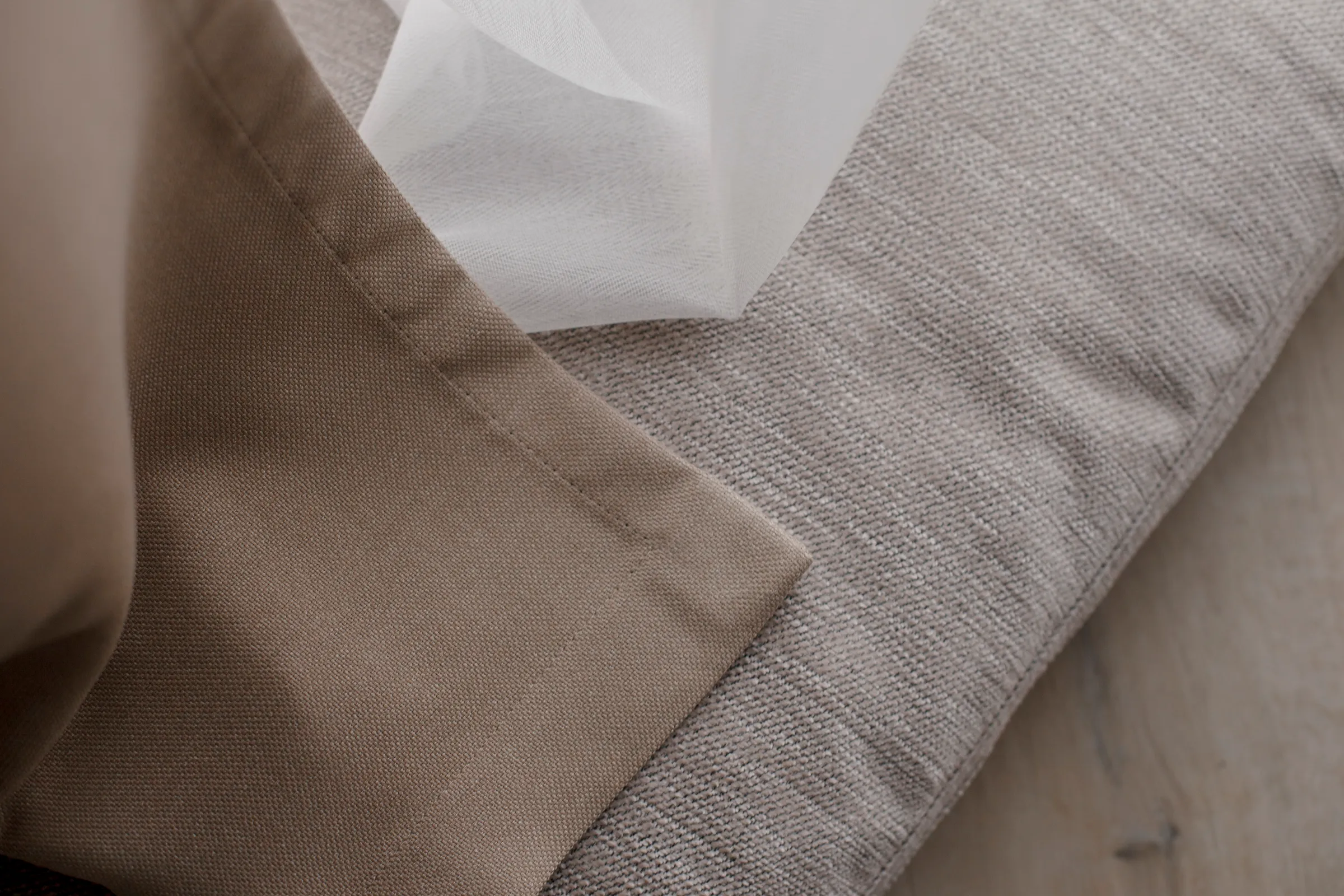
There are five main kinds of window dressing: curtains, blinds, roller blinds, roman blinds and pleated blinds. The short verdict: curtains for the living room and bedroom; blinds for the kitchen, office and bathroom; a cassette blackout roller blind for a bedroom that needs darkness from a compact blind; roman blinds where looks and 100% darkness both matter; pleated blinds for an attic window or a bathroom. This guide compares all five on twelve points, with prices, a verdict for each room, two-layer combinations, the EN 13120 child-safety standard and links to the more detailed guides.
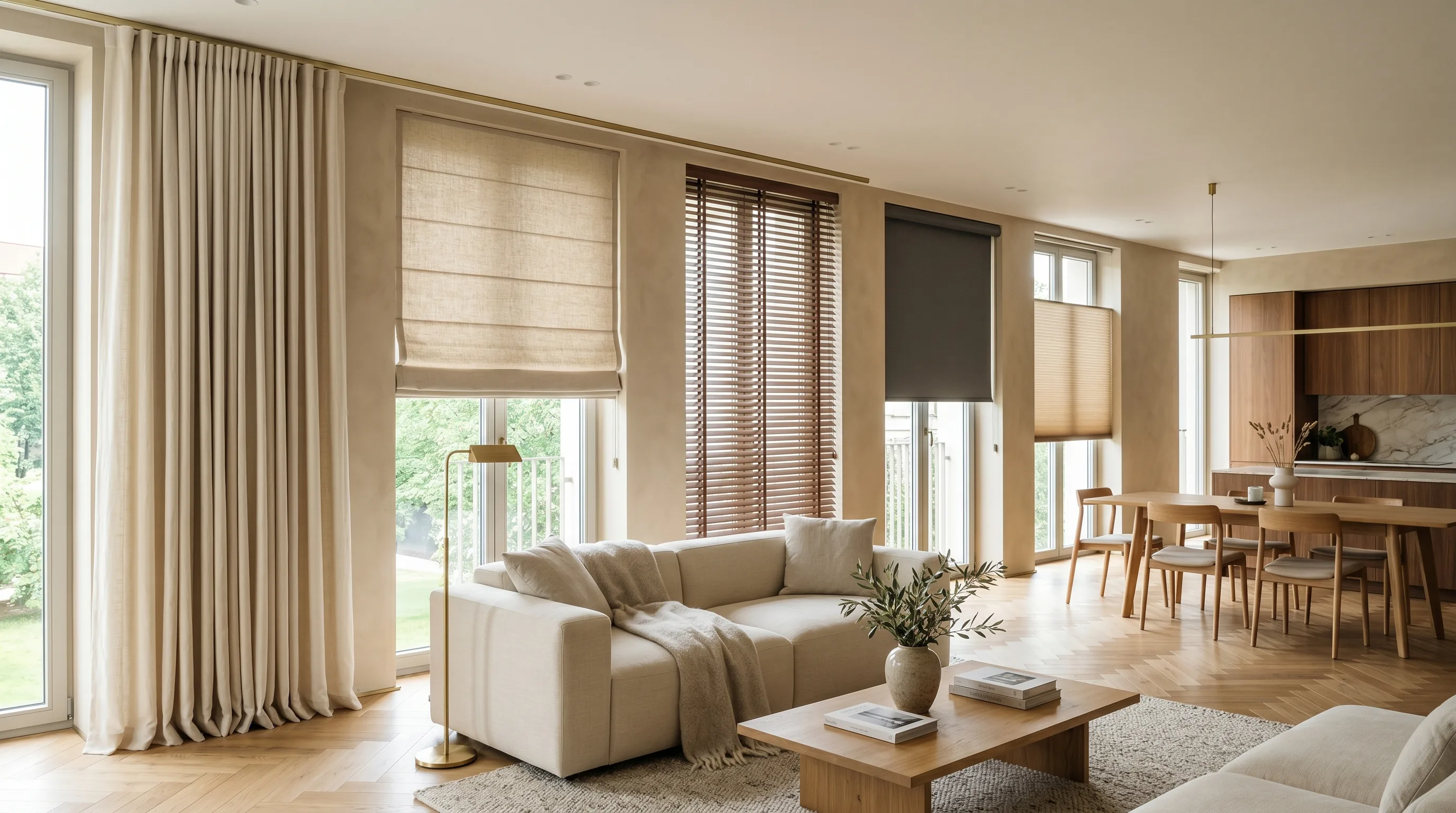
The five main categories in brief
These are the five window dressings chosen most often in Lithuania. They differ in how they are made, what they are made of and where they are used.
- 1Curtains: textile, pleated, hung on a pole or track. Fabric: linen, cotton, polyester, velvet. They suit most rooms, the living room and bedroom above all.
- 2Blinds: rigid or semi-rigid slats, horizontal or vertical. Material: aluminium, wood, bamboo, PVC, woven fabric. They control light most precisely.
- 3Roller blinds: a single sheet of fabric that winds onto a tube. Three groups: classic, cassette and day and night. The cheapest of the five.
- 4Roman blinds: woven fabric that draws up into horizontal folds. Chosen for their looks, often for the living room and bedroom.
- 5Pleated blinds: fabric folded like a concertina. Suit attic and unusually sized windows, and the bathroom.
The main categories on twelve points
| Point | Curtains | Blinds | Roller blinds | Roman blinds | Pleated |
|---|---|---|---|---|---|
| Starting price | ★★ | ★★★★ | ★★★★★ | ★★ | ★★★ |
| Looks: classic interior | ★★★★★ | ★★★ | ★★ | ★★★★★ | ★★★ |
| Looks: modern interior | ★★★ | ★★★★ | ★★★★ | ★★★ | ★★★★ |
| Light control | ★★ | ★★★★★ | ★★★ | ★★★ | ★★★ |
| Blackout (100%) | ★★★★ | ★★★ | ★★★★★ | ★★★★ | ★★ |
| Sound | ★★★★★ | ★★ | ★★ | ★★ | ★★ |
| Heat insulation | ★★★★ | ★★★ | ★★★ | ★★★ | ★★★★ |
| Resistance to damp | ★★ | ★★★★★ | ★★★★ | ★★★ | ★★★★ |
| Cleaning | ★★ | ★★★★★ | ★★★★ | ★★ | ★★★ |
| Durability | ★★★★★ | ★★★ | ★★★ | ★★★ | ★★★ |
| Child safety (no cord) | ★★★★ | ★★ | ★★ | ★★★ | ★★★ |
| Smart-home compatibility | ★★ | ★★★★ | ★★★★★ | ★★★★ | ★★★ |
None of the five wins on every point, so the usual answer is two layers at one window: a cassette blackout roller blind with curtains in a bedroom, or roman blinds with a light curtain in a living room.
Room by room: the verdict
| Room | First choice | Second choice | Layered option |
|---|---|---|---|
| Living room | Lined curtains | Roman blinds | Light roller blind + curtains |
| Bedroom | Cassette blackout roller blind + curtains | Roman blind with blackout | A combined option |
| Open-plan kitchen | Roman blinds with a Teflon finish | Aluminium blinds | Roman blind + a light café curtain |
| Closed kitchen | Cassette roller blind with a Teflon finish | PVC blinds | Roller blind + a decorative pole |
| Child's room | Curtains without tiebacks | Cordless roller blind | Curtains + a cordless roller blind |
| Office or work area | Vertical blinds | Day and night (zebra) roller blind | Blinds + light curtains |
| Bathroom | PVC blinds or pleated blinds | A water-resistant roller blind | Pleated blinds + a light curtain |
| Attic window | Pleated blinds | Blinds made for roof windows | Pleated blinds + blackout curtains |
Typical prices: every category in one table
The table is for a typical average window (1.5 × 2 m) on the Lithuanian market. The price covers the fabric and the mechanism. Smart-home modules, side channels and unusual fixings are extra.
| Category | Entry level | Mid-range | Higher end |
|---|---|---|---|
| Classic roller blind | €35–55 | €55–80 | €80–120 |
| Cassette day roller blind | €55–80 | €80–110 | €110–160 |
| Cassette blackout roller blind | €75–110 | €110–160 | €160–230 |
| Day and night roller blind | €90–130 | €130–180 | €180–250 |
| Aluminium blinds, 25 mm | €60–85 | €85–110 | €110–150 |
| Wooden blinds, 50 mm | €150–190 | €190–260 | €260–380 |
| Vertical blinds | €85–120 | €120–180 | €180–270 |
| Pleated blinds | €95–140 | €140–200 | €200–290 |
| Standard curtains | €130–180 | €180–240 | €240–360 |
| Blackout curtains | €180–250 | €250–340 | €340–500 |
| Linen curtains | €240–340 | €340–480 | €480–720 |
| Roman blinds, standard | €110–160 | €160–240 | €240–340 |
| Roman blinds with blackout | €140–210 | €210–310 | €310–460 |
| Roman blinds, linen | €180–270 | €270–390 | €390–620 |
Two layers at one window
Two layers at one window are planned more and more often when flats and houses are renovated. They cost more than one, because you buy two systems, but one layer controls the light and the other gives privacy and the look. These are the most popular combinations, room by room.
- 1For a bedroom: a cassette blackout roller blind with linen or polyester curtains. For a medium-sized room (3 windows) the price is €450–700. It helps with both sleep and street noise.
- 2For a living room: a day and night roller blind with heavy curtains. A medium-sized room costs €380–620. It controls the light through the whole day.
- 3For an open-plan kitchen: a roman blind with a light polyester café curtain. €200–360 per window. It looks right and does not get in the way of the kitchen.
- 4For a child's room: cordless curtains without tiebacks plus a cordless roller blind (if more darkening is needed). €250–420. No cords are left within a child's reach.
- 5For an office or work area: vertical blinds (light control) with light curtains (looks). €270–450. It suits video calls and screen work.
A practical tip
Two layers pay off most in the room where you sleep or work. In a living room or a child's room used for a few hours a day, one is usually enough. A simple rule: two layers in a bedroom and a living room, one in a kitchen and a bathroom.
EN 13120 and children's safety
EN 13120 is the European safety standard for internal curtains and blinds that protects small children from cord and chain loops. In practice: cords and chains must not hang within a child's reach, their ends are fixed to the wall, and loops have a safety device that comes apart when pulled.
In practice: in a home with small children, choose a cordless option or an electric motor; keep the remote of an electric system out of the child's reach and hide the power cable. Curtains without tiebacks are safe as they are. The chains on roller blinds, blinds and roman blinds need safety devices. In the United States the ANSI/WCMA A100.1-2022 standard has banned freely hanging cords from 2024, even on made-to-measure products, and the European market is moving the same way.
For families with small children
If there are children under 4 in the home, or you plan to have them, choose cordless or electric operation for every new window dressing you order.
Five common mistakes when choosing window dressings
1. Choosing by price, not by room
A client sees that the classic roller blind is cheapest and orders it for every window in the house: the living room, the bedroom, the kitchen. In the first months it becomes clear that the living room needed the warmth of textile, the bedroom full darkness and the kitchen resistance to damp. The answer is to choose for each room from the start rather than one cheap blind for every window.
2. Linen or cotton in the kitchen
A client wants linen curtains or roman blinds in the kitchen for the look, without thinking about damp and cooking smells. In time, kitchen smells soak into the fabric and do not always wash out. The answer is a polyester fabric with a Teflon finish, which looks like linen but stands up to a kitchen.
3. A single layer in a bedroom with street noise
In flats on busy streets, a bedroom often has only a blackout roller blind and no curtains. The room is dark, but the street noise still gets in and disturbs sleep. The answer is a cassette blackout roller blind plus heavy lined curtains: the soft textile layer absorbs some of the sound and cuts the echo in the room.
4. A plastic pole for blackout curtains
Blackout curtains are much heavier than sheers: the densest fabrics, such as Gravity Blackout, weigh over 350 g/m². A thin plastic pole bends under that weight in time. The answer is a metal pole or an aluminium ceiling track, with brackets no more than 60–80 cm apart. A ceiling track costs from €9 per metre, a wall pole from €14 per metre.
5. No EN 13120 check in a home with small children
Young families order standard blinds with a chain without thinking about the child-safety standard. For a child of 1.5–2 years a chain becomes dangerous. In a home where there are or will be children under 4, the answer is to order every blind cordless or electric instead. It may cost more, but safety is not up for debate.
Choosing for old and new buildings, and for the coast
In old-town and pre-war buildings, with classic architecture, curtains or roman blinds with blackout suit better. In new-build flats, consider two layers, especially in the bedroom. If you already use Apple HomeKit or Matter at home, the window dressings can be controlled by the movement of the sun.
In flats with a classic interior, curtains or roman blinds suit better. In more modern blocks of flats, roller blinds and blinds work well. On the Baltic coast we recommend damp-resistant options: PVC roller blinds, aluminium blinds and polyester curtains. Damp, salty air wears metal parts and natural fabrics faster, so this is a practical choice, not excess caution.
Smart-home control
Smart-home control of window dressings is now common: Apple HomeKit, Google Home, Amazon Alexa and Matter. Most motor makers, Somfy and Brel among them, have solutions for at least some of these ecosystems. In practice: a morning routine (all the bedroom curtains open at 6:30), sunrise detection (the living-room curtains on the south side close as the sun moves round) and a holiday mode (the curtains run as usual, so the house looks lived in).
Whether you need a separate control module depends on the motor and your ecosystem, so ask before you order. What you notice most each day is the morning and evening routine, when the curtains open and close by themselves. On a hot day, south-facing curtains that close by themselves also keep the room from heating up as much. Electric tracks cost from €170 per metre, fitted and programmed.
Links to the more detailed guides
This guide gives the overview. The guides below go into single rooms and single types of window dressing.
- Blinds or roller blinds → a detailed comparison of the two, with a twelve-point table and room verdicts
- Blinds or curtains → when you are weighing the warmth of textile against a rigid build
- Roller blinds or curtains → for those who are not considering blinds but are choosing between a roller blind and curtains
- Roman blinds for kitchens → a kitchen guide with the five most common mistakes
- Roman blinds for bedrooms → when roman blinds suit a bedroom, and when they do not
- Roman or roller blinds for a kitchen? → when you have decided on the kitchen but not on the type
- How to choose curtains → for beginners: fabric, folds and tracks
- Choosing a curtain pole or track → when the curtain sizes are clear and only the pole is left to choose
Frequently asked questions
Which window dressing is cheapest?
A classic (open-roller) blind, from €35 for a small window, and aluminium blinds of 25 mm, from €60. These suit an office, a storeroom or a second room where looks come second. In a living room or a bedroom the cheapest option often costs more in the long run, because it wears out sooner and feels cheaper.
Which window dressing saves the most heat?
Two layers (curtains plus a roller blind or a roman blind) save the most, because air is trapped between them. Of single layers, lined curtains come first, followed by pleated blinds and roman blinds with a blackout lining. Aluminium blinds help least. On cold winter nights you feel the difference by the window and the floor.
Which keeps out street noise best?
Heavy lined curtains do most. Pleated blinds and roman blinds help a little, while blinds and roller blinds have almost no effect on sound. In a noisy place, such as by a busy street, we suggest two layers, with blackout curtains and an acoustic lining: they do not stop all the noise, but they reduce the street sound and the echo in the room.
Are electric controls worth having?
They are, if (a) there are four or more windows in a room, (b) a window is high, (c) there are children under 42 months in the home or (d) you are building a smart home. Electric tracks cost from €170 per metre, fitted and programmed; whether you also need a smart-home module depends on the motor and the system. The morning routine changes everyday comfort most, for example when all the curtains open at 6:30.
Should all the old curtains be replaced at once?
Yes, if (a) the flat has been renovated recently and will be lived in for some time, (b) the budget allows €1,500–4,000 (the cost for an average flat) and (c) you want every room to match. No, if (a) only one room is a problem or (b) the budget is limited. In practice, start with the living room and bedrooms, the rooms where you spend most time. After 6–12 months you can add the kitchen, the bathroom and the child's room.
How long does it take to renew all the curtains in an average flat?
A typical flat of 60–80 m² (3 rooms) needs one measuring visit (free in Vilnius) and, usually, one day of fitting. From order confirmation to fitting takes 3–4 weeks for curtains, roller blinds, roman blinds and blinds, and 1–2 weeks for poles and tracks. If you are changing the poles and the curtains together, plan by the longer time.
Can a partial renovation be done in stages?
Yes, and we often recommend it. A staged plan: 1) the living room and bedroom (the largest effect on everyday comfort), 2) the kitchen (once you have seen how the fabric reacts to the conditions), 3) the child's room, the office and the bathroom. A staged budget would be €600–1,500 for the first stage, €400–900 for the second and €300–700 for the third. The total budget is €1,300–3,100.
Does Curtain.lt give a warranty?
Yes. Our warranty covers sewing and tracks for 12 months, and mechanisms and motors, electric ones included, for 24 months. Our warranty does not limit your rights under Lithuanian law: the seller is liable for any lack of conformity that existed at delivery and becomes apparent within two years, and this applies to made-to-measure items and to fitting we carried out. If you notice a fault, write to us and attach a photo.
Is measuring necessary?
Yes. Most of the details that would otherwise mean redoing an order come out at the measuring. The designer takes six measurements (width, height, recess depth, the handle's swing, the distance to the hob and the fixing surface), suggests options with a realistic price, and goes through smart-home control, children's safety and noise. Measuring is free in Vilnius. In Kaunas and Klaipėda it is free on orders of €200 or more. Elsewhere in Lithuania the visit is paid, and the price is agreed beforehand.
How do you start: what is the first step?
The first step is to book a measuring visit. Before it, decide what matters most (function, sound, a smart home), set a rough budget for each room and note any sensitive points (a small child, an allergy, street noise). The designer brings a box of fabric samples and suggests specific options, and the choice often becomes clear during the visit.
Book measuring for all your windows
The designer visits, looks at every window and suggests a staged or a whole-flat plan, with specific prices and fabric samples.
Book a measuring visitThe next step
If this guide has answered your questions, move on to a specific product or check your budget.