Author: Jegor Janockin
Reviewed by: Curtain.lt editorial team
Last updated:
Roman blinds for kitchens: when they suit and how to choose
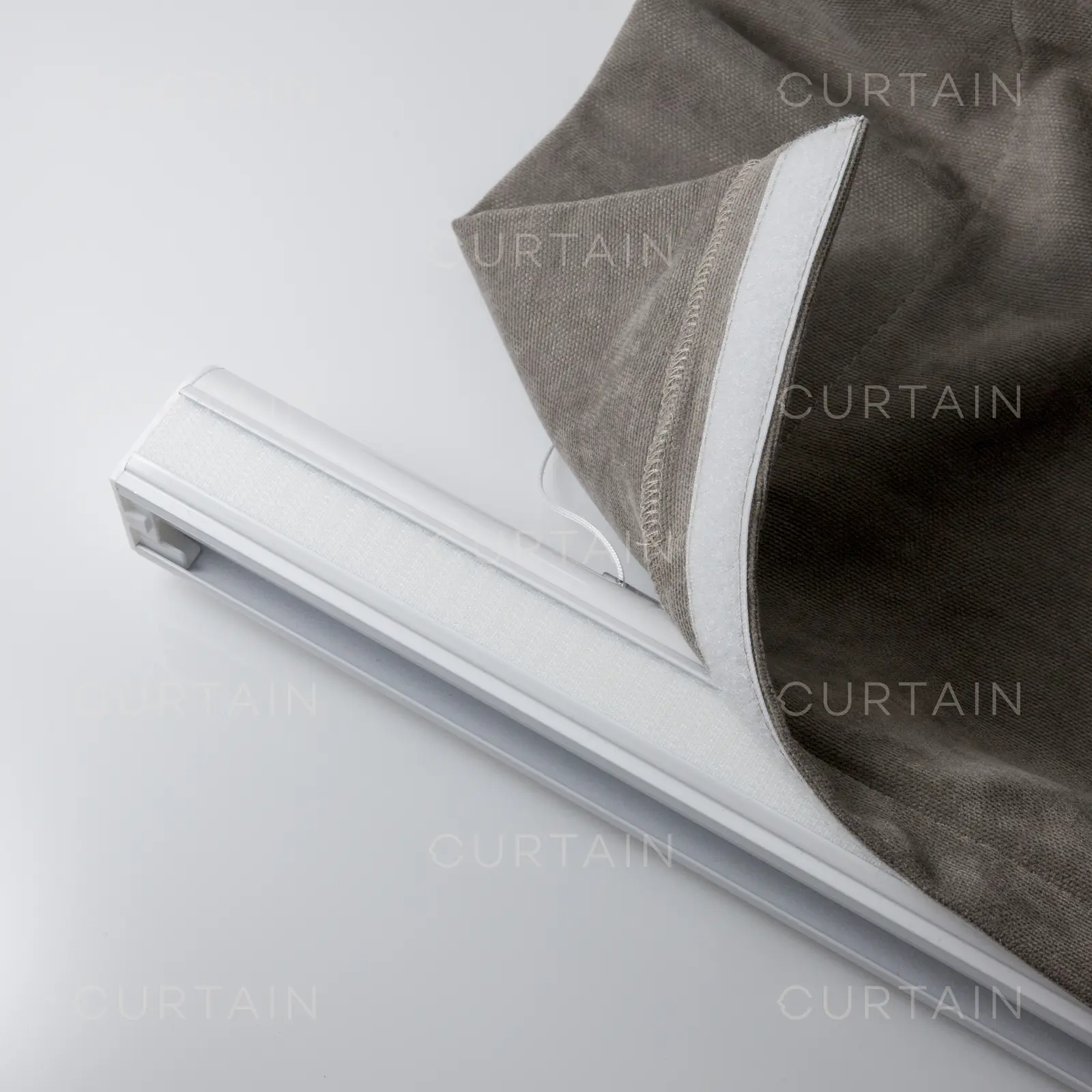
Roman blinds suit a kitchen when the fabric is a polyester blend or Teflon-treated, the window is at least 60 cm from the hob, and a very wide window is covered by two blinds. They cost more than roller blinds (from €90 against €35) but look better in an open-plan kitchen. They pay for themselves if you expect to use them for a long time.
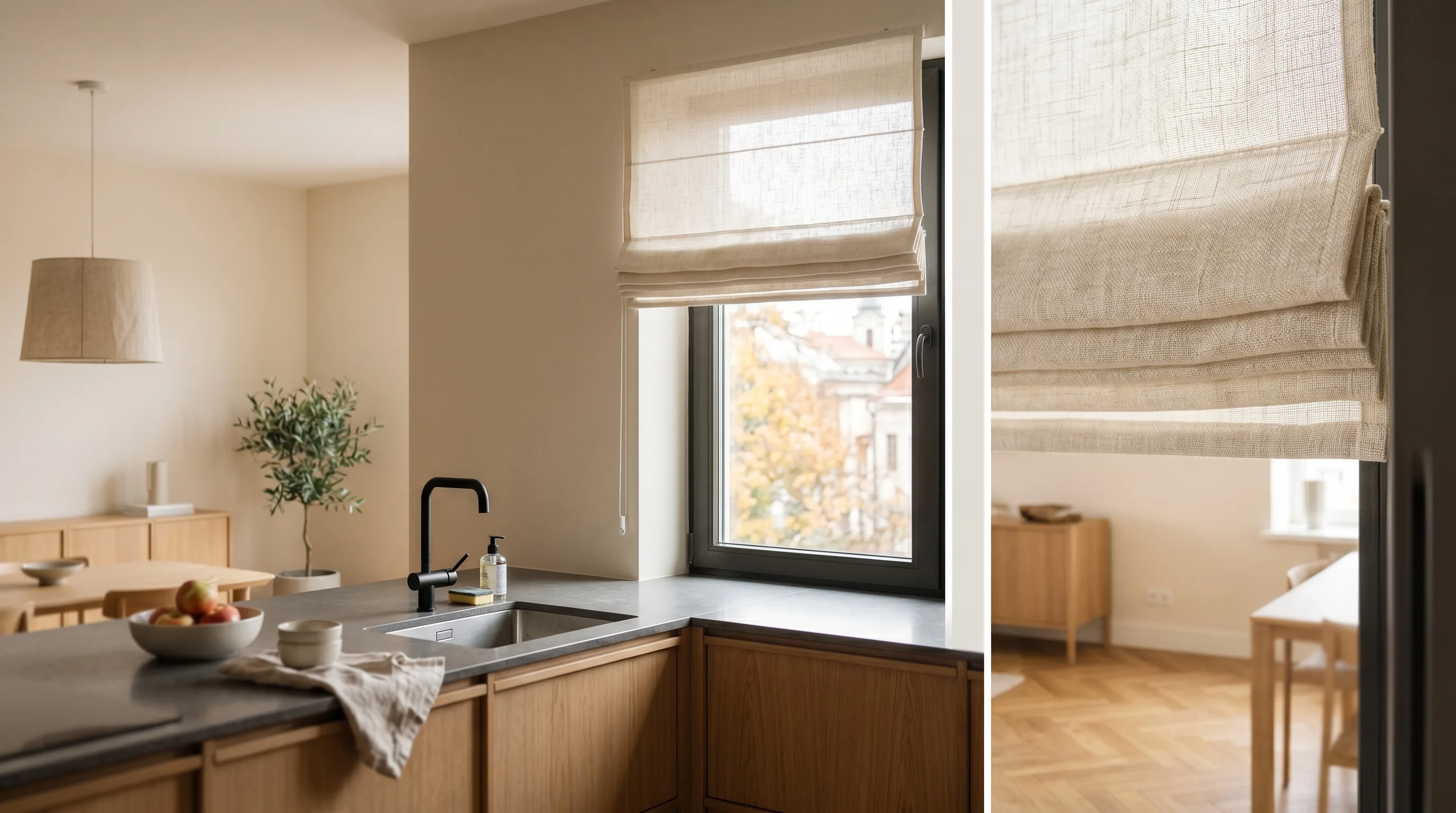
What are roman blinds for kitchens, and when do they suit?
A roman blind is a textile window covering with horizontal folds, raised by a mechanism (a chain, a handle or a motor). In a kitchen, roman blinds suit open-plan flats, where the kitchen is also a living space, the window is seen from the living room or dining area, and looks matter as much as function.
The main difference from a roller blind is that a roman blind forms fixed horizontal folds 20–30 cm high when it is raised, while the fabric of a roller blind winds onto a round tube. It differs from a curtain in the direction of movement: a curtain is drawn sideways, a roman blind goes up. The minimum width of a roman blind is 400 mm, so it suits even a narrow window over a sink.
A common mix-up of terms
Many people use the words roman blind and roller blind as if they meant the same thing. They are different products. A roller blind is a plain roll of fabric on a tube. A roman blind is a textile covering that rises in horizontal folds. For a kitchen, the choice between them rests on looks and budget, not on the name.
Roman blinds, roller blinds or curtains in a kitchen: a quick comparison
Long curtains almost never suit a kitchen: they touch the worktop, soak up grease and are hard to keep clean. The real choice is between a roman blind and a roller blind, and it comes down to looks, budget and whether the kitchen is open to the living room.
| Point | Roman blinds | Roller blinds | Curtains |
|---|---|---|---|
| Contact with the worktop | None | None | They touch (the long ones) |
| Thickness of fabric | Medium (folds) | Thin | Thick |
| Cleaning | Take down, 30 °C (polyester) | Damp cloth | A full wash |
| Price (90 × 140 cm) | €140–240 | €35–80 | €100+ with tracks |
| Child safety | Cordless or motorised | Cordless or motorised | Yes, if without tiebacks |
| Lifespan | Long, if the fabric suits a kitchen | Long | Longest (good ones) |
| Look in a kitchen | Soft folds | Minimal | Too heavy |
| Resistance to damp | Polyester + Teflon: good | PVC: good | Poor |
| Mechanism faults | Moderate | Rare | The track is stable |
| Where it suits | Above a sink, medium windows | Anywhere | Large windows, away from the hob |
It is often said that blinds are better in a kitchen because roller blinds get splashed with grease. That no longer holds: modern Teflon-treated polyester roller blinds hold up well in a kitchen, as long as the window is not directly above the hob. Roman blinds cost roughly two to three times as much as roller blinds, but in an open-plan kitchen the look makes up the difference.
Which fabrics suit roman blinds in a kitchen?
The commonest mistake in choosing roman blinds for a kitchen is the wrong fabric. Natural linen, thick cotton or velour, hung 1.5 metres from a hob, takes on the smell of fried onion within six months, and it does not wash out. It is the first reason customers come back to complain during the warranty period, and it is a care mistake, not a defect in the fabric, so the warranty does not apply.
Kitchen aerosols (oil droplets, combustion products, steam) condense on the nearest surfaces. The structure of the fibre decides how much grease and smell is absorbed over a year, and rougher fibres (wool, linen) hold more than smoother ones (polyester).
| Fabric | Suits a kitchen? | Why | Price (€/m²) |
|---|---|---|---|
| 100% polyester | Yes | Does not absorb grease; washes at 30 °C | 15–25 |
| Polyester blend | Yes (moderately) | A compromise between looks and care | 20–30 |
| Teflon / C6 treated | Yes (the strongest choice) | Repels water and grease | 25–40 |
| Pure cotton | No | Absorbs smells and grease; hard to clean | — |
| Linen | No | The fibres hold smells; poor resistance to UV | — |
| Blackout (heavy) | With care | Suits only windows more than 60 cm from the hob | 30–45 |
If a customer insists on linen
Linen lasts a good deal less in a kitchen than in other rooms, because grease and steam age it faster. Where the linen look matters, a linen-look polyester blend with a Teflon finish looks similar and stands up to a kitchen.
Makers present Teflon-treated fabric as a "stain-repellent" finish. Chemically it is a C6 fluorotelomer, a chain of six carbon atoms that replaced the older C8/PFOA version because of environmental restrictions. The finish does not last for ever. Each wash weakens it, so whatever the label says, keep kitchen roman blinds out of the washing machine.
Day and night roman blinds in a kitchen: when they are worth it and when not
Day and night (two-layer) roman blinds are worth it in a kitchen when it is also a place to work or live: in open-plan flats with south or west sun. A classic single-layer roman blind earns its price in simple kitchens, where the only job is to see whether the sun is shining.
When a day and night roman blind is worth it:
- 1A kitchen-diner in an open plan: the window is seen from two zones, and you need flexibility between privacy and light at different times of day.
- 2A kitchen with a work area: a computer on the island, children's homework at the table, where glare on a screen is a real nuisance.
- 3South- or west-facing windows: strong afternoon sun, but you do not want to choose between fully closed and fully open.
- 4A window above a sink with a neighbour close by: privacy at certain hours, but daylight wanted all the time.
- 5Customers who want one blind to do everything rather than separate day and night layers.
When a day and night roman blind is not worth it:
- 1A kitchen that is only a kitchen, with a small window: two layers are surplus, and more mechanism means more cleaning and more faults.
- 2Windows close to the hob: a double layer of fabric collects twice the grease and smell, and is harder to clean.
- 3North-facing windows: the need to control light is minimal, and you pay a surcharge of 30–50% for a function you will not use.
- 4Small windows up to about 80 cm wide: the mechanism and two layers swallow the window and make it look overloaded.
- 5Budget-conscious customers: in a kitchen the return on a day and night blind is poorer than in a bedroom, where blackout is needed.
- 6Customers who will seldom use the adjustment: if someone lowers and raises the blind twice a day, a classic blind does the same job for less.
The rule in one sentence
Day and night suits kitchens that are also a place to work or live. A classic roman blind suits kitchens that are only kitchens.
See the day and night roman blind options
See examples of classic and day and night roman blinds, the fabric collections and the prices.
Day and night roman blindsMeasuring a kitchen window: four scenarios
Before ordering a roman blind for a kitchen you must measure four things: the width of the window opening, the height, the arc of the handle and the depth of the recess. Skip any of them and you risk a mechanism fault or a fitting conflict that costs tens of euros to put right.
Scenario A: a window above the sink (the commonest)
Measure the width of the window at three places, at the top, in the middle and at the bottom, because older windows can differ in width as the building settles. Measure the height from the top to the sill or the worktop. Leave at least 5 cm between the bottom edge of the blind and the worktop, so that the fabric does not touch. For a blind above a sink, the mechanism is a chain or a motor, if the window is high and hard to reach.
Scenario B: a window above a worktop with no sink
Measure as in A, but work out separately the distance to the food-preparation zone and to the hob, if it is under the window. The minimum safe distance from the hob to the bottom edge of the fabric is 60 cm. A smaller distance speeds up wear on the fabric and, with a gas hob, creates a fire risk. Here, choose a Teflon-treated fabric and avoid blackout.
Scenario C: a window with a tilt-and-turn handle (DIY mistake no. 1)
Kitchen windows are most often opened for ventilation by tilting, and the handle turns through 70–90° and swings into the path of the blind. Measure the diameter of the handle's arc with the window tilted for ventilation. If the handle sticks out more than 2 cm when tilted, choose a fix on the wall or ceiling, not in the window recess. It is one of the commonest causes of failure in kitchen roman blinds.
Scenario D: a narrow Soviet-era flat (khrushchyovka, brezhnevka)
In older Soviet-era flats the depth of the window recess is often only 40–50 mm, while a cassette roman blind needs 50–70 mm for the mechanism. Measure the depth of the recess exactly: if it is under 50 mm, choose an open (non-cassette) roman blind, or a fix on the wall. In Vilnius Old Town this scenario is the commonest, so at the measuring visit the depth of the recess is always checked before a cassette option is suggested.
Fitting: yourself or by a professional?
A kitchen roman blind can be fitted yourself in a simple case. In a harder one, a professional saves the tens or hundreds of euros that damaged tiles or a new blind would cost.
When to call a professional fitter: five rules.
- 1The clearance of the handle's arc is under 2 cm when the window is tilted for ventilation. The blind will rub against the handle and wear through the fabric at the point of contact within 2–3 months.
- 2A tiled or concrete wall above the sink: plasterboard anchors split tiles; the job needs a diamond drill bit and anchors made for tiles.
- 3The depth of the recess is under 50 mm and you want the cassette version. The mechanism needs at least 50–70 mm, or the cassette will not hold.
- 4The window is wider than 150 cm: the blind is heavy and needs two people to fit, and one person risks an injury.
- 5A rented flat: if you damage the wall or tiles you cannot put them right, and the landlord will keep the deposit.
A simple rule for the kitchen
If the window is over a sink with a tiled wall, this is not a DIY job. A mistake here is expensive: a cracked tile has to be replaced, and the blind fitted again.
How reliable are the mechanisms, and what about child safety?
The most suitable mechanism for a kitchen is a motor with IP44 or better protection. A chain wears faster in a kitchen because of the film of grease, and a battery motor needs its battery changed more often because of damp. Compare how long each lasts in a kitchen, not only the price.
| Mechanism | Lifespan in a kitchen | Typical fault | Rating ★ |
|---|---|---|---|
| Chain | 3–5 years | Wear on the plastic gear; a film of grease | ★★★ |
| Motorised, Somfy | 10–15 years | Limit-switch drift (a rare fault) | ★★★★★ |
| Motorised, budget | 5–8 years | Damp getting into the motor | ★★★ |
| Battery | Change the battery every 3–4 years | Wear on the lithium-ion battery in damp | ★★★ |
A chain mechanism is the cheapest, but a poor choice in a kitchen because of grease. Kitchen aerosols coat the chain and the gear, the mechanism starts to stick, and the plastic parts wear out faster than in a bedroom. A motor with IP44 protection is enclosed, so grease and steam do not reach it, and mechanisms and motors carry our 24-month warranty.
The greatest danger to small children is a loose hanging control cord or chain, which can wrap around a neck. Fix the chain to the wall with a safety cleat so that it is taut and out of the child's reach, and keep chairs and furniture a child can climb away from the window.
Homes with small children
For customers with small children we offer motorised or cordless options: without a loose chain it is safer. It is a question we ask at every consultation, before suggesting a mechanism.
In the United States the equivalent rule is ANSI/WCMA A100.1-2022, in force from 1 June 2024, which is stricter: it does not allow loose hanging control cords even on made-to-order products. In Europe chains with safety elements (breakaway connectors, cord cleats) are used, but no cords at all is still the safest.
Gas or electric hob: does it matter?
We often ask customers whether the kitchen has a gas or an electric hob. In practice it is not the main factor in how long a roman blind's fabric lasts. What matters most is the power of the extractor hood and whether it is actually switched on when cooking. That factor counts for far more than the type of hob.
A gas hob does produce more damp, nitrogen oxides and fine particles, so light natural fabrics can take on a yellowish tinge within 3–5 years. With a modern polyester blend or a Teflon-treated fabric, the difference between a gas and an induction kitchen all but disappears.
A customer with a gas hob and a powerful, regularly used hood will have a roman blind that lasts longer than a customer with an induction hob and a weak hood, or one that is never switched on. A kitchen without a hood, or with one that is not used, produces a large share of the damp in the whole house. A working hood reduces the damp from cooking, and it is the simple factor that decides how long the blind lasts.
The same advice for both cases
A polyester blend with a stain-repellent finish, at least 60 cm from the hob, and a working extractor hood. The type of hob is a secondary factor.
Care: cleaning, washing and removing grease
There is one rule we tell every kitchen customer before an order: kitchen roman blinds must not be washed in a washing machine, even if the label allows it. Kitchen grease and hot water together set a stain that does not come out. In that case the warranty does not apply, because it is a care mistake, not a defect in the fabric. Have the blinds dry-cleaned professionally, or replace the fabric every 3–4 years.
A note of caution
One machine wash is enough to ruin a kitchen roman blind: the fabric then has to be replaced.
| How often | What to do | With what |
|---|---|---|
| Every week | Remove dust | A vacuum cleaner with a soft attachment |
| Every 2 weeks | Surface cleaning | A damp cloth; mild soap at up to 30 °C |
| Every 2–3 months | Hand cleaning in place | Water at 30 °C, a pH 7 detergent |
| Every 6–12 months | Deep cleaning | Professional dry cleaning |
| Every 3–4 years | Replace the fabric | The cassette stays; only the material is changed |
For Teflon-treated fabric the intervals are a little longer: hand cleaning in place can be done every 3–4 months instead of every other week. But that does not mean such fabrics last for ever. After many cleanings the Teflon finish loses a large part of its effect, and the fabric starts to behave like plain polyester.
Five mistakes to avoid when choosing roman blinds for a kitchen
The same five mistakes come up again and again when kitchen roman blinds are chosen. Each can be avoided at the consultation, before the order.
1. A natural fabric 1.5 metres from the hob
A customer sees Belgian linen in a box of fabric samples, falls in love with the texture and does not allow for the window being 1.5 metres from a gas hob. Within six months the fabric smells of fried onion, and it does not wash out. The fix is a polyester blend or a Teflon-treated polyester. Where the linen look matters, there are linen-look fabrics that come close.
2. The arc of the handle ignored when measuring
The second commonest cause of failure in kitchen roman blinds. The customer measures only the window opening and forgets that a window tilted for ventilation has an arc of a few centimetres. The blind rubs on the handle each time it is lowered, and within 2–3 months the fabric is worn through at the point of contact. The fix is to measure the diameter of the handle's arc with the window tilted, and if it is over 2 cm, to choose a fix on the wall, not in the recess.
3. Blackout for a small north-facing window
A surcharge of 30–40% is paid for full darkening that a north-facing window will never need. With a north-facing window and frosted glass the light is already controlled enough. The fix is a dim-out fabric (it darkens the room without full darkness) or a plain polyester day fabric. Use the saving for a better mechanism.
4. A tiled wall without the right anchors
A plasterboard anchor driven into a tiled wall above the sink splits the tiles. The result is a tile that has to be replaced (at €80–200) and a blind that has to be fitted somewhere else. It is the typical DIY disaster above a sink. The fix is a diamond bit and anchors made for tiles, or a professional fitter.
5. Budgeting for the blind only, not the whole package
A customer sees "from €90" in the calculator and does not realise that a boxed system, a smart-home module, a cassette cover, a non-standard fixing or a rush-making service are separate extras at €50–250 each. Then the designer arrives to measure, and the final price is "almost double", which is the classic complaint on the forums.
How to avoid price surprises
Get a detailed offer in writing, with every extra, before you order. After measuring you receive the exact final price, not a "from €X" advertisement. That avoids situations where "the price went up because it was measured wrongly".
What do roman blinds for a kitchen cost in 2026?
In 2026 in Lithuania, kitchen roman blinds cost from €90 for a small window to €450 for a large window with a motor. The final price depends on four factors: the size of the window, the type of fabric, the mechanism and whether a cassette cover is needed.
| Window size | Fabric | Mechanism | Price from |
|---|---|---|---|
| Small (60 × 90 cm) | Polyester, economy | Chain | €90–160 |
| Medium (90 × 140 cm) | Polyester or a blend | Chain | €140–240 |
| Medium (90 × 140 cm) | Teflon-treated | Chain or motorised | €180–260 |
| Large (120 × 140 cm) | Teflon + UV protection | Chain | €180–310 |
| Medium + day and night | Voile + blackout | Double mechanism | €280–400 |
| Large (150 × 180 cm) | Teflon + UV | Chain | €260–450 |
| Motorised, for a kitchen | Teflon-treated | Motor | from €350 |
The base price covers a fabric from the standard collection, a chain mechanism and standard brackets. Extras are priced separately: a motor from €120 to €250, a cassette cover €30–80, Teflon treatment +€20–40 per square metre, a smart-home module (Wi-Fi, Zigbee, Matter) €60–120, and a non-standard fixing for concrete or tiles €20–40 per fixing point.
Get an exact price for your window
After measuring you receive the final price in writing, not a general "from €X" offer. That rules out cases where "the price went up" after the order.
Arrange a measuring visitRoman blinds in Vilnius kitchens: district by district
Different districts of Vilnius bring different challenges, from the narrow recesses of the Old Town to the large windows of Pilaitė with their south-facing sun. So at the measuring visit we always ask where exactly the flat is, and allow for the type of building and which way the windows face.
Old Town
Narrow window recesses (often no deeper than 40 mm) and non-standard window dimensions: trapezoid, arched, older wooden frames. In historic rooms customers avoid drilling the walls, so the blind is usually fixed to the window frame. Cassette roman blinds often do not suit here: we choose a plain classic one with a chain or, when the window is high, a motorised one.
Žvėrynas and Antakalnis
South- and west-facing windows, kitchens with strong afternoon sun. UV protection is essential: we choose a Teflon finish and a UV-resistant polyester. Vilnius summers bring strong sun, and fabrics on south-facing kitchen windows without UV protection lose their colour within 3–5 years. It shows most in bright, saturated tones.
Naujamiestis and Šnipiškės
The modern open-plan flat: the kitchen is often joined to the dining room or living room. Here day and night roman blinds earn their price, because the window is seen from two zones. Panoramic windows can be wider than 150 cm, which calls for two mechanisms and two people to fit them.
Pilaitė, Pašilaičiai and Perkūnkiemis
New-build flats with standard windows of 1.2–1.5 metres. The most economical choice is a classic roman blind with a chain mechanism, in a fabric from the standard collection. A roman blind for a 120 × 140 cm window in a polyester blend is often enough for such a kitchen, and it can be fitted in one visit. For these customers we often suggest a version without the cassette: the price is lowest, the mechanism stays open, but the look of the kitchen does not suffer.
Frequently asked questions
Do roman blinds suit a kitchen?
Yes, if the fabric is polyester or Teflon-treated, the window is at least 60 cm from the hob; a very wide window is better covered by two blinds. Pure cotton, linen or velour do not suit a kitchen: they absorb smells and grease. The sound choice is a polyester blend with a Teflon finish.
What are the drawbacks of roman blinds in a kitchen?
They cost more than roller blinds: from €90 against €35 for a small window. They need more careful care: cleaning by hand instead of a wipe with a cloth. On a very wide window a single blind is heavy, so such a window is usually covered by two. Blackout or thick fabric does not suit windows closer than 60 cm to the hob.
What is the best window dressing for a kitchen?
For a kitchen, roman blinds are the usual choice if looks matter and the kitchen is open-plan, and roller blinds if the budget is limited and the kitchen is only a kitchen. Aluminium venetian blinds suit above a sink because they resist damp. Curtains do not suit a kitchen: they touch the worktop and soak up grease.
What do roman blinds for a kitchen cost in 2026?
From €90 for a small window (60 × 90 cm, polyester, chain) to €450 for a large one (150 × 180 cm, Teflon fabric, motor). A standard kitchen window of 90 × 140 cm in a polyester fabric costs €140–240.
Can kitchen roman blinds be washed in a washing machine?
No, even if the label allows it. The combination of kitchen grease and hot water sets a stain in the fabric, and it does not come out. This is a care mistake, not a defect in the fabric, and the warranty does not apply. Have the blinds dry-cleaned professionally, or replace the fabric every 3–4 years.
How often do roman blinds in a kitchen need cleaning?
Dust: every week, with a vacuum cleaner with a soft attachment. Surface cleaning with a damp cloth: every 2 weeks. Hand cleaning in place: every 2–3 months. Deep (dry) cleaning: every 6–12 months. For Teflon-treated fabric the intervals are a little longer.
Do I need to buy the mechanism separately?
No. An ordinary chain mechanism is included in the base price of the blind. A motor, a cassette cover and a smart-home module are separate extras, at €50–250 each. After measuring you receive a detailed offer with every extra.
What is the minimum width of a roman blind?
400 mm (40 cm). For narrow windows we recommend a plain classic roman blind, not a day and night one: a double-layer mechanism looks overloaded in a narrow window.
Will a roman blind cover the windowsill and the flowers?
No. A roman blind stops where you choose: at the worktop, at the sill or higher. It is never fitted lower than the worktop. One of the questions at measuring is whether flowers stand on the sill, and the length is chosen to suit.
How does a roman blind differ from a roller blind?
A roller blind winds onto a round tube: a thin, continuous fabric. A roman blind forms horizontal folds 20–30 cm high: a thicker fabric and a more complex mechanism. A roman blind looks soft and textile; a roller blind looks minimal. In price, a roman blind is about two to three times dearer than a roller blind.
Does a kitchen need a motorised blind?
Not necessarily, but a motor suits a high window (above 2 m from the floor) or a home with small children (no cords is safer). In a kitchen a motor with IP44 protection is often more durable than a chain, because the closed housing keeps grease out.
How do I order roman blinds for a kitchen?
In four steps: 1) a measuring visit and consultation; 2) a final offer in writing, with every extra; 3) making, with installation 3–4 weeks after order confirmation; 4) fitting in your kitchen.
Are there cordless roman blinds for families with children?
Yes. In a home with small children a loose chain is a danger, so we recommend a motor (Somfy or Brel) or a cordless spring mechanism. The motorised version is safe and convenient, and the motor carries our 24-month warranty.
What warranty do roman blinds have?
Our warranty covers sewing and tracks for 12 months, and mechanisms and motors, electric ones included, for 24 months. Note that the warranty does not cover care mistakes: washing in a machine, using the wrong cleaner, or damage to the fabric from the hob (when the 60 cm distance is not kept).
Related guides and pages
More on specific types of roman blind and other kitchen window dressings: the kitchen roman blinds page, with fabric samples and a full price table; the roman blinds category, with every type and mechanism; day and night roman blinds, if you are planning a two-layer system; the guide to when roman blinds suit better than curtains; or the comparison of venetian and roller blinds, if you are still deciding between the three categories.
Ready to take the first step?
Book a measuring visit: the designer measures the window, checks the recess and the handle's arc, and suggests a fabric to suit your kitchen. You receive the final price in writing after one visit. Measuring is free in Vilnius. In Kaunas and Klaipėda it is free on orders of €200 or more. Elsewhere in Lithuania the visit is paid, and the price is agreed beforehand.
Arrange a measuring visitThe next step
If this guide has answered your questions, move on to a specific product or check your budget.