Author: Jegor Janockin
Reviewed by: Curtain.lt editorial team
Last updated:
Roman or roller blinds for a kitchen: a direct comparison
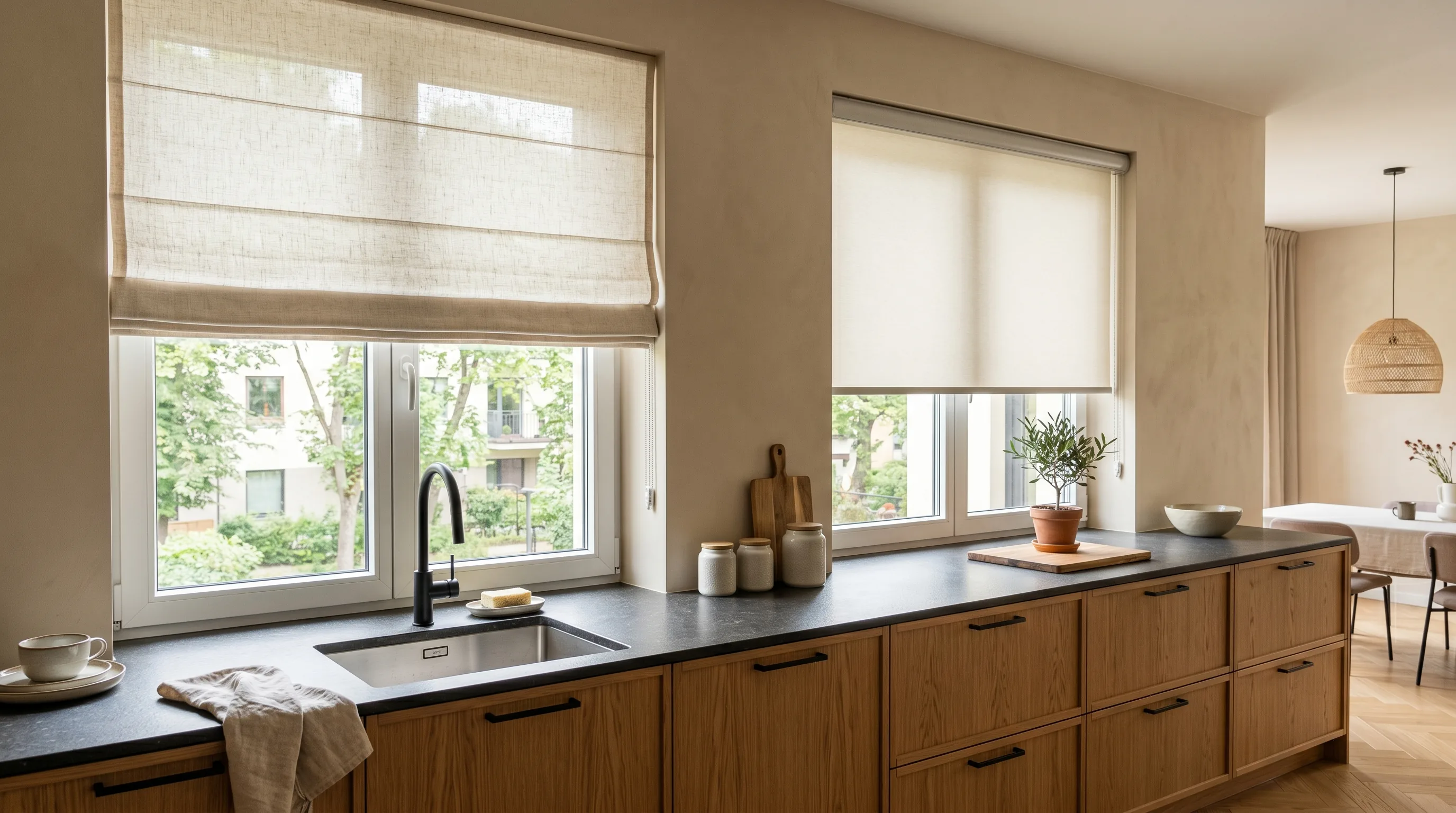
Roman blinds or roller blinds for a kitchen? Roman blinds suit when the kitchen is open to the dining room and looks matter (a window at least 60 cm from the hob, a budget of €90 or more). Roller blinds suit when the kitchen is only a kitchen and function and price come first (from €35). The fabric requirements are similar (polyester with a Teflon finish), but the construction and the look are quite different. This guide has a decision table, a comparison of fabrics, EN 13120 safety, gas against electric hobs, prices and the five mistakes we see most often in kitchens.
How the two are built
A roman blind is a single panel of fabric drawn into horizontal folds by a mechanism. It looks more like a curtain panel than a blind. A cassette at the top covers the mechanism, and the fabric stops 5–8 cm above the sill or the worktop.
A roller blind is a single sheet of fabric wound onto a tube at the top. There are three types: classic (an open tube), cassette (a closed one) and day and night (two overlapping layers of fabric). Function matters more than looks, and roller blinds cost 30–60% less than roman blinds.
Roman blinds or roller blinds for a kitchen: an eight-point decision table
| Point | Roman blinds | Roller blinds |
|---|---|---|
| 1. Look in an open-plan kitchen | ★★★★★ (like a curtain panel) | ★★★ (plain and functional) |
| 2. Resistance to damp and grease | ★★★★ (Teflon polyester) | ★★★★ (PVC or Teflon) |
| 3. Cleaning | ★★★ (hand cleaning plus dry cleaning) | ★★★★★ (a damp cloth, 2 minutes) |
| 4. Lifespan in a kitchen | ★★★ (shorter, because of the greasy air) | ★★★★ (simpler construction) |
| 5. Starting price | ★★ (from €90) | ★★★★★ (from €35) |
| 6. Reliability of the mechanism with grease | ★★★ (a chain wears faster) | ★★★★ (fewer moving parts) |
| 7. Control of light | ★★★ (open, half or closed) | ★★★★ (graded, by how far it is turned) |
| 8. Fit with a classic interior | ★★★★★ | ★★★ |
When to choose roman blinds for a kitchen: five scenarios
- 1An open-plan kitchen that runs into the dining room or living room: a roman blind looks like a curtain panel and ties the interior together.
- 2A kitchen that is the centre of the design, in well-appointed flats in Antakalnis and Žirmūnai in Vilnius or Žaliakalnis in Kaunas: roman blinds add a classic look.
- 3A window at least 60 cm from the hob and an effective extractor hood: then the fabric keeps its look for a long time.
- 4A budget of €90 or more and a wish for a better-finished window: a roman blind in Teflon fabric is worth its price.
- 5A classic or modern classic interior (Scandinavian, French, English style): roman blinds suit it well.
When to choose roller blinds for a kitchen: five scenarios
- 1A functional kitchen with no dining area: when the kitchen is only a kitchen, looks matter less.
- 2A limited budget: roller blinds cost 30–50% less than roman blinds and do much the same job.
- 3A window close to the hob (under 60 cm): a PVC roller blind resists steam and heat better than a textile one.
- 4A small window above a sink: a roller blind is compact, does not cover part of the worktop and wipes clean with a damp cloth in 2 minutes.
- 5A modern minimalist interior: a roller blind matches the clean lines, and a roman blind can look too decorative.
Fabric for a kitchen: Teflon finish, polyester and what to avoid
Both roman blinds and roller blinds for a kitchen need a fabric that resists damp, grease and smells. The main choice is polyester with a Teflon or C6 fluorotelomer finish. The chemistry is similar, but the width and the use differ a little.
| Fabric | For roman blinds | For roller blinds | Price |
|---|---|---|---|
| Polyester + Teflon C6 | ★★★★★ | ★★★★★ | €15–30/m |
| Polyester blend (no Teflon) | ★★★ | ★★★ | €8–18/m |
| PVC-coated fabric | ★ (not suited to the construction) | ★★★★★ (the choice for roller blinds) | €12–22/m |
| Linen | ★ (absorbs smells within 6 months) | N/A | — |
| Cotton | ★★ (washable, but holds smells) | N/A | — |
| Blackout fabric | ★★ (too heavy for a kitchen) | ★★★ (if you need darkening) | €20–35/m |
Linen in a kitchen, especially close to a gas hob, lasts a good deal less than in other rooms, because grease and steam age it faster. If the linen look matters, the alternative is a linen-look polyester blend with a Teflon finish. It looks similar but stands up to kitchen conditions.
Gas or electric hob: does it matter?
We often ask customers whether the kitchen has a gas or an electric hob. In practice it is not the main factor in how long the fabric of a roman or roller blind lasts. What matters most is the power of the extractor hood and whether it is actually switched on when cooking. That factor counts for far more than the type of hob.
Much of the talk about gas hobs is folk wisdom. Modern polyester + Teflon fabrics stand up both to the heat of a gas hob and to hot steam, as long as the minimum safe distance (60 cm) is kept and the hood works. Customers whose kitchen fabric spoiled within 6–12 months usually had one of these problems: (a) the window was 30–40 cm from the hob, (b) the hood's power was under 300 m³/h, or (c) the hood was never switched on.
A practical test
If your extractor hood is rated at 600 m³/h or more and is switched on when you cook, a modern polyester + Teflon fabric will stand up to the conditions of a gas or an electric hob. If the hood is weak, or you do not use it, deal with the hood before the window dressing.
Child safety in the kitchen
A loose hanging control chain is a danger to small children. In a kitchen the risk is real: children are often there with their parents and can reach a chain. For every customer with small children we offer (a) a motor with a remote control, or (b) a cordless version.
The difference in price: a cordless version adds €40–80, and a Somfy motor €120–250. It is a one-off cost, and safety is not something to negotiate. With a motor, keep the remote out of the child's reach and the power cable fixed and hidden.
What do roman and roller blinds for a kitchen cost in 2026?
| Window size | Roller blind | Roman blind | Difference |
|---|---|---|---|
| Small (60 × 120 cm) | €40–75 | €90–160 | €50–85 |
| Medium (90 × 140 cm) | €60–120 | €140–240 | €80–120 |
| Large (120 × 140 cm) | €80–160 | €180–310 | €100–150 |
| Wide (150 × 180 cm) | €110–200 | €260–450 | €150–250 |
Roller blinds for a kitchen cost on average 50% less than roman blinds. They do much the same job (resisting damp, controlling light); the difference is the look of a fabric panel. In an open-plan kitchen a roman blind repays the extra cost. In a closed, working kitchen a roller blind does the job for less.
Five mistakes to avoid in a kitchen
1. Choosing linen or cotton
A customer sees a lovely Belgian linen in a shop, falls in love with the texture and orders it for the kitchen. Within six months the fabric smells of fried onion, and it does not wash out. It is one of the commonest mistakes with kitchen window dressings. The fix is polyester with a Teflon finish, which looks similar to linen but stands up to kitchen conditions.
2. Too close to the hob
A customer measures the window and plans a roman blind in a lovely fabric. They forget that the lower edge of the window is 35 cm from the gas hob. Within six months the fabric loses its colour and stains appear, and the conditions of the warranty are breached. The fix: the minimum safe distance is 60 cm from the hob to the edge of the fabric. If it is smaller, choose a PVC roller blind or an aluminium venetian blind.
3. A chain mechanism instead of cordless or motorised
A chain wears faster in a kitchen because of the film of grease. After three years the chain starts to stick, and the plastic parts wear. The fix: cordless (+€40–80) or a motor (+€120–250). A motor with IP44 protection is enclosed, so grease does not reach it, and it lasts 10–15 years.
4. Washing in the machine
A customer plans to wash a kitchen blind in the machine at 60 °C to remove the grease. The result: the Teflon finish soon loses its effect, the fabric starts to behave like plain polyester and to collect smells. The fix: hand cleaning with a damp cloth every 2 weeks, and professional dry cleaning every 6–12 months (€15–30 per blind). The warranty usually does not apply if the fabric has been machine washed.
5. A classic (open-tube) roller blind in a kitchen
A classic roller blind with an open tube is the cheapest option, but in a kitchen the fabric is exposed to dust, a film of grease and smells. After a year or two a layer shows that a damp cloth does not remove. The fix: a cassette roller blind, where the cassette at the top covers the tube and the fabric is less exposed. The price difference is only €20–40, and it lasts noticeably longer.
Which suits which kind of kitchen in Vilnius, Kaunas and Klaipėda?
In new-build flats in Vilnius open-plan kitchens are common, so roman blinds suit better there (the look ties in with the dining area). In Soviet-era flats in Lazdynai, Justiniškės and Antakalnis, kitchens are mostly closed, so roller blinds are more practical. In renovated flats in Vilnius Old Town, windows are often tall and the look classic, and roman blinds in Teflon polyester are the standard choice.
In Kaunas, roman blinds suit the flats of Žaliakalnis with a classic interior better, and cassette roller blinds suit the blocks of Šilainiai. For flats on the coast in Klaipėda we recommend PVC roller blinds, because of the salty air. In central Klaipėda a combination also works well: a PVC roller blind for function, and a light curtain for looks.
Frequently asked questions
Which resists grease better, a roman blind or a roller blind?
In a Teflon polyester fabric they resist equally well. A PVC roller blind is often more resistant to extreme grease, but looks colder. The advantage of a roman blind is that you can choose a finer fabric that is both resistant and good to look at. The advantage of a roller blind is simpler cleaning (a smooth surface).
Is a roman blind worth the higher price in a kitchen?
It is, when (a) the kitchen is part of an open plan, (b) the window is 60 cm or more from the hob, and (c) the budget allows €90–250 per window. It is not, when (a) the kitchen is closed and functional, (b) the window is close to the hob, or (c) the budget is limited. A roman blind pays its way where looks matter; a roller blind where a simple build and the price matter most.
Which is quicker to clean?
A roller blind: a damp cloth in 2 minutes, with no special preparation. A roman blind: hand cleaning in place, or taking it down and dry cleaning. A roller blind suits families that use the kitchen heavily (cooking five or more times a week) and have little time for care. A roman blind suits a kitchen that is used moderately, where looks matter more than the easiest care.
Can a roman blind and a roller blind be combined at one window?
Yes, but in a kitchen it seldom pays. Two layers (function inside, looks outside) suit a bedroom or living room; in a kitchen one blind is usually enough. The exception is a large window (180 cm or more) in an open-plan kitchen, where a roman blind with a day and night roller blind gives the most flexibility.
Which protects better against kitchen smells?
Neither directly. The main tool for controlling smells is the extractor hood, not the window dressing. With a Teflon fabric (in a roman blind or a roller blind) the fabric resists absorbing smells. Without Teflon, both absorb smells.
How long do roman blinds and roller blinds last in a kitchen?
In a kitchen both last less long than in a living room or bedroom, because grease and steam age them. A roman blind wears faster because of its folds and moving mechanism; a motor in a closed housing keeps grease out. A roller blind is a simpler construction with fewer moving parts. In time it is usually the fabric or the mechanism that is replaced.
Which suits a small kitchen better?
A roller blind is more compact (5–7 cm above the window) and does not crowd a small room. The cassette of a roman blind takes 8–12 cm and looks larger. For small kitchens (up to 8 m²) we recommend a cassette roller blind in a suitable Teflon fabric. For medium and large kitchens (10 m² or more) a roman blind adds looks without reducing the sense of space.
Does a kitchen need a roman blind with a motor?
It does when (a) the window is high and the chain is hard to reach, (b) there are small children in the home (no cords is safer), or (c) you want smart-home control. It is not necessary when the window is within reach and there are no children. The extra cost is €120–250.
How do I book a measuring visit?
Book through the contact page, or write to us in English; we reply by e-mail. The designer comes at the agreed time, measures the windows, assesses the kitchen (the extractor's power, the distance to the hob, whether the window is in a recess) and suggests two or three options with a final price. A visit takes 30–45 minutes, and the quote follows in writing. Measuring is free in Vilnius. In Kaunas and Klaipėda it is free on orders of €200 or more. Elsewhere in Lithuania the visit is paid, and the price is agreed beforehand.
Arrange a measuring visit for the kitchen
The designer assesses your kitchen and suggests a roman or a roller blind to suit your budget and your interior.
Arrange a measuring visitRelated guides
See the related guides: "Roman blinds for kitchens" (a detailed guide to roman blinds only), "Venetian or roller blinds?" (when you are also weighing venetian blinds), "How to choose kitchen curtains" (if you are also weighing curtains) and "When to choose roman blinds" (the general guide, not only for kitchens).
The next step
If this guide has answered your questions, move on to a specific product or check your budget.