Author: Jegor Janockin
Reviewed by: Curtain.lt editorial team
Last updated:
Roman blinds for bedrooms: when they suit and how to choose
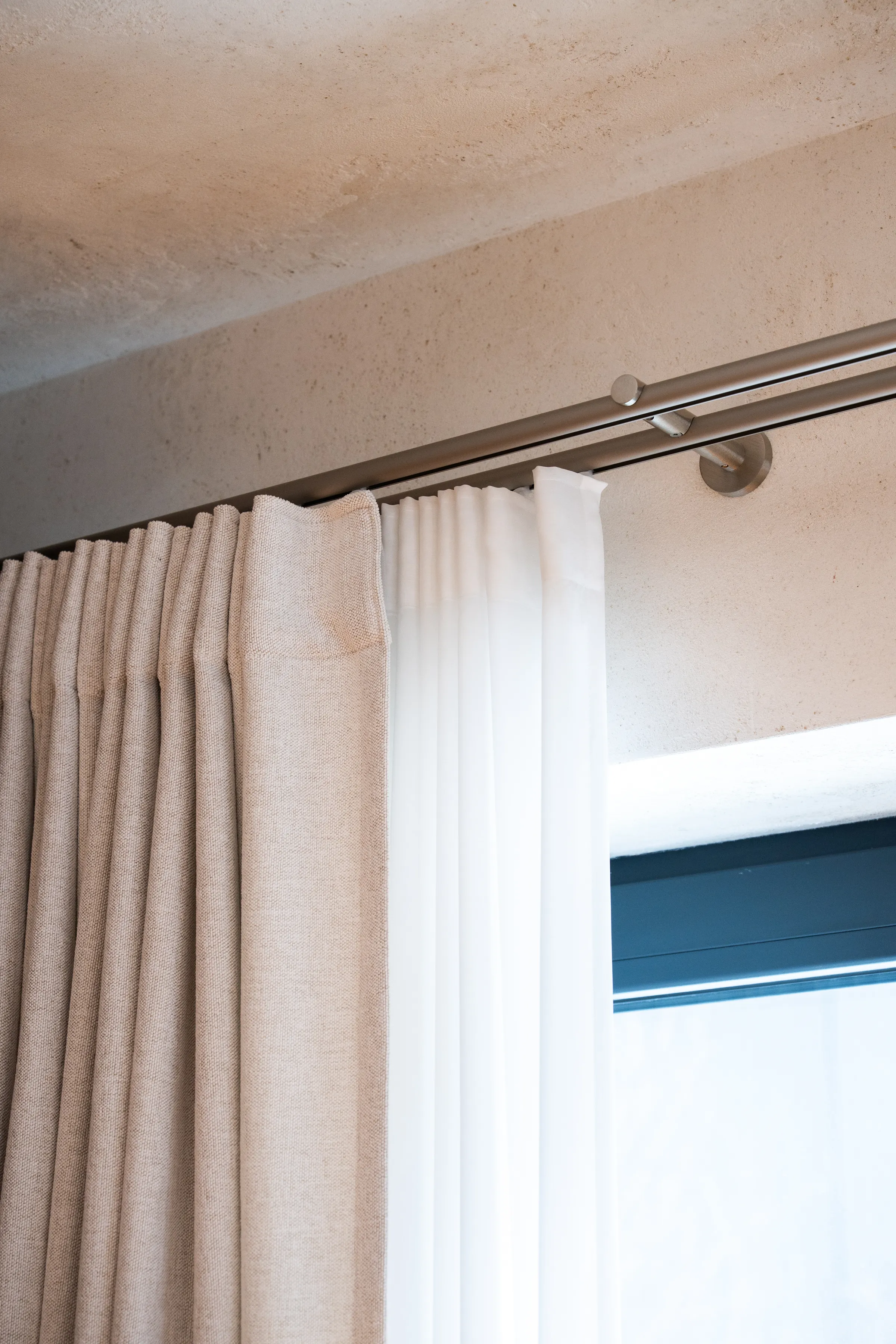
Roman blinds suit a bedroom when you want a good look and near-total darkening at the same time. Unlike in a kitchen, a bedroom allows a wider range of fabrics: linen, velvet, heavy polyester with a blackout lining. The main questions are whether you need full darkening (blackout), how much noise comes in from the street, the style of the room and the budget. This guide has a decision table, a comparison of fabrics, EN 13120 safety, prices from €110 and the five mistakes we see most often.
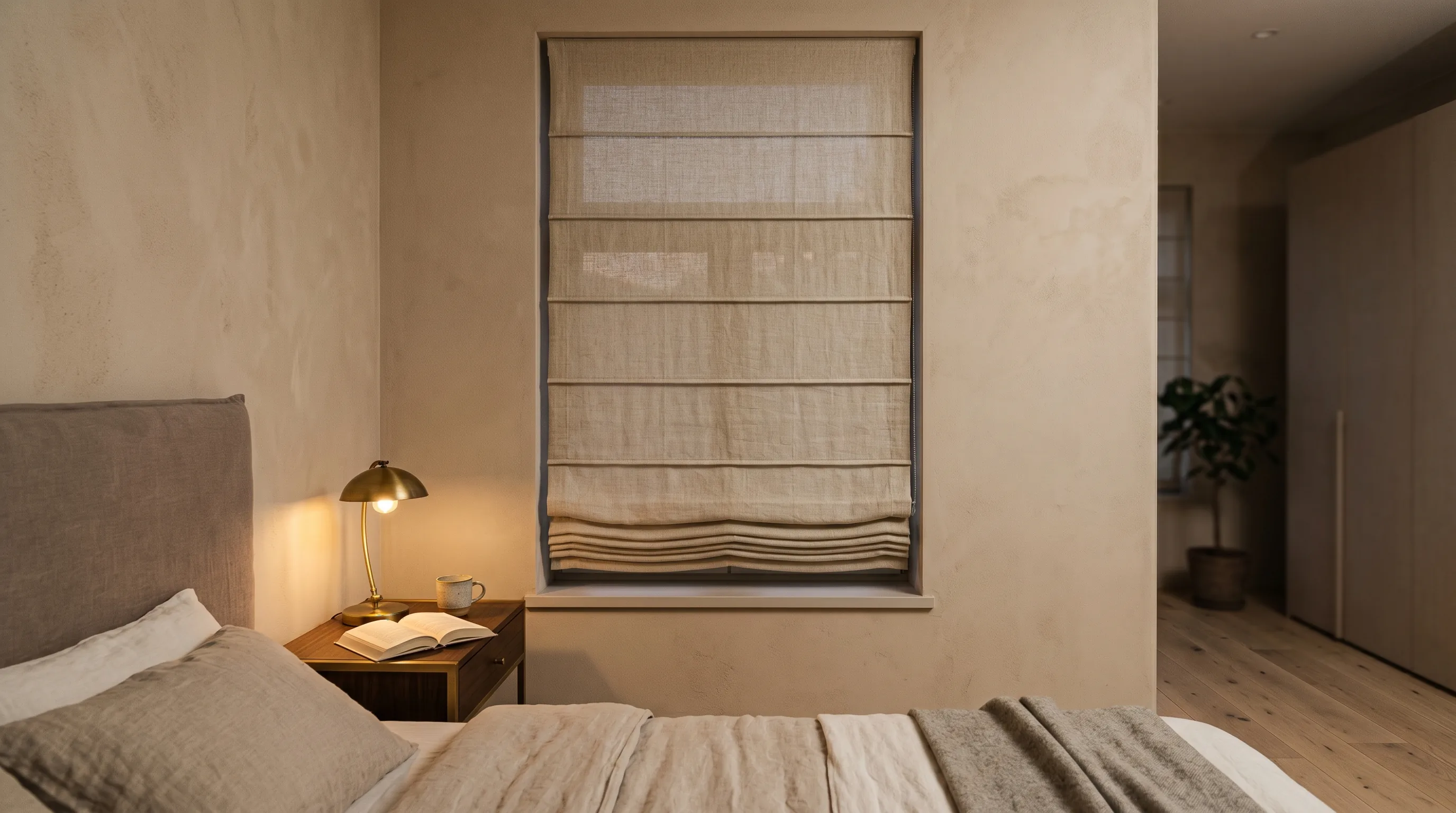
When does a roman blind suit a bedroom?
A roman blind works well in a bedroom when the window is a standard size, the interior is classic or minimalist, and you want a look that is a neat panel of fabric when closed and a deep stack of folds when open.
- 1Standard windows 80–180 cm wide: the mechanism of a roman blind works most reliably in this range.
- 2A classic or minimalist interior, where you want the effect of a flat textile panel instead of folds.
- 3You need full darkening (blackout): a woven roman blind with a blackout fabric darkens better than a single-layer curtain with a lining.
- 4You want to keep the sill usable: a roman blind ends 5–10 cm above the sill, does not cover it and leaves room for plants or decoration.
- 5A medium or higher budget: prices run from €110 for a small window to €450 for a large one (150 × 180 cm) with a blackout lining.
When are roman blinds not right for a bedroom?
- 1The widest windows: a single blind becomes heavy and puts more load on the mechanism, so such a window is usually covered by two roman blinds or by curtains.
- 2Panoramic windows from floor to ceiling: curtains or vertical blinds look better proportioned.
- 3Low ceilings (under 2.4 m) and a small room: the cassette of a roman blind takes 8–12 cm at the top, and the room looks lower.
- 4When sound absorption matters most (street noise): heavy pleated curtains with a lining reduce noise more effectively than a flat roman blind.
- 5When the budget is tight (under €60 per window): a cassette blackout roller blind does a similar job for 30–50% less.
Which fabric suits a roman blind in a bedroom?
In a bedroom, unlike a kitchen, the fabric is chosen for sound, warmth and look, not for resistance to damp. The fabrics below are grouped by what matters most in a bedroom: darkness, texture, sound or budget.
| Priority | Fabric | Typical price per metre | Note |
|---|---|---|---|
| Full darkening | Blackout polyester | €15–30/m | The standard for a bedroom |
| Look and texture | Linen with a blackout lining | €35–60/m | Natural fabric for living rooms and bedrooms |
| Sound and warmth | Velvet with a heavy lining | €40–80/m | The most sound-absorbing of the options |
| A contemporary look | A polyester blend, semi-matt | €12–25/m | All-round; contemporary interiors |
| Budget | Standard polyester (no blackout) | €8–18/m | Only if you do not need full darkness |
| A summer flat | Light cotton | €10–20/m | Airy, but does not darken fully |
Most bedrooms take a roman blind with a blackout lining, which gives the look of fabric and full darkness. Linen with a blackout lining suits renovated flats with high ceilings and a classic interior.
The mechanism: chain, motorised or cordless?
In a bedroom the reliability of the mechanism matters a little less than in a kitchen (there is no grease), but child safety matters a great deal. Where small children are about, controls without loose hanging cords are the safest. The three options, compared for a bedroom:
| Mechanism | Lifespan | Child safety | Price |
|---|---|---|---|
| Chain (the classic) | 7–10 years | Needs a safety cleat | Included |
| Cordless (no cord) | 8–12 years | Safe | +€40–80 |
| Motor on the mains | 10–15 years | Safe | +€120–250 |
| Battery motor | 6–10 years | Safe | +€150–280 |
For households with children under four we offer only a cordless or motorised option. A motor can be worked by remote, by app and on a schedule; the Brel Home app can be linked to Siri, Google Home and Alexa. For other smart-home systems we check compatibility before the order.
A smart-home tip
If you already run a smart-home system, discuss compatibility with the motor before the order. You can set up a morning routine: at 6:30 all the bedroom blinds rise automatically, and at 22:00 they close. It helps most on dark winter mornings.
Sound and street noise
In a flat on a busy central street in Vilnius, noise is often a problem to solve. A heavy fabric with a blackout lining reduces noise, and pleated curtains reduce it further. A roman blind is a compromise here: a single flat layer reduces noise much less.
In a noisy city the answer is two layers: a roman blind plus heavy curtains. The roman blind does the darkening (measured to the recess, and compact), and the curtains absorb the sound. In central Vilnius in 2026 the pair costs €350–600 for a bedroom, and the difference in sleep is noticeable.
Five mistakes to avoid when choosing roman blinds for a bedroom
1. A fabric with no blackout lining
A standard polyester fabric without a blackout lining lets through 20–40% of the light. In a bedroom the customer finds this out on the first sunny morning: the light wakes them at 5:30, and the blind does not protect against it. The fix is a blackout lining (+€8–15 per metre of fabric) or a blackout polyester fabric from the start. The price difference is only €25–50 per window, and the result is far better sleep.
2. A roman blind with no side channels
Even with a blackout fabric, light gets through the gaps between the edges of the blind and the window frame (2–5 mm on each side). Side channels close those gaps. They cost an extra €40–80 depending on the size of the window, and only then is the darkening full. We recommend them to every bedroom customer for whom full darkening matters.
3. Choosing a chain too soon with small children
Customers with children of 1–3 sometimes buy a standard chain without thinking of the cord risk. Once the child starts climbing, the chain becomes dangerous. The fix: if there are, or will be, children under four in the home, choose a cordless or motorised blind from the start. It costs +€40–250, and safety is not something to negotiate.
4. The wrong fabric width, because of a false idea about the folds
Some customers think the "folds" of a roman blind need extra fabric width, as curtains do. In fact the width of a roman blind is set by the way it is fixed, not by the folds. The folds form only when the blind is raised: the lower edge of the fabric draws up and 4–6 horizontal folds form. In a recess the blind is ordered 1 cm narrower than the recess; on the frame it is the glass width plus 4 cm on each side; on the wall above the window it is the window width plus at least 5 cm on each side.
5. A mechanism that is not quiet, in a bedroom
A standard chain mechanism makes a noise when it is worked, enough to wake a partner at 6 a.m. The fix: a silent chain mechanism (+€20–40) or a motor with a quiet mode. Customers often do not think of this until the first morning, which is why we ask about it at the measuring visit.
What do roman blinds for a bedroom cost in 2026?
| Window size | Standard (with blackout) | Linen with a blackout lining | With a motor |
|---|---|---|---|
| Small (60 × 120 cm) | €110–170 | €180–260 | €230–380 |
| Medium (90 × 140 cm) | €160–240 | €260–380 | €320–520 |
| Large (120 × 140 cm) | €200–310 | €320–460 | €400–620 |
| Wide (150 × 180 cm) | €290–450 | €440–620 | €550–780 |
| Double (2 windows of 120 × 140 cm) | €380–580 | €600–860 | €750–1,100 |
The price covers the fabric, the blackout lining (if chosen), the chain or cordless mechanism and the cassette cover. Extras (side channels, a smart-home module) are priced separately.
Which roman blinds suit which kind of home in Vilnius, Kaunas and Klaipėda?
In Vilnius Old Town, Antakalnis and the other historic districts, classic or linen roman blinds with a blackout lining suit better: tall windows and a classic look call for a good fabric, not the cheapest one. In flats in the blocks of Žirmūnai and Pašilaičiai, a mid-range polyester version works well, and a motor helps when the window is high or hard to reach.
For bedrooms facing the street in older houses in central Kaunas, velvet or a heavier fabric suits, and in smaller rooms in the newer blocks of Šilainiai, compact blinds in blackout polyester. For flats on the coast and in Klaipėda we recommend a polyester that resists salt and damp.
Frequently asked questions
Do roman blinds darken a bedroom 100%?
With a blackout fabric and side channels, almost completely (less than 1% of the light remains). Without side channels the darkening reaches about 90–95%: enough for many people, but not for everyone. We recommend side channels for an extra €40–80 in a bedroom; it is a one-off cost that changes the quality of sleep.
How do roman blinds differ from a blackout roller blind?
Construction: a roman blind draws up into horizontal folds, and a roller blind winds onto a tube. Look: a roman blind is closer to a curtain panel, a roller blind to a functional cover. Price: roman blinds cost 30–60% more than a comparable roller blind, but look more refined. Darkening: with a blackout fabric both darken equally well.
Can roman blinds and curtains be combined in a bedroom?
Yes. The roman blind goes inside, for the darkening, and the curtains go next to the wall, for the look and the sound absorption. The pair costs 30–40% more than one layer, and the window then works at every level of privacy, day and night.
Which gives better insulation, roman blinds or curtains?
Lined curtains reduce heat loss through a window slightly more than roman blinds with a blackout lining, because the folds create a double air gap. In Vilnius on cold winter evenings a roman blind is enough in a bedroom, but if the window faces north or the house has poor windows, curtains, or curtains over a roman blind, will give more warmth.
How long do roman blinds last in a bedroom?
The fabric lasts 8–12 years (polyester) or 12–18 years (linen with a blackout lining). The mechanism: a chain 7–10 years, a motor 10–15 years. After that it is usually only the fabric or the mechanism that is replaced, and the cassette stays. With proper care, a roman blind in a good fabric lasts 15 years or more.
Can a roman blind in a bedroom be washed?
The fabric (blackout polyester, blends) can be washed by hand at 30 °C in a basin. Do not machine wash most roman blind fabrics: the lining can delaminate and the coating of the fabric loses its properties. Linen and velvet are dry-cleaned only. In practice it is enough to wipe with a damp cloth every two weeks and to have the blind dry-cleaned every 12–18 months (€15–35 per blind).
Does a bedroom need roman blinds with a motor?
It does when (a) the window is high and hard to reach in the morning, (b) there are small children in the home (no cords is safer), or (c) you want to work the blinds by phone, on a schedule or by voice. It is not necessary when the window is a standard height (180–220 cm), there are no small children and you do not plan smart-home integration. The extra cost is €120–250 per blind.
Do roman blinds suit a panoramic bedroom window?
Yes, but the wider the blind, the heavier it is and the greater the load on the mechanism, so a wide window is usually split into two roman blinds. For a panoramic bedroom window: two separate roman blinds side by side, vertical blinds, or two layers with blackout curtains. For a panoramic window we most often recommend vertical blinds and blackout curtains.
How do day and night roman blinds differ from blackout roman blinds?
Day and night roman blinds have two layers of fabric (see-through and darkening) that overlap. They let you adjust the light. Blackout roman blinds are a single layer of blackout fabric, which either darkens or lets through everything. For a bedroom blackout is usually better (you need full darkening), and for a living room day and night (continuous control by day).
How long does it take to make and fit them?
From order confirmation to installation, roman blinds take 3–4 weeks. That time covers preparing the fabric, making, delivery and fitting, so plan ahead if you need the blinds by a particular date.
How do I book a measuring visit?
Book through the contact page, or write to us in English; we reply by e-mail. The designer comes at the agreed time, measures the windows, assesses the sound and the style of the room, and suggests two or three options with a final price. A visit takes 30–45 minutes, and the quote follows in writing. Measuring is free in Vilnius. In Kaunas and Klaipėda it is free on orders of €200 or more. Elsewhere in Lithuania the visit is paid, and the price is agreed beforehand.
Arrange a measuring visit for the bedroom
The designer measures your bedroom windows, assesses the sound and the style of the room, and suggests two or three roman blinds with a final price.
Arrange a measuring visitRelated guides
See the related guides: "Roman blinds for kitchens" (if you are also weighing the kitchen), "Blinds or curtains?" (a comparison of the alternatives), "Roller blinds or curtains?" (if you are also weighing a cassette blackout roller blind) and "When to choose roman blinds" (the general decision guide, not only for a bedroom).
The next step
If this guide has answered your questions, move on to a specific product or check your budget.