Author: Jegor Janockin
Reviewed by: Curtain.lt editorial team
Last updated:
Blinds or curtains: how to choose, room by room
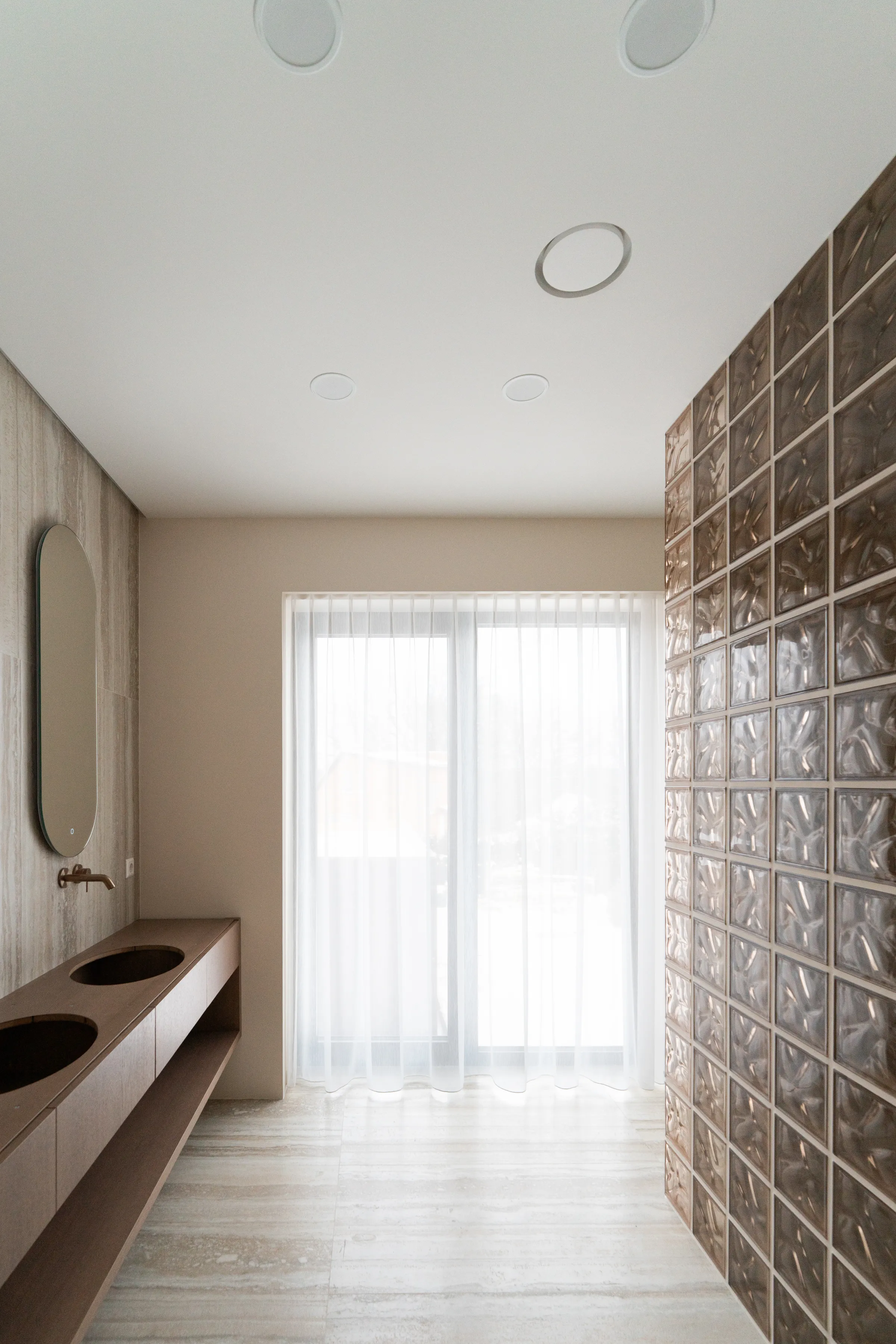
Blinds or curtains? In short: curtains suit the living room and the bedroom, and wherever you want the warmth of fabric. Blinds suit the kitchen, the office and the bathroom, and wherever exact control of light and easy cleaning matter most. The price is similar only at first glance: blinds are cheaper at once, but curtains last longer. This guide gives a twelve-point decision table, verdicts for six rooms, child-safety advice and the five mistakes we see most often.
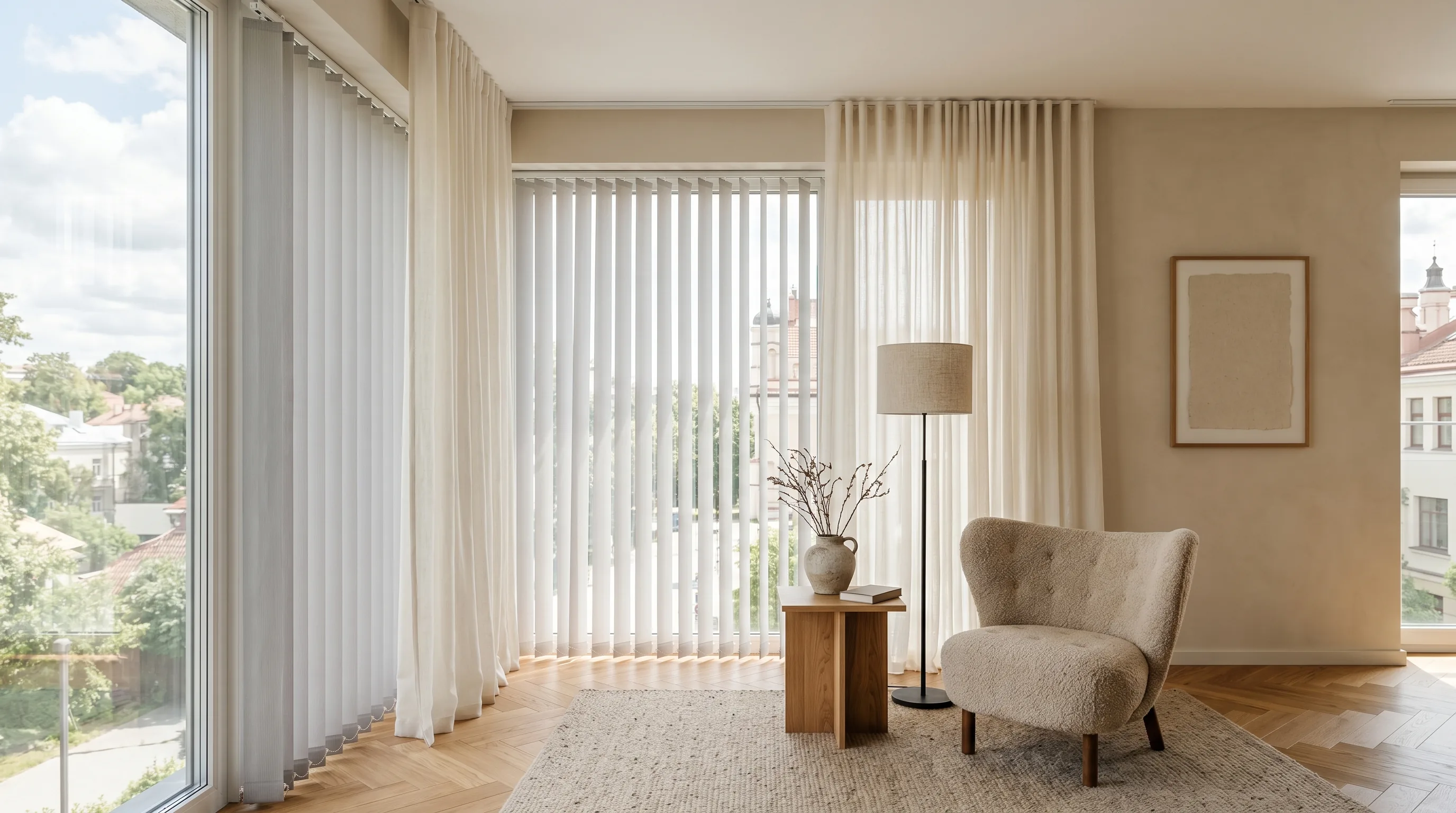
Blinds and curtains: what each one is
Curtains are textile hangings on a track or pole that fall in loose folds. The fabric is soft (linen, cotton, polyester, velvet) and 1.5–2.5 times as wide as the track, to allow for the folds. They are drawn to the sides or held back with tiebacks, the traditional European way to dress a window.
Blinds are a rigid or semi-rigid construction of horizontal or vertical slats. The material is wood, bamboo, aluminium, PVC or woven fabric. They control light by turning the slat (0–180°) or by raising the whole blind. They are compact: they take little room and sit close to the window.
A note on terms
In this guide "blinds" means blinds with rigid slats: venetian (horizontal) and vertical blinds, in wood, aluminium or PVC. Roller blinds and roman blinds are separate categories, and have their own guides. Here we compare slatted blinds with fabric curtains.
Blinds or curtains: a decision table on twelve points
This table sums up the twelve practical points we weigh at every consultation. The stars show which of the two does better on each point.
| Point | Blinds | Curtains |
|---|---|---|
| 1. Exact control of light | ★★★★★ (slat angle 0–180°) | ★★★ (open or closed, not graded) |
| 2. A warm look | ★★ (a rigid construction) | ★★★★★ (fabric, folds, layers) |
| 3. Sound absorption | ★★ (minimal) | ★★★★ (a dense fabric absorbs sound) |
| 4. Thermal insulation | ★★★ (an air gap) | ★★★★ (especially with a lining) |
| 5. Blackout (full darkening) | ★★★ (special models only) | ★★★★★ (a blackout lining is standard) |
| 6. Cleaning | ★★★★★ (a damp cloth, 2–3 minutes) | ★★ (wash at up to 30 °C every 6–12 months) |
| 7. Resistance to damp and grease | ★★★★★ (aluminium, PVC) | ★★ (fabric absorbs smells) |
| 8. Starting price | ★★★★ (from €35/m²) | ★★ (from €70/m with making) |
| 9. Lifespan | ★★★ (8–12 years) | ★★★★★ (good ones 15–25 years) |
| 10. Child safety | ★★ (the risk from the chain) | ★★★★ (without tiebacks: safe) |
| 11. Fit with the interior | ★★★ (modern, Scandinavian) | ★★★★★ (universal) |
| 12. Fitting | ★★★★ (20–40 minutes) | ★★★ (track + hanging, 45–90 minutes) |
The weight of each point depends on the room and the way you live. In a kitchen, for example, point 7 (resistance to damp) matters more than point 2 (a warm look), and in a bedroom it is the other way round.
When to choose blinds: five clear scenarios
- 1In a kitchen less than 60 cm from the hob: aluminium or PVC blinds resist grease, steam and high temperature. Fabric curtains in such a zone take on smells within 6–12 months that no longer wash out.
- 2In an office or study where you need exact control of light at a computer screen. The slats of vertical or horizontal blinds let you tilt the light away from the screen without losing daylight.
- 3In a bathroom: aluminium or PVC blinds do not crease in damp and wipe clean easily. Wooden ones are unsuited, because they can warp where the humidity is over 65%.
- 4In smaller rooms, where curtains would make the room look smaller. Blinds lie almost flat to the window, while curtains with folds take 10–20 cm of space from the wall.
- 5For windows of non-standard size or shape: triangular, arched, a band of 3–5 narrow windows. Blinds are easily made to size, while curtains need extra track constructions.
When to choose curtains: five clear scenarios
- 1In a living room and bedroom, where you want the warmth of fabric. Textile softens the corners and gives a room the feeling of being finished, while blinds often leave an interior a little industrial.
- 2For large windows from floor to ceiling (especially panoramic ones): curtains from ceiling to floor give a vertical sense of height. Blinds can look heavy and mechanical at that scale.
- 3If sound matters: a home cinema corner, a work room with video calls, a bedroom on a noisy street. A heavy lined fabric absorbs sound, where blinds do almost nothing acoustically.
- 4In historic or classic interiors, where the modern look of blinds does not match the style. In renovated flats in Vilnius Old Town, curtains clearly suit the historic style.
- 5When a bedroom needs full darkening. A blackout lining is standard for curtains; the "blackout" versions of blinds work less well, because of the gaps between the slats, through which light still gets in.
Room by room: six rooms and the usual choice
| Room | Recommendation | Main reason | Alternative |
|---|---|---|---|
| Living room | Curtains (or layered) | Look, sound absorption, size | Wooden blinds for a classic interior |
| Bedroom | Curtains with blackout | Full darkening, sound absorption | Blinds behind the curtains |
| Kitchen | Blinds (aluminium or PVC) | Damp, grease, cleaning | Roman blinds, if the window is 60+ cm from the hob |
| Child's room | Curtains without tiebacks | Safe for small children | Cordless blinds |
| Office / work area | Blinds (vertical or horizontal) | Control of light at a screen | Roller blinds, if the budget is limited |
| Bathroom | Blinds (PVC or aluminium) | Damp up to 80% | Pleated blinds for small windows |
These verdicts rest on how each room is used: damp, light, noise and the safety of children. Blinds and curtains together suit bedrooms especially: the pair costs only 30–40% more than one layer and does a good deal more.
Two layers: how to combine blinds and curtains
Here two layers hang at one window. The inner layer (closer to the window) controls the amount of light exactly, and the outer one (closer to the room) gives looks and extra darkening. These are the commonest combinations for a bedroom and a living room:
- 1Wooden blinds + blackout curtains: the blinds for daylight, the curtains for night and for looks.
- 2Vertical blinds + heavy curtains: for large windows or a terrace door, where you need both control of light and thermal insulation.
- 3Sheer curtains + blackout roller blinds: if you do not want blinds, a cheaper option in their place.
- 4Roman blinds + light curtains: for a kitchen in an open plan, where the roman blind is functional and the curtain decorative.
A note on cost
Two layers do not cost double: often only 30–40% more, for full control of light round the clock. For an average bedroom (3 windows of 1.5 × 2 m) in Vilnius in 2026, two layers cost €450–700, against €300–500 for one.
Child safety: blinds and curtains
The greatest danger to small children is a loose hanging control cord or chain, which can wrap around a neck. A chain has to be fixed to the wall with a safety cleat and kept taut, and the cot and any furniture a child can climb should stand away from the window.
In practice this means that in homes with children under 4, blinds with traditional chains are a risk. We offer either motorised options or cordless control. Curtains without tiebacks are the safe default; those with tiebacks must be fixed to the wall with safety cleats.
In the United States the equivalent rule is ANSI/WCMA A100.1-2022, in force from 1 June 2024, which is stricter: it does not allow any loose hanging control cords, even on made-to-order products. In Europe chains with safety elements are used, but no cords at all is still the safest.
A specific recommendation for a child's room
If you are preparing a room for a child under 4, choose curtains without tiebacks or blinds with cordless control. For every customer with small children we explain the cord risk beforehand and suggest only safe options.
Comparing the cost: the starting price and ten years of ownership
At first glance blinds look 2–3 times cheaper than curtains. Over ten years the costs come closer together, because curtains last longer and are replaced less often. This is an analysis of a typical 1.5 × 2 m window in the Lithuanian market in 2026.
| Type | Price range | Notes |
|---|---|---|
| Aluminium blinds, 25 mm | €60–110 | A low-cost option, for kitchens and offices |
| Wooden blinds, 50 mm | €150–260 | A classic interior, living room |
| Vertical blinds | €85–180 | For large windows, offices |
| Standard curtains (polyester) | €130–240 | All-round, with making and a track |
| Curtains with a blackout lining | €180–340 | For a bedroom |
| Linen curtains | €240–480 | Natural fabric; living and dining rooms |
| Type | Starting price | Replacement or upkeep over 10 years | Total over 10 years |
|---|---|---|---|
| Aluminium blinds | €85 | €60 (replaced once, in year 8) | €145 |
| Wooden blinds | €180 | €90 (two professional cleans) | €270 |
| Polyester curtains | €170 | €40 (dry cleaning, twice) | €210 |
| Blackout curtains | €260 | €60 (lining replaced in year 7) | €320 |
| Linen curtains | €360 | €80 (dry cleaning, three times) | €440 |
Blinds of average quality come out about 30% cheaper than curtains over ten years (€145 against €210 in the table), but the difference in looks remains. Choose by priority: if price comes first, blinds; if the feel of the whole home comes first, curtains.
Five mistakes when choosing between blinds and curtains
1. Wooden blinds in damp rooms
Wooden blinds in a kitchen near the hob, or in a bathroom, warp within 2–3 years because of the changes in damp. The cause is often simple: wooden blinds are chosen for their looks without allowing for the conditions in the kitchen. The fix: aluminium or PVC wood-effect blinds, or move the wooden ones to the dining room or living room.
2. Blackout curtains without the right track
Blackout curtains are heavy: the densest fabrics, such as Gravity Blackout, weigh over 350 g/m². A standard 16 mm plastic pole does not hold that load for long and starts to sag in time. The fix: a metal pole of 20 mm or more, or a sturdy aluminium ceiling track, with brackets no more than 60–80 cm apart. It costs only €20–30 more, and the pole will not bend.
3. Vertical blinds for small windows
Vertical blinds were made for large glazed surfaces: terrace doors more than 2 m wide, panoramic windows. Fitted on a standard window of 120 × 140 cm, they give an office look and the feeling of a home is lost. The fix: horizontal wooden or aluminium blinds, or a cassette roller blind for a standard window.
4. Curtains without enough fabric width
The rule: the width of the curtain should be 1.5–2.5 times the length of the track, depending on the heading: 1.5× for a flex tape or eyelets, 2× for a wave heading and 2.5× for pinch pleats. When a customer saves money and buys fabric 1:1, the curtains look stretched, without folds, like a sheet hung on a wall. The fix: when settling the dimensions, write down the length of the track × 2, then talk through the options.
5. Skipping the measuring because "I don't have to"
A customer measured and ordered from their own figures, and at fitting it turned out that the recess was too shallow for a cassette blind, or the track was too inflexible for the curtain to slide freely. The fix: book a measuring visit; the terms are in the questions below. In about 20 minutes the designer takes six measurements and suggests suitable options, so the chance of a mistake in the dimensions falls sharply.
Which suits which kind of home in Vilnius, Kaunas and Klaipėda?
Regional differences in brief
In flats in historic centres with high ceilings, curtains suit more often. In new districts, both curtains and blinds or roller blinds work well. On the coast, because of the damp and the salty air, blinds or roller blinds are more practical.
Regional differences come first from the type of building. In Vilnius Old Town and the central districts (Žirmūnai, Antakalnis, Naujamiestis) there are many historic flats with high ceilings and a classic interior, so curtains suit better. In Pašilaičiai, Pilaitė and the other new districts the windows are standard, so choose by room: curtains for the living room and bedroom, blinds or roller blinds for the kitchen and the work room.
In central Kaunas (Žaliakalnis, Centras, Naujamiestis) there are many flats of classic architecture, which suit curtains better. In Šilainiai and Eiguliai, in tall blocks with a lot of light, blinds or roller blinds are more practical, because they make it easier to control the light exactly.
In Klaipėda and on the coast the key factor is salty air and damp. Blinds or roller blinds are more practical there, because fabric curtains lose their quality faster in a sea climate. Aluminium blinds with an anti-corrosion coating resist salt in the air.
Frequently asked questions
Are blinds cheaper than curtains?
At the start, yes: blinds are 30–50% cheaper. Over ten years the difference narrows to about 30%, because curtains last longer and need less spent on replacement. An example: aluminium blinds of 1.5 × 2 m cost €85, and polyester curtains €170. Over ten years that becomes €145 and €210.
Can blinds and curtains be combined at one window?
Yes. The inner layer (blinds) controls the amount of light, and the outer one (curtains) gives looks and sound absorption. The pair costs 30–40% more than one layer and does twice the work. The commonest combination is wooden blinds + blackout curtains for a bedroom.
Which is better for a child's room, blinds or curtains?
For children under 4, controls without loose hanging cords are needed. We recommend curtains without tiebacks, or blinds with cordless control. Curtains have an added advantage: a soft surface that does not hurt a child who falls against it. In cost, curtains are dearer, but safety and sound absorption matter more than price.
Which suits a kitchen, blinds or curtains?
For a kitchen, blinds are better, aluminium or PVC. They resist damp, grease and high temperature, and wipe clean with a damp cloth in 2–3 minutes. Fabric curtains near the hob take on smells within 6–12 months, and linen or cotton lasts only 1.5–2 years in a kitchen. If the kitchen is open-plan and the window is 60+ cm from the hob, the alternative is roman blinds (see the guide to roman blinds for kitchens).
Which warms a room more, curtains or blinds?
Lined curtains reduce heat loss through a window more than blinds do. Blinds make an air gap between the window and the room, which also reduces losses a little. If thermal insulation matters (a cold room, a north-facing window), choose curtains with a thermal lining.
How long do blinds and curtains last?
Aluminium blinds last 8–12 years if the mechanism does not break. Wooden blinds last 10–15 years, but need a professional clean every 5 years. Polyester curtains last 10–15 years. Linen and fine curtains last 15–25 years, and longer with proper care. Over that time the lining of curtains may need replacing (after 7–10 years), while the fabric usually stays in good condition.
Do blinds collect dust?
All rigid constructions collect dust, blinds more, curtains less. The slats of blinds need wiping with a damp cloth every 2 weeks, and curtains need washing every 6–12 months. Vertical blinds collect less dust than horizontal ones, because dust does not settle on the edges.
Do curtains suit small windows?
On small windows (up to 80 cm wide), curtains with full folds make the window look smaller and take light from the room. Choose roman blinds, blinds or short café curtains (on the lower part only) instead. The alternative is a ceiling track with long curtains, which make the window look taller.
Do blinds suit panoramic windows?
On large panoramic windows (2+ m wide), horizontal blinds can look heavy and mechanical. Choose vertical blinds if function comes first, or two layers: a day roller blind to control light and curtains for looks. The commonest pairing in new-build flats is vertical blinds with thin curtains.
Which models resist south-facing sun?
Windows on the south side lose their colour within 3–5 years without UV protection. We suggest aluminium blinds with a UV-resistant coating, polyester curtains with UV protection, or linen curtains with a blackout lining.
Can fabric curtains be washed at home?
Polyester and cotton curtains can be washed at no more than 30 °C with a mild detergent. Linen and velvet need dry cleaning. Take the blackout lining off before washing, because it can delaminate at a high temperature. After washing, dry the curtains hanging from the track, in the sun only briefly, so that the colours do not fade.
What does fitting cost in Vilnius and Kaunas?
Measuring is free in Vilnius. In Kaunas and Klaipėda it is free on orders of €200 or more. Elsewhere in Lithuania the visit is paid, and the price is agreed beforehand. The price of fitting is given in the quote. Fitting takes 20–90 minutes, depending on what is fitted: aluminium blinds 20 minutes, blackout curtains with a track 45–90 minutes. Complicated cases (tiled walls, a concrete window) can need an extra €20–40 per fixing point.
How does a cassette roller blind differ from a venetian blind?
A cassette roller blind has a single sheet of fabric, wound into a cassette at the top, and is closer to a textile hanging. A venetian blind has rigid slats that let you control the angle of the light. A cassette roller blind is simpler mechanically and usually cheaper, but less flexible in controlling light. See the separate guide "Venetian or roller blinds?" for a detailed comparison.
How do I book a measuring visit?
Book through the contact page, or write to us in English; we reply by e-mail. The designer comes at the agreed time, measures the windows, assesses the room and suggests two or three options with an exact final price. A visit takes 30–45 minutes, and nothing needs to be prepared in advance. The quote follows in writing.
Book a measuring visit and consultation
The designer looks at your windows and the room and suggests blinds, curtains or both together.
Arrange a measuring visitRelated guides
If you are still deciding between categories, or looking for specific answers, see these guides: "Venetian or roller blinds?" (a detailed comparison of the two), "Roller blinds or curtains?" (an alternative comparison with roller blinds), "Roman blinds for kitchens" (if you are weighing woven blinds for the kitchen) and "How to choose curtains" (for beginners). Start with measuring: after it the choice is clear.
The next step
If this guide has answered your questions, move on to a specific product or check your budget.