Author: Jegor Janockin
Reviewed by: Curtain.lt editorial team
Last updated:
Jacquard fabric: a woven or a printed pattern, and what damask is
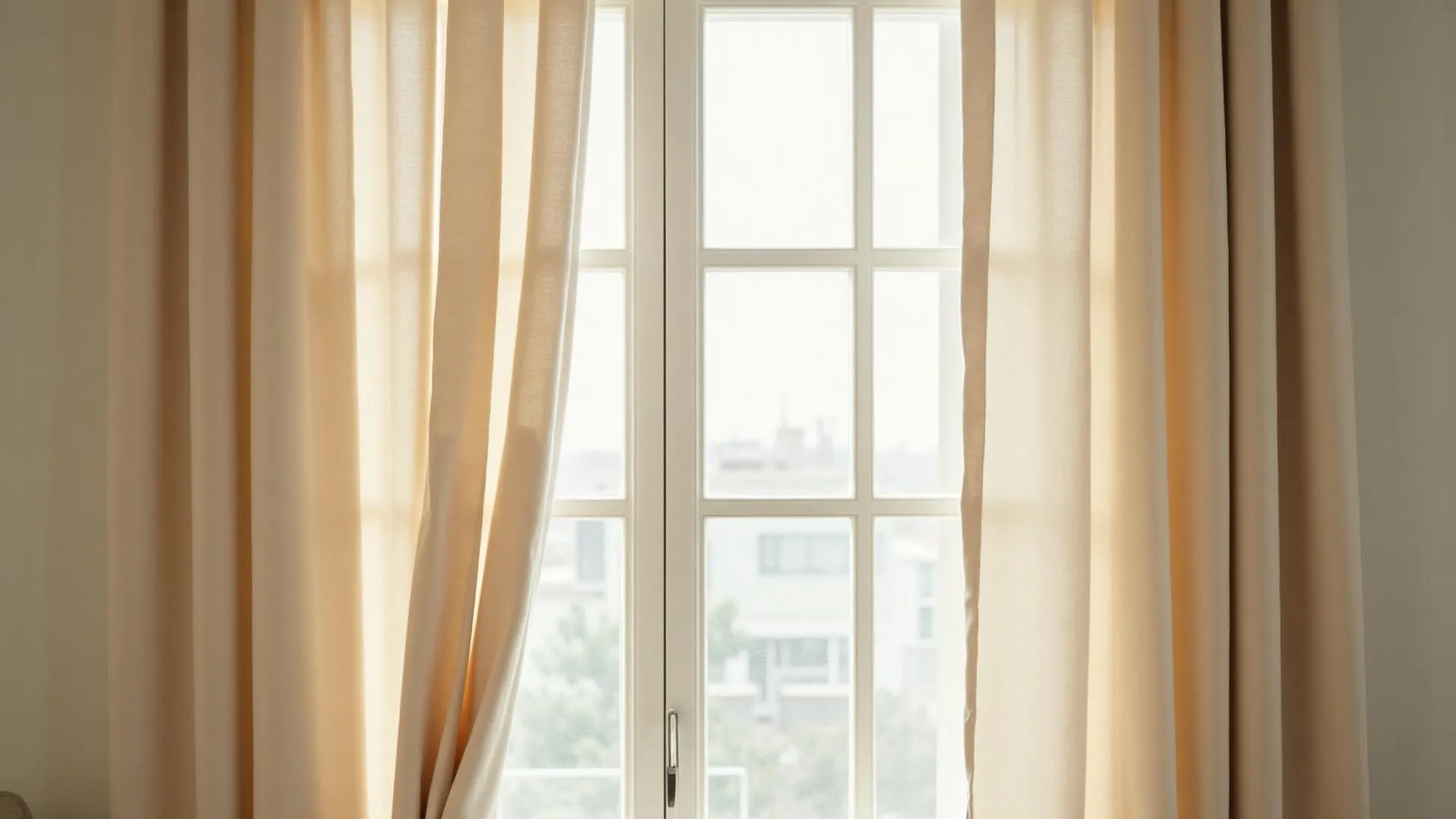
Jacquard is a fabric whose pattern is not printed on the surface but woven into the structure itself, on special jacquard looms. So the pattern does not fade, peel or rub off, and it is often visible from both sides (reversible). Damask is a kind of jacquard with a satin sheen.
What is jacquard fabric?
Jacquard is a weaving technique and says nothing about the fibre. In an ordinary plain or twill weave the warp and weft cross with an even rhythm, but in a jacquard weave each warp thread is controlled separately. That allows intricate ornaments, floral motifs, geometric figures or even portraits to be woven straight into the structure of the fabric. The pattern appears because threads of different colours or different sheen come to the surface in different places.
For curtains and furnishing textiles, jacquard fabrics are made from polyester, viscose, cotton, linen or blends of them. The technique has nothing to do with a particular fibre: a cheap polyester jacquard can be woven just as easily as a silk damask. Its relief, its feel and a depth that printing cannot reach make jacquard one of the commonest fabrics for formal rooms.
Where the name comes from: the Jacquard loom
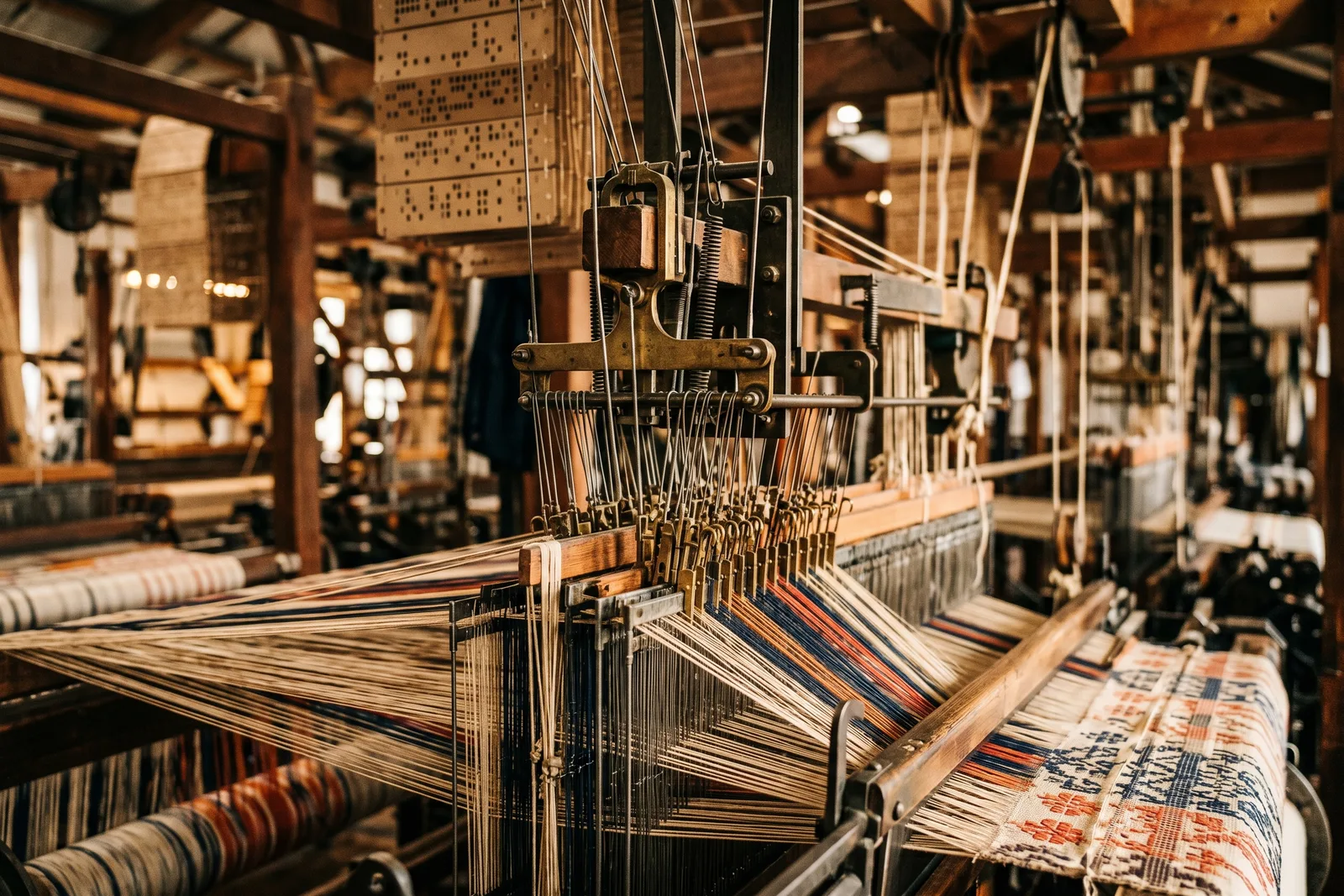
The name comes from the French inventor Joseph Marie Jacquard, who in 1804 in Lyon built a loom with punched cards. Each hole in a card told the loom which warp thread to lift and which to leave, so that a whole pattern was coded mechanically. It was the first time that the most intricate ornaments, which had been woven by hand over weeks, could be repeated exactly and quickly.
Jacquard's punched cards later inspired early computer programming. Today jacquard looms are controlled electronically, but the principle has stayed the same: the pattern is formed by controlling each of thousands of threads separately, not laid over a fabric that has already been made.
A woven pattern or a printed one: what is the difference?
A printed pattern is a layer of dye laid on a plain fabric that has already been made. It can be seen only from the front, and the other side stays white or shows the pattern faintly. A woven jacquard pattern is in the structure of the fabric itself: it is made of different threads interlaced, so it is not laid on anywhere and cannot come away from the surface.
The practical difference shows after a few years of use. A printed pattern gradually fades from the sun, washing and rubbing, and where use is heavy it can start to peel or crack. A woven pattern can fade only together with the whole fabric: it has no way of fading or peeling off by itself, because the pattern and the fabric are one and the same. So jacquard curtains usually keep their formal look for decades.
The second advantage is reversibility. Many jacquard fabrics are reversible: the front shows the pattern directly, and the back shows the negative of the same pattern (the colours swapped). That matters for curtains that are also seen from outside: a printed curtain looks white and grey from the courtyard side, while a jacquard curtain stays good to look at from both sides.
Jacquard compared with printed polyester
| Property | Jacquard fabric (woven) | Printed polyester |
|---|---|---|
| How the pattern is made | Woven into the structure | Laid on the surface in dye |
| Durability | Decades; the pattern does not peel | Moderate; the pattern wears and cracks |
| Fading in the sun | Minimal; fades only with the fabric | Noticeable after 2–3 seasons |
| Reversibility | Often reversible (a negative of the pattern) | The back is white or pale |
| Relief and texture | Tactile, with depth | A smooth, flat surface |
| Price per metre | Higher (€15–40/m and more) | Lower (€8–18/m) |
When to choose a printed fabric
A printed fabric makes sense when you need a bright multi-coloured motif (for example a photographic landscape in a child's room) or when the budget is limited and the curtains are to be changed in a few years. The most intricate, finely coloured pictures cannot be woven in jacquard, and there printing wins.
What is damask?
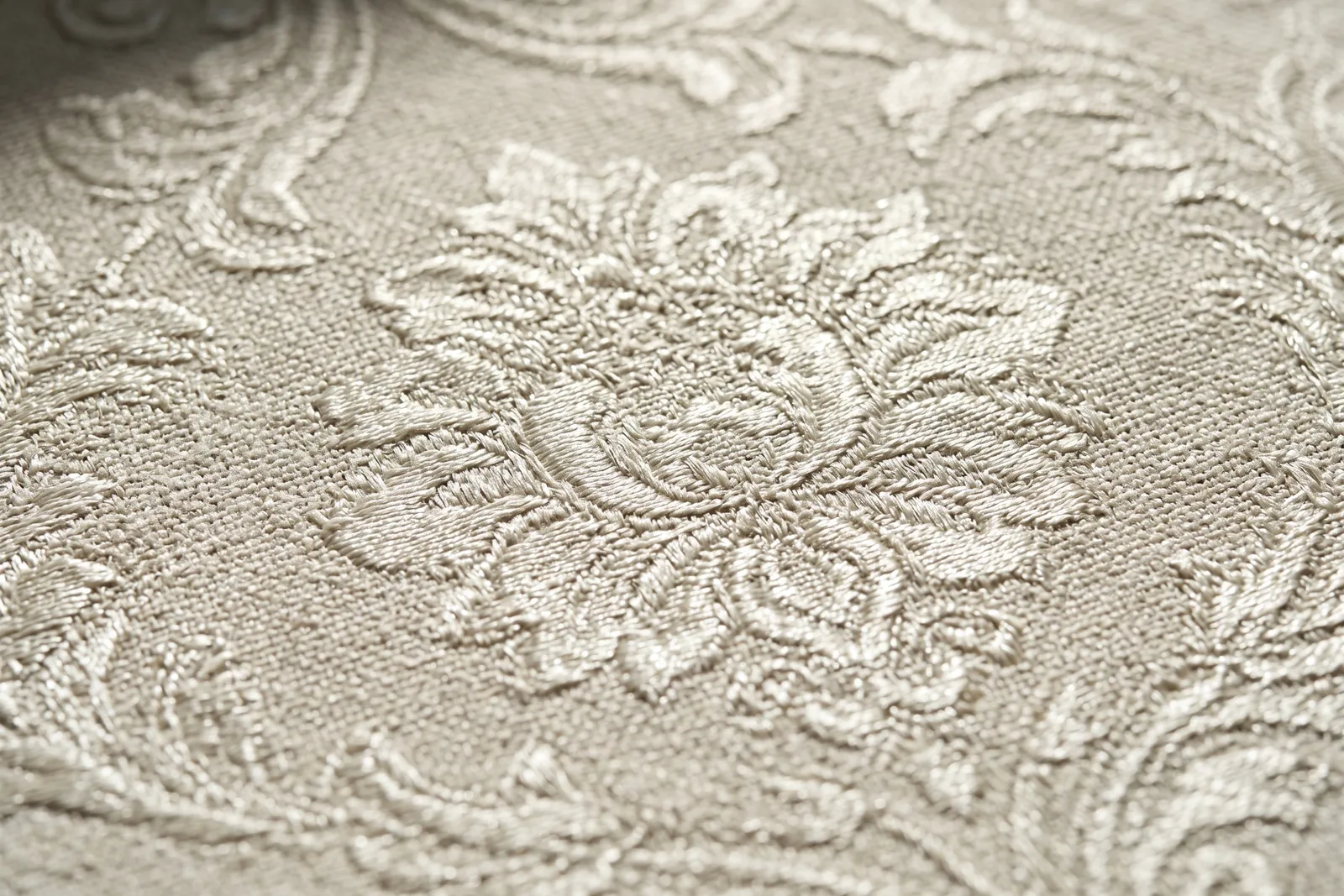
Damask is a kind of jacquard with a characteristic satin sheen and a contrast of tone. The name comes from the city of Damascus, through which patterned silks travelled to Europe in the Middle Ages. In classic damask the pattern and the ground are woven in the same fibre, but in different weave directions: one part is picked out in a satin weave (glossy), the other in a twill weave (matt). So the same fabric looks two-toned, though physically it is one colour. Every damask is a jacquard, but not every jacquard is a damask.
This play of sheen gives damask its formal look: as the lighting changes, or the angle you look from, the pattern seems to pulse. Classic damask motifs (acanthus leaves, pomegranates, stylised flowers) are still used in living rooms, bedrooms and restaurant interiors. Every damask is a jacquard, but not every jacquard is a damask: what marks damask out is the satin sheen and the single-colour contrast of tone.
How to recognise jacquard: five steps with a sample in your hand
When you look at a fabric sample at home, you can tell jacquard from a printed pattern in a minute. These are the practical steps the designer takes at a measuring visit:
- 1Turn the sample over and check the other side. If you see the negative of the same pattern (the colours swapped), it is woven jacquard. If the other side is white or barely visible, the pattern is printed.
- 2Run your fingers over it and feel the relief. A jacquard pattern is tactile and slightly raised; a printed surface is quite smooth, with the dye only on top.
- 3Tilt it against the light and watch the sheen. In damask the pattern changes in brightness with the angle, because of the satin weave; a printed pattern looks equally matt from every side.
- 4Look at the edge threads and check the structure. In jacquard you can see that the coloured threads run through the whole thickness of the fabric; in a printed fabric the colour is only a thin layer on the fibre.
- 5Rub it with a damp finger on a hidden spot to check the fastness. Good printing should not smear, but cheap printing can leave a mark; a jacquard pattern never smears, because it is threads, not dye.
Are jacquard curtains worth the higher price?
Jacquard fabrics cost more than printed ones because of the more complex weaving, the greater use of thread and the denser structure. But the price per metre is only part of the picture. For curtains made to order, what matters most is how many years they keep their formal look. A jacquard that does not peel or fade for decades often turns out cheaper in the long run than a printed curtain that you want to change after a few seasons.
Jacquard pays off most in formal rooms (a living room, a dining room, a bedroom) and in rooms with large windows seen from outside. For a child's room or a temporary rented home, where brightness or a low price matters more, a printed version may suit better. The easiest way to decide is to see and handle both versions in person at your own window: the lighting and the interior count for a great deal.
Look through the fabric catalogue
Look through the whole fabric catalogue and compare the textures.
See the curtain fabricsThe commonest mistake in choosing a fabric
Many people judge a fabric only from a photograph on a screen, where a woven and a printed pattern look the same. A screen conveys neither the relief nor the reversibility nor the sheen of damask. When choosing for curtains, especially for windows that can be seen from outside, always look at the sample in person and check the other side of the fabric.
The choice between jacquard and printed fabric also depends on what the curtain is for and what other layers hang with it. Sheer curtains follow their own rules, and darkening often needs a separate blackout layer or a lining: then a decorative jacquard is paired with a working layer.
Read more on choosing fabrics
For how jacquard combines with darkening and everyday fabrics, see the guides to blackout fabrics and to the fabrics used for sheer curtains.
Read the guide to sheer curtain fabricsFrequently asked questions
What is jacquard fabric, and how does it differ from a printed pattern?
Jacquard is a weaving technique in which the pattern is woven straight into the structure of the fabric by controlling each warp thread separately. In a printed fabric the pattern is a layer of dye laid on a fabric that has already been made. So a woven jacquard pattern does not fade or peel, has relief and is often visible from both sides, while a printed pattern wears over time.
Are jacquard curtains dearer than printed ones?
Yes. Jacquard fabrics are usually dearer because of the more complex weaving and the greater use of thread, often €15–40 per metre and more, against €8–18 per metre for printed polyester. But jacquard lasts for decades without peeling or fading, so in the long run it often proves more economical than a printed curtain that has to be changed after a few seasons.
Are jacquard curtains reversible?
Often, yes. Many jacquard fabrics are reversible: the front shows the pattern directly, and the back shows the negative of the same pattern with the colours swapped. That matters for windows seen from outside, because the curtain stays good to look at from both sides. But not every jacquard is reversible: denser fabrics, or ones reinforced with a lining, can have one clearly marked side only.
How do I recognise jacquard on a sample?
Turn the sample over: if you see the negative of the same pattern on the other side, it is woven jacquard; if the other side is white, the pattern is printed. Run your fingers over it: jacquard has relief and is tactile, while a printed surface is quite smooth. Tilted against the light, damask changes its sheen because of the satin weave, while a printed pattern stays equally matt from every side.
A consultation at your home
Would you like to see fabric samples at your own window? Arrange a consultation: the designer brings the samples, judges the lighting and helps to choose what suits your interior. Measuring is free in Vilnius. In Kaunas and Klaipėda it is free on orders of €200 or more. Elsewhere in Lithuania the visit is paid, and the price is agreed beforehand.
Arrange a design consultation