Wooden blinds
Bamboo blinds
An eco-minimal alternative to traditional wood. Bamboo is a renewable source of wood fibre, ready in 3–5 years. Bamboo blinds are light (40% less weight than basswood slats), with the distinctive grain of a natural fibre. They suit a bedroom, a living room and a child's room, but should be kept out of damp rooms.

Why choose bamboo?
In short: bamboo blinds in four decisions.
1. When to choose: an eco-minimal style, light weight (1.8–2.5 kg against 3.5 kg for basswood) and a renewable source. It suits a living room, a bedroom and a child's room. 2. Resistance to damp: ★★. Bamboo is the wood type most sensitive to damp. Avoid it in bathrooms, in kitchens with a weak extractor and in flats on the Klaipėda coast. 3. Colour: natural tan (light) or lava (dark). The light shade shows the grain of the bamboo, and the dark one suits a dark-toned interior. 4. Price: €70 per m² (35 and 50 mm slats), more than faux wood (from €48 per m²) and basswood (€130). Impregnated versions go up to €290.
Five advantages that set bamboo blinds apart from traditional wood.
Renewable source: bamboo matures in 3–5 years (against 30+ years for basswood). After it is cut, it regrows without replanting.
Light weight: bamboo slats are 40% lighter than basswood (1.8–2.5 kg against 3.5 kg for a standard window). The lighter load is easier on the mechanism and suits weaker wall fixings.
Distinctive grain: bamboo fibres have natural nodes and a structure unlike any other wood. Its look suits tropical, eco and Scandinavian interiors. Faux wood materials cannot imitate it.
Better insulation: bamboo's cellular structure is porous and holds heat better than basswood. In summer it blocks the heat, and in winter it reduces heat loss through the window.
Life in good conditions: in a dry room, bamboo blinds last a long time without special care, and impregnation protects the surface further. The impregnated range has a UV-protection layer that keeps the original colour.
When do bamboo blinds not suit?
Where bamboo falls short:
Bathrooms and spa areas: bamboo is the wood type most sensitive to damp. Even brief exposure to damp makes the fibres take up water and the slats lose their shape. In a bathroom choose faux wood.
A kitchen with a weak extractor: if the extractor is weak or not always switched on, grease vapour damages the bamboo surface within 1–2 years. Impregnated versions resist better, but still less well than basswood or faux wood.
Klaipėda and coastal flats: salty air and higher humidity shorten the life of bamboo considerably. In Klaipėda we recommend basswood (better resistance) or faux wood (the best against damp).
Cellars and semi-basements: in semi-basement conditions (50–70% humidity) bamboo begins to lose its shape within 1–2 years. Faux wood suits better there, because it resists damp and mould.
Bamboo, basswood or faux wood?
A comparison of three options on six criteria.
Price (90 × 140 cm window, 35 mm): bamboo about €88, basswood about €78, faux wood about €60. Resistance to damp: bamboo ★★ (max 50%), basswood ★★★ (max 65%), faux wood ★★★★★ (up to 90%). Weight: bamboo ★★★★★ (the lightest), basswood ★★★ (medium), faux wood ★★ (the heaviest). Environmental effect: bamboo ★★★★★ (renews in 3–5 years), basswood ★★★ (renews in 30+ years), faux wood ★ (PVC is not recycled). Thermal insulation: bamboo ★★★ (similar to basswood), basswood ★★★ (medium), faux wood ★★ (PVC is weaker). Look: bamboo ★★★★★ (a distinctive grain), basswood ★★★★ (classic), faux wood ★★★ (an imitation).
Sources and standards
EN 13120, internal blinds: the EU standard that applies to rooms where children up to 42 months old live.
Questions
How do bamboo blinds differ from wooden ones?
Bamboo has natural nodes and a distinctive grain, which suits tropical and eco styles. It is 40% lighter than basswood (1.8–2.5 kg against 3.5 kg for an average window). It is more sensitive to damp, so it does not suit a bathroom.
Do bamboo blinds suit a kitchen?
Only with a powerful extractor that is switched on every time, and a window at least 80 cm from the hob. Treated bamboo resists grease better, but still less well than basswood or faux wood. For a classic kitchen we recommend basswood or faux wood.
Is bamboo eco-friendly?
Yes. Bamboo regrows within 3–5 years (against 30+ years for basswood) and needs no replanting. For clients who care about the climate, bamboo is a principled choice.
Which bamboo colour should I choose?
The most versatile is natural tan (light): it shows the grain of the bamboo and goes with Scandinavian and tropical interiors. The dark Lava colour suits a dark wooden interior. A greenish or anthracite shade suits when you want a stronger accent.
Do bamboo blinds last long?
In a dry room (living room, bedroom, dining room), a long time, if the blind is cleaned regularly. Impregnation protects the surface further, and a UV-protection layer keeps the original colour longer. In damp rooms the life is much shorter: in a kitchen with a weak extractor the slats lose their shape sooner, and bamboo is best kept out of a bathroom.
Are bamboo blinds noisy?
Less than aluminium, and similar to wooden blinds. Bamboo's cellular structure absorbs sound, so it makes less noise on windy days or when it is operated. The higher-priced versions have a quieter chain system.
How much do bamboo blinds cost?
Bamboo costs €70 per m² (35 and 50 mm slats). A small window (60 × 120 cm) about €50. A medium one (90 × 140 cm) about €88. A large one (120 × 140 cm) about €118. A wide one (150 × 180 cm) about €189. Fitting is €15 per blind. Faux wood is cheaper (from €48 per m²).
Are bamboo blinds suitable for people with allergies?
Regular cleaning matters more than the material. Dust collects on any blind, so wipe bamboo blinds regularly with a damp cloth. We make no claim about bamboo and allergies beyond that.
Ideas for your home
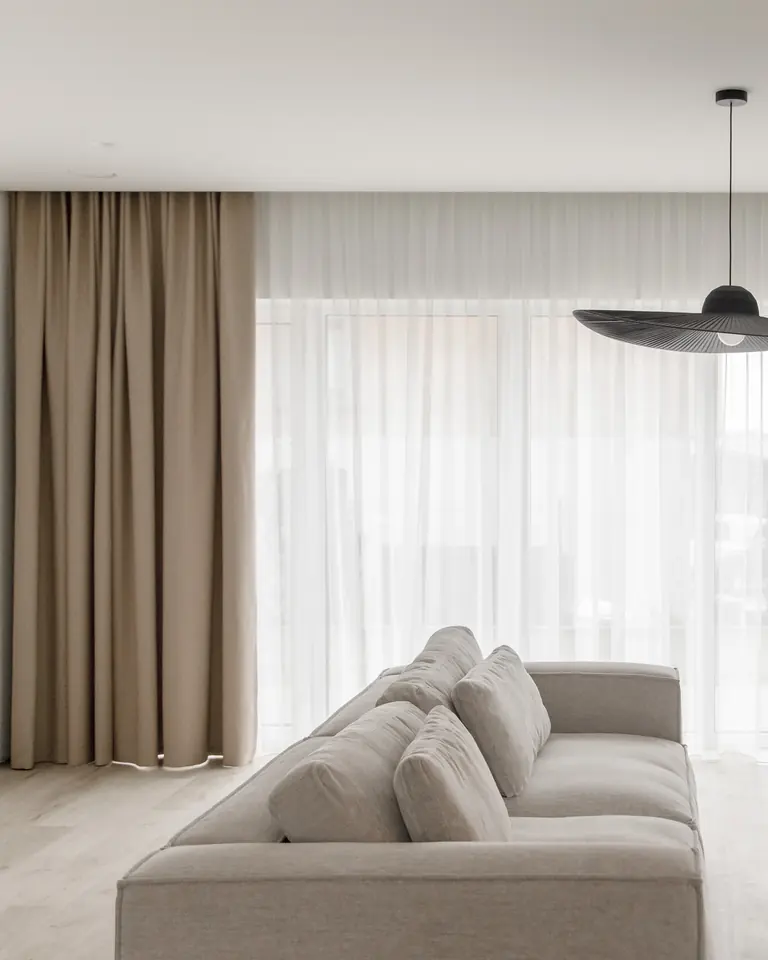
Flat, living room. A white sheer across the whole window wall and sand-coloured curtains from ceiling to floor. 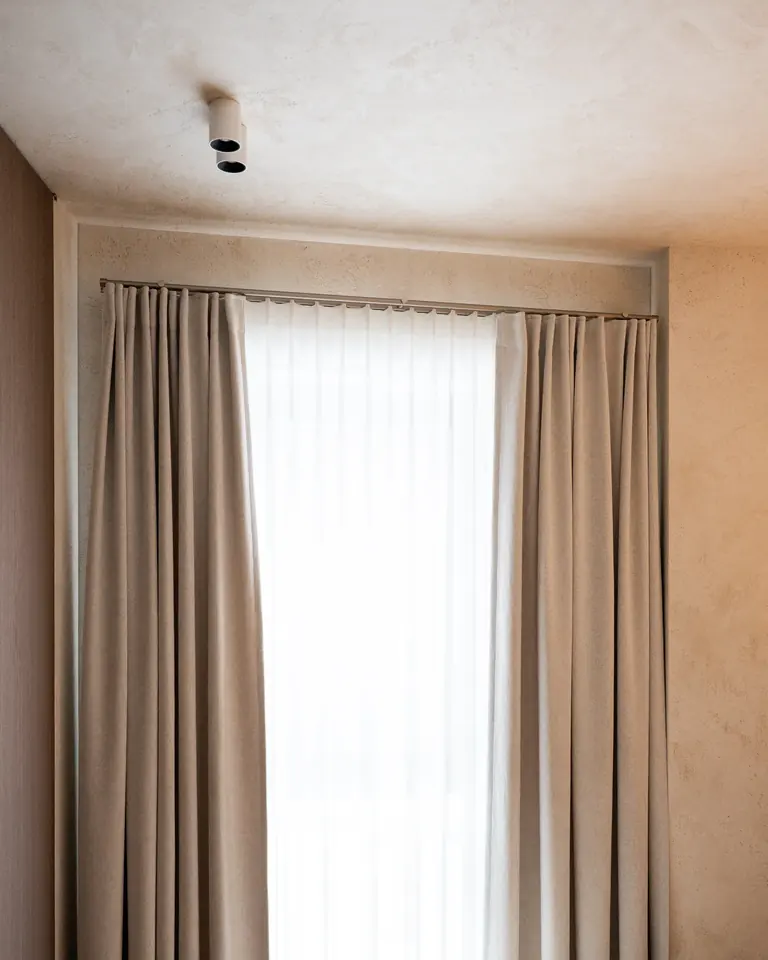
House, window recess. Sand-coloured curtains and a white sheer on a ceiling track. 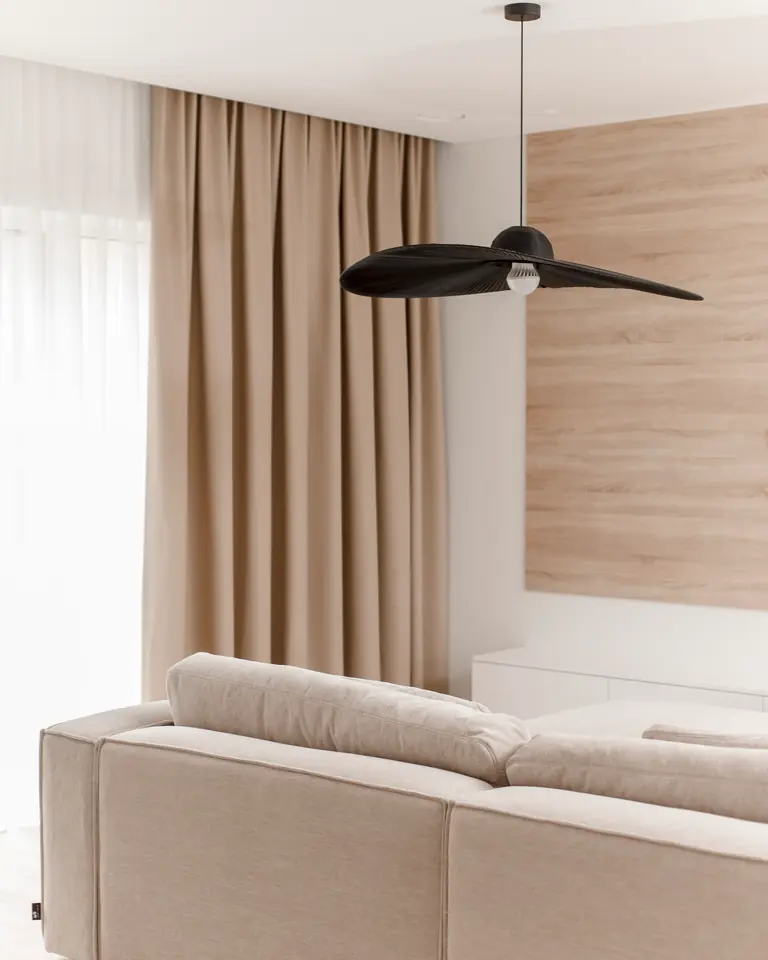
Flat, living room. Sand-coloured curtains and a white sheer from ceiling to floor. 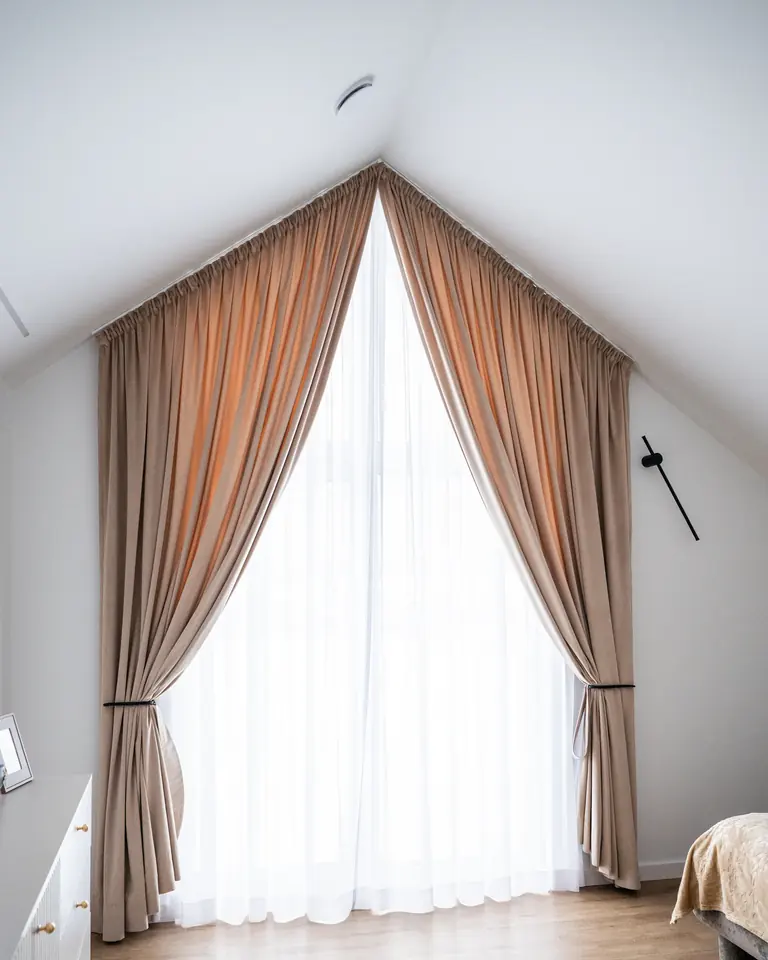
House, bedroom under a pitched roof. Peach curtains with tie-backs and a white sheer. 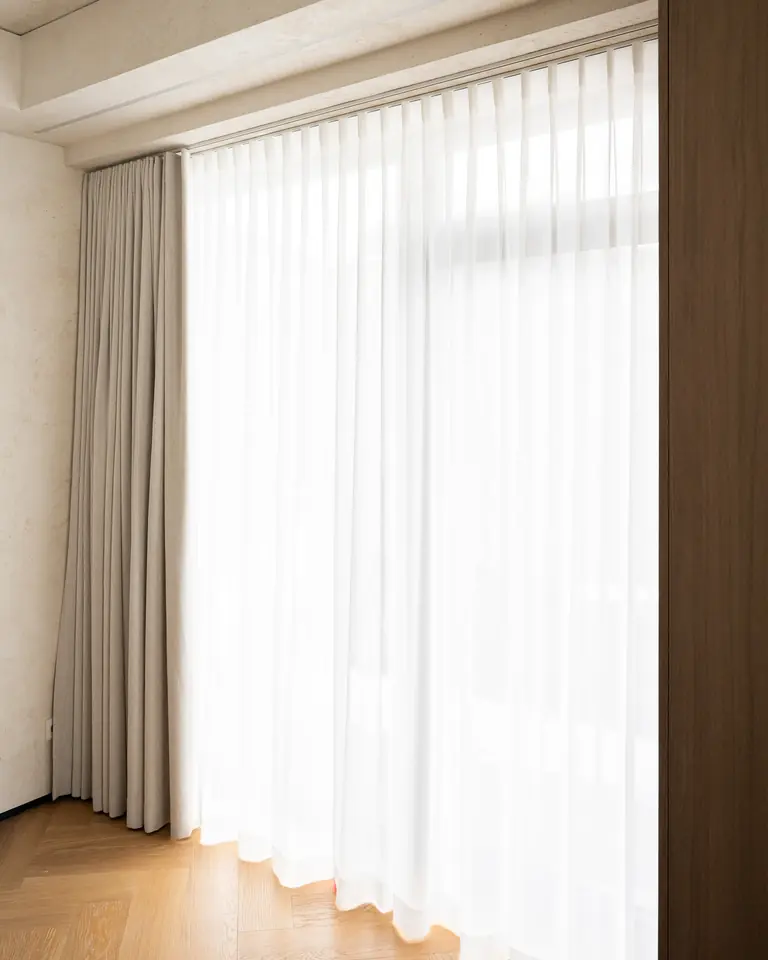
House, room with oak floors. A sheer in wave pleats and a pale curtain in a ceiling recess. 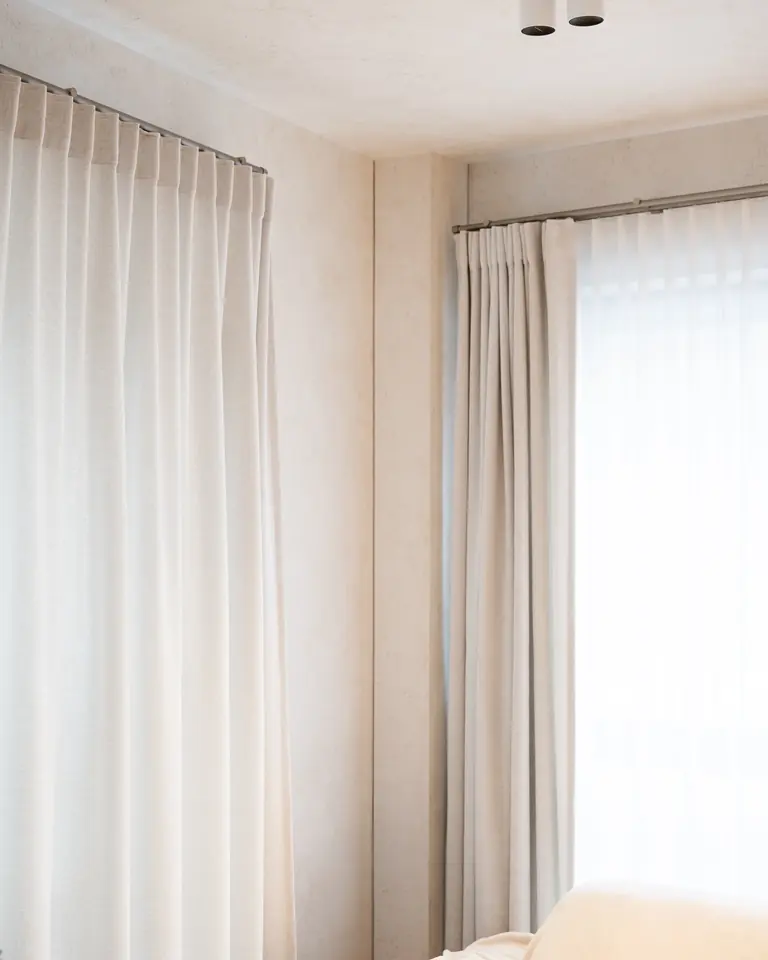
House, corner room. White sheers in wave pleats on ceiling tracks.