Blinds
Wooden blinds for kitchens
Real wood or faux wood: how to choose. Wooden blinds suit a kitchen when the window is at least 60 cm from the hob and the extractor is effective. In harder conditions, faux wood will withstand damp and grease without warping. This guide helps you choose for the conditions in your own kitchen.
Faux wood from €48 per m², natural wood from €56 per m²

When do wooden blinds suit a kitchen?
The short version, in four decisions. 1. Distance from the hob: at least 60 cm. Closer than that, choose faux wood rather than natural wood. 2. Damp: if the extractor in the kitchen is weak or not always on, natural wood warps within 1–2 years, so choose faux wood (PVC with a wood effect). 3. Slat width: 25 mm for windows up to 100 cm, 35–50 mm for medium and large windows above a sink. 4. Price: natural wooden blinds from €56 per m², faux wood from €48 per m². For a kitchen, faux wood is usually enough.
Conditions in which natural wood will last a long time in a kitchen.
A distance of 60+ cm from the hob: the minimum safe distance from the bottom slat to a gas or electric hob. Closer than that, hot vapour damages the surface of the wood within 6–12 months.
A powerful extractor, switched on every time: the power of the extractor matters more than the type of hob. A powerful extractor removes the damp and grease that wood would soak up. With a weak extractor, choose faux wood.
An open plan with a dining area: in an open-plan kitchen where the dining area runs into the living room, wooden blinds tie the interior together. A classic choice for the living room and wooden blinds in the kitchen go well together.
A window 80–150 cm wide: the best size for wooden blinds. A window that is too wide (over 200 cm) needs a heavy blind with electric operation. For small windows you can choose 25 mm slats.
Looks as the priority: natural basswood or abachi looks and feels more natural. Faux wood costs less (from €48 per m²), but feels more artificial.
A classic or Scandinavian style: wooden blinds go with oak cupboards, a marble worktop and brass details. For an industrial or high-tech interior, aluminium or PVC roller blinds suit better.
Natural wood or faux wood: which for a kitchen?
This is the main decision, and in a kitchen faux wood (PVC with a wood effect) is often the more practical one.
Resistance to damp: natural wood risks warping; faux wood (PVC) resists humidity of up to 90%. Cleaning grease: natural wood, with a damp cloth, carefully; faux wood, with a solvent or soapy water. Looks: natural wood is authentic; faux wood is a good imitation. Weight (a 1.5 × 1.5 m window): natural wood 2.5–3.5 kg; faux wood 3.5–4.5 kg (heavier). Price from: natural wood €56 per m²; faux wood €48 per m². Life in a kitchen: natural wood depends on the extractor and the distance from the hob; damp and steam do not harm faux wood.
Our recommendation for a kitchen: an open-plan kitchen, a window 80+ cm from the hob and a powerful extractor suit natural basswood (the look is worth the price). A classic closed kitchen, frequent cooking and a budget suit faux wood (it lasts for years without warping). Aluminium or PVC roller blinds are an alternative if you want a flat blind with no slats.
What are the five most common mistakes when choosing wooden blinds for a kitchen?
1. Choosing natural wood for a damp kitchen: the client wants the authentic look of wood, but the kitchen has no extractor or the window is close to the hob. Within 1–2 years the slats warp and the blind loses its shape. The answer: faux wood (PVC) looks similar, but withstands 90% humidity with no ill effects.
2. A slat too close to the hob: the bottom slat of the blind is 30–40 cm from a gas hob. Hot vapour damages the surface, and stains and cracks appear. The safety rule: at least 60 cm. Closer than that, choose faux wood or an aluminium or PVC roller blind.
3. A slat width that is too wide: the client buys 50 mm slats for a window 90 cm wide, and the blind looks out of proportion and dominates the room. The rule: 25 mm up to 100 cm, 35 mm for a medium window, 50 mm only from 140+ cm. The proportion of the window matters more than taste.
4. Choosing cheap faux wood: the cheapest faux wood (€40–60) looks artificial in a kitchen, and the plastic imitation shows from a distance. Mid-range faux wood (€90–130) has a more accurate wood imitation and a 4D finish, and is hard to tell from natural wood by eye.
5. Cleaning with aggressive products: abrasive cleaners used to remove grease from a wooden slat damage the surface and leave faded patches. The answer: only a damp, soft cloth with mild soap. Faux wood can be cleaned with solvents without a problem.
What is special about kitchens in Vilnius, Kaunas and Klaipėda?
How the type of home and the climate change the choice of wooden blinds for a kitchen.
Vilnius: for the historic arches of flats in Senamiestis, the Old Town, 25 mm basswood and a classic look suit. In new-build flats, 50 mm slats and modern minimalism go well. In an open-plan kitchen with a powerful extractor you can choose natural wood; elsewhere faux wood is safer.
Kaunas: for the classic interiors of houses in Žaliakalnis, 35 mm basswood slats suit. In the closed kitchens of blocks of flats with a mid-range extractor, faux wood is more practical.
Klaipėda: in coastal flats, salty air and higher humidity keep natural wood from lasting, so choose faux wood for a kitchen. We avoid the bamboo version in Klaipėda.
Sources and standards
EN 13120, internal blinds: the EU standard that applies to rooms where children up to 42 months old live. ANSI/WCMA A100.1-2022: the US counterpart, in force from 1 June 2024.
Which slat width suits a kitchen window?
By window size and interior style.
from €56/m²
Window size up to 100 cm. Small windows, classic style.
from €62/m²
Window size 100–140 cm. Medium windows above a sink.
from €72/m²
Window size 140–200 cm. Large windows, modern minimalism.
from €85/m²
Window size 200+ cm. Panoramic windows, open plan.
Questions
Are wooden blinds suitable for a kitchen?
Yes, when the window is at least 60 cm from the hob, the extractor is effective and you switch it on every time you cook. In those conditions natural basswood lasts a long time in a kitchen. In harder conditions choose faux wood (PVC with a wood texture), which withstands 90% humidity without warping.
How does a natural wooden blind differ from faux wood?
Natural wood (basswood, abachi, bamboo) is authentic but sensitive to damp and grease: in a kitchen it risks warping within 1–2 years if the conditions are poor. Faux wood is PVC with a 4D wood effect, resistant to humidity of up to 90% and easy to clean with a solvent. Prices: natural from €56 per m², faux wood from €48 per m². In a kitchen, faux wood is often more practical.
How far should a wooden blind be from the hob?
At least 60 cm from the bottom slat to the surface of a gas or electric hob. Closer than that, hot vapour damages the surface and stains and cracks appear within 6–12 months. If the position of the window does not allow that, choose aluminium or PVC roller blinds, which withstand higher temperatures.
Which slat width suits a kitchen window?
25 mm for small windows up to 100 cm wide (classic arches, Old Town flats). 35 mm for medium windows of 100–140 cm (the commonest kitchen size above a sink). 50 mm for large windows from 140 cm (open-plan kitchens). 65 mm for panoramic windows over 200 cm. The proportion of the window matters more than personal taste.
How do I clean wooden blinds in a kitchen?
With a damp, soft cloth and mild soap every 2 weeks. For stronger stains, a damp microfibre cloth with a vinegar-and-water solution (1:5). Do not use abrasive cleaners, solvents or scouring pads: they damage the surface. Faux wood can be cleaned with solvents without a problem, which is an advantage in a kitchen.
How long do wooden blinds last in a kitchen?
Natural basswood or abachi ages faster in a kitchen than in a living room; how long it lasts depends on the power of the extractor and the distance from the hob. Bamboo is more sensitive to damp, so it has the shortest life in a kitchen. Faux wood is not harmed by damp or steam. Our warranty on the mechanism is 24 months in any version.
Do bamboo blinds suit a kitchen?
Bamboo is the wood type most sensitive to damp, and has the shortest life in a kitchen. In Klaipėda (a sea climate) bamboo is not considered at all. If an exotic look matters, choose faux wood with a tropical-wood effect: it looks similar but withstands kitchen conditions.
How much do wooden blinds for a kitchen cost in 2026?
Faux wood (PVC) is €48 per m²: about €35 for a small window (60 × 120 cm) and about €130 for a large one (150 × 180 cm). Natural basswood (35 mm) is €62 per m²: from €45 to €167. Bamboo is €70 per m²: from €50 to €189. Fitting is €15 per blind.
Do wooden blinds for a kitchen need electric operation?
Not necessarily. Standard cord operation suits windows up to 150 cm wide. For larger windows, or ones that are hard to reach (above a sink with a deep basin), an electric motor (for 50 and 65 mm slats) adds about €40 to the price and makes daily use easier. For families with children, a cordless version is available.
Is measuring available for wooden blinds in a kitchen?
Yes. Measuring is free in Vilnius. In Kaunas and Klaipėda it is free on orders of €200 or more. Elsewhere in Lithuania the visit is paid, and the price is agreed beforehand. The designer brings faux wood and natural wood samples, assesses the conditions in the kitchen (extractor power, distance to the hob, window width and recess) and recommends natural or faux wood.
Ideas for your home
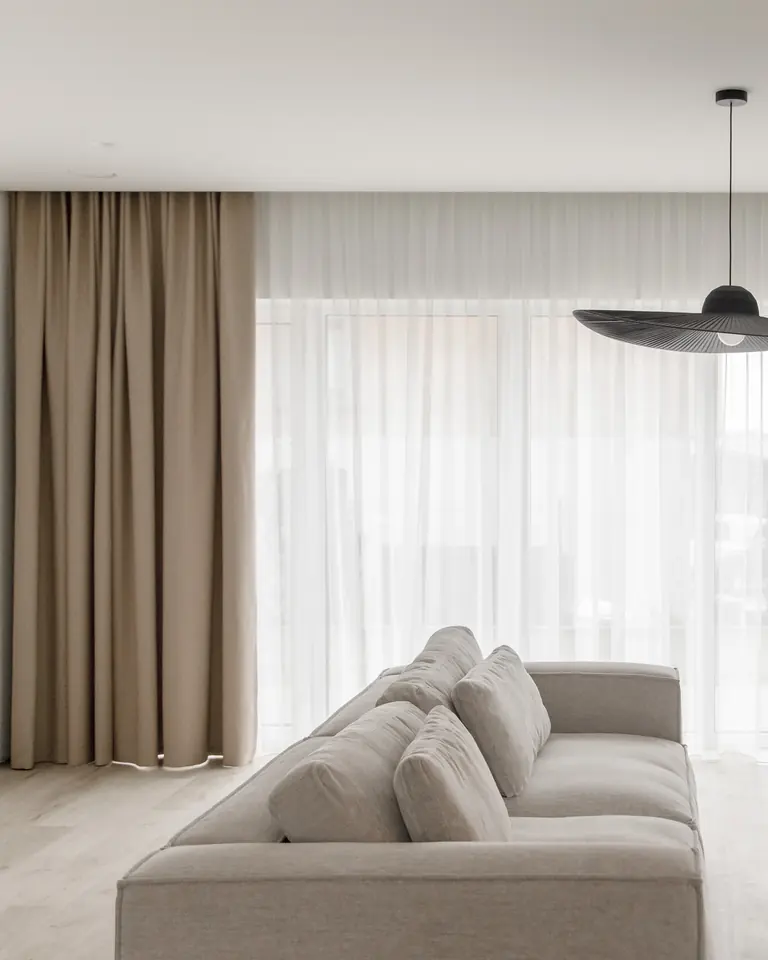
Flat, living room. A white sheer across the whole window wall and sand-coloured curtains from ceiling to floor. 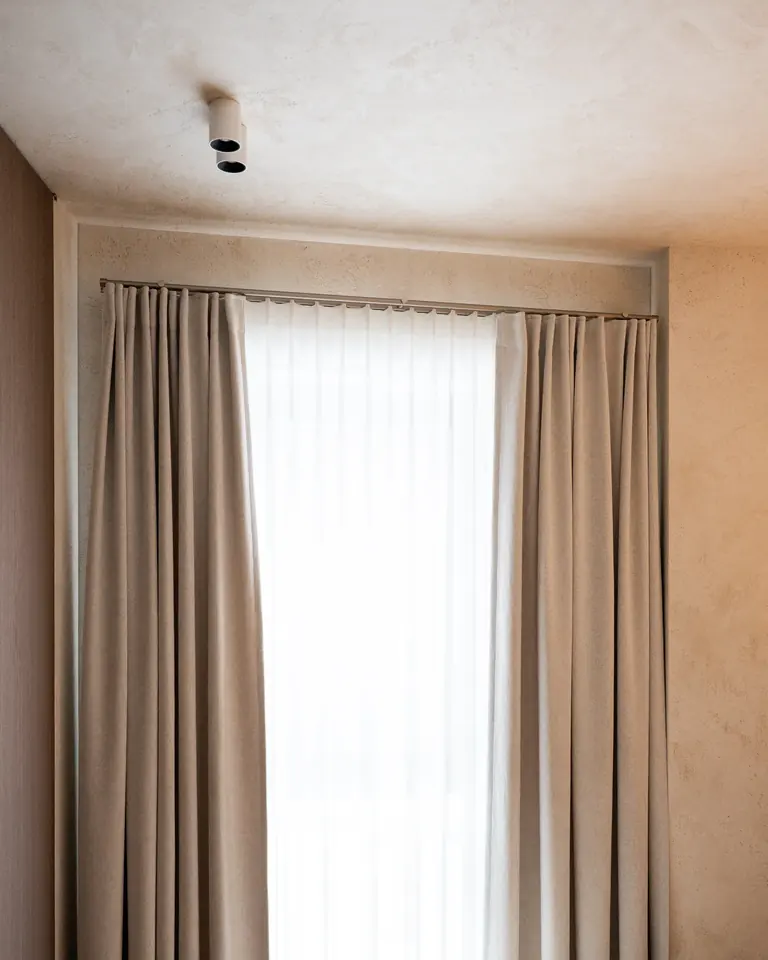
House, window recess. Sand-coloured curtains and a white sheer on a ceiling track. 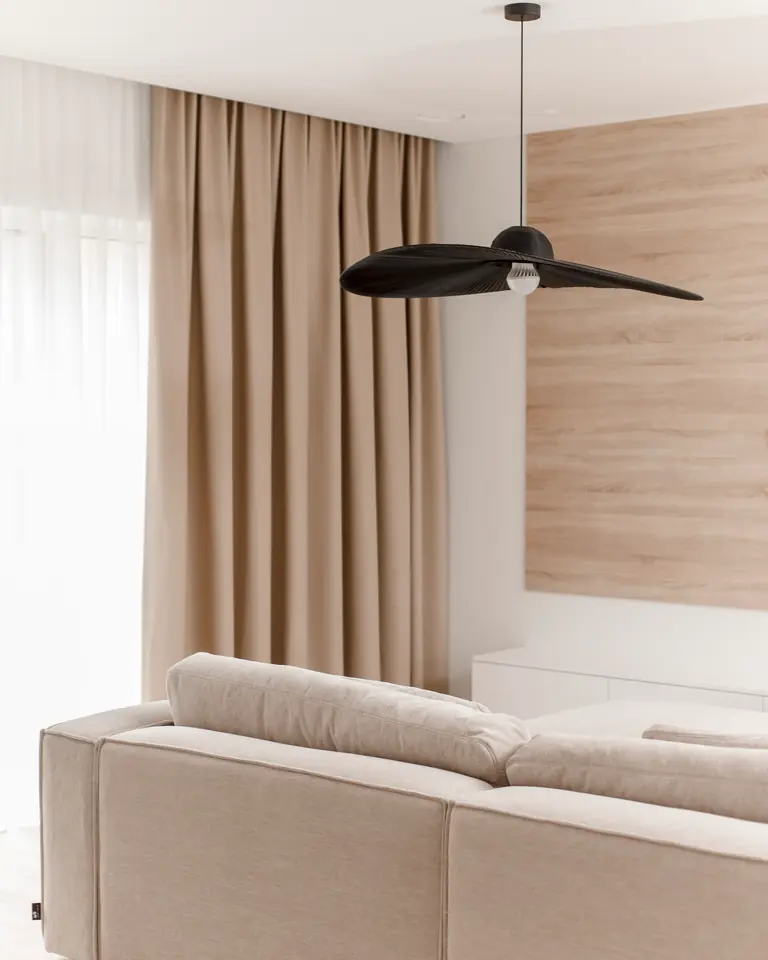
Flat, living room. Sand-coloured curtains and a white sheer from ceiling to floor. 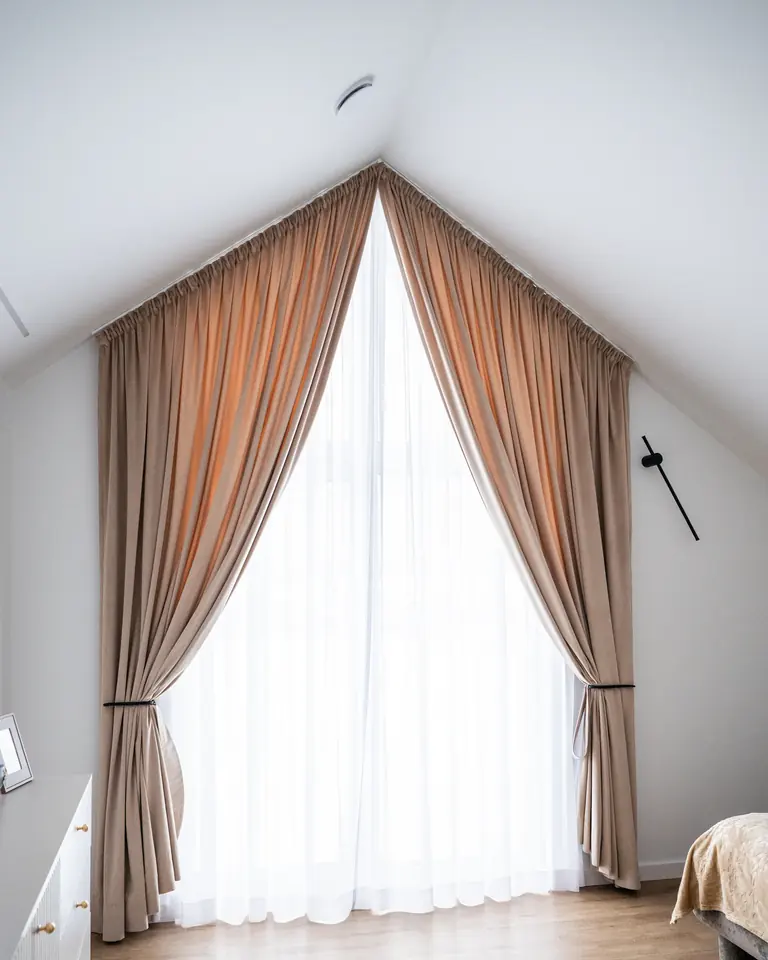
House, bedroom under a pitched roof. Peach curtains with tie-backs and a white sheer. 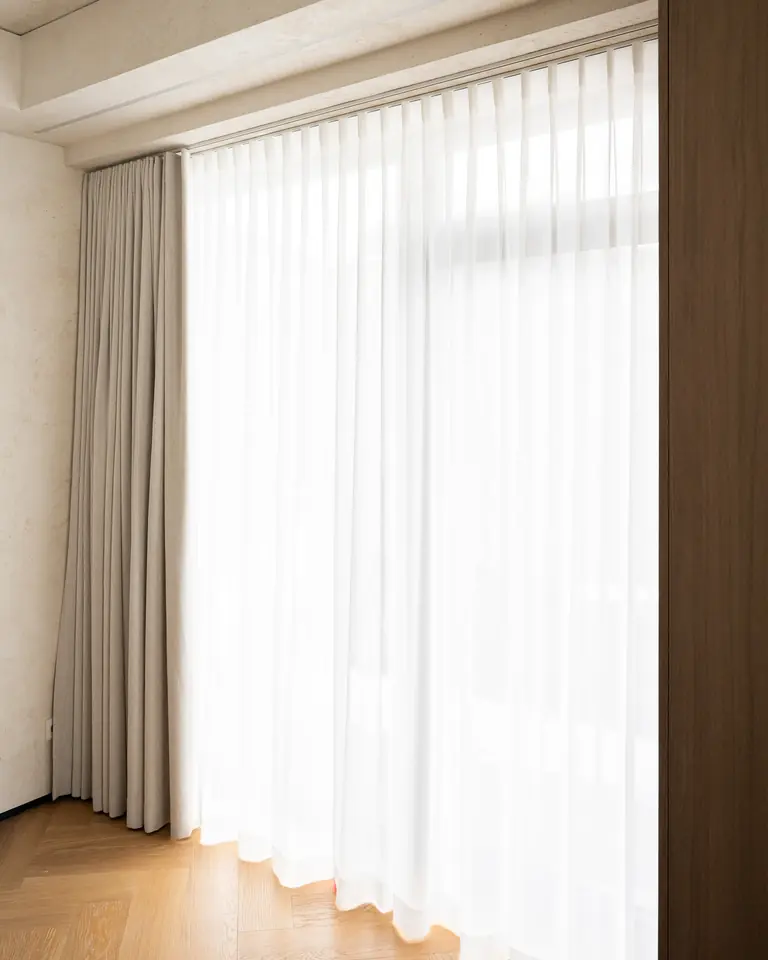
House, room with oak floors. A sheer in wave pleats and a pale curtain in a ceiling recess. 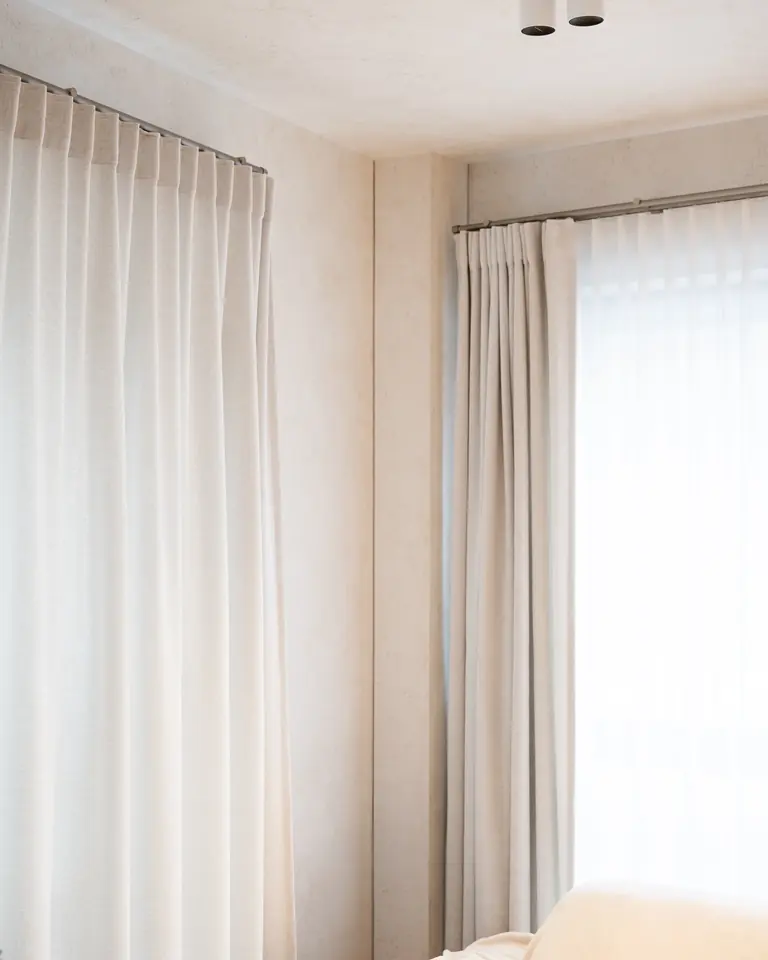
House, corner room. White sheers in wave pleats on ceiling tracks.