Author: Jegor Janockin
Reviewed by: Curtain.lt editorial team
Last updated:
Curtains during a renovation: what to decide before the ceilings and painting
- Plan the curtains before the ceilings are closed: that decides whether the track is hidden in a ceiling recess or visible.
- A ceiling recess needs a depth of 10 cm for one track, 15–20 cm for two and 20–25 cm for a wave heading; the height is 12–15 cm.
- For an electric track, bring a 230 V outlet to the recess 10–15 cm from its end, and where the ceiling is closed leave a 30 × 30 cm hatch below the motor.
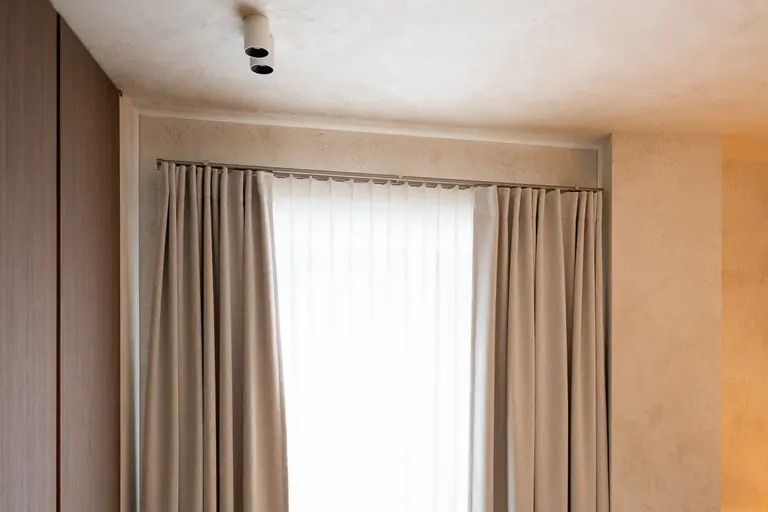
Curtains are most often remembered last, when the ceilings are painted and the furniture is in. Then only a wall-fixed pole or a track under the ceiling is left. If the windows are thought of during the renovation, the same window can have a hidden track in a ceiling recess, a cable for an electric track and curtains from ceiling to floor with no visible fittings. This guide covers what to decide and when, what dimensions to give the builders and when to order the curtains themselves.
When should you start thinking about curtains during a renovation?
The deciding moment is before the ceilings are put in. While the ceiling is open, a recess for the curtains, reinforcement for the track and a power cable for the motor can be put in within a few hours. Once the ceiling is finished, the same job means taking it apart, filling and painting again.
- 1Before the electrical work: decide whether any window will have an electric track, and mark where a 230 V outlet will be needed.
- 2Before the ceilings go in: plan the ceiling recess or hidden profile and its dimensions, and the reinforcement for fixing.
- 3Before painting: check that the recess is straight and the same depth along its whole length; paint the inside of the recess with the ceiling.
- 4Once the floors are down: measure the drop of the curtains, because it is measured to the final floor covering.
- 5After the dusty work: fit the tracks and hang the curtains once the building dust has been cleaned away.
What depth of ceiling recess do curtains need?
A ceiling recess is a hollow in a plasterboard ceiling next to the window wall, in which the track is hidden. From the room you see only the curtains falling from the ceiling. The depth of the recess depends on how many tracks it will hold and on the heading: a wave heading needs more room, because the waves project on both sides of the track. A gap of 5 cm is left between the wall and the first track, between the tracks, and between the last track and the edge of the recess.
Ceiling recess, section
Ceiling recess from below
| What goes in the recess | Depth of the recess | Note |
|---|---|---|
| One track | 10 cm | Only a sheer curtain or only a lined curtain |
| Two tracks | 15–20 cm | A sheer curtain and a lined curtain |
| Wave heading | 20–25 cm | The waves project on both sides of the track |
| Height of the recess | 12–15 cm | So that the track and gliders cannot be seen from below |
The recess should be long enough for the track to project 20–30 cm beyond the window on each side, so that curtains drawn back do not cover the glass. It is often simplest to make the recess the whole length of the wall, from corner to corner.
How do you prepare the power for an electric track?
A mains-powered electric track connects to the 230 V supply. Bring the outlet into the recess itself, 10–15 cm from its end, on the side where the motor will be. Then the cable cannot be seen, and the motor can be connected to a switch, a remote or a smart-home system.
Where the ceiling will be closed, leave a 30 × 30 cm service hatch below the motor: through it the motor can be reached without taking the track down. If a cable can no longer be brought in, the option left is a battery motor, which has to be charged from time to time. Electric tracks cost from €170 per metre, fitted and programmed, and mechanisms and motors carry our 24-month warranty.
An electric track in a recess
How electric tracks work, which motors there are and what fitting costs.
Electric curtain tracksWhat should you tell the plasterboard fitters?
Plasterboard cannot hold a track by itself, especially when the curtains are heavy or have a motor. So give the fitters a short, clear list before they start on the ceilings.
- Put reinforcement (a timber batten or a profile) along the top of the recess, over its whole length, and fix the track to it every 60–80 cm.
- The depth and height of the recess are the same along its whole length; the permitted tolerance is a few millimetres.
- The recess runs at least 20–30 cm beyond the window on each side, or along the whole wall.
- The electrical outlet for the motor is in the recess, 10–15 cm from the end; where the ceiling is closed, a 30 × 30 cm hatch below the motor.
- An LED strip, if one is planned, is fitted separately from the track, so that it does not get in the way of the gliders.
A hidden track or a visible pole?
A hidden track in a recess suits when you want a calm, clean look and curtains from ceiling to floor. If you do not want to make a recess, or there is no time, a ceiling track is fixed straight to the ceiling: it is visible, but narrow, and takes no space on the wall. Where the ceilings are higher than 280 cm, the curtains almost always hang best from the ceiling. A wall-fixed pole still suits a classic interior: it is fixed 10–15 cm above the window frame.
A hidden track in a recess
Profiles, shadow gap and LED lighting: how to make a recess in which the track cannot be seen at all.
Guide to a hidden track in a recessWhen should you measure and order the curtains?
Tracks can be measured once the recess is made, but the drop of the curtains only once the floors are down: it is measured from the track to the final floor covering. From order confirmation to installation, curtains, roman blinds and other blinds take 3–4 weeks, and tracks 1–2 weeks. So order the tracks after painting, and the curtains as soon as the floors are laid.
The designer can come during a renovation, to discuss recesses, power and fabrics while everything can still be changed. Measuring is free in Vilnius. In Kaunas and Klaipėda it is free on orders of €200 or more. Elsewhere in Lithuania the visit is paid, and the price is agreed beforehand.
What do curtains cost in a new home?
Sheer fabrics cost from €9.50 per metre and lined fabrics from €24 per metre. Making costs €8 per metre for sheer curtains and €13 per metre for lined ones. A ceiling track costs from €9 per metre, and fitting it from €9 per metre; an electric track costs from €170 per metre. A one-window project with making and fitting starts at €100, and an average project costs €800–1,000.
How much fabric your windows need
How the amount of fabric and the price are worked out, with examples, including for tall windows.
How the price of curtains is worked outFrequently asked questions
Can a ceiling recess be made once the ceilings are finished?
It can, but it is then a separate building job: the ceiling has to be cut open, a recess with reinforcement made, and the ceiling filled and painted again. It is often simpler to choose a narrow ceiling track fixed straight to the ceiling.
Does an electric track have to have a cable?
No. If a cable cannot be brought in, a battery motor will do. But during a renovation it is simplest to bring a 230 V outlet into the recess, and then the motor never needs charging.
How much space should be left between the window and the edge of the recess?
The track should project 20–30 cm beyond the window on each side, so the recess has to be at least that much longer than the window. If there is a corner or a wardrobe next to the window, carry the recess right up to the corner.
Can the designer come during a renovation?
Yes. A visit during a renovation is the most useful: you can still change the depth of the recess, move the electrical outlet and choose fabrics to go with the colour of the walls. The final dimensions for the curtains are confirmed once the floors are down.
Plan the curtains together with the renovation
The designer comes with fabric samples, helps plan the recesses and the power, and works out the price.
Arrange a design consultationThe next step
If this guide has answered your questions, move on to a specific product or check your budget.