Author: Jegor Janockin
Reviewed by: Curtain.lt editorial team
Last updated:
How to hang curtains without drilling: four ways for renters

Curtains can be hung without drilling in four ways: a spring-loaded (tension) pole fitted in a recess; adhesive or Command hooks on a smooth wall; a magnetic pole on the metal frame of a uPVC window; and Klemmfix clamps on an opening sash. All four suit light sheers. Blackout fabric needs drilling.
How do you hang curtains without drilling the wall? (the short answer)
Not drilling pays off for renters, in kitchens and bathrooms with tiled walls, and wherever a uPVC window frame rules out drilling into the glazing profile. Three things decide the choice: where you are fixing (a recess, a smooth wall, a window frame or a sash), what the surface is (painted plaster, tiles, plastic, metal) and how much the curtain weighs together with its pole.
The general rule is simple. For a light sheer, voile or thin daytime curtain, any of the four methods will do. For medium-weight daytime curtains, a tension pole or a magnetic pole suits. Heavy, multi-layer or blackout curtains almost always need brackets screwed into the wall, because adhesive systems do not hold their weight for long. Each method is covered below, with realistic weight limits and the usual mistakes.
Four ways to hang curtains without drilling: weight limits compared (kg)
The table helps you choose in a minute. The weight limits are for one bracket or one system and are a guide: always check the maker's data on the pack, because adhesion depends a great deal on how clean the surface is and on the temperature.
| Method | Where it fixes | Weight limit | Suits |
|---|---|---|---|
| Tension (spring-loaded) pole | In a recess between two walls or jambs | up to 3–5 kg | Sheer, voile, light daytime curtains |
| Adhesive or Command hooks | A smooth painted wall, smooth plaster | 0.5–2 kg per hook | Sheer, thin daytime curtains |
| Magnetic pole | The metal profile of a uPVC window frame | up to 1–2 kg | Sheer, café curtains |
| Klemmfix clamps | An opening sash (no jamb needed) | up to 1.5–2.5 kg | Sheer, pleated blinds, light roller blinds |
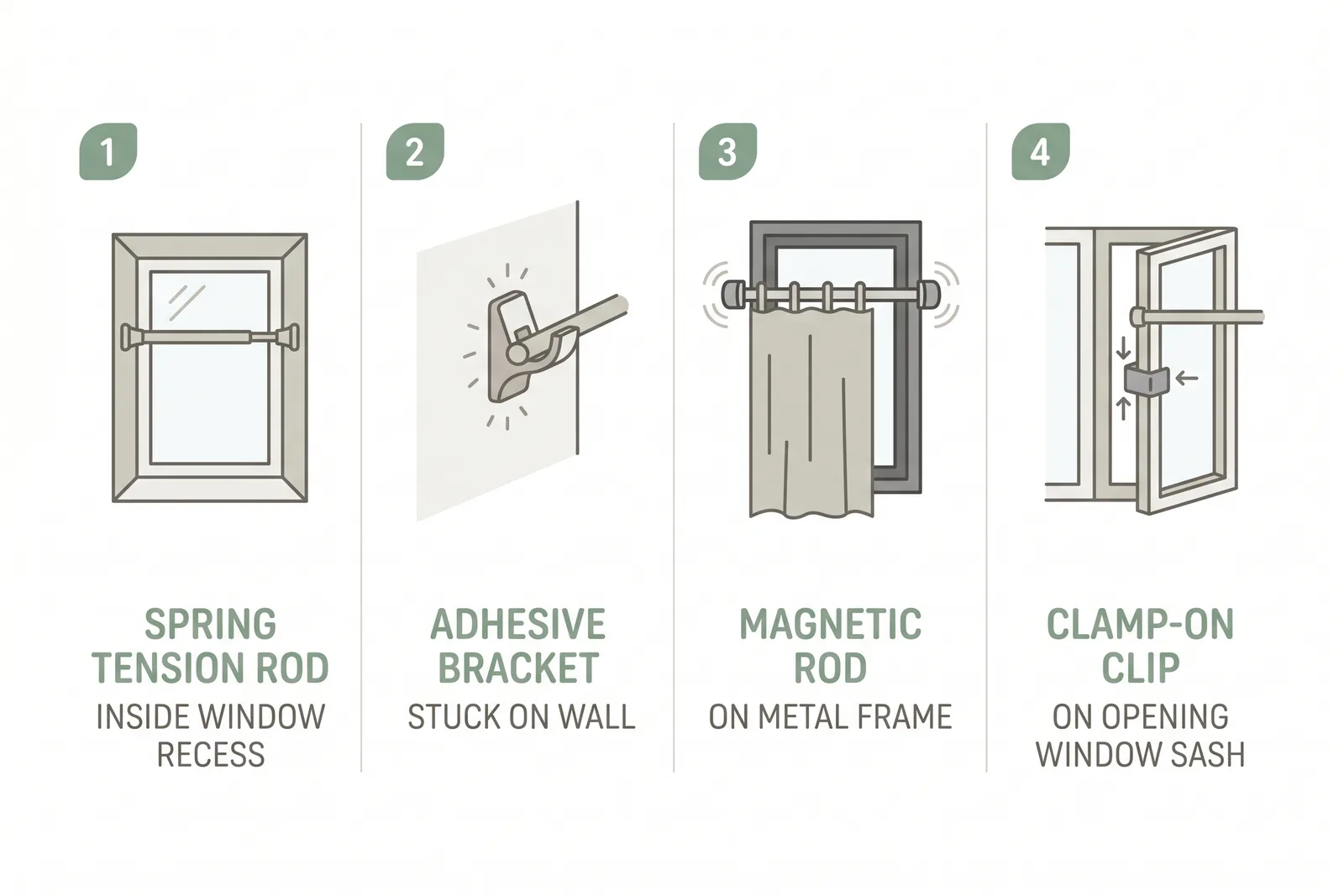
A tension (spring-loaded) pole: when the window sits in a recess
A tension pole, also called a telescopic pole, is a hollow tube with a spring inside. It is stretched between two opposite supports, for example the sides of a window opening, two jambs or the walls of a recess, and it stays put by pressure on its ends alone. It needs no screws and leaves no holes, and it is the usual fixing for small kitchen windows, bathroom windows and small recesses.
The main condition is hard supports facing each other, square to the pole. A plasterboard partition or loose plaster will not stand the pressure, and the pole will fall. When you buy, measure the exact distance and choose a pole whose working range falls in the middle rather than at the end of the spring: the pressure is then firmer. The usual weight limit is 3–5 kg, so a tension pole suits sheers, voile and light café-style curtains.
A tip for wide openings
On openings wider than 1.2 m a tension pole bends in the middle and the fabric sags. In that case choose a pole of a thicker diameter, or add a magnetic support point in the middle. A narrow kitchen recess 60–100 cm wide suits a tension pole well.
Adhesive and Command hooks: on a smooth painted wall
Adhesive hooks and 3M Command systems fix the pole bracket to the wall with a strong acrylic or double-sided adhesive strip. It is the only way to hang an ordinary wall-fixed pole above the window, rather than only inside the opening, without leaving a single hole. The advantage of Command hooks is that they can be taken off by pulling the tab, without damaging the paint.
Success here depends mostly on preparation. The surface must be smooth, dry, painted in matt or satin paint and wiped with spirit or isopropyl alcohol first (not a cleaner containing silicone). After sticking the bracket on, leave it to bond fully for at least 24 hours before you load the curtain: this is the mistake most often ignored. A realistic weight limit for one firm bracket is 0.5–2 kg, so two brackets reliably hold only a sheer or thin daytime curtains.
Adhesive hooks do not hold for ever
Even when they are stuck on correctly, adhesive hooks weaken over time with the temperature swings by a window and with the sun. Never hang heavy or multi-layer curtains from them: a falling pole can smash the windowsill or hurt someone. For a heavier fabric, choose a fixing that is drilled.
A magnetic pole for a uPVC window: for sheers and café curtains
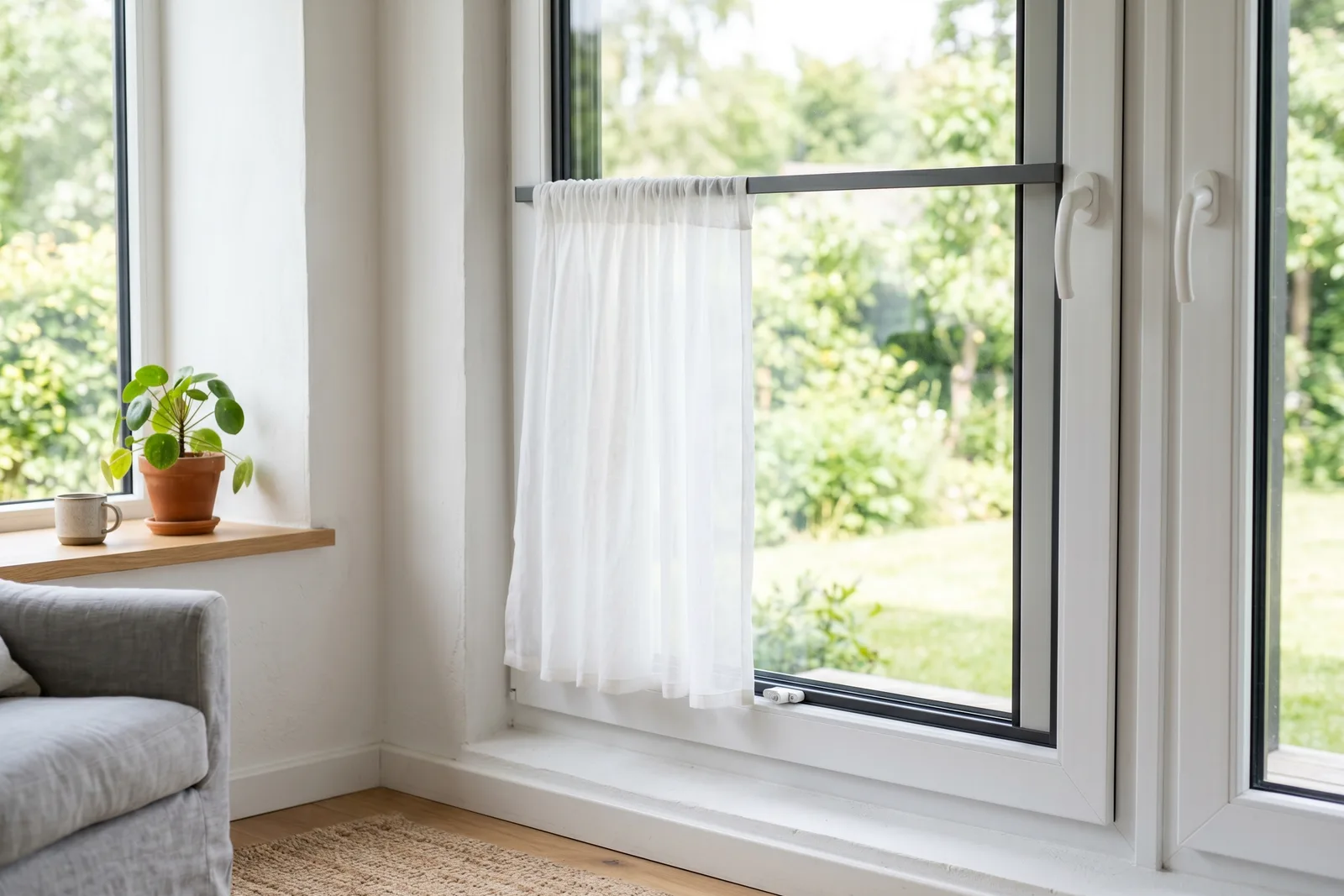
A magnetic pole is a thin rod with a magnetic holder at each end. One holder goes on the window side and the other, with a counter-magnet, on the inside, and they pull together through the metal profile of the uPVC window sash. Most uPVC window sashes have a steel reinforcing profile built in, to which magnets cling well. No holes are needed, and the pole can be moved in a second.
This method suits café curtains, a short sheer in Lietutis or similar that covers only the glass of the sash. The curtain moves with the sash when you open it to air the room, which is handy in a kitchen. The weight limit is modest, up to 1–2 kg, so the fabric has to be light. Before you buy, check that the profile of your sash has metal in it: in rare cases a cheaper sash has no steel insert and the magnet will not hold.
Klemmfix clamps: on an opening sash
Klemmfix clamps (German for a clamping fixing) slip over the top edge of the opening sash of a uPVC window and are tightened with a small screw that presses on the sash profile, not on the glass or the frame. No holes are needed here either. These clamps were made for roller blinds, pleated blinds and light café curtains that hang straight on a single sash.
Klemmfix holders are usually sold with a roller or pleated blind set and suit a standard sash profile 1.5–2.5 cm thick. Check that enough gap is left between the sash and the frame for the clamp, so that nothing rubs when the window closes. The weight limit is up to 1.5–2.5 kg per sash, so they suit a single sash but not a whole run of windows.
Where adhesive hooks do not work: tiles, plastic frames, concrete, plaster
Not every surface suits an adhesive fixing. Glazed tiles look smooth, but adhesive strip on a shiny surface often lets go after a few weeks, especially in the damp air of a bathroom or kitchen. A tension pole between two walls works more reliably there. Tiles can also be drilled with a tile bit, if the tenancy agreement allows it.
- Glazed and glossy tiles: damp and the glossy glaze weaken the bond
- Textured or sanded plaster: the strip touches only part of the surface
- A uPVC window frame profile: slippery, with silicone left from manufacture
- Unfinished concrete and masonry: porous and dusty, so the strip has nothing to hold
- Wallpaper: the hook comes away with the torn wallpaper and damages the wall as well
The best surface for adhesive hooks is a smooth, dry plasterboard or plastered wall painted in matt paint. A bracket prepared correctly holds reliably there. Everywhere else, choose a tension pole that works by pressure or a magnetic fixing on the window's metal, or, for heavier fabric, drill after all.
Not sure which pole will suit your window?
The type of pole decides whether the curtains hang well and for long. Our guide shows how to choose a pole to suit the window, the fabric and the room.
How to choose a curtain pole or trackFitting without drilling by fabric weight: sheer, daytime or blackout
The weight of the curtain together with its pole matters more than the wall. The plan below helps you choose a method to suit the fabric and fix it safely without drilling, from assessing the load to hanging.
- 1Weigh the fabric: if the curtain with its pole weighs up to 1 kg (sheer, voile), any method without drilling suits. Over 3 kg, choose drilling.
- 2Assess the surface: check whether the wall is smooth and painted or is tiles, plastic or concrete. It decides between an adhesive and a pressure fixing.
- 3Prepare the surface: for an adhesive hook, wipe the spot with spirit and let it dry. For a tension pole, check that both supports are hard and square.
- 4Fix the holders: stick on or fit the pole, and leave an adhesive strip to bond for at least 24 hours with nothing on it.
- 5Load it gradually: hang the empty pole, add the curtain only after a day, and watch for a few days to see whether the holders begin to slip.
Spread the weight
If the fabric is near the limit, use three or four adhesive hooks instead of two: the weight is shared and each one carries less. A light sheer with more folds looks full but weighs little, so it is the safest fabric to hang without drilling.
When not drilling is not enough: heavy and blackout curtains
Blackout and heavy curtains need drilling
Blackout fabric is dense and heavy. The densest fabrics, such as Gravity Blackout, weigh over 350 g/m², and a pair on a double track is far beyond what a no-drill fixing can take. No adhesive, magnetic or pressure system will hold that weight safely for long. Lined, multi-layer or full-blackout curtains need brackets screwed into the wall or ceiling; nothing else is safe.
If you want real bedroom darkness or full, double curtains falling to the floor, you cannot do without drilling. Dense blackout fabric, a double track for the sheer and the lined curtain, and a large amount of heavy textile create a load that only a firm wall or ceiling fixing can carry. The good news: brackets screwed in with plugs that suit the wall hold heavy curtains securely, and the holes can be filled when you move out.
Choosing lined or blackout curtains?
Heavy blackout fabric needs a sturdy track and professional fitting. See our lined curtain options.
Lined curtainsFrequently asked questions
How do you hang curtains without drilling holes in the wall?
Choose one of four ways to suit the place: a tension (spring-loaded) pole fitted in a recess between walls; adhesive or Command hooks on a smooth painted wall; a magnetic pole on the metal frame of a uPVC window; or Klemmfix clamps on an opening sash. All suit light sheers, and heavier fabric needs drilling.
How many kilograms do adhesive curtain hooks hold?
One strong adhesive or Command hook reliably holds about 0.5–2 kg, depending on the maker and the surface. Two hooks realistically hold only a sheer or thin daytime curtains. The bond reaches its maximum only after 24 hours, so let the strip bond fully before you load it. For heavier fabric use three or four hooks, or choose drilling.
Can you hang curtains on tiles without drilling?
Yes, with conditions. The most reliable way in a tiled kitchen or bathroom is a tension pole held by pressure between two walls or a recess. Adhesive hooks hold badly on glazed, glossy tiles, especially in damp air, and often let go. If you need a firm wall-fixed pole, drill with a tile bit, if the tenancy agreement allows it.
Does a magnetic curtain pole suit a uPVC window?
Yes, a magnetic pole is made for uPVC windows. Most window sashes have a steel reinforcing profile built in, to which the magnets cling firmly through the edge of the sash. It suits a light sheer and café curtains up to about 1–2 kg, and the curtain moves with the sash when you open it. Before you buy, check that your sash profile contains metal.
When is hanging without drilling not enough?
When the fabric is heavy. Blackout, lined, multi-layer or wide double curtains with their pole weigh several times as much as a sheer, which no adhesive, magnetic or pressure system will hold for long. Textured plaster, porous concrete and wallpaper also rule out fixing without drilling. In these cases you need a fixing screwed into the wall or ceiling, ideally with professional fitting.
The designer's visit
The designer measures the window and advises on a fixing that suits the window, the fabric and the room. Measuring is free in Vilnius. In Kaunas and Klaipėda it is free on orders of €200 or more. Elsewhere in Lithuania the visit is paid, and the price is agreed beforehand.
Arrange a visit