Author: Jegor Janockin
Reviewed by: Curtain.lt editorial team
Last updated:
Measuring and fitting roman blinds: inside the recess or on the wall
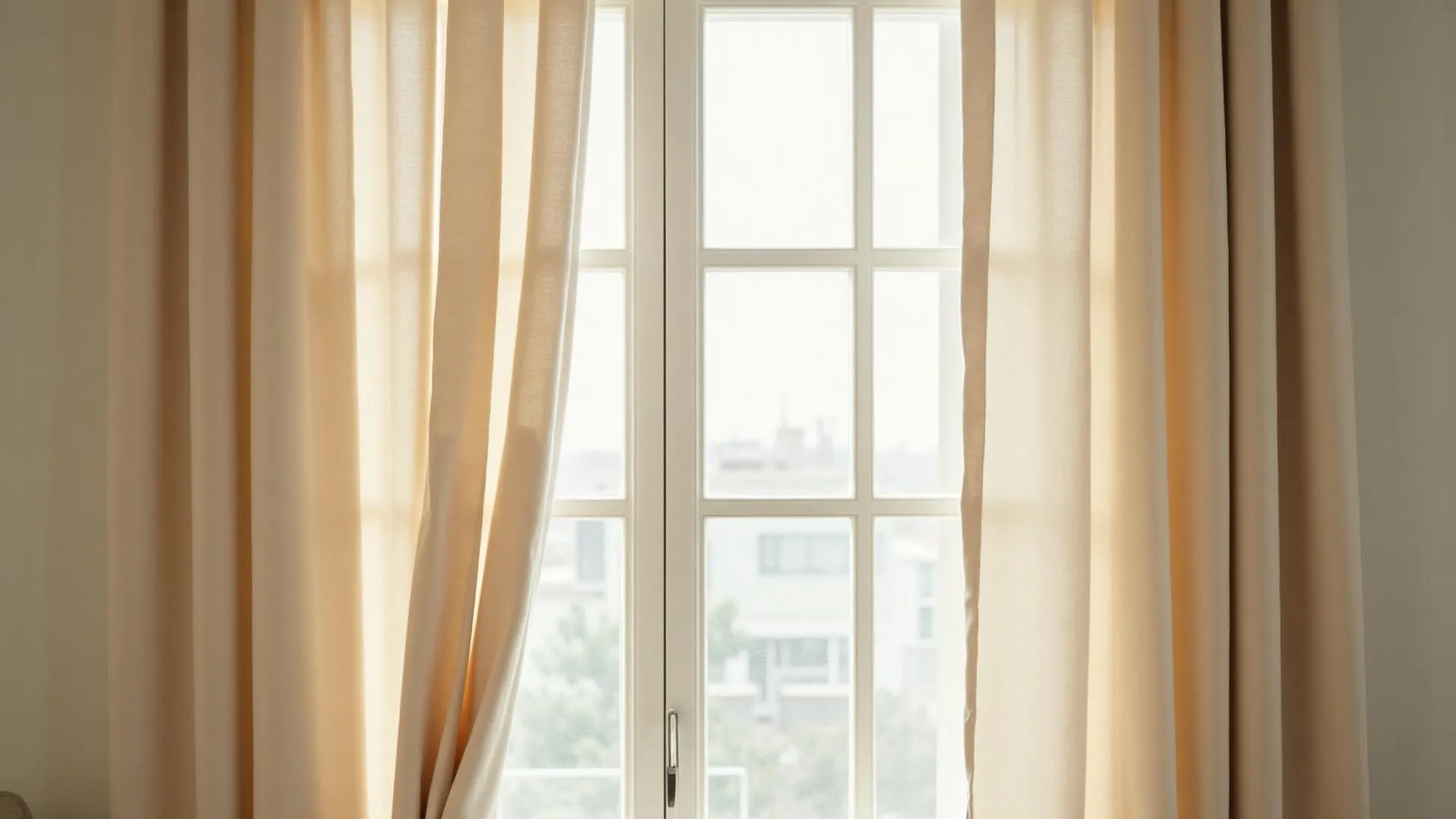
A roman blind can be fitted in three ways: inside the recess, on the frame, or above the window on the wall or ceiling. In a recess, take 1 cm off the width of the opening. On the frame, add 4 cm on each side. Above the window, leave at least 35–40 cm above the top of the frame if the window opens inwards. A raised roman blind (the stack height) takes 25–30 cm. Fabric costs from €9.50 per metre (voile) to €43 per metre (blackout and dim-out fabrics); tracks and mechanisms cost €5–95, and fitting €4–64.
Fixing on the wall above the window recess
A fix on the wall above the window is the most common choice, and it makes the window look larger. Fix the track above the frame by at least the height of the raised blind (the stack height, about 25–30 cm), so that the stack does not cover the glass. The blind should extend at least 5–10 cm beyond the frame on each side: without that overlap light gets in at the edges and the blackout effect is lost.
The measuring principle for a fix above the window: you measure the total width you want the blind to be, which is the width of the glass plus the side overlaps. For example, 100 cm of glass + 10 cm (5 cm on each side) = a blind 110 cm wide. The drop is measured from the fixing point of the track to where the bottom of the blind should be, usually to the sill or 1–2 cm below it.
A wall-fixed track suits most types of wall. A ceiling track looks more modern and lets the blind hang closer to the ceiling, which makes the room look taller.
A common mistake: many buyers measure only the width of the glass and forget the side overlaps. The result is a blind that seems to float in the window and does not block light from the sides.
Stack height: how much room the raised blind needs
Stack height is the height a roman blind takes when it is fully raised. For a window 180 cm high with a fabric of 3–4 layers, the stack is 25–30 cm. That means that if the track is hung only 10 cm above the window frame, the raised blind will cover 15–20 cm of the top of the glass.
The formula is simple: the minimum distance from the top of the window frame to the track = the stack height + a safety margin of 2–3 cm. For windows that open inwards you need at least 35–40 cm from the top of the frame: that is the room an opened sash needs so as not to tear the fabric. A day blind of thin voile raises into a much more compact stack than a two-layer day and night or blackout blind.
A worked example: a window 160 cm high that opens inwards, with a fabric stack height of 26 cm. The distance needed above the frame is the larger of the two figures, 35 cm for the sash and 26 cm for the stack, so at least 35 cm. If only 30 cm is left up to the ceiling, change the plan or choose a fix in the recess.
Fixing inside the window recess
A fix in the recess gives the cleanest line: the blind sits entirely within the window opening. It suits narrower windows and minimalist interiors. If less than 25–30 cm is left up to the ceiling, a fix in the recess may be the only realistic option.
The main drawbacks: a blind fixed in a recess cannot extend at the sides, so it blocks light less well, and light gets in at the edges. For a blackout blind this can be a serious drawback. And if the window opens inwards, a blind in the recess may stop the sash opening.
The measuring rule for a recess: take 1 cm off the width of the recess, so that the blind fits freely and the mechanism moves without friction. Measure the drop from the top of the recess to the sill, again taking off 1 cm. Example: a recess 95 cm wide and 140 cm high: order 94 × 139 cm.
| Point | In the recess | On the frame | Above the window (wall or ceiling) |
|---|---|---|---|
| Measuring principle | Width of the recess − 1 cm | Width of the glass + 8 cm (4 cm on each side) | A free width with side overlaps |
| Light blocking | Lower (light at the edges) | Medium | The most (with overlaps) |
| Look | Minimalist, set in | Neutral | Makes the window look larger |
| Suitability for blackout | Limited | Suitable | The most suitable |
| Stack height requirement | The depth of the recess must take it | Above the frame | Above the window: free space |
| Fitting complexity | Medium | Simple | Medium |
What the final price of a roman blind covers
The final price of a roman blind has several separate parts: the fabric, the track and mechanism, and the fitting work. A simple window can cost a few tens of euros, but a roman blind made to measure with a blackout fabric and motorised control can reach several hundred.
| Type of fabric | Price | Use |
|---|---|---|
| Voile (330 cm) | €9.50/m | Day, light |
| Net sheer (320 cm) | €12/m | Day, structured |
| Lietutis (320 cm) | €13/m | Day, textured |
| Crepe (300 cm) | €15/m | Day, denser |
| Soft voile (330 cm) | €15/m | Day, soft drape |
| Ramune (320 cm) | €16/m | Day, higher price band |
| Nobel (320 cm) | €16.50/m | Day, higher price band |
| Blackout and dim-out | €11–43/m | Night, darkening |
Tracks and mechanisms cost €5–95 per metre or per unit. A chain is the standard control and the cheapest. A remote raises the price of the blind noticeably, so it makes sense only where the window is hard to reach. Making costs an extra €32 per m² (€64 per m² for a day and night blind), and the fitting price depends on the fixing.
Work out the price of a roman blind
Open the price calculatorSee the roman blind collection
Show the collectionArrange a consultation
Arrange a consultationFrequently asked questions
Should a roman blind go inside the window recess or above the window on the wall?
A roman blind can be fixed in three ways: in the recess, above the window on the wall, or above the window on the ceiling. A fix in the recess gives a tidy, built-in look, but needs measuring accurate to the millimetre. A fix above the window on the wall is more flexible and suits windows that open inwards better. The final choice depends on the type of window, the depth of the recess and your own taste.
The roman blind stops the window opening: how do I avoid that?
A roman blind stops a window opening most often because it is hung too low, on a window that opens inwards. For windows that open inwards, leave at least 35–40 cm from the top of the frame to the track of the blind, so that the opened sash does not tear the fabric. The alternative is to fix the blind straight onto the window frame, or in the recess if it is deep enough.
How do I avoid problems when opening windows with roman blinds?
The main rule for windows that open inwards: hang the blind no lower than 35–40 cm above the top of the frame, so that the opened sash passes freely under the fabric. If the depth of the recess allows, the blind can be fixed in the recess, and then it will not get in the way of the window at all. Good planning and exact measuring in advance solve most of the problems in use.
How do day and night roman blinds differ?
Day roman blinds let some light through and give soft, diffused lighting, but do not darken the room completely. Night roman blinds are made of a dense blackout fabric that lets no light through, suited to bedrooms and children's rooms. Day and night roman blinds combine both fabrics on one mechanism, so the room can be light or dark.
How do I work out the stack height of a roman blind?
Stack height, the height of the raised blind, is 25–30 cm for a window 180 cm high with a fabric of 3–4 layers. There has to be enough free space above the window for this stack.
Can I fit a roman blind myself?
Yes. The mechanism of a roman blind is simple, and the ways of fixing it (recess, wall, ceiling) let you adapt to different conditions. Good planning and exact measuring in advance solve most of the problems in use. For a bathroom, choose a damp-resistant fabric.
How much do tracks and mechanisms cost?
Tracks and mechanisms in Lithuania cost from €5 to €95, depending on the type, the length and the maker. Manual control by chain is the standard and the cheapest. Making costs an extra €32/m² (€64/m² for a day and night blind), and fitting depends on the size of the window and how complicated it is.
How do I measure a window for a roman blind?
Fixing on the window frame: measure the width of the glass without the frame and add 4 cm on each side. Fixing in the recess: take 1 cm off the width and the height of the opening. Measuring has to be accurate to the millimetre, because a mistake cannot be corrected afterwards. Measure the drop from the fixing point to the sill, allowing for the stack height above the window.
How many centimetres should I leave above the window for a roman blind?
Leave at least 35–40 cm above the top of the frame if the window opens inwards. You also have to allow for the stack height: for a window 180 cm high, the raised blind takes 25–30 cm. If the window does not open, or opens outwards, room for the stack alone is enough.
How much room does a raised roman blind take on the track?
A raised roman blind takes 25–30 cm in height: that is the stack height, which forms when the fabric is folded up. This figure is for a window 180 cm high with a fabric of 3–4 layers; for a thinner fabric the stack height will be smaller. If the stack height is not allowed for, the raised blind may cover part of the window or press against the ceiling.
What do day roman blinds cost?
Fabric for day roman blinds costs from €9.50 per metre (voile) to €16.50 per metre (Nobel, the higher price band). The final sum depends on the size of the window, the type of mechanism and how complicated the fitting is. Day roman blinds are usually cheaper than blackout ones, whose fabric costs €11–43 per metre. Tracks and mechanisms cost €5–95, and making €32 per m² (€64 per m² for day and night).