Blinds
Vertical blinds for floor-to-ceiling windows
Vertical blinds for floor-to-ceiling windows are made for panoramic glazing, balcony and terrace doors, French windows and open-plan living rooms. 127 mm louvres keep the proportion on large areas, and accurate measuring keeps the louvre edges from rubbing on the floor.
Which windows count as floor-to-ceiling, and why do vertical blinds suit them?
In short, four decisions. 1. Louvre width: 127 mm louvres are made for large and panoramic windows from floor to ceiling, and look in proportion with fewer joins. 2. Measuring: the most important figure is the distance from the headrail to the floor. Leave a gap of 1–2 cm, so that the louvres do not drag on the floor. 3. Cleaning: for large vertical blinds a dry brush or a microfibre glove is enough, 2–3 times a year. 4. Price: from €35 per m²; larger windows (3 m high, 4 m wide) cost about €50–80 per m² with a denser fabric and a reinforced headrail.
Six typical situations where vertical blinds work best.
A panoramic window (2.5–4 m wide): a single large pane from floor to ceiling, common in new-build flats in Žirmūnai or Antakalnis. Vertical louvres control the sun across the full width and turn easily with one sweep. The textile does not hide the view altogether.
A balcony door with a side pane: a common arrangement in Soviet-era and new-build homes. A vertical blind lets only the door side be opened and the other left closed. 127 mm louvres do not stop the door from opening, and can be pushed to one side.
A terrace or garden door: a glazed terrace door on an upper floor, or a house opening onto a garden. Vertical blinds stand up to frequent opening without the mechanism failing, and the louvres turn with the draught. Choose a denser fabric for direct sun.
An open-plan living room with a dining area: a glass wall 4–5 m long from floor to ceiling. 127 mm louvres make a minimal, tidy look with no heavy folds. The look suits Scandinavian and industrial interiors.
An office conference room: a commercial setting, such as office buildings in Vilnius's business districts. Vertical blinds cover glass 3–6 m wide and let privacy be set during presentations. The most resistant fabrics are polyester with an antistatic coating.
French windows: a window that opens like a door, common in refurbished and heritage buildings. Vertical blinds do not stop it opening, and the louvres turn to the side. A special bottom chain bracket is needed, to stop swaying when the door is opened.
Should large windows have 127 mm or 89 mm louvres?
This is the main decision. On large floor-to-ceiling windows, 127 mm louvres are the norm: fewer joins and a better proportion.
Best window width: 89 mm, up to 2.5 m; 127 mm, 2.5–6 m. Number of louvres (a window 4 m wide): 89 mm, about 45; 127 mm, about 32 (fewer joins). Proportion: 89 mm ★★ (too fine); 127 mm ★★★★★ (matches the mass of the window). Resistance to wind: 89 mm ★★★ (sways more); 127 mm ★★★★ (a heavier louvre is steady). Price from (4 × 3 m): 89 mm about €38 per m²; 127 mm about €42 per m². Suits French windows: 89 mm, yes, but many joins; 127 mm, yes, and they open more smoothly.
For windows wider than 2.5 m we recommend 127 mm louvres: fewer joins, a cleaner look and better resistance to wind on balcony and terrace doors. 89 mm suits only smaller French windows up to 2.5 m wide, or when the interior calls for a finer pattern. If you are not sure, arrange a measuring visit: the designer brings the fabric samples. Measuring is free in Vilnius. In Kaunas and Klaipėda it is free on orders of €200 or more. Elsewhere in Lithuania the visit is paid, and the price is agreed beforehand.
How do I keep the louvres from dragging on the floor?
Three details stop the louvres rubbing on the floor and the edges wearing.
The commonest problem with vertical blinds on floor-to-ceiling windows is that the bottom edges of the louvres touch the floor, wear, and leave marks on parquet or tiles. Proper measuring and three technical elements solve this for the whole life of the blind.
1. Weight at the bottom of the louvre: each louvre has a plastic or metal weight at the bottom (3–6 g each). It keeps the louvre vertical even when the balcony door is open and there is a draught. Without the weight, swinging would damage the chain system within 6–12 months.
2. A bottom chain bracket (chain weight): the chain linking the bottoms of all the louvres levels them and keeps them from swaying. EN 13120 requires it in rooms where children stay. A fixed bracket is used, screwed to the sill or skirting board.
3. The distance from the floor: 1–2 cm is the precise measuring figure. Less, and the louvres rub on the floor; more (3+ cm), and an empty band catches the eye. 1.5 cm is the best compromise between looks and technical safety. This figure is recorded in the measuring protocol.
How heavy should the fabric be, and which chain systems are used?
Large floor-to-ceiling windows need a stronger construction than standard vertical blinds.
A standard vertical blind fabric weighs 130–180 g/m². For large floor-to-ceiling windows a fabric of 200–280 g/m² is chosen: it is denser, less translucent and holds its vertical shape without warping. A light fabric in a louvre 3 m high begins to ripple within 8–12 months, so take care when choosing cheaper versions.
The headrail system is reinforced too. Instead of the standard 1.1 mm aluminium profile, large windows take a reinforced headrail of 1.5–2 mm with double carriers. That way the sliding mechanism can carry a total weight of 30–40 kg (louvres + chains + weights).
Alternatives for large windows: wooden horizontal blinds do not suit above 2.5 m high (too heavy); curtain tracks with pleated curtains are an alternative if you want a soft texture; and ceiling tracks suit when the window is close to the ceiling and there is no room above the opening.
What do vertical blinds for large floor-to-ceiling windows cost?
Vertical blinds cost from €35 per m²; larger windows cost about €50–80 per m² with a reinforced construction.
Window height 2.4 m, width 2.5–3.0 m: about €38–45 per m² (standard fabric, 180 g/m²). Height 2.7 m, width 3.0–4.0 m: about €45–55 per m² (denser fabric, 220 g/m², reinforced headrail). Height 3.0 m, width 4.0–5.0 m: about €55–70 per m² (fabric of 250+ g/m², headrail with double carriers). Height 3.2 m+, width 5.0 m+: about €70–80 per m² (commercial, designed to order).
The vertical blind prices guide has a detailed calculation; the designer's consultation gives one for your own windows.
What are the five most common mistakes when buying vertical blinds for panoramic windows?
1. Choosing 89 mm louvres for a window 4 m wide: a client chooses 89 mm for the lower price and buys them for a panoramic window 4 m wide. The result is about 45 louvres, a look that is too fine, and joins that catch the eye. The rule: from 2.5 m wide choose 127 mm, the standard for panoramic windows.
2. The weight of the fabric does not match the height: a 150 g/m² fabric in a louvre 3 m high starts to ripple within a year, and the blind looks uneven. The answer: for a large window choose a 200–280 g/m² fabric, and also check that the fabric has an anti-static coating (important in a dry summer climate).
3. A distance from the floor of 5 cm or 0 cm: too large a gap (5+ cm) looks untidy and shows the structure at the bottom of the headrail. Too small (0 cm, or a louvre touching the floor) and the edges wear within 6–12 months. The norm: 1–2 cm, with the bottom chain bracket fixed to the sill.
4. A standard headrail for a large window: a 1.1 mm aluminium headrail does not suit a window 4 m+ wide. The carrier mechanism wears, and a scraping is heard as the blind slides. A reinforced 1.5–2 mm headrail with a double carrier is needed. Cheaper quotes often leave this out.
5. French windows without a bottom fixing: French windows are opened every day, so the louvres start to swing and the chain breaks within 2–3 years. The answer: French windows need an additional bottom chain fixing to the sill or skirting board, so there is no swinging and the system lasts 10+ years.
What is special about new-build flats in Vilnius, and flats in Kaunas and Klaipėda?
How the type of flat and its location change the choice of vertical blinds for panoramic windows.
Vilnius: new-build flats often have wide panoramic windows, for which 127 mm louvres in a denser fabric (220+ g/m²) suit. For offices in business centres, choose the most hard-wearing polyester fabrics.
Kaunas: heritage buildings in Žaliakalnis often have French windows that are opened every day, so plan a bottom fixing for them. In newer blocks with standard panoramic balcony doors, 127 mm louvres in a medium-weight fabric suit.
Klaipėda: coastal flats and houses with terraces often have large panoramas onto the sea. The most resistant fabrics are chosen (resistant to UV and damp), and the sea wind calls for a reinforced headrail.
Sources and standards
EN 13120, internal blinds: the EU standard that applies to rooms where children up to 42 months old live.
ANSI/WCMA A100.1-2022: the US counterpart, in force from 1 June 2024.
Guide author: Jegor Janockin, Curtain.lt, 500+ completed projects. Related source: the guide to vertical blinds.
Questions
Do vertical blinds suit floor-to-ceiling windows?
Yes. Vertical blinds suit panoramic and French windows that run to the floor better than most window dressings. Wooden horizontal blinds become too heavy above 2.5 m high, and roller blinds need a complex mechanism for a large area. Vertical louvres are easy to turn with one movement, let you open only part of the window and do not get in the way of a balcony or terrace door. 127 mm louvres in a 200–280 g/m² fabric, with a reinforced headrail, suit even large windows 4–5 m wide.
What height of blind do panoramic windows need?
The standard floor-to-ceiling window height in Lithuania is 2.4–2.7 m, and 3.0–3.2 m occurs in new-build flats in Žirmūnai and Antakalnis. Vertical blinds are made to measure: the louvres are cut so that the bottom edge leaves a gap of 1–2 cm to the floor. That distance is best: less causes wear from rubbing, and more looks untidy. When measuring, the exact height of the window is recorded at every point, because the floors in new buildings are not always exactly level.
How do I stop the louvres touching the floor, and keep them from swinging?
Three technical elements work together: (1) a plastic or metal weight at the bottom of each louvre, 3–6 g each, which holds the louvre vertical even in a draught; (2) a bottom chain linking all the louvres, which stops them swinging and is required by EN 13120 in rooms where children stay; (3) a bottom chain fixing, screwed to the sill or skirting board, which is the critical element for French windows and balcony doors that are opened every day. Without this fixing the chain breaks within 2–3 years; with it the system lasts 10+ years.
How much do large floor-to-ceiling vertical blinds cost?
From €35 per m² with a standard construction. For large floor-to-ceiling windows the price rises because of the denser fabric (200–280 g/m²) and the reinforced headrail: a window 2.5–3 m wide and 2.4 m high costs about €38–45 per m², one 3–4 m wide and 2.7 m high about €45–55 per m², and a panorama 4–5 m wide and 3 m high €55–70 per m². For commercial projects and offices (3.2+ m high, designed to order), up to €80 per m².
Do they suit French windows and balcony doors?
Yes. French windows and balcony doors are among the main uses vertical blinds were made for. Unlike roller blinds (which have to be raised fully before the door can be opened) or roman blinds (which physically get in the way), vertical louvres turn or slide to the side, and the door opens freely. For French windows an additional bottom fixing, screwed to the sill, is used, so that the louvres do not swing when the door is opened every day. 127 mm louvres suit them best: they slide more smoothly than 89 mm, with fewer joins.
Which louvre width is better for a large window, 89 mm or 127 mm?
For floor-to-ceiling windows, 127 mm without question. The main reasons: (1) proportion: 89 mm louvres look too fine on a window 4 m wide, making a line of about 45 joins that catches the eye, while 127 mm reduces this to about 32 and looks cleaner; (2) resistance to wind: a heavier 127 mm louvre is steadier on open terraces and balcony doors; (3) distribution of the fabric: fewer seams mean less risk of wear over 10+ years. 89 mm suits only windows up to 2.5 m wide, or an interior that calls for a finer pattern.
Ideas for your home
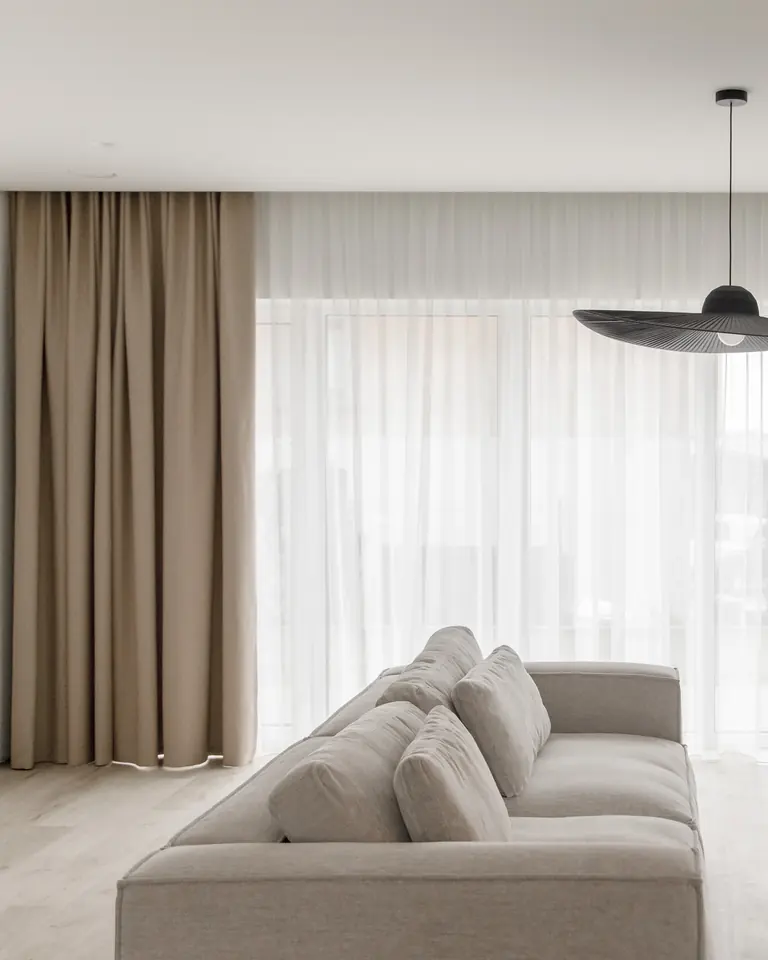
Flat, living room. A white sheer across the whole window wall and sand-coloured curtains from ceiling to floor. 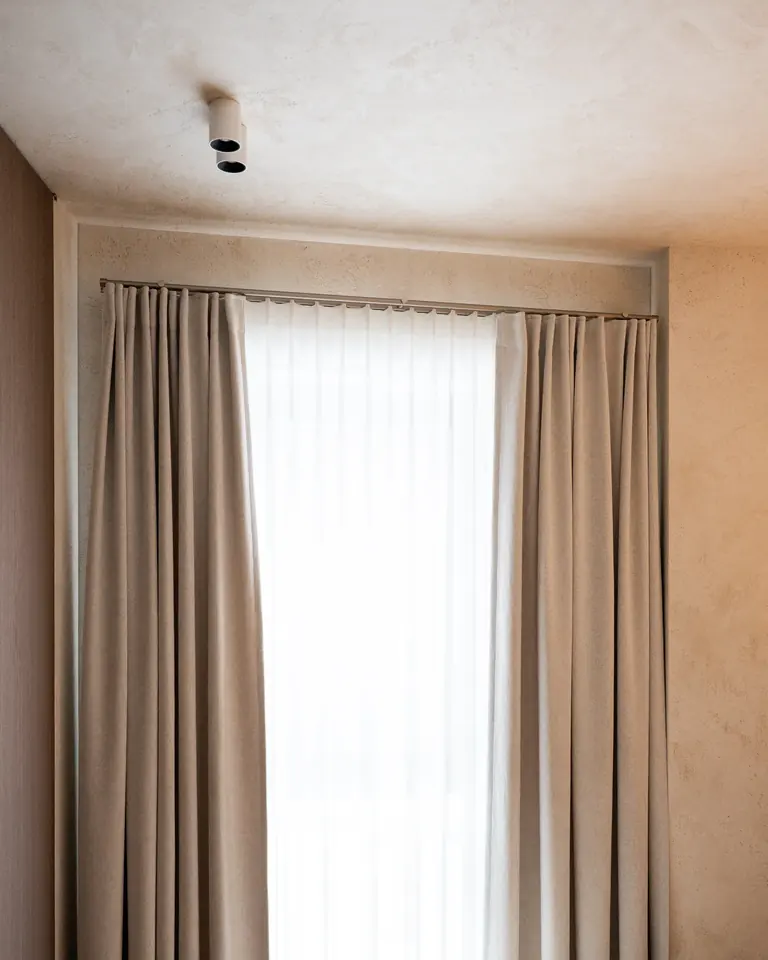
House, window recess. Sand-coloured curtains and a white sheer on a ceiling track. 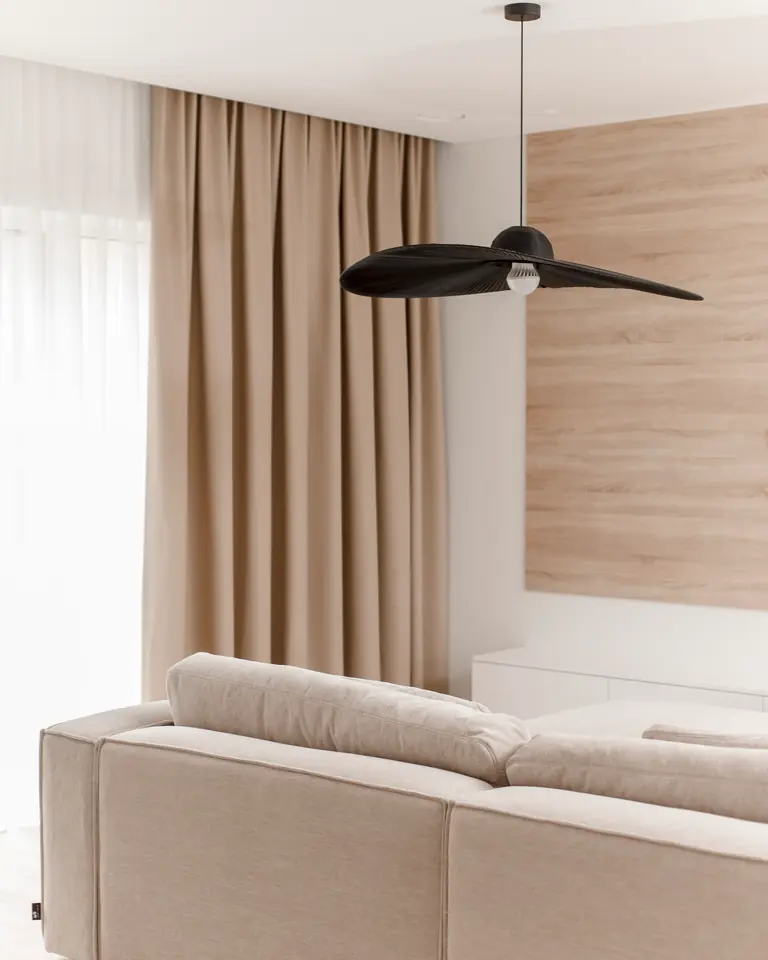
Flat, living room. Sand-coloured curtains and a white sheer from ceiling to floor. 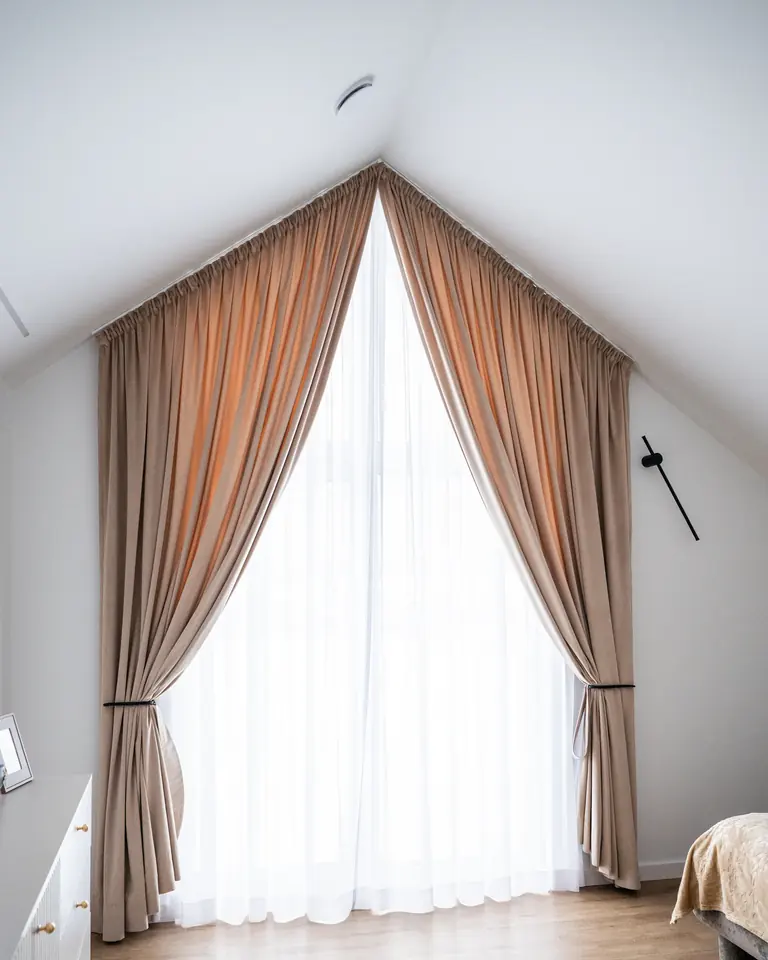
House, bedroom under a pitched roof. Peach curtains with tie-backs and a white sheer. 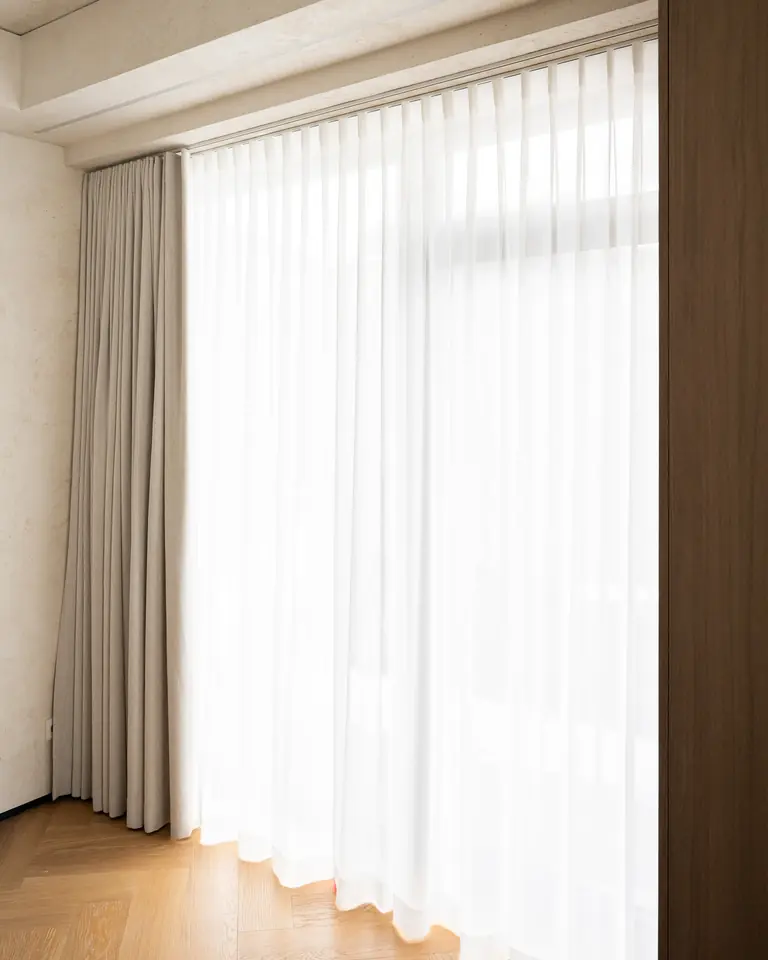
House, room with oak floors. A sheer in wave pleats and a pale curtain in a ceiling recess. 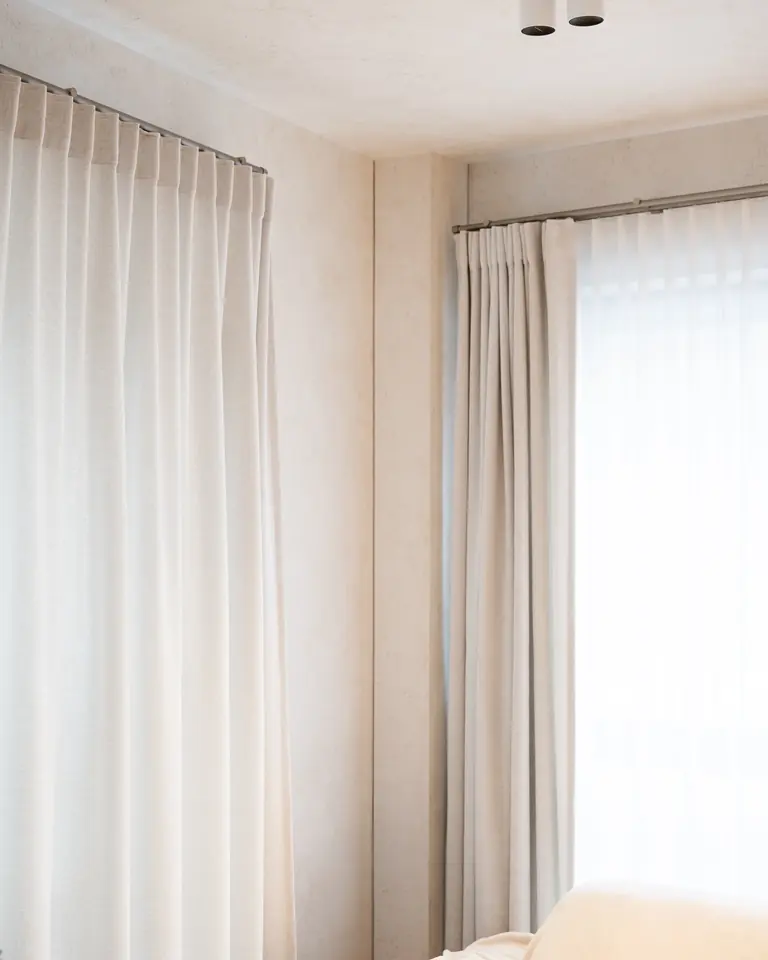
House, corner room. White sheers in wave pleats on ceiling tracks.