Author: Jegor Janockin
Reviewed by: Curtain.lt editorial team
Last updated:
Curtains for awkward windows: tall, sloping and trapezoid
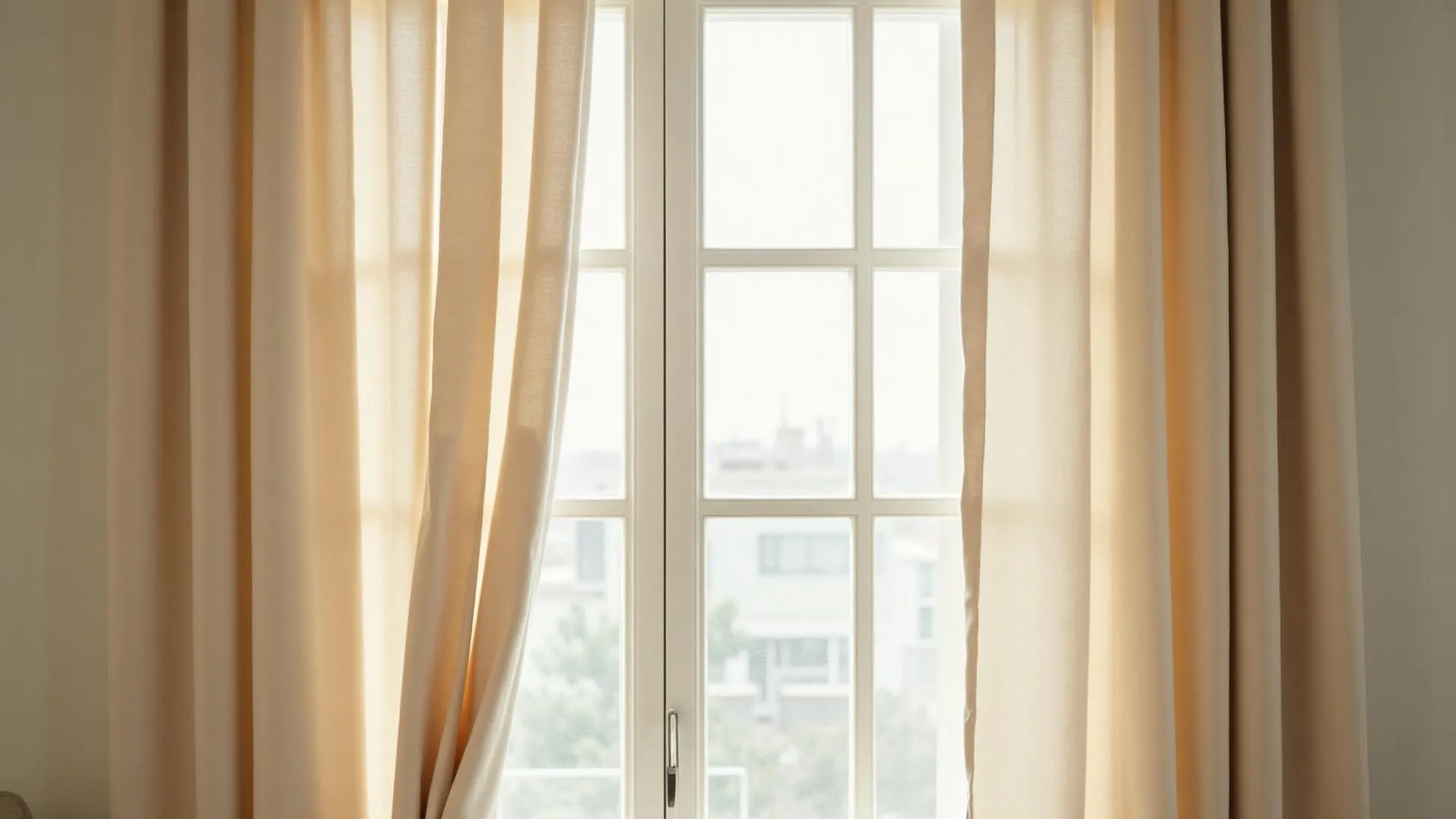
Awkward windows need exact measuring on site, a track chosen for the window and stronger fixings. On windows taller than 2.8 m a motorised track saves drawing heavy curtains by hand. For sloping attic windows, pleated blinds fixed top and bottom suit best, and a trapezoid window has to be measured on site.

Tall windows: lofts, stairwells and double-height rooms
Dressing a tall window, from 3 to 6 metres, is an engineering job. Curtains that tall take a lot of fabric, and lined and blackout fabrics are the heaviest (the densest, such as Gravity Blackout, weigh over 350 g/m²). That weight needs wall fixings with a higher load rating; standard plastic wall plugs will not hold it.
A pole or track for a tall window has to meet stricter requirements than an ordinary one. Use at least 4 fixing points, whatever the length of the pole, especially for heavy blackout curtains. A ceiling track with side returns gives stability and also closes the gap between the track and the wall, which full darkening depends on.
Motorised tracks
On windows taller than 2.8 m a motorised track is the practical choice: nobody has to draw heavy curtains by hand every day, so the fabric and the mechanism take less strain. Motorised tracks cost from €170 per metre with fitting and programming.
When the fabric is too narrow for a tall window, seams cannot be avoided. They run horizontally and are matched to the pattern of the fabric, which makes them almost invisible from a normal viewing distance.

| Type of pole or track | Advantages | Drawbacks |
|---|---|---|
| Ceiling track | Makes the space look larger, needed for tall windows, closes the gap better | More complicated to fit |
| Wall-fixed pole | Simpler to fit, less visible | Does not suit very tall windows, leaves a gap at the top |
Sloping and trapezoid windows in attics
Standard poles and tracks do not fit a sloping attic window. Gravity pulls the fabric steadily down the slope, so an ordinary horizontal pole does not work: the fabric keeps sliding down.
The answer is fixed poles with special stabilisers fitted at the top and the bottom. The upper bracket holds the pole to the ceiling or the frame, and the lower one to the bottom of the window or the sill. The fabric is stretched and held exactly in position, whatever gravity does.
A trapezoid window needs a sketch of its own with exact figures: measure all four sides and both diagonals with a steel tape. The four sides and one diagonal fix the shape, the second diagonal checks it, and the maker works out the angles from these figures. It has to be measured on site, not from a distance.
Trapezoid window
A common mistake
A standard horizontal pole is fitted on a sloping attic window. The result: within days the fabric slides down and the pole bends. The answer: use a special fixed pole with top and bottom fixings.
Pleated blinds: an alternative for sloping windows
A curtain hangs straight down, so it falls away from any glass that leans. On a sloping window, pleated blinds fixed top and bottom are the most practical option. They are fixed straight into the window frame, with the upper bracket at the top of the frame and the lower one at the bottom, so gravity cannot pull them down.
Measure the angle first
Before choosing between traditional curtains and pleated blinds, check whether the glass slopes. If it leans even a little from the vertical, choose a blind fixed at the top and the bottom or one that runs in side guides: only then does the fabric stay against the glass.
Pleated blinds come in sheerer fabrics for the day or in full blackout for a bedroom. A two-layer pleated blind adjusts the amount of light as needed, which matters most in attic bedrooms in summer.

See the pleated blind collection
Pleated blinds for sloping and awkwardly shaped windows.
See the collectionHow to order curtains for awkward windows
Curtains for awkward windows are made to measure, and how well they turn out depends on how exact every step of the process is.
- 1Consultation: write to us and describe the type of window (tall, sloping, trapezoid), the light control you want and the style of the room.
- 2Measuring on site: the designer visits with fabric samples and measures the awkward windows exactly. Trapezoid and sloping windows must be measured on site.
- 3Choosing the fabric and the track: the fabrics, the heading and the track are chosen to suit the style of the room, the window measurements and what the window has to do.
- 4Making: the curtains are made to your measurements. Fabric costs from €9.50 per metre for sheers and from €11 per metre for lined curtains. From order confirmation to installation, curtains, roman blinds and other blinds take 3–4 weeks, and tracks 1–2 weeks.
- 5Fitting: the curtains are fitted and adjusted so that the fixing is firm and they hang neatly. For heavy blackout curtains at least 4 fixing points are used.
Find out the exact price
Enter the size of the window and the fabric for a first budget.
Work out the priceFrequently asked questions
How do you hang curtains on sloping attic windows?
Pleated blinds fixed top and bottom suit sloping attic windows best: they are fixed straight into the window frame and do not slide even in a vertical position. Standard poles and hanging curtains do not suit sloping windows, because the fabric would fall away from the glass.
How do you fix a pole to a sloping ceiling?
On a sloping ceiling the pole is fixed with special adjustable brackets, which make up for the slope and keep the pole horizontal. Measure the angle of the slope exactly before fitting. If the ceiling is plasterboard, metal plates are also used to spread the load.
How do you measure a trapezoid window correctly?
A trapezoid window has to be measured physically on site. With a steel tape, measure all four sides separately and both diagonals: the angles are worked out from them, and the second diagonal checks the first. Even windows that look symmetrical often differ by a few millimetres, so this is a job for the measuring visit.
Which curtains are best for full darkening?
A dark blackout fabric alone is not enough for full darkening: the type of track matters just as much. Only a ceiling track with side returns closes the gap between the track and the wall, which light would otherwise get through. For awkward windows we suggest combining a blackout curtain with a sheer.
How long can a pole be made without a joint?
How long a track can be without a joint depends on the profile and on whether a one-piece track can be carried into the room, so it is settled at the measuring visit; a longer track is joined with a connector. The amount of fabric for a tall window is worked out from the heading: wave 2×, pleated 2.5× and eyelet 1.5× the width of the pole. Do not fit a tall pole yourself: it takes several people and special tools.
What is the difference between ceiling and wall fixing of a pole?
A ceiling fixing holds the track straight to the ceiling. It is needed when the ceiling is higher than 280 cm or the top of the window reaches the ceiling, and it makes the space look larger. Wall fixing is simpler, but it leaves a gap between the pole and the ceiling, through which light can get in.
How much do large curtains weigh, and how does it affect the fixing?
The weight depends on the fabric and how much of it there is: a tall window takes 1.5–2.5 times the track length in fabric, and lined and blackout fabrics are the heaviest (the densest, such as Gravity Blackout, weigh over 350 g/m²). That weight needs special wall fixing systems: standard wall plugs do not hold such a mass safely. Before fitting, assess the wall material and choose fixings of the right type.
Do pleated blinds suit attic windows?
Yes. Pleated blinds fixed top and bottom suit attic windows best. They are fixed straight into the window frame with special brackets and do not fall even in a fully vertical or a sloping position.
Which curtains should you choose for tall windows?
Decide first how they will be drawn: a manual mechanism soon wears under the weight of the fabric. Then hang two layers: sheers for the day and denser lined curtains for the evening.
Why does a tall window need a motorised track?
On windows taller than 2.8 m, a motorised track saves drawing heavy curtains by hand, and the constant heavy load tells on a manual mechanism. Motorised control also makes it possible to include the curtains in a smart-home system.
How much do curtains for awkward windows cost?
Curtains for awkward windows cost €30–200 per m², depending on how complicated the mechanism is and on the type of fabric. Natural fabrics (linen, cotton) and synthetics differ in care and in how they fade in the sun, so choose the fabric for the side the window faces. From order confirmation to installation, curtains, roman blinds and other blinds take 3–4 weeks, and tracks 1–2 weeks.