Author: Jegor Janockin
Reviewed by: Curtain.lt editorial team
Last updated:
Terrace curtains for wind: fabric and fixing
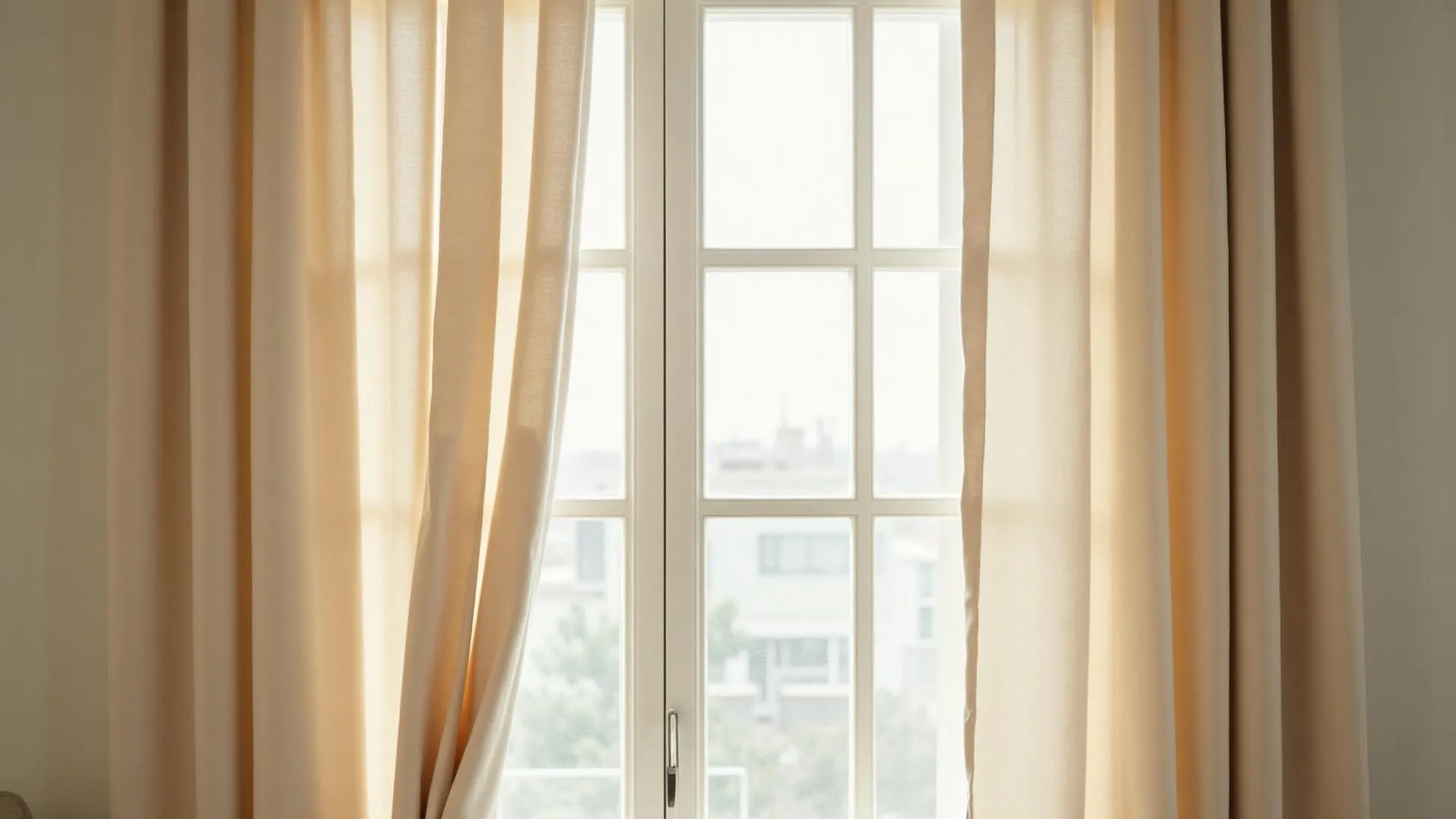
For a terrace in the wind, choose acrylic or polyester fabric with a UV-resistant, water-resistant coating and a Teflon finish that is renewed every year. For stability, the eyelets are fixed at the top and at the bottom, with a heavier bottom edge and anchor points, or a zip track at the sides.
Terrace curtains for wind: where to start
Outdoor terrace curtains do three jobs: they stop wind, shade the terrace from strong sun and keep it usable when it starts to rain. Unlike indoor curtains, they are exposed all the time to UV rays, damp, swings in temperature and the mechanical load of gusts. So three technical choices come before the colour: the type of fabric, the fixing system and whether the curtain should let wind through.
The main difference from a window curtain is that outdoors there is no rigid wall for the fabric to lie against. An open terrace span acts like a sail: if the curtain is fixed only at the top, the wind fills it, it slaps against the posts and soon tears out the eyelets. That is why outdoor curtains are always fixed in at least two planes and weighted at the bottom. Everything else, the coating of the fabric, the density of the mesh, the type of track, is a variation on that basic rule.
- The fabric: acrylic or polyester, and what UV and water-resistant coating it has.
- Permeability to wind: solid fabric, or mesh (a net weave that lets some wind through).
- The fixing: a freely hanging curtain with eyelets and anchors, or a zip track at the sides.
Which fabric stands up to sun, rain and wind?
Two fabrics do the work outdoors: acrylic and polyester. Acrylic (for example, solution-dyed acrylic fibre) is the dearer choice: the colour goes right through the fibre, so it does not fade in the sun for 5–10 years, and the fabric breathes and holds its shape well. Polyester with a PVC coating is cheaper and more often fully watertight, but it fades faster in strong sun and is hotter underneath in summer. In both cases the coating of the surface matters more than the fibre.
The UV coating decides how many years the colour lasts and how long before the fabric dries out and becomes brittle. The water-resistant coating (usually an acrylic dispersion or a PU layer) decides whether raindrops run off or soak through. A Teflon finish is an extra surface treatment that repels water and dirt, so the fabric soaks through and gets dirty less. It is this finish that has to be renewed.
Renew the Teflon finish every year
The layer that repels water and dirt wears off over a season from rain, sun and cleaning. Once a year, preferably in spring before the season, spray the clean, dry fabric with a proofing product, and drops will roll off again instead of soaking into the fibre. Without renewal the fabric gradually begins to take up water and dries more slowly.
| Property | Acrylic (solution-dyed) | Polyester with a PVC coating |
|---|---|---|
| Resistance to UV and fading | Very good (5–10 years) | Moderate (3–5 years) |
| Water resistance | Repels water, breathes | Up to fully watertight |
| Comfort in the sun | Cooler; the fabric breathes | Hotter under the coating |
| Price | Higher | Lower |
| Teflon finish | Recommended; renew every year | Recommended; renew every year |

Wind-permeable mesh or solid fabric?
Mesh is a net-like fabric that lets part of the wind through. It stops most of the wind but lets gusts pass through, so it slaps less, puts less load on the fixings and stays more transparent: you can see the garden or the view through it. Solid (sealed) fabric stops wind and rain and blocks the view in completely, but acts like a sail and needs sturdier fixing and stronger weighting at the bottom.
The choice depends on how open your terrace is and what you most want protection from. For an open, windy corner or a terrace by the sea, mesh is often more practical: it slaps less and lasts longer. For a more enclosed terrace, partly sheltered from the wind, where full privacy and protection from rain matter, solid fabric suits. Many people choose a combination: solid fabric where privacy is needed, and mesh where the view matters.
- An exposed, windy place: choose mesh, which puts less load on the fixings.
- You need full privacy and protection from rain: solid fabric.
- You want to keep the view of the garden: mesh, or a lighter, more transparent fabric.
- Strong, frequent gusts: mesh + a zip track at the sides.
How to fix outdoor curtains against wind
The logic of fixing is simple: the curtain has to be taut in at least two planes, so that the wind has nowhere to fill it. In practice that means metal eyelets at the top and at the bottom edge. At the top the fabric hangs from a wire rope, a tube or a track, and at the bottom a wire is run through the eyelets, or the curtain is hooked to anchor points screwed into the floor.
The second essential is a weighted bottom edge. That can be a weight sewn into the bottom hem: a weight tape, a tube or a chain, which holds the fabric taut and stops it lifting even when it is not fully fastened at the bottom. The third is the anchor points: stainless-steel loops or hooks screwed into the floor or the upstand, to which the bottom of the curtain is drawn by a wire with a tensioner (a turnbuckle). All the fittings must be stainless, because ordinary steel rusts outdoors within a year.
Fixing only at the top: the commonest and costliest mistake
If the curtain is fixed only at the top, the first stronger gust fills it like a sail, the fabric starts to slap against the posts, and the eyelets and seams are torn. Within a few weeks the fixing points are pulled out or the fabric tears. Always fix at the top and at the bottom, and use a weighted edge and anchor points: that matters more than the fabric itself.
Zip track or a freely hanging curtain?
A freely hanging curtain is fabric with eyelets, wires and anchors, which can be hung and taken down quickly. It is cheaper and simpler, and suits more enclosed terraces or occasional use. The drawback is that even a well-tensioned curtain can ripple a little at the sides in strong wind, and a little wind and rain gets in at the edges.
A zip-track system is side tracks into which the edges of the fabric are fed through a zip, so the curtain is fully taut and sealed at the sides. It suits open, exposed terraces, and anywhere the sides must be sealed against wind and rain. The system is dearer and needs exact measuring and sound fitting, but it all but stops the slapping and the draught. The choice comes down to how open the terrace is, the budget and how often the curtains will be used.
| Point | Freely hanging | Zip track |
|---|---|---|
| Sealing at the sides | Partial | Complete |
| Resistance to strong wind | Moderate | Very good |
| Complexity of fitting | Simple | More complex, exact |
| Price | Lower | Higher |
| Suits | More enclosed terraces, occasional use | Open, windy terraces |
Outdoor curtains for your terrace
The fabric, the mesh density and the fixing are chosen for your terrace, from a freely hanging curtain to a zip track.
See outdoor curtains
Measuring an open terrace span, step by step
A terrace is measured differently from a window. For a window, the width and height of the opening are enough, but outdoors you measure the distances between posts, allow for the slope of the floor and the sag of the wire, and for whether the fabric must reach the floor. These are the main steps before you order outdoor curtains.
- 1Distance between posts: measure the span between the supports at the top and at the bottom separately, because posts are seldom exactly parallel; use the smaller figure, or the average, depending on the system.
- 2Height from the top to the floor: measure at several points across the whole width, because terrace floors often slope so that water runs off; the bottom of the fabric must stay clear of puddles and not catch.
- 3Fixing planes: mark where the top wire or track will run and where the bottom anchor points will be; check there is something to fix to (timber, metal, concrete).
- 4Allowance and sag: allow for hems and eyelets and for the sag of the wire, so that the finished curtain is properly taut, not too short or too long.
- 5Wind direction and exposure: judge which side the strongest wind comes from, so as to choose mesh or solid fabric and the density of the fixings.
Measuring on site
The geometry of outdoor spans is almost never exactly rectangular, and a measuring error gives a curtain that slaps or is too short. The safest course is a visit: the designer measures and chooses the fixing on the terrace itself, which avoids expensive remaking.
Gazebos, open balconies and terrace doors
A gazebo usually has four open sides, so the curtains hang round the whole perimeter and are often made in separate sections, so that one side can be opened. A combination of mesh and zip track matters most here, because the wind can blow from any direction.
An open balcony is often narrower and taller, with an upstand to which it is convenient to fix the bottom anchors. Here it matters that the fabric does not create too much wind load or slap towards the neighbours, so in blocks of flats a more permeable mesh is often chosen. For a terrace door zone (on the outside), a narrower, vertically sliding curtain suits, or a roller blind that is drawn down only when needed. In every case the same rule applies: fixing at the top and at the bottom, plus a weighted edge.
What do outdoor terrace curtains cost?
The price of outdoor curtains depends on the fabric (acrylic costs more than polyester), the fixing system (a freely hanging curtain is cheaper than a zip track), the area, the number of sections and the fittings (stainless steel costs more). A simple set-up costs from a few hundred euros, and a fully fitted medium-sized terrace with several sections usually costs from a few hundred euros to a thousand or more. The exact sum depends on the dimensions and the system chosen.
The most reliable way to find the price is a measuring visit, after which you receive a specific quote for the size of your terrace, the fabric and the fixing. That avoids the typical mistake of ordering too weak a system for an open, windy terrace and having to redo it later.
Would you like an exact price for your terrace?
See the range of outdoor and terrace fabrics, or arrange a measuring visit, and we will give you a quote based on the real dimensions.
See the fabricsCommon mistakes when choosing outdoor curtains
Mistakes that shorten the life of the curtains
The commonest mistakes: fixing only at the top (the fabric slaps and tears), using an indoor fabric outdoors (it soon fades and breaks down), too little weight at the bottom, ordinary fittings that rust, not renewing the Teflon finish, and choosing solid fabric for an exposed, windy place instead of mesh. All of them lead to faster wear and expensive remaking.
Care and measuring: where to look next
For outdoor curtains to last, they need to be cleaned in good time, the proofing renewed every year and the fixing fittings checked. Exact measuring and making to order make sure the fabric is properly taut and stands up to the wind. Below are useful links on measuring, making and care.
Care tips and the measuring service
Find out how to look after the fabric through the season, or arrange exact measuring and making to order.
Read the curtain care guideFrequently asked questions
Which curtains suit an outdoor terrace, and how do I fix them against wind?
For an outdoor terrace, choose acrylic or polyester fabric with a UV and water-resistant coating and a Teflon finish renewed every year. For stability the curtain is fixed at the top and at the bottom: with eyelets, a weighted bottom edge and anchor points in the floor, or a zip track at the sides. For exposed, windy places a wind-permeable mesh fabric is better, because it slaps less.
Are outdoor curtains completely waterproof?
It depends on the fabric. Acrylic fabrics usually repel water and breathe: they stand up to light rain, but in a long downpour a little may soak through. Polyester with a PVC coating can be fully watertight. A Teflon finish raises the resistance, so drops roll off instead of soaking in. For full sealing, choose solid fabric with zip tracks.
How is measuring a terrace different from measuring a window?
For a window, the width and height of the opening are enough, but for a terrace you measure the distances between the posts at the top and at the bottom separately, and allow for the slope of the floor, the sag of the wire and the fixing planes. Outdoor spans are seldom exactly rectangular, so a measuring error gives a curtain that slaps or is too short. The safest course is to arrange a measuring visit on site, so that the designer can choose the fixing too.
What do outdoor and terrace curtains cost?
The price depends on the fabric, the fixing system, the area and the number of sections. A simple freely hanging curtain costs from a few hundred euros, and a fully fitted medium-sized terrace with several sections and zip tracks usually costs from a few hundred euros up to a thousand or more. The exact price follows a measuring visit, based on the real dimensions of your terrace.
Do outdoor curtains need to be taken down for the winter?
Yes, ideally. Even weather-resistant outdoor fabrics last longer if they are taken down for the winter, cleaned, dried thoroughly and kept in a dry room, so they are not worn by the weight of snow, ice and constant damp. Zip-track systems with a rigid frame are sometimes left up for the winter, but even then it pays to take the fabric down. In spring, before the season, renew the Teflon finish.
A consultation and measuring on your terrace
The designer comes, measures the terrace and suggests the fabric and the fixing; the curtains are then made to order. Measuring is free in Vilnius. In Kaunas and Klaipėda it is free on orders of €200 or more. Elsewhere in Lithuania the visit is paid, and the price is agreed beforehand.
Arrange a design consultation