Blinds
Vertical blinds for offices
Made to order: 89 mm or 127 mm louvres, in dim-out and blackout fabrics. Vertical blinds suit office windows: they cover large areas, set the light precisely, reduce echo in open-plan rooms and give a businesslike look.

Why do vertical blinds suit an office?
In short, vertical blinds for an office in four decisions. 1. Louvre width: 127 mm suits a standard office (windows from 150 cm); 89 mm suits smaller windows and a stricter look. 2. Fabrics: dim-out (60–80% light blocking) is the most versatile for an office; blackout is needed only in conference rooms with projectors. 3. Prices: from €35 per m² (89 mm dim-out) to €65 per m² (127 mm blackout with an acoustic lining); a complete order for a standard office costs €450–1,200. 4. Fitting: level the headrail accurately and set the weights and chains correctly; without them the louvres tangle after only 2–3 months of use.
Six reasons why vertical blinds suit offices.
Large windows: vertical blinds can be made up to 6 m wide and 4 m high with no extra structure. They suit panoramic office windows, where horizontal blinds or roller blinds would be out of proportion and technically difficult.
Ergonomic control from the desk: a chain or wand that rotates the louvres lets you change their angle in 2–3 seconds. An employee can adjust the light without leaving the monitor, which matters over long working days.
Acoustic comfort for an open-plan office: the fabric of vertical blinds absorbs some sound. In an open-plan office with concrete floors this helps reduce echo, which makes conversations on video calls clearer.
Precise control of the light at workstations: turning the louvres to 45° can remove glare on monitors altogether without closing the room. It matters to staff who do CAD, graphic design or work at several screens at once.
A businesslike, neutral look: vertical louvres cover the window frames and make one unbroken vertical line, which makes the room look wider and gives a corporate appearance. It suits both a minimal and a classic office style.
Easy care and quick repair: a single louvre can be replaced in 5 minutes with no special tools. The fabric can be washed at 30 °C or cleaned with a damp sponge, which is cheaper than the chemical cleaning of roller blinds or curtains.
Should an office have 89 mm or 127 mm louvres?
The main decision. 127 mm louvres dominate modern offices, and 89 mm louvres suit compact rooms.
Window width it suits: 89 mm, 80–150 cm; 127 mm, 150 cm and wider. Look: 89 mm is fine and classic; 127 mm is bold, modern and corporate. Price from: 89 mm, €35 per m²; 127 mm, €42 per m². Number of louvres (a 3 m window): 89 mm, about 22 louvres; 127 mm, about 16. Light blocking: 89 mm has a smaller gap, so a better seal; 127 mm has wider panels, so even cover. Conference room: 89 mm suits only smaller ones (up to 20 m²); 127 mm suits rooms of 80–100 m².
Our recommendation for an office: a standard office (windows 150–250 cm, open-plan or classic layout) → 127 mm louvres in a dim-out fabric: a modern look, fewer joins and simpler care. A compact private office or an archive room (windows 80–140 cm) → 89 mm louvres in a standard dim-out fabric: a better-proportioned look and a better seal in a narrow window.
Which fabric for an office: dim-out, blackout or translucent?
The choice of fabric matters more than the louvre width: it decides how comfortable the work is.
Choose the fabric for an office by the kind of work. For computer work a non-reflective surface is essential, or the louvres reflect the monitor and add to eye strain. Dim-out fabrics suit most offices: they hold back 60–80% of the light, but leave enough natural light for the workstations.
Dim-out (versatile, 60–80% blocking): suits almost any office. It lets natural light in and removes glare on monitors. Fabric thickness 0.4–0.6 mm.
Blackout (100% blocking): needed only in conference rooms with projectors, or in video studios. It makes no sense at workstations, where staff feel tired without light.
Translucent (screen, 5–10% blocking): suits receptions and corridors, where the view out is wanted. It gives UV protection, but hardly regulates the light.
Acoustic lining: costs 30% more and reduces echo further, for open-plan offices with many video calls.
What about conference rooms and open-plan offices?
Large rooms are dressed differently from standard offices.
In open-plan offices and conference rooms the logic of vertical blinds changes. A single 6 m window with 16 louvres makes an impressive façade, but operating it by hand becomes awkward: an employee has to walk the length of the room to turn the louvres. So in large conference rooms, consider electric operation with a remote control or a phone app.
Electric operation adds €180–320 per m² to the cost of the project, depending on the maker, but it saves staff time. It pays off when the room is used more than 3 times a week, or when the windows are taller than 2.5 m and mechanical operation becomes physically difficult.
For panoramic office windows (4 m and more) we suggest a double headrail, with a dim-out fabric on one and a screen fabric on the other. Through the day you switch between light (screen) and privacy (dim-out). It suits offices where natural light comes first but the midday sun tires the eyes.
What do vertical blinds for an office cost?
The 2026 price list. Measuring is free in Vilnius. In Kaunas and Klaipėda it is free on orders of €200 or more. Elsewhere in Lithuania the visit is paid, and the price is agreed beforehand.
A window 100 cm wide: 89 mm, €95–130; 127 mm is not recommended (on a small window 89 mm is better proportioned). 150 cm: 89 mm, €140–180; 127 mm, €160–210 (the crossover point, where both suit). 200 cm: 89 mm, €190–250; 127 mm, €220–290 (a standard office window). 300 cm: 89 mm not recommended; 127 mm, €330–420 (open-plan offices take 127 mm). 400 cm: 127 mm, €440–580; for a conference room, a double headrail costs €180 extra. 600 cm panoramic: 127 mm, €650–890; electric operation costs €280 extra.
All prices include the headrail set. The fabric category is dim-out (the standard). Blackout adds 20%, and an acoustic lining adds 30%.
What are the five most common mistakes when buying vertical blinds for an office?
1. Choosing a blackout fabric for workstations: the client assumes blackout means better quality and orders a fabric that blocks the light for the whole office. The result: staff feel shut in, artificial lighting has to run all day, and the electricity bill rises. The answer: blackout only in conference rooms with projectors; dim-out (60–80% blocking) for workstations.
2. 89 mm louvres on a large window: the client chooses 89 mm "for the lower price", but on a window 3 m wide that makes 22 vertical lines, which looks chaotic and makes the office look crowded. The rule: from 150 cm choose 127 mm louvres. The difference in price is only €7 per m², but the effect on the look is large.
3. A fabric with a reflective surface: cheap PVC or polyester fabrics have a shiny surface that reflects monitors and adds to eye strain. Staff begin to complain of headaches. The answer: matt fabrics only, because the difference in price quickly pays back.
4. Skipping the levelling of the headrail: a headrail hung without a laser level and out by 1–2° makes the louvres run unevenly, tangle and catch on their neighbours. The mechanism fails within 2–3 months. Use a laser level for every headrail.
5. Overlooking the weights and chains: at the bottom of vertical blinds there are weights and linking chains. Without them the louvres would move chaotically, and wind through an open window would damage them. Cheap blinds are often supplied without chains. Check that the quote includes the weights (essential) and the chains (recommended in an office that is often aired).
What is special about offices in Vilnius, Kaunas and Klaipėda?
How the kind of office and its location change the choice of vertical blinds.
Vilnius: in new business centres with open-plan offices and panoramic windows 4–6 m wide, 127 mm louvres in dim-out fabrics suit. For offices in the Old Town with smaller windows, 89 mm louvres in classic sand-coloured or grey fabrics are better proportioned. For an open-plan office, consider an acoustic lining.
Kaunas: for modern IT offices, 127 mm louvres in a neutral screen or dim-out fabric give a neutral look. In smaller offices in older buildings, 89 mm louvres in a dim-out fabric are better proportioned. For conference rooms with a projector, a blackout fabric with electric operation.
Klaipėda: in the port city, salty air damages cheap polyesters, so choose more resistant fabrics for offices. Sunny coastal rooms suit fabrics with UV protection. Before ordering, ask for a fabric sample and check it against your window.
Sources and standards
EN 13120, internal blinds: the EU standard that applies to offices and to areas children can reach.
ANSI/WCMA A100.1-2022: the US counterpart, in force from 1 June 2024.
Related guides: the guide to vertical blinds · vertical blind prices. Alternatives: wooden blinds, outdoor curtains, lined curtains.
Questions
Which louvre width suits an office, 89 mm or 127 mm?
The window width and the style of the office decide. 127 mm louvres suit a standard office (windows from 150 cm): they give a modern, businesslike look, have fewer vertical joins and are easier to operate. 89 mm louvres suit compact rooms (windows 80–150 cm), small private offices and classic-style offices. The difference in price is small: 89 mm from €35 per m², 127 mm from €42 per m². For most offices, 127 mm louvres in a dim-out fabric suit: they reduce glare and do not darken the room.
How much do vertical blinds for an office cost?
Vertical blinds for an office cost from €35 per m² (89 mm dim-out fabric) to €65 per m² (127 mm blackout with an acoustic lining). For a standard office window 2 m wide with 127 mm dim-out fabric, €220–290, with the headrail set. For an open-plan office with a panoramic window 4 m wide, €440–580. Electric operation adds €280 per window.
How do I look after vertical blinds in an office?
In an office it is enough to clean vertical blinds every 3–6 months. Standard care is a vacuum cleaner with a soft attachment, or a damp microfibre sponge with mild soapy water (30 °C). Fabrics that can be taken down can be hand-washed and dried hanging, without ironing. Acoustic linings need chemical cleaning once every 2–3 years (€50–80 per set). Replacing a single louvre takes 5 minutes and costs €8–15, depending on the fabric category.
Do vertical blinds suit a conference room?
Yes, especially large ones (40–100 m²). 127 mm louvres in a blackout fabric block the light for projector use, and an acoustic lining reduces echo. For rooms used more than 3 times a week, fit a double headrail (dim-out + blackout): it switches between presentation and working mode in 5 seconds. Electric operation (€280 per window) becomes a necessity when the height exceeds 2.5 m.
Which fabrics resist sun best in office windows?
For sunny sides of an office (south, south-west, west), choose fabrics with UV protection and a dense, UV-stable fibre. Cheap polyesters fade quickly on a sunny side, and you will see that the louvres are much paler on the window side than on the room side. For coastal offices in Klaipėda, choose a fabric that resists salty air as well as UV.
Is electric operation worth it in an office?
Yes, in three cases: (1) the windows are taller than 2.5 m and manual operation becomes physically difficult, (2) a conference room is used more than 3 times a week and time matters, (3) in an open-plan office, operating the blinds by hand interrupts the work. The cost is €180–320 per m², depending on the maker of the motor. Electric operation also saves staff time and spares the mechanism, because the louvres turn evenly.
Ideas for your home
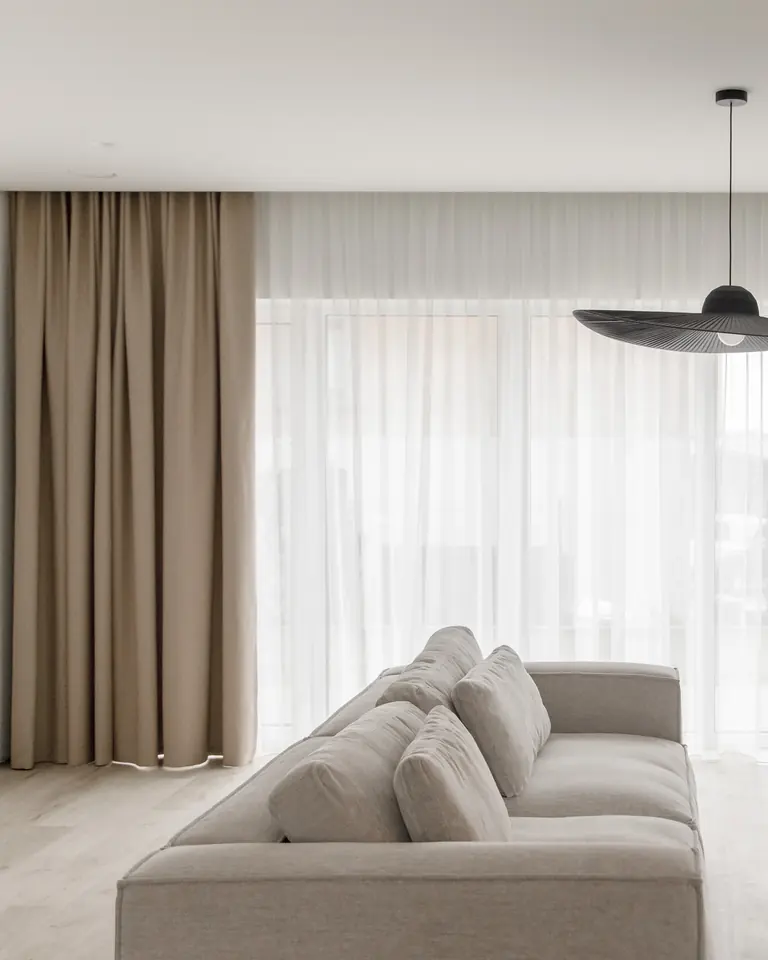
Flat, living room. A white sheer across the whole window wall and sand-coloured curtains from ceiling to floor. 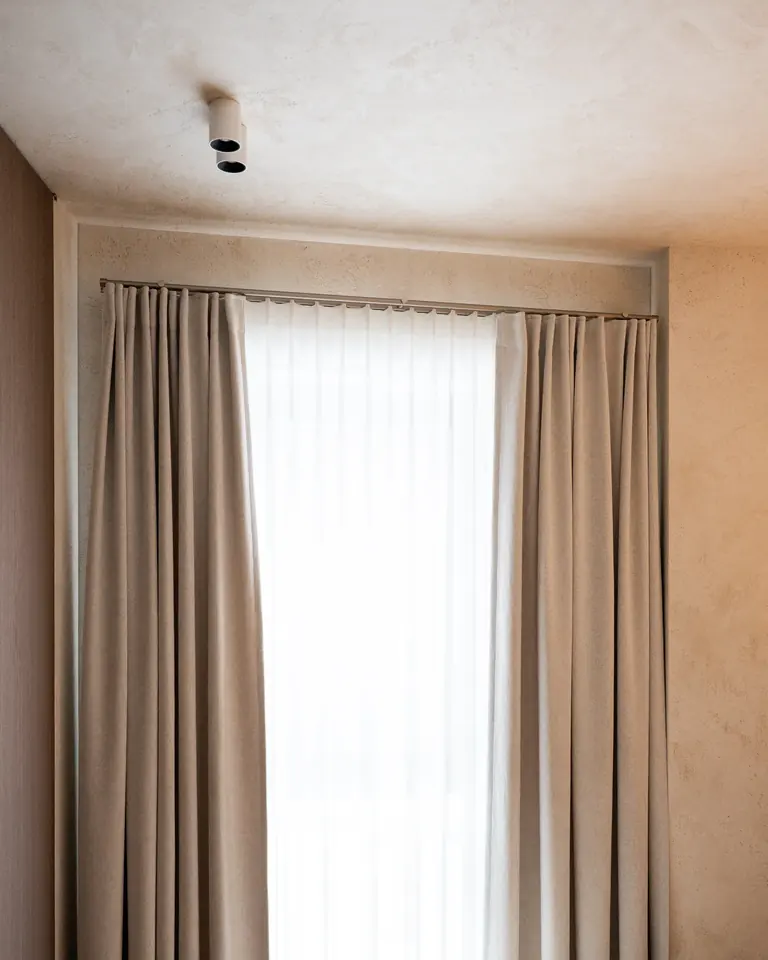
House, window recess. Sand-coloured curtains and a white sheer on a ceiling track. 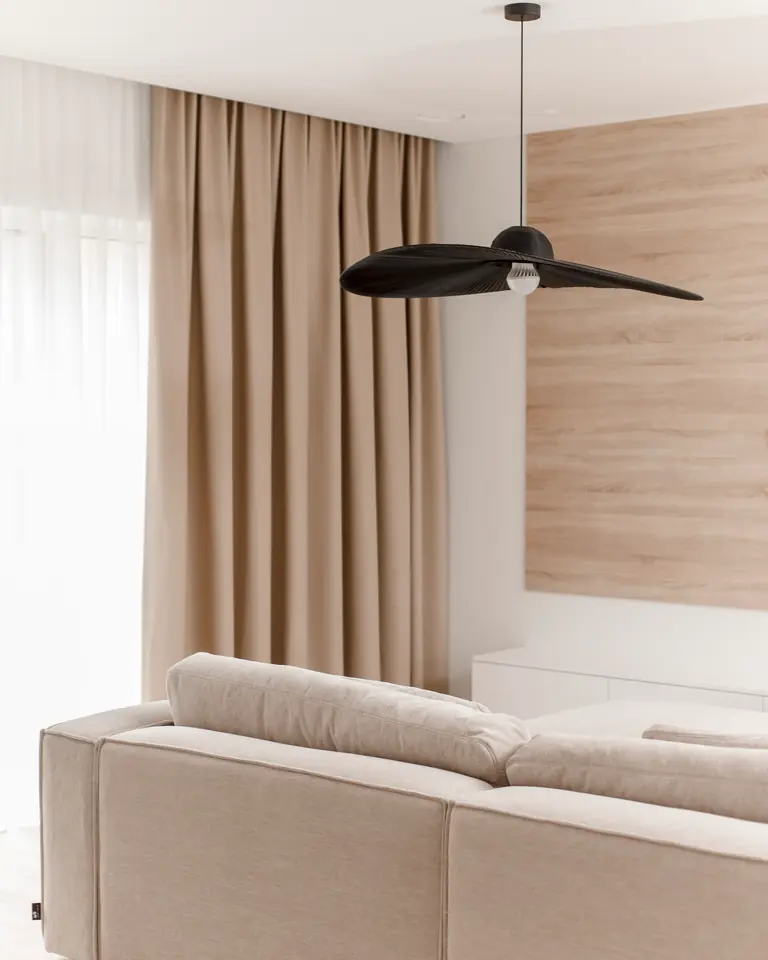
Flat, living room. Sand-coloured curtains and a white sheer from ceiling to floor. 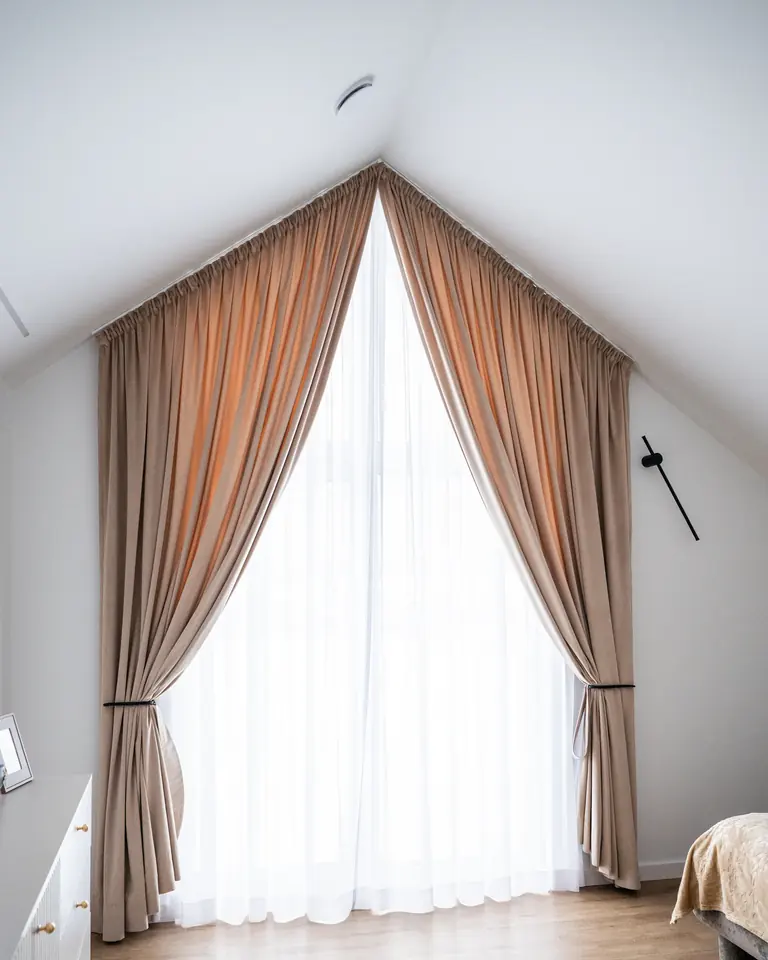
House, bedroom under a pitched roof. Peach curtains with tie-backs and a white sheer. 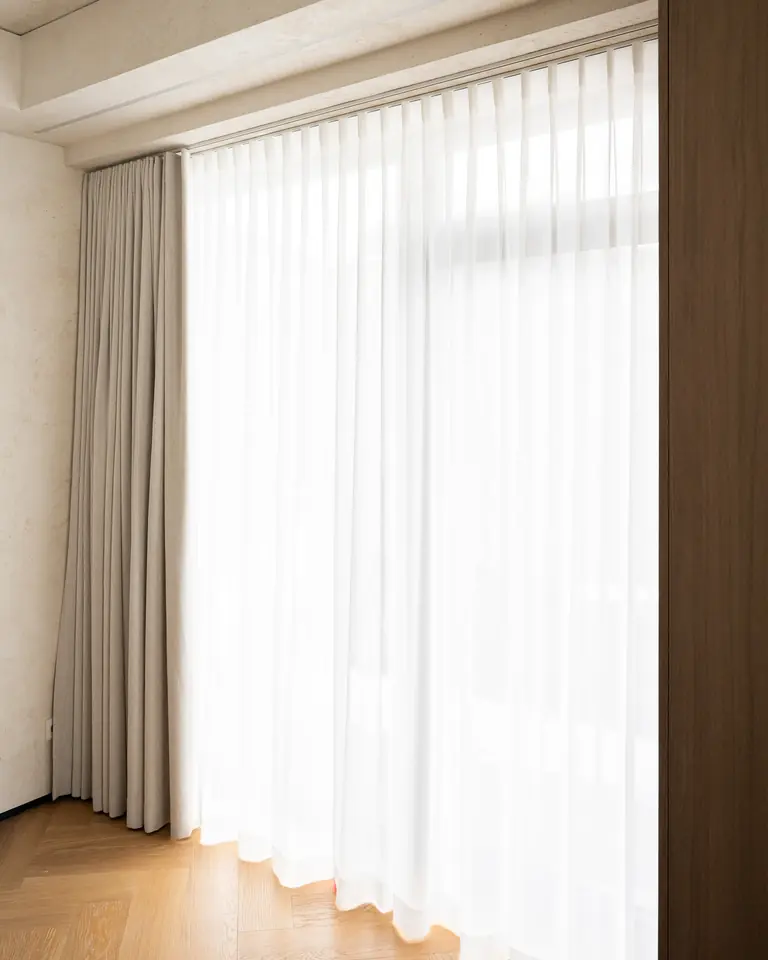
House, room with oak floors. A sheer in wave pleats and a pale curtain in a ceiling recess. 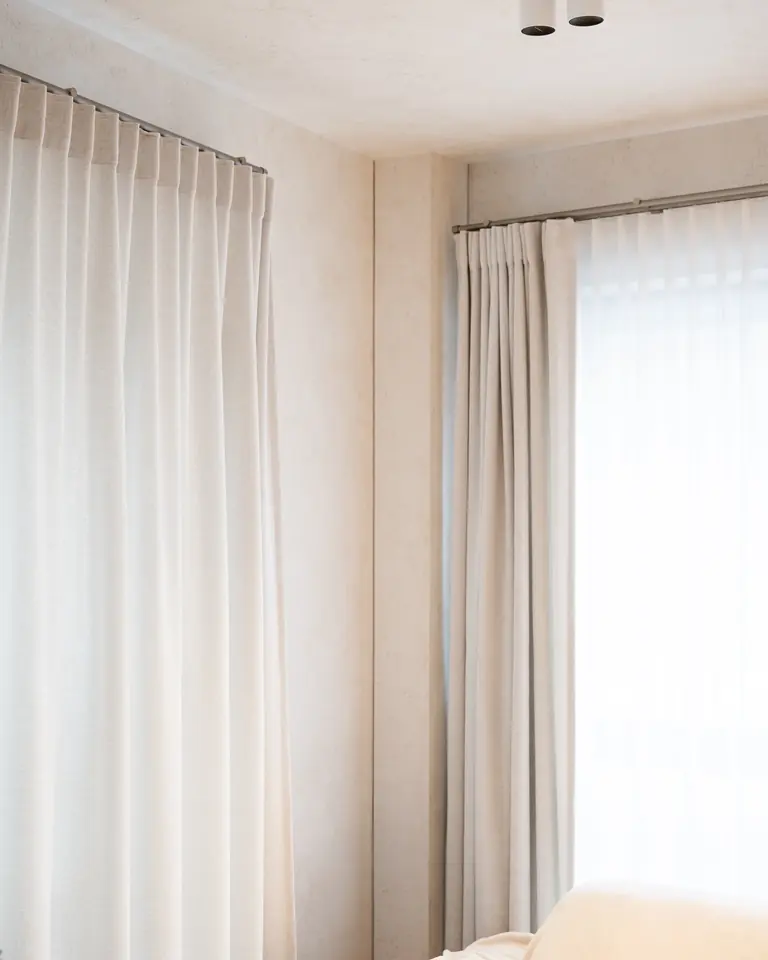
House, corner room. White sheers in wave pleats on ceiling tracks.