Wooden blinds
Wood-effect (faux wood) blinds
A damp-resistant alternative to natural wood. Faux wood is PVC with a 4D wood-effect finish. It is hard to tell from natural wood by eye, resists humidity of up to 90%, can be cleaned with solvents and is 30% cheaper. It suits a bathroom, a kitchen and a cellar.

When does wood-effect beat natural wood?
When to choose it: damp rooms (a bathroom, a kitchen, a cellar), a limited budget (from €48 per m² against €56 for natural basswood), and a window near a heat source. Resistance to damp: faux wood (PVC) resists humidity of up to 90%, while natural wood warps at 65%. Looks: a good 4D imitation cannot be told from wood at a distance, while the cheapest flat versions look like plastic. Life: damp does not warp faux wood, while natural wood ages much faster in a kitchen.
Five scenarios in which faux wood is the more practical choice.
Bathroom and spa areas: humidity in a bathroom reaches 70–90%, especially after a shower. In these conditions natural wood warps within 6–12 months and becomes uneven. Faux wood (PVC) withstands 90% humidity with no ill effects, and is easy to clean with soapy water.
A kitchen without a powerful extractor: if the extractor is weak or sometimes not switched on, grease vapour damages the surface of natural wood. Faux wood is easy to clean with solvents and copes better with kitchen conditions.
Cellar or semi-basement: damp semi-basement conditions (50–70% relative humidity) make natural wood go mouldy within 1–2 years. Faux wood has no organic material, so mould physically cannot grow.
Klaipėda and coastal flats: salty air and higher humidity shorten the life of natural wood, while faux wood is not affected. On the coast faux wood is usually the more practical choice.
A limited budget: faux wood from €48 per m² against natural basswood from €56 per m². For a flat with three 120 × 150 cm windows and 35 mm slats, faux wood costs about €75 less.
A child's room, or a family with pets: faux wood resists scratching and the damp from pets or children's spills, and is easy to clean. Natural wood needs careful handling, which is not always possible with small children.
How do natural wood and faux wood compare in detail?
Seven criteria, assessed at every consultation.
Resistance to damp: natural wood ★★ (max 65%), faux wood (PVC) ★★★★★ (up to 90%). Cleaning: natural wood ★★★ (a damp cloth, carefully), faux wood ★★★★★ (solvent or soapy water). Looks: natural wood ★★★★★ (authentic), faux wood ★★★★ (a good 4D imitation). Weight (1.5 × 1.5 m): natural wood 2.5–3.5 kg, faux wood 3.5–4.5 kg (heavier). Price from: natural wood €56 per m², faux wood €48 per m². Life: natural wood lasts longest in a dry room and ages fast in a damp one; faux wood is not affected by damp. Environmental effect: natural wood ★★★★ (a renewable source), faux wood ★★ (PVC is not recycled).
What separates a €60 faux wood blind from a €130 one?
Three grades: cheap, mid-range and higher-priced faux wood.
Budget (€40–80): a flat 2D imitation and a thin PVC layer. It looks like plastic from a distance. It suits cellars, storerooms and summerhouses, where looks do not matter. This grade is not offered.
Mid-range (€90–130): a 4D finish with a realistic image of wood grain. From 1–2 m it cannot be told from natural wood. This is the standard choice for a bathroom and a kitchen.
Higher-priced (€140–220): a 6D finish and an authentic feel of wood even to the touch. Specific wood effects (walnut, birch, lava).
What are the five most common mistakes when choosing faux wood blinds?
1. Choosing the cheapest faux wood (€40–60): a flat 2D imitation looks like plastic even from 3 m. Clients regret it after the first month. The answer: choose the mid-range 4D finish, which looks like natural wood.
2. Choosing faux wood for a living room with no damp: in a dry living room natural wood lasts a long time and looks richer. Faux wood is surplus there, and the look is lost. The answer: faux wood only for damp rooms.
3. A slat width that does not suit the window: a buyer takes 50 mm slats for a window 90 cm wide, and it looks out of proportion. Faux wood slats come in 25 mm (for small windows), 35 mm (for medium ones) and 50 mm (for large ones over 140 cm).
4. Ignoring the weight of the slats: faux wood is 30–40% heavier than natural wood. For a large window (over 180 cm wide), choose natural wood or split it into two blinds. A buyer who ignores the weight gets a blind that is hard to raise.
5. Cleaning with abrasives: scouring pads and abrasive powders cause micro-scratches on the PVC, and matt marks appear. The answer: a damp microfibre cloth with soapy water, or a vinegar-and-water mixture (1:5). Solvents (acetone, isopropyl alcohol) are allowed for strong stains.
Which suits Vilnius, Kaunas and Klaipėda?
How the room and the climate decide between imitation and natural wood.
Vilnius: faux wood suits bathrooms and kitchens, while dry living rooms and bedrooms suit natural wood. White, classic faux wood goes well with an interior in the Old Town.
Kaunas: in the closed kitchens of blocks of flats, faux wood is more practical. For the classic interiors of houses in Žaliakalnis, natural wood suits better.
Klaipėda: salty air and higher humidity keep natural wood from lasting, so on the coast faux wood is the one to choose. A good 4D imitation suits the interiors of coastal flats.
Sources and standards
EN 13120, internal blinds: the EU standard that applies to rooms where children up to 42 months old live. ANSI/WCMA A100.1-2022: the US counterpart, in force from 1 June 2024.
Questions
How do wood-effect blinds differ from faux wood?
They are the same product: PVC with a 4D wood-effect finish. "Faux wood" is the term many retailers use, and "wood-effect" describes the same thing. This kind of blind resists humidity of up to 90% and is 30% cheaper than natural wood.
When should I choose wood-effect blinds over natural wood?
In damp rooms (a bathroom, a kitchen, a cellar), on a limited budget, for a child's room (more resistant to scratches) and in flats on the Klaipėda coast. In a dry living room natural wood lasts longer and looks richer, so the imitation is surplus there.
Does cheap faux wood look like plastic?
Cheap versions (€40–60 each) have a flat 2D imitation that shows from a distance. The mid-range (€90–130 each) has a 4D finish with realistic wood grain, hard to tell from natural wood from 1–2 m away. The higher-priced range (€140+) has a 6D finish.
How do I clean wood-effect blinds?
A damp microfibre cloth and soapy water. For stronger stains use a vinegar-and-water mixture (1:5) or neutral cleaners. Solvents (acetone, isopropyl alcohol) are allowed for specific stains. Do not use abrasive cleaners, which create micro-scratches.
How long do wood-effect blinds last?
The life of faux wood depends little on its surroundings: a bathroom, a kitchen or a cellar does not shorten it. Natural wood ages much faster in damp rooms than in a dry living room. The advantage of faux wood is a steady life whatever the surroundings.
Are faux wood blinds heavier than natural ones?
Yes, by 30–40%. For a 1.5 × 1.5 m window, faux wood weighs 3.5–4.5 kg and natural wood 2.5–3.5 kg. For windows wider than 180 cm, choose natural wood or split the window into two blinds.
Is faux wood eco-friendly?
PVC is not recycled in Lithuania, which is an environmental drawback. For eco-minded clients natural wood (bamboo above all, which regrows quickly) is a principled choice. But the long life of faux wood in damp rooms reduces its overall impact over the life of the blind.
How much do faux wood blinds cost in 2026?
Faux wood costs from €48 per m². A small window (60 × 120 cm) about €35. A medium one (90 × 140 cm) about €60. A large one (120 × 140 cm) about €81. The widest (150 × 180 cm) about €130. Fitting is €15 per blind. Measuring is free in Vilnius. In Kaunas and Klaipėda it is free on orders of €200 or more. Elsewhere in Lithuania the visit is paid, and the price is agreed beforehand.
Ideas for your home
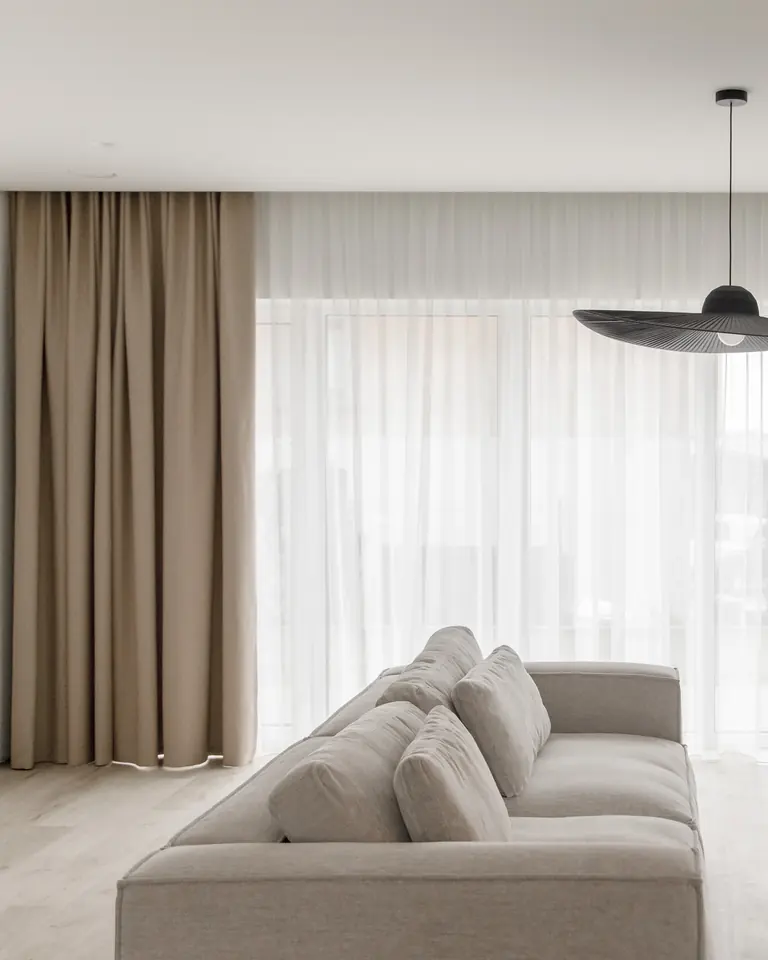
Flat, living room. A white sheer across the whole window wall and sand-coloured curtains from ceiling to floor. 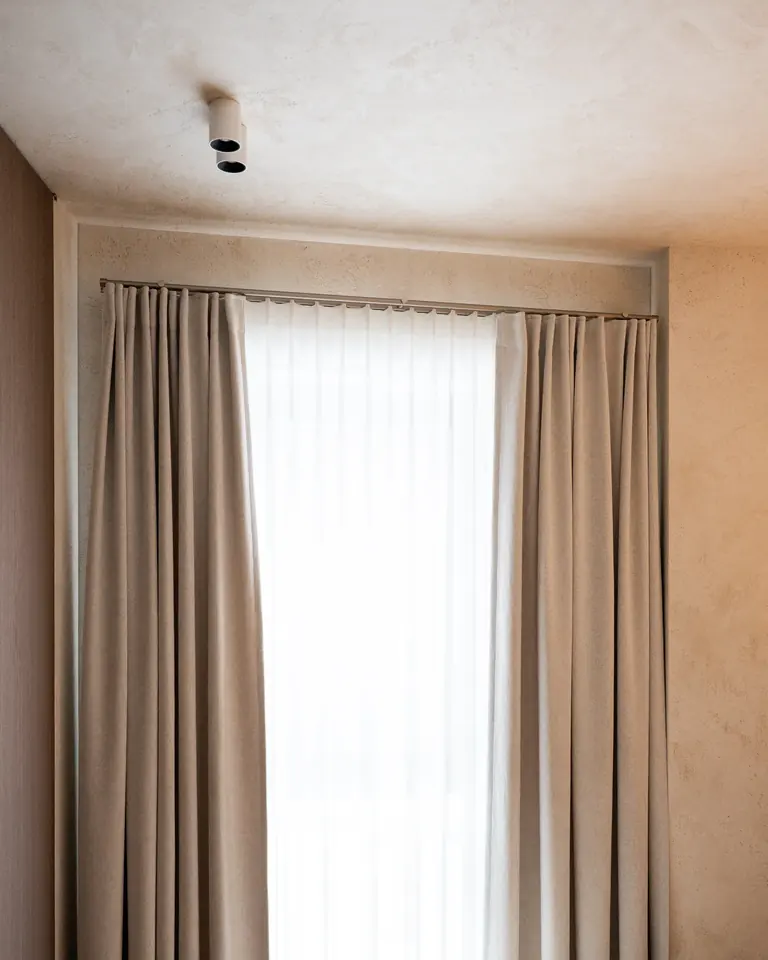
House, window recess. Sand-coloured curtains and a white sheer on a ceiling track. 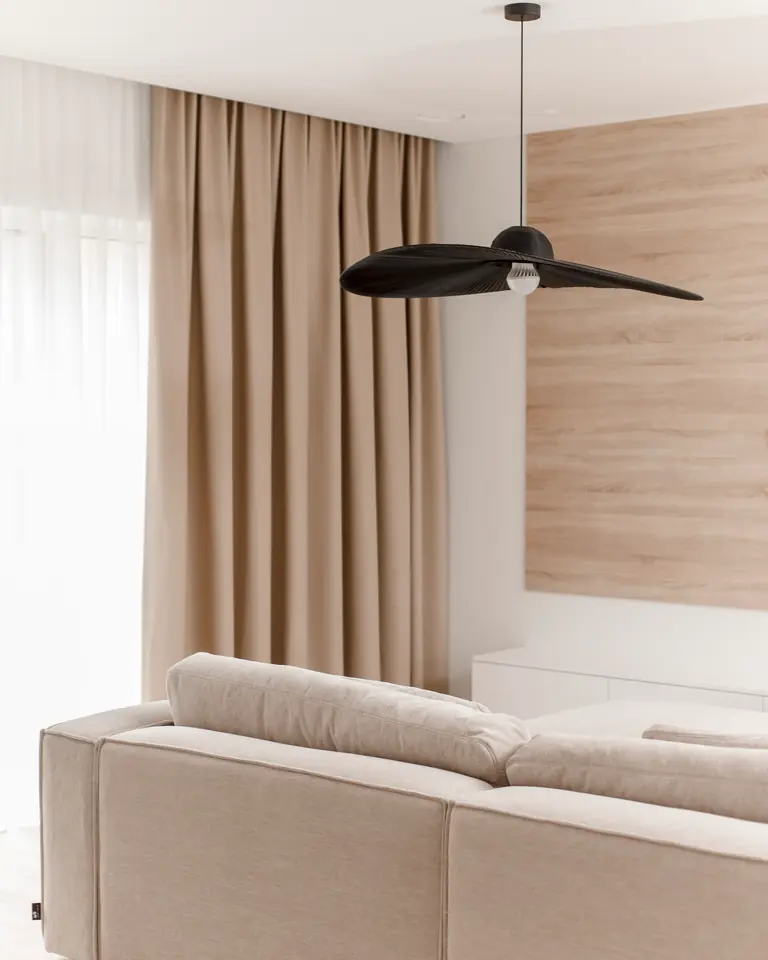
Flat, living room. Sand-coloured curtains and a white sheer from ceiling to floor. 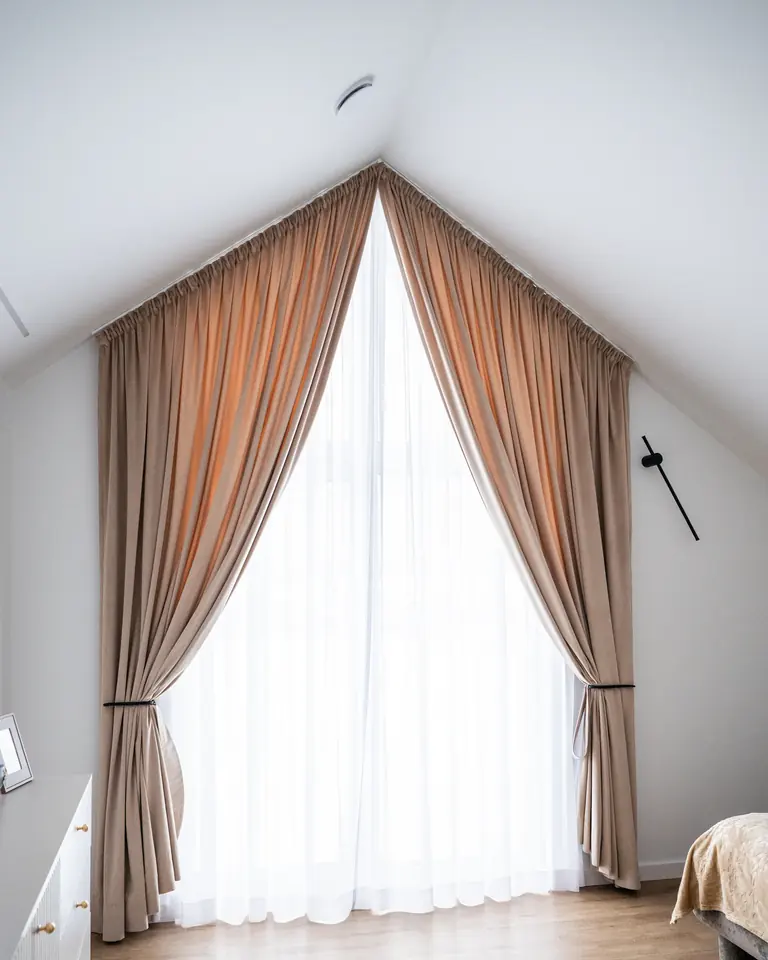
House, bedroom under a pitched roof. Peach curtains with tie-backs and a white sheer. 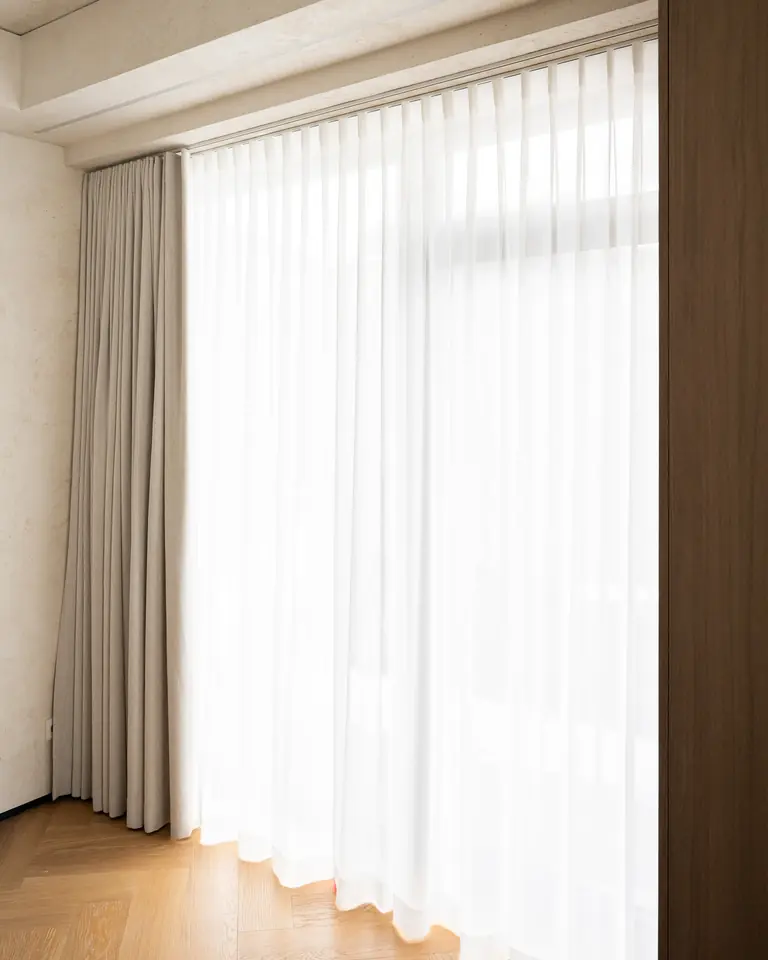
House, room with oak floors. A sheer in wave pleats and a pale curtain in a ceiling recess. 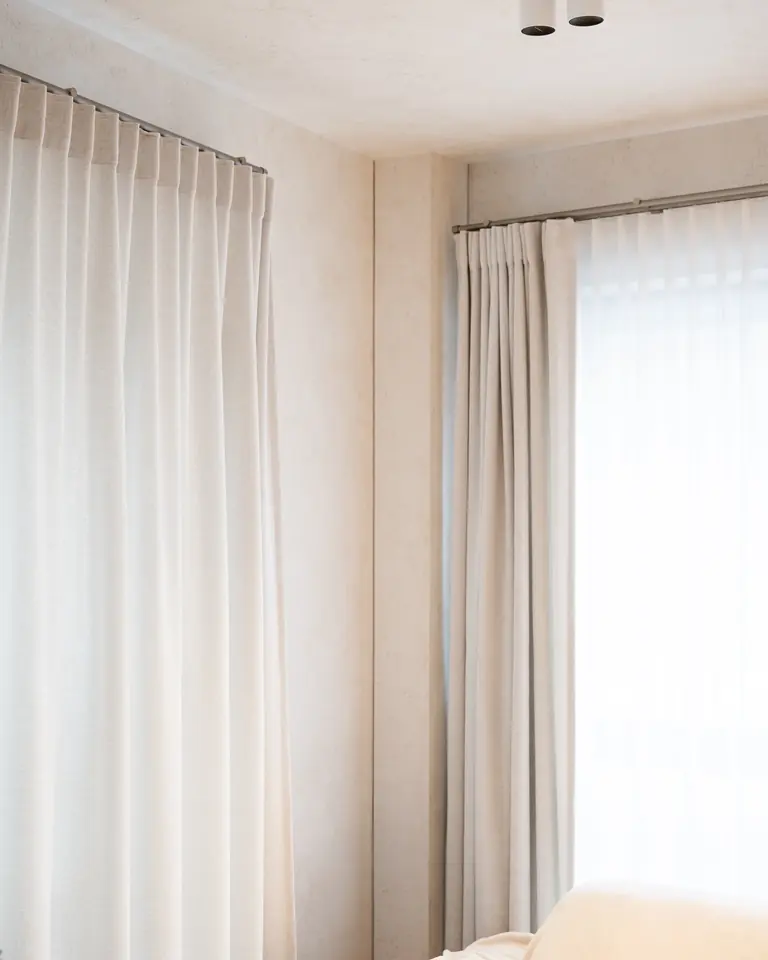
House, corner room. White sheers in wave pleats on ceiling tracks.