Wooden blinds
Faux wood blinds
A damp-resistant alternative to real wood. Faux wood is PVC with a 4D wood-effect finish, resistant to humidity of up to 90% and 30% cheaper than natural wood. The same product is also sold as wood-effect blinds: that page has a detailed guide with six scenarios and quality grades.

What is faux wood, and how does it differ from natural wood?
In short: faux wood blinds (PVC with a wood-effect finish).
1. What faux wood is: PVC with a 4D wood-effect finish, also called wood-effect. 2. Resistance to damp: ★★★★★ (up to 90% humidity), more resistant than any natural wood. 3. Price advantage: cheaper than natural basswood (35 mm slats: €48 against €62 per m²). 4. Best use: bathroom, kitchen, cellar, child's room, and flats on the Klaipėda coast.
The exact term is faux wood. It is also called wood-effect, or PVC with a wood-grain finish.
Material: polyvinyl chloride (PVC), a compact plastic. The slats are moulded and given a 4D wood-effect layer on the outside.
Look: good faux wood with a 4D finish is hard to tell from natural wood from 1–2 m away. The cheapest flat imitations look like plastic.
Resistance to damp: the main advantage. PVC has no organic structure, so it takes up no damp, does not curl and does not go mouldy. It resists humidity of up to 90%.
Where does faux wood beat natural wood?
Specific cases where faux wood is the more practical choice.
Bathroom (humidity 70–90%): faux wood has no rival here. Natural wood warps within a year, while damp does not harm faux wood.
A kitchen without a powerful extractor: grease vapour damages the surface of natural wood. Faux wood is easy to clean with solvents, which restores its original look.
Cellar and semi-basement (humidity 50–70%): mould physically cannot grow on PVC. Natural wood goes mouldy within 1–2 years in these conditions.
Klaipėda and coastal flats: salty air damages the varnish of natural wood. Faux wood resists salt dust and damp.
Child's room: more resistant to scratches, and it can be wiped damp without limit.
A limited budget (a lower price): for a flat with three 120 × 150 cm windows and 35 mm slats, faux wood costs about €75 less than natural basswood.
Where does natural wood still beat faux wood?
Natural wood is the better buy in four cases.
A dry living room or bedroom: where humidity is steady at 30–40%, natural basswood or abachi looks richer and lasts a long time in a dry room. Faux wood is surplus protection there.
Looks and formal interiors: in renovated flats in Senamiestis, the Old Town, and in formal living rooms, the feel of natural wood under the hand cannot be copied. Faux wood still feels like an imitation to the touch.
Eco-minded choice: basswood renews, while PVC is not recycled. For eco-minded clients natural wood (bamboo above all) is a principled choice.
Thermal insulation: wood insulates better than PVC. On cold windows (the north side) the difference shows in winter.
Questions
What are faux wood blinds?
Faux wood blinds are made of PVC with a 4D wood-effect finish. They are also sold as wood-effect blinds. From 1–2 m away they are hard to tell from natural wood, and they resist humidity of up to 90%.
What does faux wood do better than natural wood?
Resistance to damp (90% against 65% for natural wood), cleaning (solvents can be used), price (from €48 per m², natural basswood from €56) and life in damp rooms (damp does not warp it). Its drawbacks: it is heavier (30–40% more weight), PVC is not recycled, and the feel under the hand is less authentic.
Where does faux wood suit best?
Where there is a lot of damp. On the coast, for example in Klaipėda, it does not swell or warp. In drier, well-ventilated flats natural wood can also be chosen. In damp rooms (a bathroom, a kitchen) faux wood is the most reliable choice in any city.
Does faux wood look like plastic?
Cheap versions (€40–60) do: a flat 2D imitation. The mid-range (€90–130) has a 4D finish with realistic wood grain, hard to tell from natural wood. The higher-priced range (€140+) has a 6D finish and an authentic feel even to the touch. We offer the mid-range and above.
Do faux wood blinds resist sunlight?
Yes. The higher-priced versions have a UV-protection layer that keeps the original colour longer. Cheaper versions in direct sunlight may begin to fade much sooner. For south-facing windows choose the UV-protected versions.
How do I look after faux wood blinds?
Wipe with a damp microfibre cloth every 2 weeks, with a neutral soap solution. For stronger stains use a vinegar-and-water mixture (1:5); solvents (acetone, isopropyl alcohol) are allowed for specific stains. Do not use abrasive cleaners, which cause micro-scratches.
Can faux wood blinds be electric?
No. PVC slats are made for manual operation only (cord and wand). An electric motor is available for 50 and 65 mm natural-wood blinds, where the calculator adds about €40. The extra weight of faux wood (3.5–4.5 kg for an average window) needs sturdy brackets, especially for large windows (over 180 cm).
How much do faux wood blinds cost?
Faux wood (PVC) costs from €48 per m². A small window (60 × 120 cm) about €35. A medium one (90 × 140 cm) about €60. A large one (120 × 140 cm) about €81. A wide one (150 × 180 cm) about €130. Fitting is €15 per blind; 50 mm PVC slats cost €63 per m². Measuring is free in Vilnius. In Kaunas and Klaipėda it is free on orders of €200 or more. Elsewhere in Lithuania the visit is paid, and the price is agreed beforehand.
Ideas for your home
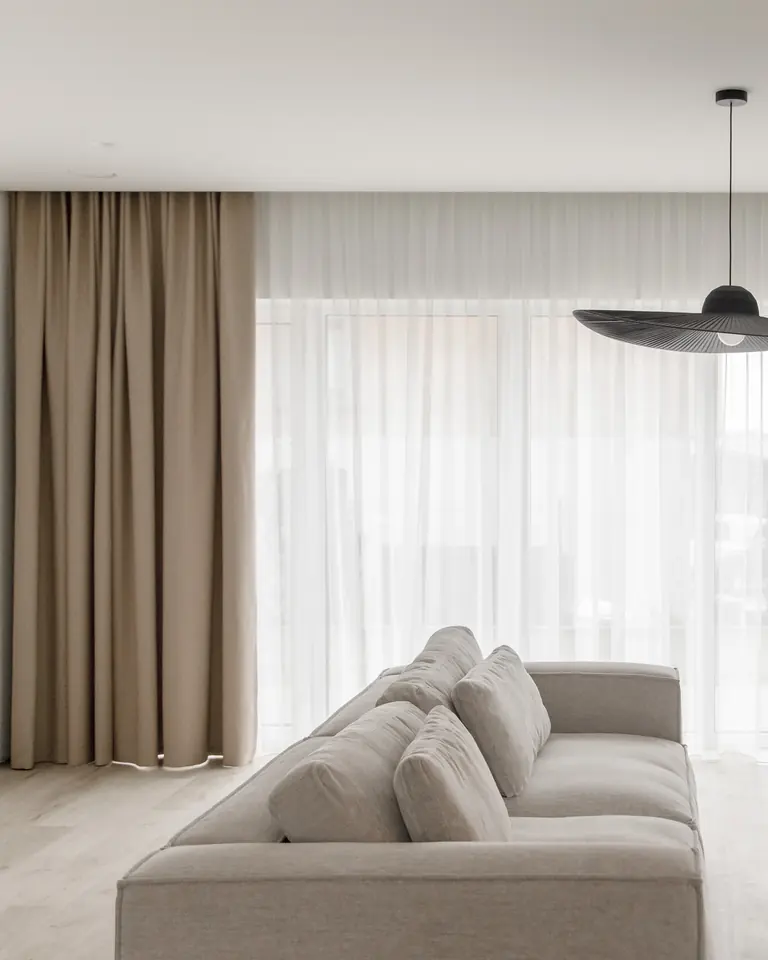
Flat, living room. A white sheer across the whole window wall and sand-coloured curtains from ceiling to floor. 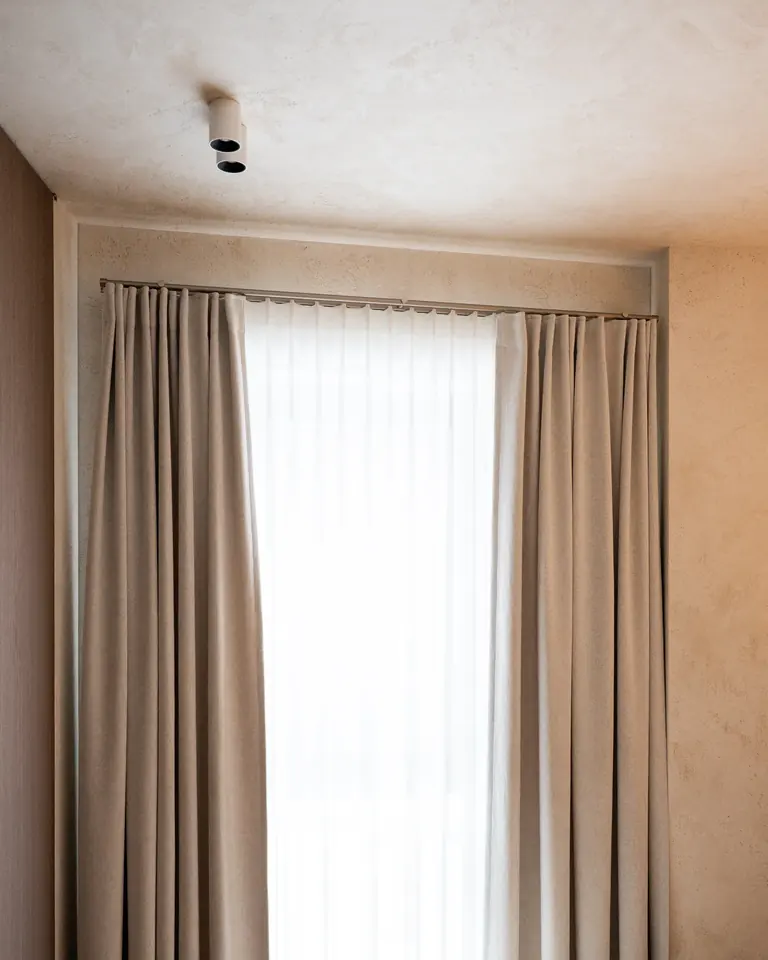
House, window recess. Sand-coloured curtains and a white sheer on a ceiling track. 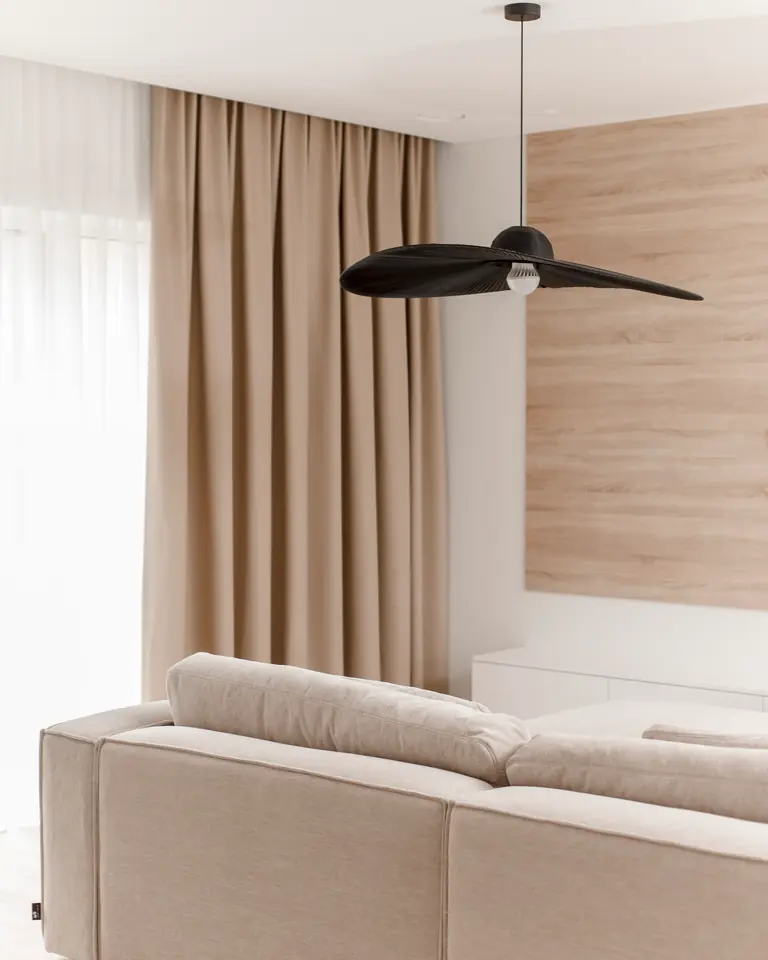
Flat, living room. Sand-coloured curtains and a white sheer from ceiling to floor. 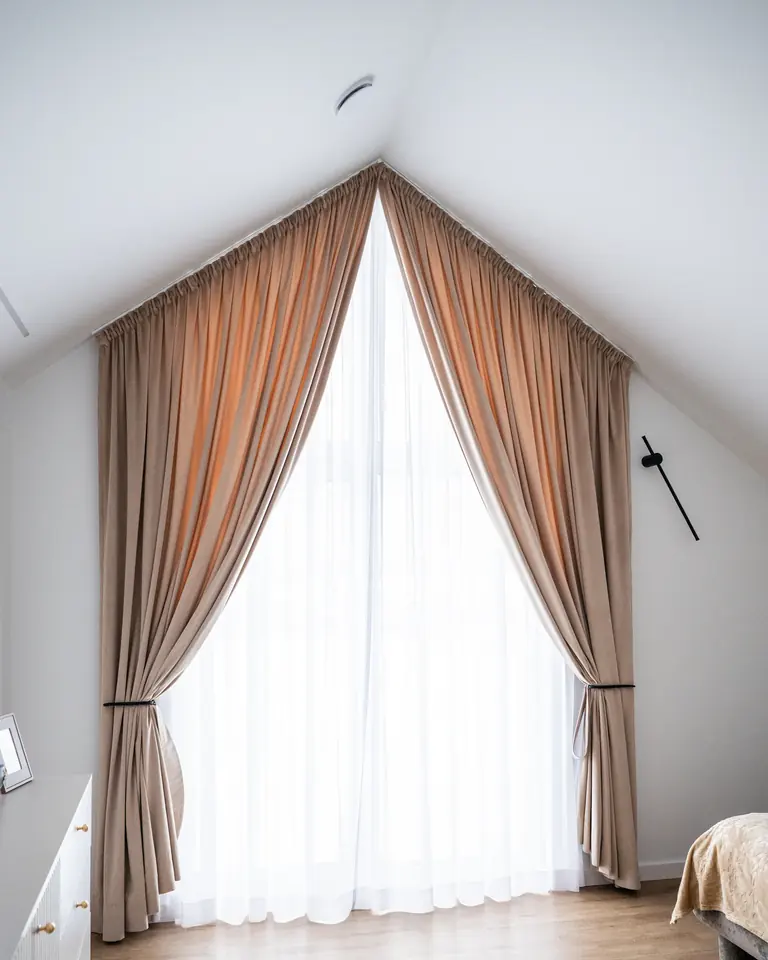
House, bedroom under a pitched roof. Peach curtains with tie-backs and a white sheer. 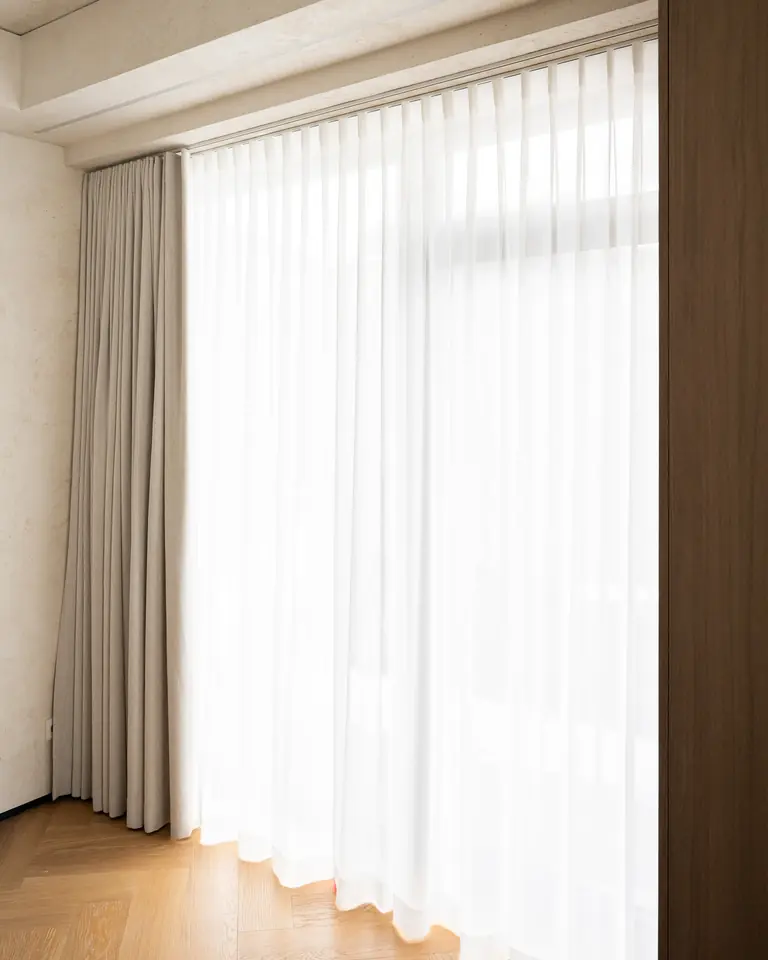
House, room with oak floors. A sheer in wave pleats and a pale curtain in a ceiling recess. 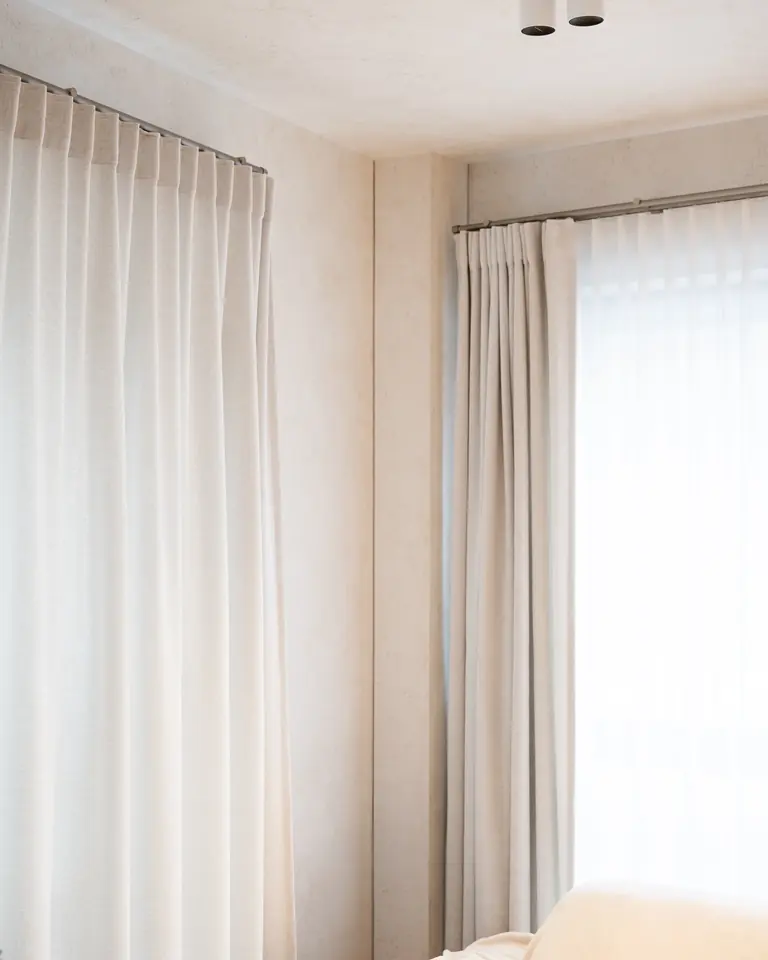
House, corner room. White sheers in wave pleats on ceiling tracks.