Blinds
Wooden blinds for bathrooms
Faux wood: the damp-resistant alternative to wood. Natural wood does not suit a bathroom: 70–90% humidity and condensation damage the surface within a year. The answer is faux wood (PVC with a 4D wood effect), which resists humidity of up to 90%, looks like wood and is easy to clean with soapy water. This guide covers the colours, slat widths and operation that suit a bathroom.

Why does natural wood not suit a bathroom?
In short, wooden blinds for a bathroom in four decisions. 1. Wood or faux wood: always faux wood (PVC). Natural wood in a bathroom warps within 6–12 months, while faux wood withstands 90% humidity. 2. Colour: white or light grey shades are neutral, go easily with the sanitaryware and do not show damp marks. 3. Slat width: 35 mm for small bathrooms (up to 4 m²), 50 mm for medium and large ones; PVC slats come in these two widths. 4. Operation: PVC blinds are operated by hand, so fit the control away from the shower and do not pull it with wet hands.
Three main reasons, and the humidity norms in a bathroom.
1. Warping from damp: relative humidity in a bathroom reaches 70–90% after a shower. Natural wood takes up the damp, and the slats lose their shape within 6–12 months, becoming uneven, so the blind no longer runs evenly.
2. Mould and fungus: wood is an organic material, and mould grows on it in damp conditions. Faux wood (PVC) is inorganic, and mould has no surface to grow on.
3. Damage to the varnish: varnished wooden slats crack under hot steam. Condensation gets into the structure of the wood, the varnish flakes and white marks appear.
Humidity norms in bathrooms. After a shower: 80–95% relative humidity, with condensation on surfaces. After 30 minutes of ventilation: it falls to 60–70%. Base bathroom humidity: 50–65% (against 30–40% in a living room). All of these levels are a problem for natural wood.
Which faux wood colours suit a bathroom?
Choose by the tone of the sanitaryware and the height of the ceiling.
Classic white. When to choose it: small bathrooms (up to 4 m²), with white sanitaryware. Advantages: it makes the space look larger, and is a neutral tone.
Light grey. When to choose it: medium bathrooms, a contemporary design. Advantages: it hides limescale marks and goes with grey tiles.
Light sand. When to choose it: a Scandinavian style, with light wood in the interior. Advantages: a warm tone that goes with an oak vanity unit.
Dark anthracite. When to choose it: a design-led bathroom, for contrast with white sanitaryware. Advantages: a bold contrast that draws the eye.
Colours to avoid: dark brown and black, on which limescale marks show most. Bright colours (red, blue) look too strong in a bathroom.
What are the five most common mistakes with bathroom blinds?
1. Choosing natural wood for a bathroom: the client wants the authentic look of wood and ignores the damp. Within 6–12 months the wood warps and marks appear. The answer: faux wood (PVC) with a 4D wood effect, similar to look and resistant to humidity of up to 90%.
2. Choosing a standard chain: pulling a chain with wet hands after a shower is unsafe. The answer: fit the control on the side of the window away from the shower, and for families with children choose a cord holder out of their reach. Safety matters more than the starting price.
3. A blind too close to the shower or the bath: a blind directly in front of a shower cubicle gets a constant spray of water, and even faux wood begins to show marks. The answer: if the window is directly above the bath or in the shower, choose pleated blinds with a water-resistant coating.
4. Choosing dark colours: dark brown or black faux wood in a bathroom shows every limescale mark after every shower. The answer: white or light grey, on which limescale does not show and the bathroom looks larger.
5. Ignoring ventilation: a bathroom with no ventilation has damp circulating round the clock, and even faux wood does not protect the surrounding surfaces from mould. The answer: a fan, or the window ajar after a shower. This saves not only the blinds but the whole interior.
Sources and standards
EN 13120, internal blinds: the EU standard that applies to rooms where children up to 42 months old live. IEC 60529, the IP protection classes: IP44 or higher is required for electric motors in a bathroom.
Questions
Can I choose natural wood for a bathroom?
No. Relative humidity in a bathroom reaches 70–90% after a shower. In those conditions natural wood warps within 6–12 months, stains appear and mould can grow. For a bathroom choose only faux wood (PVC with a wood effect), which resists humidity of up to 90%.
Which faux wood colour suits a bathroom?
For small bathrooms (up to 4 m²), classic white or light grey, which make the space look larger. For medium and large ones, light sand for a Scandinavian style, or dark anthracite for a stronger design. Avoid dark brown and black, on which limescale stains show most.
Can blinds hang directly above a bath?
Only with limits. A direct stream of water damages even the surface of faux wood. If the window is directly above the bath, choose pleated blinds with a water-resistant coating, or a PVC roller blind. A standard faux wood blind suits a window beside the bath, but not directly above it.
Which operation is the safest in a damp bathroom?
Operation without loose hanging cords, or a cord fixed with a holder out of children's reach; it matters most for families with children. Fit the control on the side of the window away from the shower. PVC blinds are not made with a motor: it is available only for 50 and 65 mm natural-wood blinds.
Do faux wood blinds go mouldy in a bathroom?
Faux wood (PVC) does not go mouldy itself, because it has no organic structure. But if the bathroom is not ventilated and damp collects round the blind, mould can grow on the surfaces nearby (frames, walls). The answer: a fan, or the window ajar after a shower, and cleaning of the damp zone.
How long do faux wood blinds last in a bathroom?
Faux wood is not harmed by damp, so in a ventilated bathroom it lasts a long time without special conditions. Versions with UV protection and a hydrophobic layer keep their colour longer. Our warranty on mechanisms is 24 months. The cheapest flat imitations age faster.
How do I clean faux wood blinds in a bathroom?
For surface cleaning, a damp microfibre cloth every 2 weeks. For stronger limescale stains, a vinegar-and-water mixture (1:5) or citric acid. For stronger soap marks, a neutral bathroom cleaner. Solvents (acetone) are allowed for strong stains, but only on a small area.
How much do faux wood blinds for a bathroom cost?
Faux wood (PVC) costs €48 per m² (35 mm) or €63 per m² (50 mm). For a standard bathroom window (60 × 120 cm), about €35. For a medium one (90 × 140 cm), about €60. For large bathroom windows (120 × 140 cm), about €81. Fitting is €15 per blind.
Ideas for your home
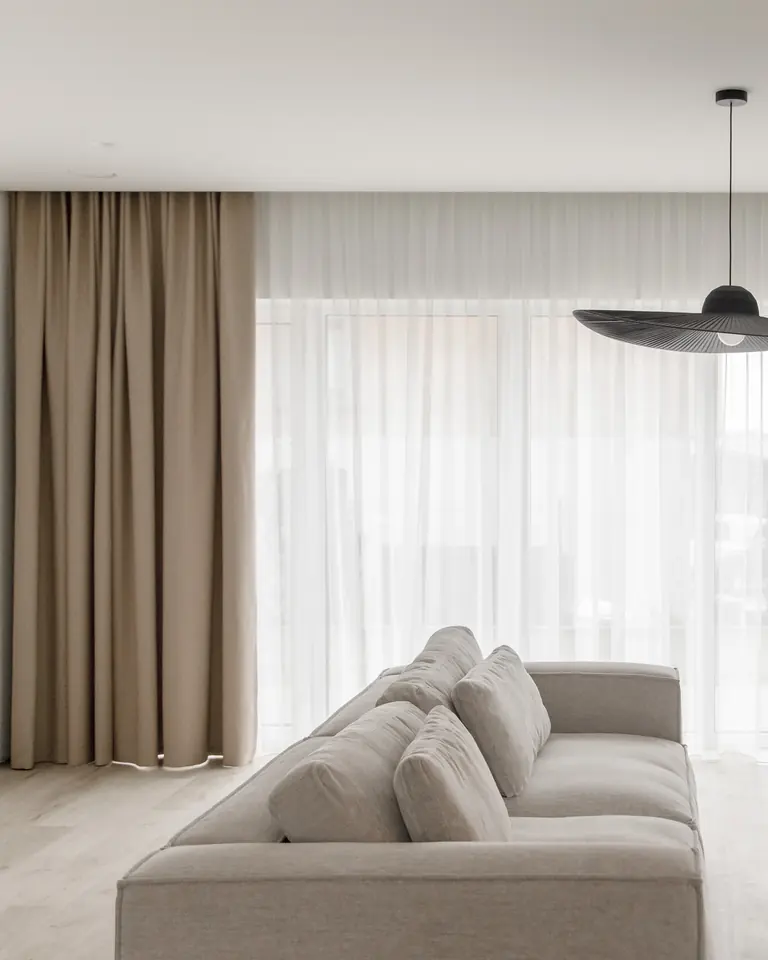
Flat, living room. A white sheer across the whole window wall and sand-coloured curtains from ceiling to floor. 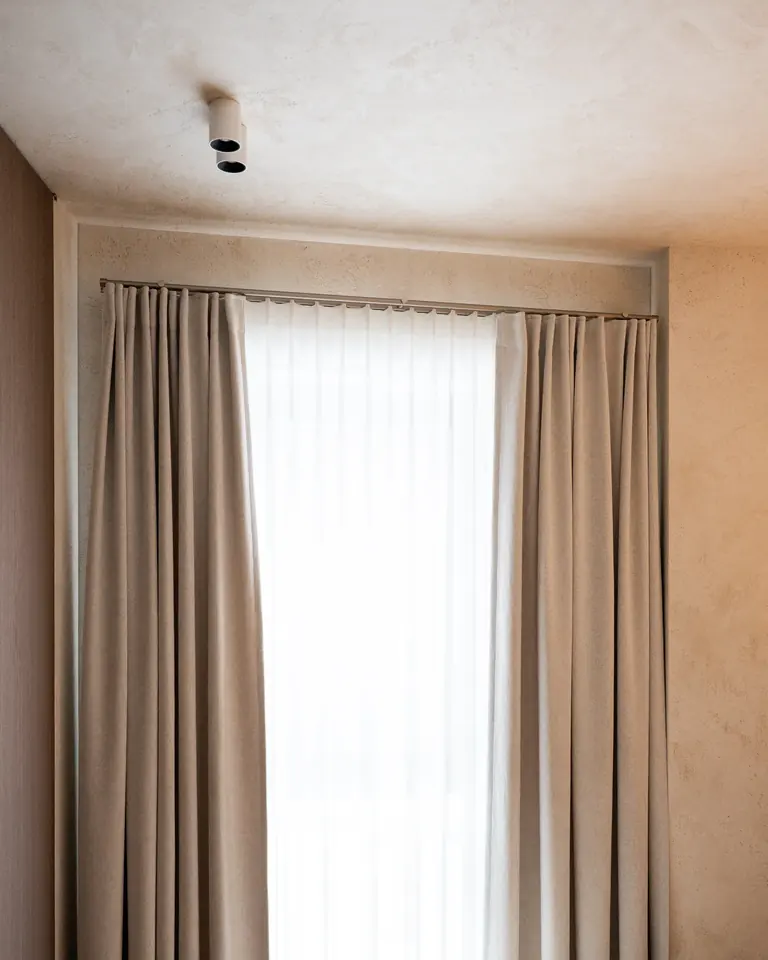
House, window recess. Sand-coloured curtains and a white sheer on a ceiling track. 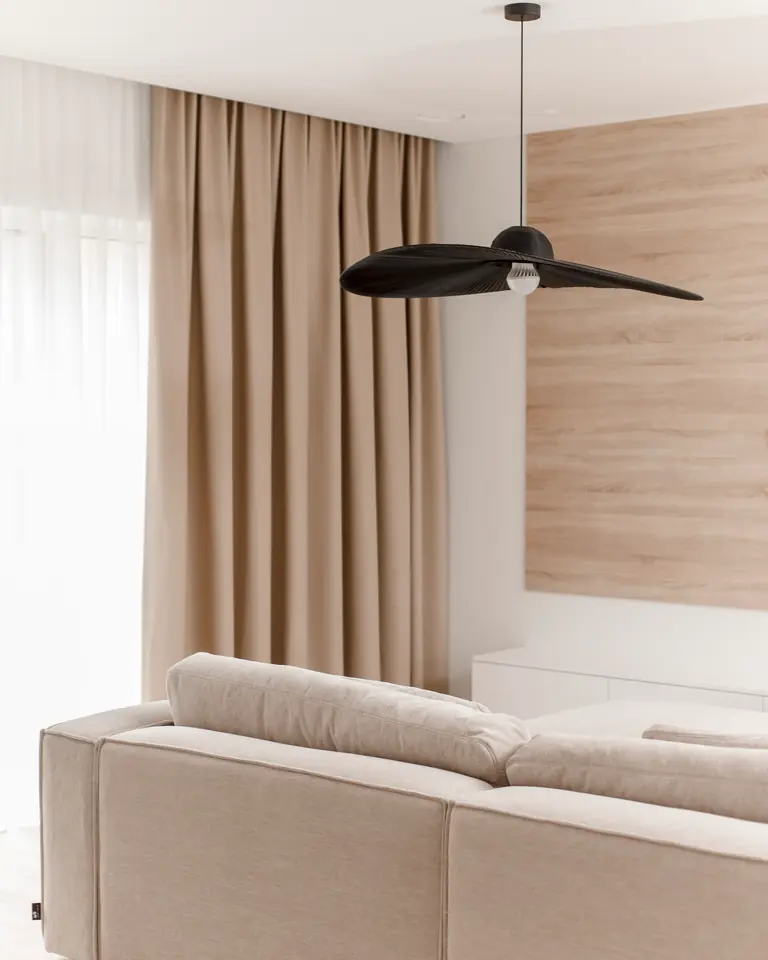
Flat, living room. Sand-coloured curtains and a white sheer from ceiling to floor. 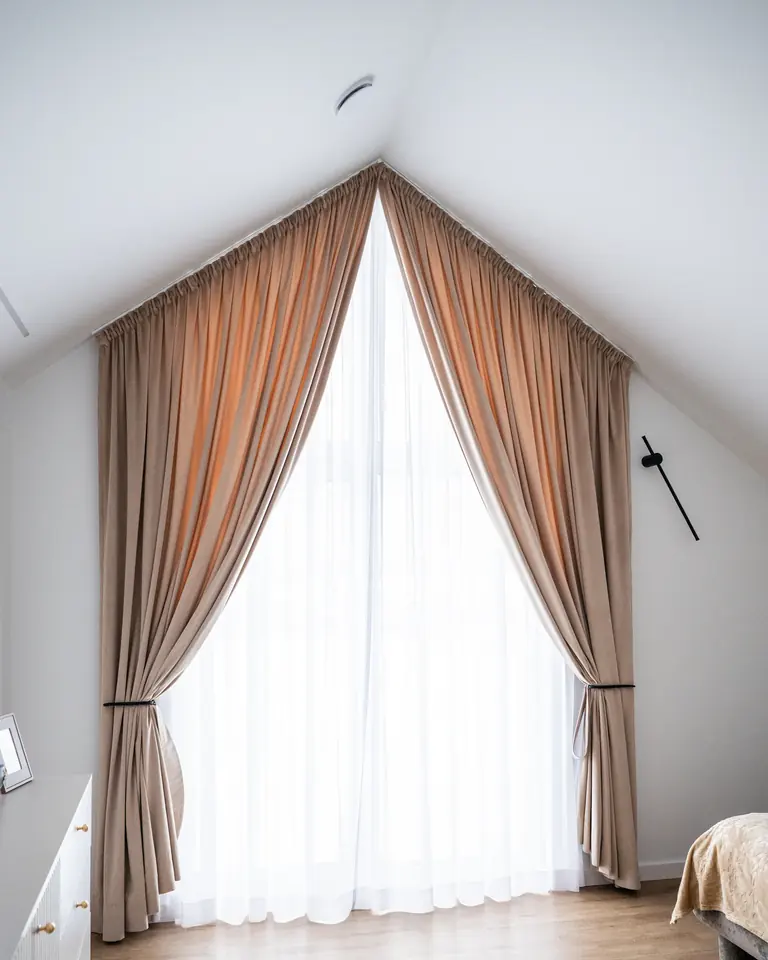
House, bedroom under a pitched roof. Peach curtains with tie-backs and a white sheer. 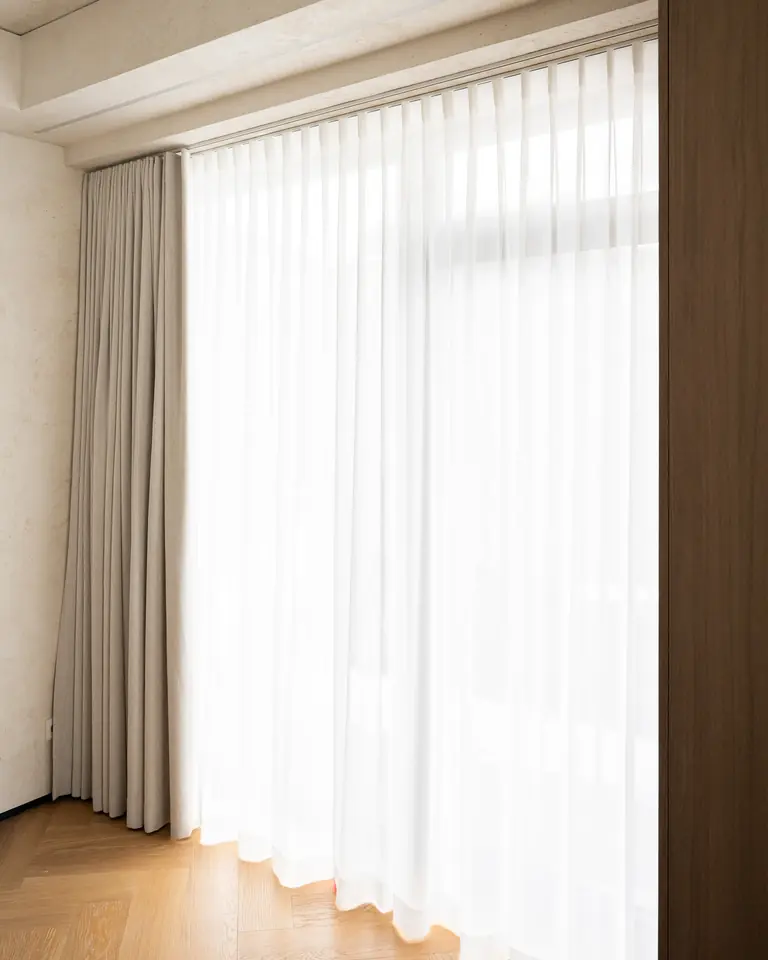
House, room with oak floors. A sheer in wave pleats and a pale curtain in a ceiling recess. 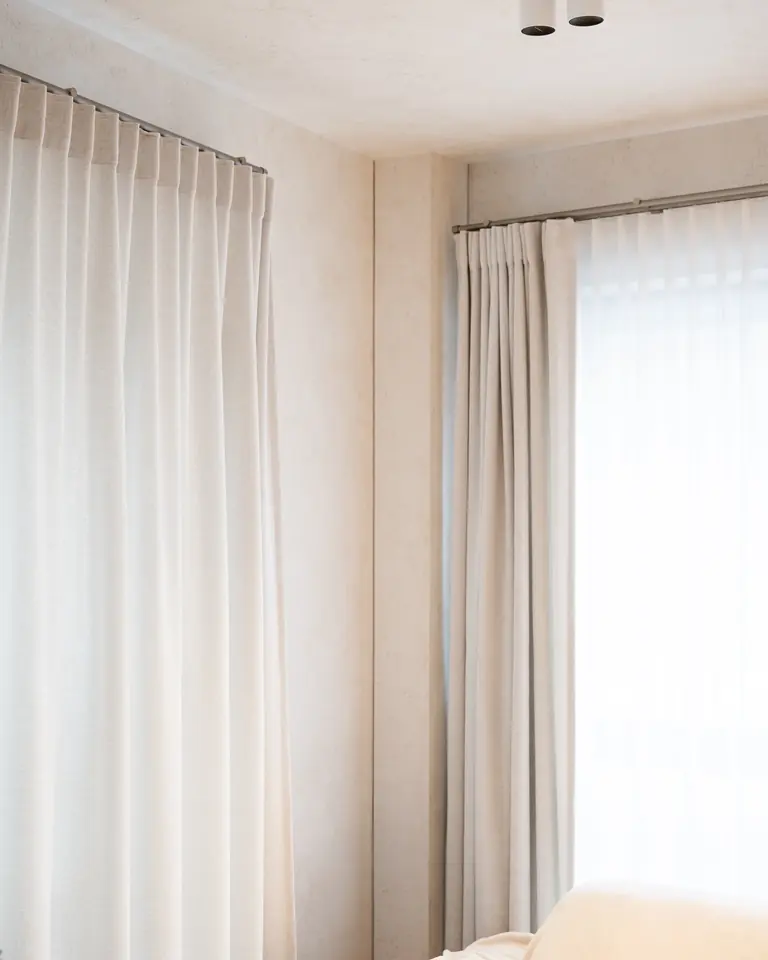
House, corner room. White sheers in wave pleats on ceiling tracks.