Author: Jegor Janockin
Reviewed by: Curtain.lt editorial team
Last updated:
How to keep a room cool in summer with curtains and blinds
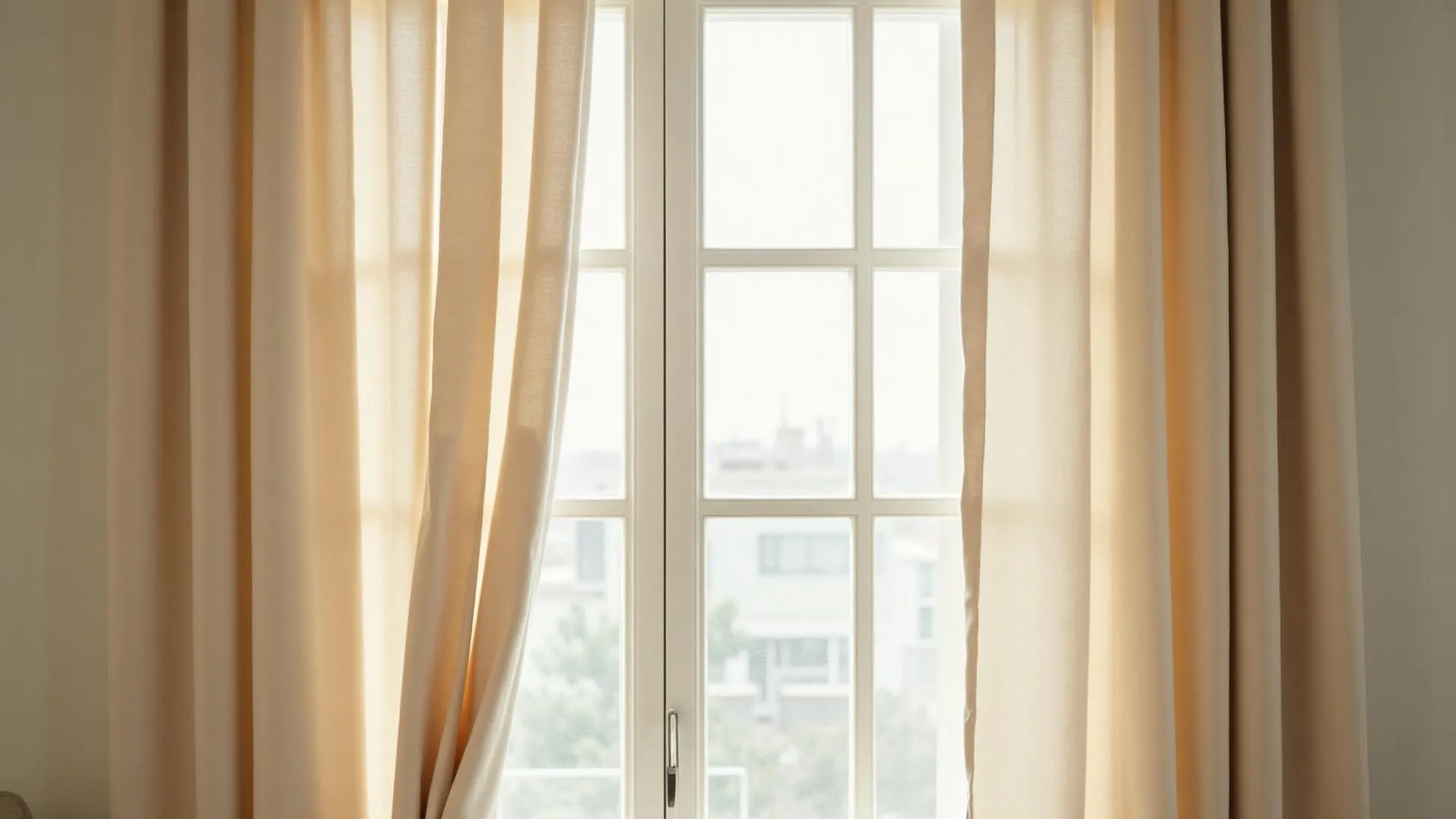
Light-coloured curtains with a reflective or thermal lining keep the heat out best. Cover south- and west-facing windows by day, and open the windows and the curtains at night, when the air outside is cooler.
The short answer: which curtains protect best from sun and heat?
Light curtains or roller blinds with a white reflective or thermal (aluminised) lining stop the most solar heat before it gets into the room. Such a fabric stops infrared radiation from turning into heat indoors: part of it is reflected back out through the glass.
With the right lining and a light colour, much less solar heat comes through a sunny south or west window. A bedroom or living room then stays more comfortable, and an air conditioner, if there is one, has less work to do.
The key rule
Stop the heat as close to the window, and as far out, as you can. An outdoor curtain or awning holds heat back before it reaches the glass, so it cools far more effectively than any curtain indoors.
How curtains block solar heat: colour, lining and reflection
Solar heat gets into a room in three ways: radiant heating through the glass (the largest part), the fabric warming up, and that fabric giving its heat off into the room. An interior curtain always warms up, so what matters is that it reflects as much radiation as possible back, rather than absorbing it. Three things decide this: colour, the density of the fabric and the type of lining.
The combination that works best is a light front face that reflects well, with a thermal or reflective lining on the back. A dense blackout fabric holds back the light but heats up itself, so a white reflective layer next to the glass helps it most. The table ranks the options by how much solar heat they stop.
| Type | How much solar heat it holds back | Effect on the room |
|---|---|---|
| Light curtain without a lining | Lowest | A slight cooling |
| Light curtain with a thermal lining | Higher | A noticeable cooling |
| Blackout with a white reflective lining | High | A stronger cooling |
| Outdoor curtain or awning | Highest | The strongest cooling |

Light or dark: why a white reflective lining cools most
A dark surface absorbs most of the sun's energy that falls on it and heats up, while a light one reflects it back. A dark grey or anthracite curtain at a south window can be hot to the touch at midday, and then radiates that heat into the room, even if the fabric is blackout and lets through no light.
That is why a compromise works best in summer: a colour you like, to suit the room, on the room side, and a white or light grey reflective lining on the window side. Such a two-layer build lets you have even dark curtains in the bedroom without letting the heat in, because it is the reflective back layer, not the front colour, that stops most of the heat.
A common mistake
People choose dark curtains for darkness in the bedroom and expect them to cool the room as well. A dark fabric without a reflective lining heats up strongly itself and can even make things worse: the room stays dark but becomes stuffy. It is the lining that keeps the heat out.
Window orientation: south and west come first
Not all windows heat up equally. In Lithuania in summer, rooms on the south and west sides suffer most. A south window gets sun almost all day, and a west window gets the strongest, low afternoon sun, which heats until 19:00–21:00. East windows heat only in the morning and north windows hardly warm up, so a lighter fabric is enough for them.
Spend the budget where the heat is worst. The table below sets out what each side of the house needs.
| Window side | Heat risk | What suits it |
|---|---|---|
| South | Very high | An outdoor curtain, or blackout with a reflective lining |
| West | High | Thermal roller blinds, or dense curtains with a lining |
| East | Medium | Light curtains with a light thermal lining |
| North | Low | Light sheers; the lining can be left out |
Closed by day, open at night: how to use blinds and curtains in summer
Even the best curtain cools badly if you use it the wrong way round. The summer rule is the opposite of the winter one: by day, especially from 10:00 to 19:00, cover south and west windows so that solar heat does not get in. Draw the blind or the curtains just before the room heats up, not when it is already stuffy.
In the evening and at night, once the air outside is cooler than the room, open the windows and the curtains. Cross-ventilation through windows open on opposite sides cools the building in a few hours, without using electricity. Air the room again in the morning while it is still cool, then cover the sunny windows again: that shuts in the cool of the night.
A practical rhythm for a hot day
Morning (6:00–9:00): ventilate with the window open. Day (10:00–19:00): sunny windows covered. Evening and night (after 20:00): windows and curtains open to ventilate.
Roller blinds, roman blinds or curtains: which cools better?
How well something cools depends less on the type of product than on the density of the fabric, the lining and how snugly it covers the glass. Roller blinds and roman blinds hang close to the glass or inside the opening, so they separate the hot window from the room more tightly and let less warm air round the sides. Classic curtains hang further from the window, but with a good thermal lining and enough width they insulate well too.
Dense blackout roller blinds with a reflective lining are the most convenient for south and west windows, because they are easy to draw all day. Roman blinds with a lining are an in-between choice: they look warmer than roller blinds and insulate better than thin curtains. Curtains with a thermal lining suit a room that wants the warmth of fabric and full cover across a large window.
Want to know which lining suits your window?
The lining decides both summer cooling and winter insulation. The differences between thermal, blackout and dim-out linings are covered in a separate guide.
Read about curtain lining typesOutdoor and terrace curtains: the most effective way to stop heat at the window
Heat is best stopped before it reaches the glass. Any interior curtain acts only after the sun's rays have passed through the glass and begun to heat the air and the fabric inside. An outdoor curtain, awning or terrace curtain on the outside reflects and scatters much of the solar energy before the window, so little of it reaches the room.
This matters most for large glass walls, terraces, balconies and south-facing living rooms with panoramic windows, where interior curtains can no longer cope with the heat. Outdoor curtains also protect furniture and floors from fading, give shade on the terrace and let you use the space in the hottest part of the day.
When a south-facing window or terrace overheats
If interior curtains can no longer keep up, protection on the outside is the most effective answer: it stops the heat before the glass.
See the outdoor curtain options
Summer cooling or winter insulation: how the logic of the lining differs
A good lining works both ways, but in summer and in winter the physics runs the opposite way. In summer we want the fabric to keep the sun's heat out: what matters most is a reflective, light lining that cuts radiant heating. In winter we want to keep the room's warmth in and cut the cold draught off the glass: the density of the lining and the layer of air between curtain and window matter most.
A thermal lining is handy because it suits both seasons: in summer its reflective layer holds back heating, and in winter the same dense fabric cuts heat loss through the window. You do not need to change curtains with the season. Only the rhythm of use changes (closed in the sunny day in summer, closed at night in winter).
| Point | Summer | Winter |
|---|---|---|
| The aim | keep the sun's heat out | keep the room's warmth in |
| What matters most | reflection, a light side next to the glass | density, a layer of air |
| When to close | on a sunny day | in the evening and at night |
| The most suitable lining | thermal or reflective | thermal or blackout |
A practical plan for a cooler room in summer
Start with the window that heats up most and work down the list.
- 1Find the hottest windows: check which windows face south and west. They need the strongest protection.
- 2Choose a light reflective lining: a thermal or reflective lining next to the glass stops much of the solar heat.
- 3Cover the windows by day: keep sunny windows covered from 10:00 to 19:00, before the room heats up.
- 4Ventilate at night: on a cool night and early in the morning, open windows on opposite sides to make a cross-draught.
- 5Consider protection on the outside: for south-facing windows and terraces an outdoor curtain or awning cools far more effectively than one indoors.
- 6Match the room and the measurements: order made to the exact window size, so that the fabric covers the glass snugly, with no gaps of light at the sides.

Exact measuring: how to make sure the window is covered snugly
Even the best thermal fabric cools badly if gaps are left at the sides and the top, through which the sun and the heated air stream reach the room. A snug cover matters as much as the fabric itself, so measure exactly before you order.
- 1Measure the window width: measure the glass or the opening in three places (top, middle, bottom) and take the largest figure.
- 2Add overlap at the sides: so that the sun does not get in at the edges, a curtain pole or track runs 20–30 cm past the window on each side, and a wall-fixed roller blind 5–10 cm.
- 3Decide the length: for a bedroom to the sill is often enough, and for a living room or a terrace to the floor seals best.
- 4Allow for the pole or brackets: hang the pole 10–15 cm above the window so that the fabric also covers the gap between the curtain and the ceiling.
- 5Confirm with the designer: at the measuring visit the designer assesses the orientation of the windows and suggests a suitable fabric and lining for the room. Measuring is free in Vilnius. In Kaunas and Klaipėda it is free on orders of €200 or more. Elsewhere in Lithuania the visit is paid, and the price is agreed beforehand.
Frequently asked questions
Which colour of curtains protects best from heat?
Light colours work best: white, sand, light grey, because they reflect the sun's rays rather than absorbing them. If you want a darker interior or darkness in the bedroom, choose any colour with a white reflective or thermal lining on the window side: it is the reflective back layer, not the front colour, that stops most of the heat.
Do curtains really cool a room in summer?
Yes. Light curtains with a thermal lining, chosen well, cut the solar heat entering a room at a sunny south or west window. The effect is greater if you cover the windows by day, before the room heats up, and ventilate through an open window on cool nights.
Should curtains be kept closed or open in summer?
The summer logic is the opposite of the winter one: keep sunny south and west windows covered by day, especially from 10:00 to 19:00, to keep the heat out. In the evening and at night, when the air outside cools, open the windows and the curtains so that a cross-draught cools the room. Ventilate again in the morning, then cover the sunny windows again.
Which cools better, roller blinds or curtains?
The density of the fabric and the lining decide it, more than the type. Roller blinds and roman blinds hang close to the glass, so they separate the hot window from the room more tightly, and they are easy to draw all day. Curtains with a thermal lining insulate just as well when they are wide enough and cover the window properly. Any of these with a light reflective lining cools best.
Is a thermal lining right for both summer and winter?
Yes, and that is its biggest advantage. In summer the reflective layer stops the sun heating the room, and in winter the same dense fabric cuts heat loss through the window and the cold draught. Only the rhythm of use changes: in summer you cover the window on a sunny day, in winter in the evening and at night.
A consultation and measuring at your home
The designer visits, assesses the orientation of your windows and the risk of heat, and suggests a fabric, a colour and a lining for a cooler room in summer. Measuring is free in Vilnius. In Kaunas and Klaipėda it is free on orders of €200 or more. Elsewhere in Lithuania the visit is paid, and the price is agreed beforehand.
Arrange a consultation