Author: Jegor Janockin
Reviewed by: Curtain.lt editorial team
Last updated:
Condensation and mould behind curtains: how to prevent them

Condensation forms behind curtains when warm, damp room air meets cold glass and a closed curtain holds the moisture against the window. Mould follows. Leave an air gap between the fabric and the glass, fit the pole or track further from the window, draw the curtains back by day and ventilate regularly.
Why does condensation form behind curtains at the window?
Room air always holds some water vapour. When air saturated with vapour cools, it can no longer hold as much moisture, and the surplus comes out as droplets of water. The temperature at which this happens is called the dew point. In winter the window glass is the coldest surface in the room, so condensation settles on it first. It is the same effect as dew on a glass of cold water in summer.
A closed curtain acts as a moisture trap. The fabric separates the warm room air from the glass, and behind the curtain a closed pocket of still air is left, where the glass cools even more and the vapour builds up with nowhere to go. Heavy curtains also often cover the radiator under the sill, which cuts off the flow of warm air that would normally wash over the glass and warm it. The result is permanent damp on the glass, the sill and the frame.
The problem is worse in an old home with old wooden or single-glazed windows. In winter, when the room is warm and damp, the surface of such glass can drop to 5–8 °C. In new double or triple glazing the inner pane stays much warmer, so there is less condensation, but even in a modern house it appears right by the frame, in corners and wherever air circulation is weak, such as behind a thick blackout curtain.

When does damp turn into mould, and why does it matter?
A single bout of condensation is not yet a problem. The trouble starts when the damp stays. Mould spores are always in the air, and they need only three things to germinate: moisture, warmth and organic matter to feed on. A window offers all three: damp fabric, dust on its surface, a wooden frame and a sill. With relative humidity above 70% and a badly ventilated spot, the first black specks on the silicone of the frame or the bottom of the fabric appear within 1–2 weeks.
Black mould (most often of the Aspergillus and Cladosporium genera) is more than a cosmetic problem. Spores can irritate the airways, the eyes and the throat, and in more sensitive people may trigger or worsen allergy and asthma. In fabric, mould works between the fibres and leaves greyish-black stains that ordinary washing often no longer removes. On a wooden frame and sill it breaks down the paint and in time damages the wood itself.
Mould comes back if the cause is not removed
Wiping off a visible stain is only a temporary fix. If the air gap, the ventilation and the heating do not change, the mould returns in the same places within weeks. Always deal with the cause of the damp first, and clean the surfaces afterwards.
How to prevent condensation and mould behind curtains: fitting and daily care
- 1Leave an air gap: hang the curtain so that at least 10–15 cm of free air is left between the fabric and the glass. Do not push the fabric right up to the window.
- 2Draw the curtains back: by day, uncover the window completely so that warm air can wash over the glass and the light can come in. Draw the curtains in the evening, only for rest.
- 3Uncover the radiator: do not cover the heater under the sill. Its rising warm air has to wash freely over the glass and dry it.
- 4Ventilate with a cross-draught: at least twice a day, open the windows wide for 5–10 minutes, so that damp air goes out and drier air comes in.
- 5Control the moisture: when cooking, drying washing or showering, switch on the extractor, and if you need to, use a dehumidifier to hold the humidity at 40–55%.
- 6Choose a damp-proof material: in damp, cold places, fit faux wood, PVC or aluminium blinds instead of heavy fabric. They do not soak up damp and wipe clean easily.
What air gap and pole distance from the window are best?
The main rule is that the curtain must not touch the glass. The ideal gap between the fabric and the window is 10–15 cm. That is enough for warm room air to circulate freely at the glass, warm it and keep drying off the damp. If the gap is under 5 cm, a closed pocket of cold, damp air forms behind the curtain, which is exactly where mould thrives.
In practice the gap is set by how far the pole sits from the wall. Choose a wall-fixed pole with brackets 12–18 cm long, and if there is a radiator under the sill, work out the distance so that the curtain, drawn back, does not cover the heater. A ceiling track should be fixed at least 12–15 cm from the window opening. If the window sits deep in a recess, move the pole out into the room rather than fit it in the recess against the glass.
| Where it is fitted | Distance from the window or wall | Note |
|---|---|---|
| Wall-fixed pole | 12–18 cm brackets | The fabric does not cover the radiator |
| Ceiling track | 12–15 cm from the opening | Suits deep windows and recesses |
| Blinds in the frame | Straight on the frame, drawn back by day | Faux wood or PVC, not fabric |
| A window in a deep recess | Move the pole out into the room | Avoid a gap right at the glass |
Ventilation and heating: without them no fabric will help
Even a well-chosen curtain and an air gap will not save you if the room has too much moisture and too little air exchange. In an ordinary home a good deal of water vapour goes into the air every day, from cooking, showering, drying washing and even breathing. In sealed windows this moisture has nowhere to go and settles on the coldest surface, the glass behind the curtain.
The aim is to keep relative humidity within 40–55%. A short, intense airing does it (a window wide open for 5–10 minutes several times a day works much better than a window left constantly ajar, which only cools the walls). Damp rooms need mechanical extractor ventilation. Heating completes the ventilation: warm glass simply does not reach the dew point, so no condensation forms. Never turn the heating off completely in winter in a room with a window.
A cheap humidity meter helps at once
Get a hygrometer (a humidity meter), which costs around €10–20. It shows when the humidity in a room passes 60% and it is time to ventilate. That way you stop the cause of mould before the first stains show.
Good care makes curtains last longer
Find out how to look after, air and clean curtains every day so that the fabric stays dry and free of mould.
Read the curtain care guideWhich materials do not go mouldy?
For damp, cold places by a window, the best materials are those that do not soak up moisture and do not feed mould. Natural fabric (cotton, linen) absorbs damp like a sponge, so in damp rooms it goes mouldy first. Choose man-made, non-porous materials instead.
| Material | Resistance to damp | Where it suits |
|---|---|---|
| Faux wood | Very good: does not swell or warp | Bathroom, kitchen, a north-facing window |
| PVC / vinyl | Excellent: waterproof | Bathroom, shower, the kitchen by the hob |
| Aluminium blinds | Excellent: metal does not absorb damp | Kitchen, balcony, utility rooms |
| Synthetic (polyester) fabric | Good, if washed regularly and dried well | Bedroom, living room with a risk of damp |
| Pleated blinds (polyester) | Medium: they hang close to the glass, so draw them back by day | North-facing windows, attic rooms, recesses |
Faux wood blinds look like real wood but are made of a damp-resistant composite: they do not swell or warp and wipe clean with a damp cloth. PVC and aluminium blinds suit the dampest places best. If you want a softer, fabric look, pleated blinds in polyester take little room, but they hang close to the glass, so draw them back by day to let the glass dry.
Blinds for a bathroom and a kitchen
Damp-resistant faux wood and PVC blinds, made for bathrooms, kitchens and other damp rooms.
See wooden blinds for bathroomsDamp rooms: the kitchen, the bathroom, a bedroom by a north-facing window
In a kitchen by a window, cooking steam and grease particles are always about, and they settle on the fabric and become food for mould. Heavy curtains do not suit; faux wood or aluminium blinds wipe clean with a damp cloth. In a bathroom, where the damp is greatest, the only lasting answer is PVC or faux wood blinds, which take direct moisture without harm.
A bedroom by a north-facing window is a risk zone that often goes unnoticed. The north side gets the least sun, so the glass and the wall there stay coldest, and at night the moisture in the room rises from breathing. Thick blackout curtains easily become a moisture trap here. The answer is to combine a thinner, well-ventilated material with a proper air gap, or to choose polyester pleated blinds and draw them back by day, so the glass dries and no damp collects.
Pleated blinds for north-facing windows and recesses
Compact pleated blinds for windows where moisture is a risk and heavy fabric does not suit; draw them back by day so the glass dries.
See pleated blinds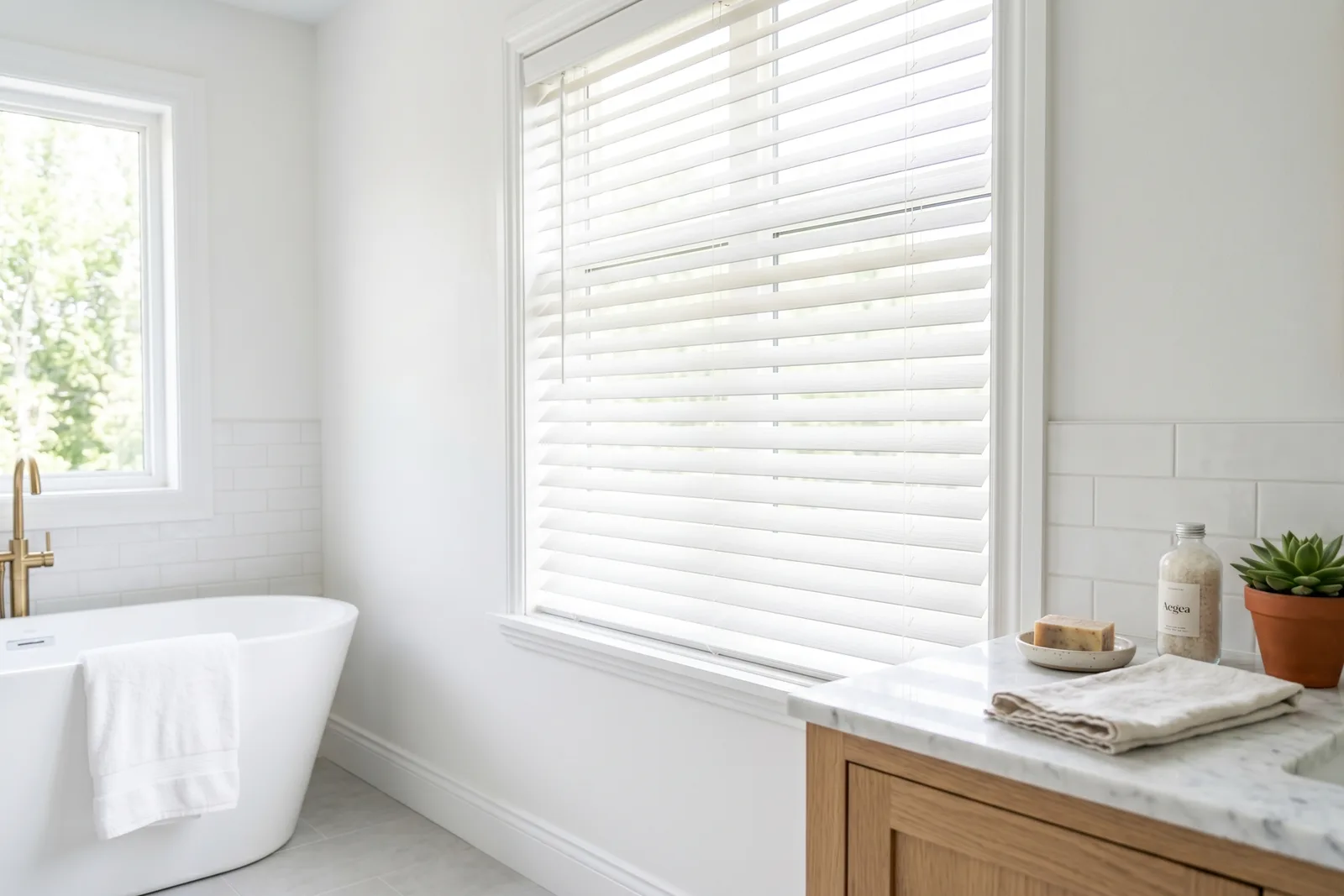
What to do if mould has already appeared
If there are only a few stains and the fabric can be washed, try cleaning it first. Wash a washable synthetic fabric no hotter than its care instructions allow (our washable fabrics: 30 °C) with a mould-removing product, or soak it in a solution of water and white vinegar (about 4:1), then rinsed well and dried completely. After cleaning the fabric must be dried right through: damp fabric hung back up will start to go mouldy again. On a wooden frame and sill, clean the mould with a special mould remover, and wear gloves and a mask.
When to replace the fabric, and when cleaning is enough
If the mould has gone deep, leaving greyish-black stains that do not come out in the wash, or the fabric is porous (linen, heavy cotton) and soaked through, it is safer to replace it. The spores stay in the fibre and carry a health risk even after the surface is cleaned. In damp rooms, choose a damp-resistant material instead of the old fabric, so that the problem does not come back.
Frequently asked questions
Why does condensation form on a window behind closed curtains?
A closed curtain separates warm room air from the cold glass and makes a closed, cooler pocket of air behind it. In that pocket the glass cools below the dew point and the vapour cannot get away, so moisture settles on the glass, the sill and the frame. The curtain often covers the radiator as well, cutting off the flow of warm air that would normally dry the glass.
Do curtains cause mould at the window?
No, but they encourage it if they trap moisture at the glass and stop air circulating. The real causes of mould are excess moisture, cold glass and poor ventilation. A curtain hung properly, with an air gap and regular ventilation, will not cause the problem. A heavy curtain pressed against the glass with no ventilation will.
What air gap should there be between the curtain and the window?
10–15 cm between the fabric and the glass is ideal. That is enough for warm air to circulate freely at the glass and keep drying it. In practice that means pole brackets longer than 12 cm, or by a ceiling track fitted 12–15 cm from the window opening. A gap of under 5 cm makes a pocket of damp in which mould thrives.
Which curtains or blinds do not go mouldy in damp rooms?
Non-porous materials that do not absorb water: faux wood blinds, PVC or vinyl blinds and aluminium blinds. For bathrooms and kitchens faux wood and PVC blinds suit best, because they wipe clean with a damp cloth. Avoid natural cotton and linen curtains in damp places.
What should you do if mould has already appeared on a curtain?
Wash a washable synthetic fabric no hotter than its care instructions allow (our washable fabrics: 30 °C) with a mould-removing product, or soak it in a solution of water and vinegar, then rinsed well and dried completely. If the stains are deep and do not come out in the wash, or the fabric is porous and soaked through, it is safer to replace it, because the spores stay in the fibre. Above all, remove the cause of the damp, or the mould will return.
A consultation and measuring at your home
The designer visits, measures and advises on damp-resistant blinds or curtains and the right pole distance and air gap for your windows. Measuring is free in Vilnius. In Kaunas and Klaipėda it is free on orders of €200 or more. Elsewhere in Lithuania the visit is paid, and the price is agreed beforehand.
Arrange a consultation